

Watching your baby take their first bites of solid food is more than a milestone. It's a beautiful beginning of independence, exploration, and a lifetime of healthy eating.
It’s completely normal for weaning to feel a little overwhelming at first. Many parents – probably you too – worry about whether they’re doing it right. But with a bit of guidance, patience, and a warm approach, weaning can become a deeply enjoyable journey for both you and your baby.
When to start weaning
During the first six months of life, your baby receives all the nutrients he needs from breast milk or infant formulas. These provide the perfect balance of vitamins, minerals, and calories to support healthy growth, brain development, and immunity.
After six months of age, your baby’s nutritional needs begin to change, especially his need for iron. His digestive system and kidneys also become mature enough to start handling solid foods.
For these reasons, your baby’s paediatrician usually recommends introducing weaning foods around six months.
Is your baby ready to wean?

Moments like seeing another baby start solids at five months can leave you wondering what’s right for your little one, whether it’s too soon or if you truly need to wait until the six-month mark.
The truth is that babies grow and develop at their own unique pace. Some are ready to explore solid foods a little earlier, while others need a bit more time. Both are perfectly normal.
Instead of relying strictly on age, it’s helpful to look for the gentle cues your baby gives you, showing you when he is ready to take this next step.
Your baby may be ready to try solids if he can:
Hold his head up steadily
Sit with minimal support
Keep food in his mouth rather than pushing it out (which is losing tongue-thrust reflex)
Show interest in what you’re eating, like reaching for food or watching intently
Seeing these signs can give you confidence that your baby is ready to begin this new and exciting phase.
Wondering whether your baby is truly ready for solids or how to best begin? A consultation with our paediatricians at Thomson Medical can offer clarity and reassurance as you take this next step together. Request an appointment today.
Our ParentCraft trainers
Loading...
7 tips for success weaning
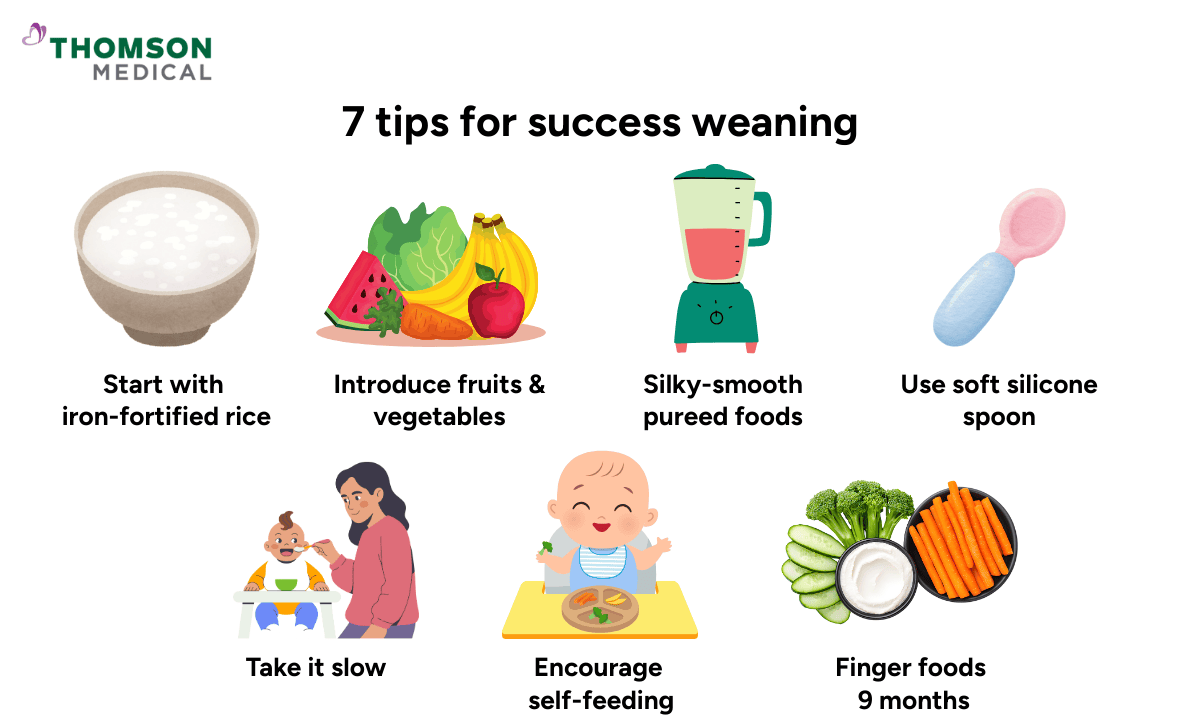
These seven tips may help you feel more confident and supported as your baby discovers new tastes and textures. They can also turn mealtimes into moments of connection and joy, rather than stress or doubt.
Start with iron-fortified baby rice
When introducing solids, start with iron-rich foods. Iron-fortified baby rice is a wonderful first choice, as it's gentle on your baby’s tummy and unlikely to cause allergies. Feed the same food for three to four days and watch for any signs of a reaction, such as rashes, swelling, vomiting, or diarrhoea.
Once tolerated, you can offer cereals made with wheat or oats. Mixing 1–2 teaspoons of cereal with breastmilk or formula provides a familiar taste that encourages acceptance.
Gradually introduce fruits and vegetables
After rice and cereal, start adding single-ingredient fruits and vegetables. For veggies, you can choose cooked and pureed pumpkin, sweet potato, carrots, peas, or zucchini. As your baby gets used to these, gradually make the texture thicker.
When it comes to fruit, pureed apples, pears, bananas, berries, or peaches are the best options. Avoid offering large chunks of raw fruit, especially apples, as they pose a choking hazard.
Keep the texture smooth and runny
Your baby’s first meals should be silky-smooth pureed foods. Think oatmeal - thin consistency. You can use a blender or food processor to get the right texture. Over time, move from purees to finely mashed foods, then soft lumps by around nine months.
Use the right spoon
Choose a baby spoon with a soft silicone tip to protect delicate gums even if your baby bites down. A flat-tipped spoon is even better, as it helps you scoop up stray bits and offer them to him again with ease.
Avoid putting cereal or food into your baby’s bottle, as these items can interfere with his ability to learn how to eat from a spoon while sitting upright.
Take it slow
You may want to nurse or bottle-feed first, then offer your baby solid food. Early on, your little one may only take a few spoonfuls; that’s perfectly okay. If he seems not interested, try again in a few days. You don’t need to force it.
Introducing solids is a big milestone, so it can feel exciting and nerve-wracking at the same time. The key is to keep it stress-free. Keep in mind that in the first year of life, solids are mostly about exploration and complementing milk feeds, not replacing them.
Encourage self-feeding
Let your baby explore! Offer a spoon for him to hold and feed him in between his attempts. It’ll be messy, but it’s a great way for your child to develop fine motor skills and confidence.
Introduce finger foods around 9 months
At about nine months, your baby can handle finger foods like soft fruits, cooked veggies, or small pieces of tender meat. Remember to cut food into fingertip-sized pieces to prevent choking.
This period is also a good time to offer sips of water from a sippy cup during meals. Skip sugary drinks like juice, as they’re not recommended for infants.
What not to do when weaning
Weaning is a learning process for your baby and for you. Along the way, there are a few things that are best avoided to help keep your baby safe and make the journey smoother.
Don’t put food in a bottle
It may seem convenient, but bottles aren’t designed for solids. Your baby needs to learn how to move food around their mouth and swallow safely, which are best developed with a spoon.
Avoid offering food larger than your baby’s fingertip
Larger pieces can be tricky for little mouths to manage. Keeping foods soft and fingertip-sized makes eating feel safe and enjoyable, especially as your baby learns to feed themselves.
Stay away from hard foods to prevent choking risks
Some foods, like whole grapes, uncut bread slices, popcorn, raw carrots, or nuts, can easily block a baby’s airway. Choosing soft, age-appropriate textures helps keep mealtimes calm and confidence-building for both you and your little one.
Don’t give cow’s milk as a main drink before one year
Your baby’s kidneys are still developing and not quite ready for the high levels of protein and minerals in cow’s milk. Breast milk or formula continues to be the gentlest and most suitable main drink throughout his first year of life.
Avoid forcing your baby to eat
Babies are surprisingly good at knowing when they’re hungry and when they’ve had enough. Trusting these cues helps them build a healthy, positive relationship with food that will serve them well as they grow.
Don’t give up too soon
It’s completely normal for your baby to take several tries (sometimes 10–15) before accepting a new flavour. As your baby learns to enjoy new foods, a little patience, gentle encouragement, and repeated exposure can make a significant difference.
Starting solids is a beautiful journey, full of discovery and shared joy. Some days will be smooth, others a little messy, and that’s all part of the process. Be gentle with yourself and trust your instincts that you know your baby better than anyone else.
If you’re feeling unsure about the weaning journey, consider consulting a health professional at Thomson Medical. Our paediatricians offer hands-on guidance to make introducing solids smoother and more enjoyable for both you and your baby.
FAQ
What is the best age to wean a baby?
Most babies are ready for solids around six months, when their digestive system matures and their iron needs rise. Some may be ready a little earlier or later. Let’s follow the developmental readiness signs that your baby shows rather than the calendar.
What happens if you delay solids?
Waiting too long may increase the risk of iron deficiency and limit your baby’s chance to learn textures and chewing. Introducing solids around six months helps support healthy development.
Which is recommended: baby-led weaning (BLW) or traditional weaning?
Both are safe and effective. Many parents use a mix of purées and finger foods. What matters most is readiness, safety, and following your baby’s cues.
Is it okay to skip a day of solids?
Absolutely, milk is still the main source of nutrition in the first year of life. If your baby is worn out, unwell, or uninterested, it’s fine to skip a day and try again later.
What can a 7-month-old eat?
Soft options like mashed banana, smooth yoghurt, soft scrambled egg, porridge, or fruit mixed with iron-fortified cereal all work well. Keep textures soft and easy to mash.
How much milk does my baby need during weaning?
Most babies aged 6–12 months take about 500–700 ml of breast milk or baby formula daily. As solids increase, milk feeds naturally adjust. The best advice is to follow your baby’s cues.
The information provided is intended for general guidance only and should not be considered medical advice. For personalised recommendations and advice based on your unique situation, please consult a specialist at Thomson Medical. Request an appointment with Thomson Medical today.