

Being told you have an abdominal aortic aneurysm (AAA) can feel frightening. It can leave you with many questions about what comes next. However, it is important to know that not all aneurysms are emergencies, and the level of risk depends on factors such as size, growth rate, and your overall health.
Many small aneurysms remain stable for years and can be managed safely with regular monitoring. Larger aneurysms, however, may need medical treatment to reduce the risk of complications.
Understanding what an AAA is, recognising warning signs, and knowing when to seek medical care can help you feel more informed and prepared as you make decisions about your health.
What is an abdominal aortic aneurysm?
An abdominal aortic aneurysm (AAA) happens when the wall of your aorta – the largest blood vessel in your body – weakens and bulges in your belly area.
Your aorta carries blood from your heart to the rest of your body. When a section of the aortic wall weakens, it can expand to more than 1.5 times its normal size.
Small aneurysms may stay stable for years. Large ones, on the other hand, can burst. This is very dangerous and needs immediate medical care.
Causes of AAA
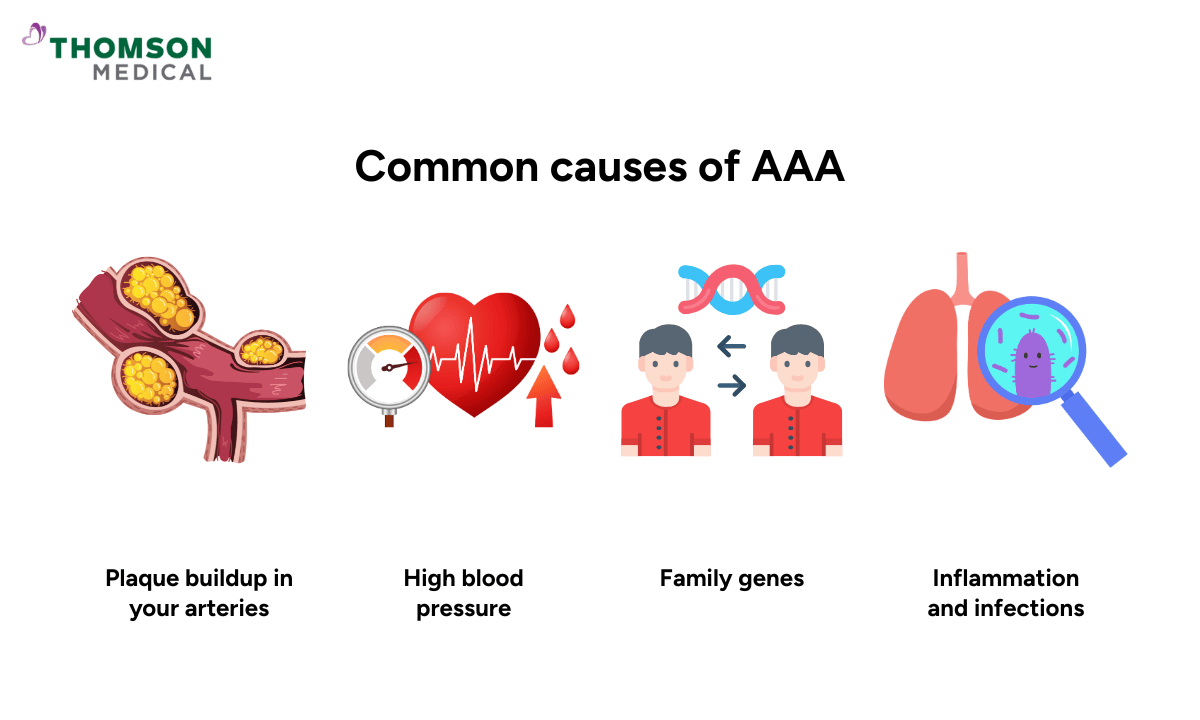
Your aortic wall can weaken for different reasons, including:
Plaque buildup in your arteries (atherosclerosis):
This is the most common cause of AAA. It happens when fatty deposits stick to your artery walls over time.
High blood pressure:
Constant pressure pushing against weak spots can make the bulge grow faster.
Family genes:
Sometimes AAA runs in families. If your parent or sibling had AAA, your risk may be higher.
Inflammation and infections:
These are less common causes. Some inflammatory conditions or infections can damage the aorta directly.
Learning about these causes may feel concerning at first, but this helps you take better care of yourself. You can use this information to stay proactive about regular check-ups and catch any potential issues early when treatment is most effective.
Symptoms
Most of the time, the aneurysm grows quietly without any warning signs. You may feel no different at all, with no signs that anything’s wrong. In fact, many people only discover they have one during scans for other health problems.
As the aneurysm gets bigger, you may notice:
Steady, deep pain in your belly or along your side
Back pain that doesn’t go away when you rest
A pulsing feeling near your belly button, like you can feel your heartbeat there
These symptoms don’t always mean your AAA is about to rupture. However, if you’re experiencing these signs, you should see your doctor soon.
Who is at risk
There are certain factors that can increase your risk of developing AAA. Knowing these risks can help you decide whether to get screened.
If you’re over 60:
Your risk usually climbs after age 60. Men over 65 face the highest risk, while women often develop AAA later, after 70.
If you smoke:
Smoking is one of the strongest factors. It increases your risk of AAA by 4-6 times compared to those who’ve never smoked.
If you have a family history:
Your risk can be higher if you have a parent, sibling, or several family members with AAA.
If you have other health conditions:
Conditions such as high blood pressure, high cholesterol, or heart disease can also increase your risk of AAA.
Having one or several of these doesn’t guarantee you’ll develop AAA. However, it does mean you should talk to your doctor about screening as soon as possible. Finding AAA early helps make treatment much safer.

AAA size and what it means
Your doctor measures your AAA in centimetres. The size of your AAA will help guide the next steps.
Here’s what your AAA size means:
Normal aorta:
It’s less than 2 cm wide.
Small AAA:
It’s about 3-4.4 cm. If you have a small AAA, your chance of it bursting is very low (less than 1% per year). Your doctor will watch it with scans every 6-12 months.
Medium AAA:
It’s about 4.5-5.4 cm. The rupture risk increases to a moderate level, around 1-11% per year. In this case, you’ll need closer monitoring every 3-6 months so your doctor can catch any concerning changes early.
Large AAA:
It’s about 5.5 cm or bigger. The risk of bursting is highest at this size, about 10-20% per year. Your doctor will recommend surgical repair to prevent an emergency situation.
The size of your AAA is important in helping your doctor evaluate your condition, but it’s not the only factor.
They’ll also consider:
How fast it’s growing
Your overall health
The shape of your aneurysm
Whether you have any symptoms
With all this information, your doctor can recommend the right treatment plan for your specific conditions. Whatever the size of your AAA, there are proven strategies to manage it safely. Your doctor will either monitor it closely with regular scans or recommend timely surgical repair, depending on what's best for your health.
How is AAA diagnosed?
Most AAAs are found during imaging tests. If you’re at risk, your doctor may recommend screening to catch problems before they become dangerous.
Common tests to find and measure AAA include:
Abdominal ultrasound:
This is the main screening test. You’ll lie down when your doctor moves a wand across your belly. Abdominal ultrasound is very accurate for finding and measuring AAA.
CT scan:
This gives your doctor detailed pictures if the ultrasound finds an aneurysm. It shows the exact size, shape, and location of your AAA. Based on that, your doctor may plan surgery if you need it.
MRI scan:
This is an alternative option that helps your doctor get detailed images of your AAA. Your doctor may recommend an MRI scan if a CT scan isn’t suitable for you.
These tests are straightforward and painless. They give a clear answer about whether you have an AAA and how big it is. This information is essential because the size of your AAA decides what happens next. It guides your entire treatment journey, helping you and your doctor create the right care plan for your situation.
When to seek urgent vs emergency care

With AAA, the type of symptoms you experience determines where you should go for help. Some symptoms need immediate emergency care. Others require prompt medical attention.
Emergency care
The most serious complication is a rupture, which happens when your AAA breaks open.
This is a life-threatening medical emergency with symptoms that usually include:
Sudden and extreme pain in your belly or back
Pain spreading to your groin, bottom, or legs
Feeling clammy and sweaty
Heart racing
Feeling dizzy or about to faint
Nausea and vomiting
In this case, call 955 right away. Don’t drive yourself or wait to see if symptoms improve. Instead, it’s best to lie down and stay still while waiting for help.
Urgent care
If you're experiencing concerning symptoms but they're not sudden or severe, the Urgent Care Centre (UCC) can help evaluate your condition:
New or worsening abdominal or back pain that's persistent but not sudden
A pulsating feeling in your belly that's bothering you
Pain that doesn't improve after a few hours
Concern about AAA symptoms, but you're not sure if it's an emergency
The care team can perform some assessment, order imaging tests if needed, and determine whether you need a specialist referral or emergency care.
What happens if an AAA ruptures?
A ruptured AAA is one of the most serious medical emergencies you can face. It happens when your aneurysm wall tears open and blood pours into your belly. The bleeding can occur quickly and requires immediate medical attention.
With proper monitoring and timely treatment, rupture is preventable in most cases.
However, if it happens, the emergency team will work fast to:
Start IV fluids and blood transfusions immediately
Stabilise your blood pressure
Rush you to the operating room
Perform emergency repair surgery
There is a big difference in the outcomes. If the surgery is planned before rupture, it has over a 95% success rate. However, emergency rupture surgery succeeds only 40-50% of the time.
This difference highlights why regular screening and monitoring matter so much. With these proactive steps, most ruptures can be prevented. They also help ensure you receive care when it's most effective, giving you the best possible outcome while avoiding emergency situations.
Our urgent care centre specialist
Loading...

FAQ
How fast do abdominal aortic aneurysms grow?
Most AAAs grow slowly, about 2-3 mm per year on average. But this varies from person to person.
Larger aneurysms tend to grow faster (4-5 mm per year or more). Smoking, high blood pressure, and inflammation can speed up growth.
Can an abdominal aortic aneurysm heal on its own or shrink?
No. Once your aortic wall weakens and bulges, it won't go back to normal. Surgery is the only way to repair it.
How long can you live with an aortic aneurysm?
It depends on the size, how fast it grows, and how well you manage your health. Many people live for years, even decades, with a small AAA that's properly monitored.
Small aneurysms (under 5 cm) rarely rupture if they’re monitored correctly. Larger ones need surgery, which works very well when done before emergency situations.
What are the survival rates for AAA surgery?
Planned AAA surgery has a high success rate, with over 95% of people doing well. Emergency surgery for rupture, on the other hand, only succeeds about 40-50% of the time.
Will I feel pain if my AAA is growing?
Probably not. Most people feel nothing as their aneurysm grows.
You might feel a pulsing near your belly button or have vague belly or back discomfort, but many people have zero symptoms.
How common are abdominal aortic aneurysms in women vs men?
AAA is much more common in men. About 4-8% of men over 65 develop it, compared to only 1-2% of women.
However, when women do get AAA, their AAAs can rupture at smaller sizes than men's, and they also tend to have more complications with surgery.
The information provided is intended for general guidance only and should not be considered medical advice. For personalised recommendations based on your medical conditions, request an appointment with Thomson Medical.
For more information, contact us:
Thomson Medical 24-Hour Urgent Care Centre (Novena)
- Call: 6350 8812
Notice:
The range of services, vaccinations, and tests may vary. Please contact us directly to enquire about the current availability.
Request an Appointment