

After undergoing an egg retrieval procedure, you might wonder whether the number of eggs retrieved is sufficient for conception. However, the number of eggs varies from woman to woman depending on various factors; there is no single number that guarantees success.
Knowing what affects the average number of eggs retrieved during the IVF process may help you to be more informed about what to expect from this fertility treatment.
What is the egg retrieval procedure?
Egg retrieval, also known as oocyte retrieval, is a procedure used during in vitro fertilisation (IVF) to collect mature eggs from your ovaries. It usually takes place after ovarian stimulation, when hormonal medication is used to encourage the development of multiple eggs, which are then collected.
Egg retrieval is usually carried out under sedation or light anaesthesia, so you should experience little to no discomfort. The process usually takes 15 to 30 minutes, and here’s what you could expect:
Preparation:
In the days leading up to retrieval, your doctor will monitor your follicles with ultrasound guidance and blood tests.
You will take fertility medications to encourage several follicles (the fluid-filled sacs holding your eggs) to develop at once, rather than the single egg usually released during a natural menstrual cycle.
Trigger shot:
When your follicles are ready, you will receive a hormone injection (known as a trigger shot) to help your eggs reach final maturity before collection.
Egg retrieval process:
After your final hormone injection, but before natural ovulation, the eggs are retrieved from the ovaries using a procedure called transvaginal ultrasound-guided aspiration.
During the egg retrieval process, your doctor will gently insert an ultrasound device into the vagina to direct a thin needle toward the ovaries to retrieve the eggs from the follicles.
Recovery:
You may usually return home the same day and go back to your usual routine soon afterwards, though mild cramping or bloating is common.
Afterwards, the retrieved eggs are either fertilised in a laboratory to create embryos, which are then transferred to the womb during the embryo transfer process, or cryopreserved for future use.
What is the average number of eggs retrieved during IVF?
The average number of eggs retrieved during IVF cycles varies from woman to woman. Factors such as age, ovarian reserve, and response to stimulation medication could influence the final number collected.
Research performed in the UK in 2023 found that the average number of eggs retrieved is around 6 to 15. Below is a table providing a general guide to how ovarian response is categorised:
| Response | Number of eggs retrieved | What this may mean |
|---|---|---|
Low | Around 1 to 5 | This number of retrieved eggs is considered a low response rate, although pregnancy is still possible if high-quality embryos develop. However, the lower number of eggs means there are fewer potential opportunities for fertilisation and embryo selection. |
Average | From 6 to 15 | Considered a typical response and may provide several chances for fertilisation and embryo development. |
High | Around 16 to 25 | A higher response that may provide more embryos for transfer or freezing. However, it may also carry an increased risk of ovarian hyperstimulation syndrome (OHSS), a serious condition where the ovaries become swollen and painful. |
Very high | Approximately 26 or more | An uncommon response, occurring in fewer than 3% of cycles. Retrieving a very high number of eggs may be associated with a higher risk of OHSS. Your doctor may recommend a freeze-all approach, where all embryos are frozen for transfer in a later cycle. |
Your doctor may aim for around 6 to 15 eggs, as this range may balance having enough eggs for fertilisation while keeping the risk of OHSS lower. However, a lower egg count does not rule out the possibility of pregnancy if good-quality embryos develop, and a higher count does not guarantee a successful outcome.
Additionally, the number of eggs collected does not always match the number of follicles seen on ultrasound. This is because some follicles may not contain an egg, and some eggs may not be mature enough for fertilisation.
If you would like to discuss your egg retrieval results or understand what they may mean for your treatment, request an appointment with a fertility specialist at Thomson Medical. A doctor could help you understand your results and guide you on the next steps in your treatment.
Our fertility doctors in Singapore
Loading...
How egg quantity and quality affect IVF
Although retrieving more eggs during the procedure may help to achieve conception, it is important to note that the number of eggs collected is only one factor. This is because the quality of the eggs is just as important in determining whether healthy embryos could develop.
Here's how these two factors differ:
Egg quantity
While the number of eggs retrieved did not significantly affect the likelihood of a pregnancy in the initial cycle, it did make a difference when frozen embryo transfers were also considered. Additionally, having more embryos allows for multiple implantation attempts and helps to increase the overall chances of success if a new IVF cycle is required.
Egg quality
Egg quality affects how well an egg fertilises, develops into an embryo, and implants into the lining of the womb. As you get older, egg quality naturally declines, so a smaller number of high-quality eggs may sometimes lead to better embryo development than a larger number of lower-quality eggs.
What affects how many eggs you produce?
Several factors influence how many eggs your ovaries produce during an IVF cycle, these include:
Your age and ovarian reserve
Two of the biggest influences are age and ovarian reserve. As you get older, both your egg supply and your ovaries' response to stimulation naturally decline. If you have a higher reserve, you generally have more follicles available to develop during treatment. Younger women typically produce more eggs. Egg quality also tends to decline as you get older.
How your body responds to treatment
Every woman responds differently to ovarian stimulation medication. Some ovaries produce a larger number of mature follicles, while others develop fewer follicles and eggs despite receiving the same treatment. The type and dosage of medication used in your treatment plan may also influence how many eggs are retrieved.
Your overall health
Certain medical conditions may change the number of eggs retrieved. For example, polyendocrine metabolic ovarian syndrome (PMOS), formerly known as polycystic ovary syndrome (PCOS), often leads to a higher number of eggs, while conditions like endometriosis or a low ovarian reserve may lead to fewer eggs.
Smoking, drinking too much alcohol, and significant changes in your weight may affect how the ovaries respond to treatment.
How could you support egg quality and quantity before IVF?
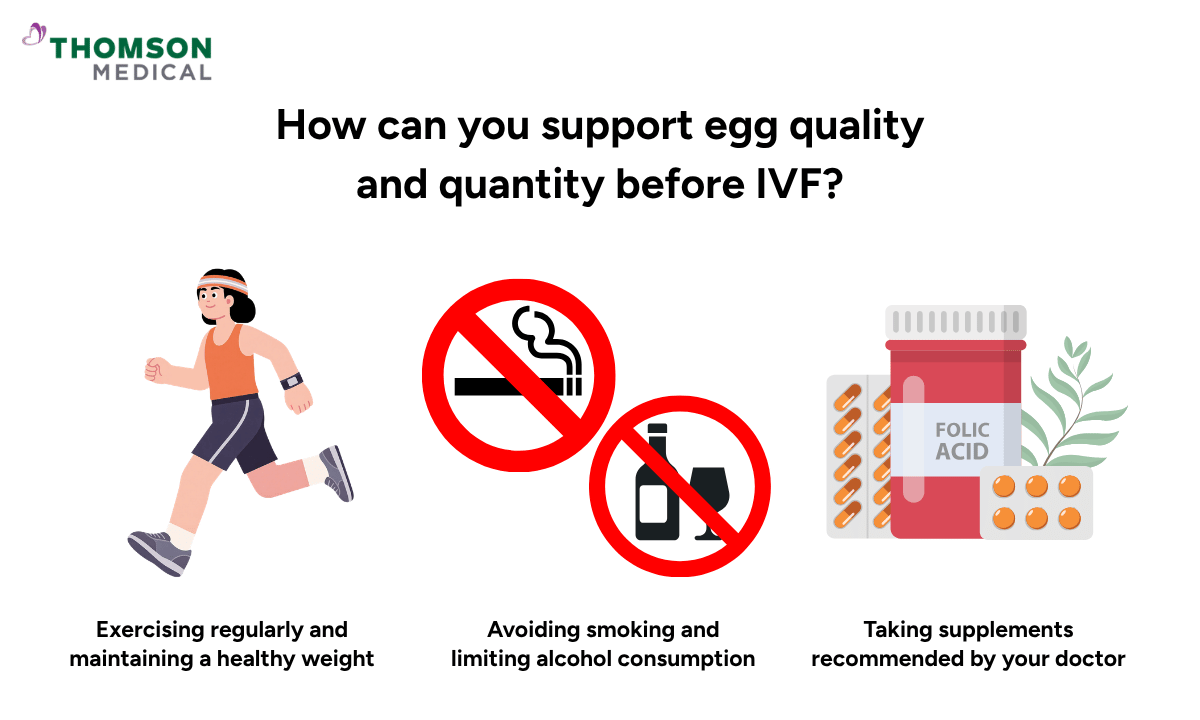
While you might not be able to completely control how your ovaries respond, certain habits may help support your overall reproductive health before treatment. These include:
Eating a balanced diet rich in fruits, vegetables, healthy fats, and lean protein, such as a Mediterranean diet
Exercising regularly and maintaining a healthy weight
Avoiding cigarette smoking and limiting alcohol consumption
Taking supplements recommended by your doctor, such as folic acid
Managing stress and getting enough sleep
Following your medication schedule carefully during treatment
If you are preparing for IVF and would like advice on supporting your reproductive health, request an appointment with a fertility specialist at Thomson Medical. They may assess your individual circumstances and recommend steps to support your treatment.
FAQ
Can retrieving too many eggs be harmful?
Retrieving a very high number of eggs can increase the risk of ovarian hyperstimulation syndrome (OHSS), which causes the ovaries to become swollen and painful. Mild symptoms can include mild abdominal pain, bloating, fluid retention, and nausea.
However, severe OHSS can potentially be life-threatening. Seek immediate medical attention if you experience severe abdominal pain, persistent vomiting, sudden weight gain, decreased urination, or difficulty breathing.
Does age affect the number of eggs retrieved?
Age is one of the most important factors affecting how your ovaries respond. Younger women typically produce more eggs. Egg quality also tends to decline as you get older.
Can medications increase the number of eggs retrieved?
A follicle-stimulating hormone (FSH) is used to stimulate your ovaries. This medication is designed to encourage several follicles to develop, increasing the number of eggs available for retrieval. However, every woman responds differently.
How does egg quality relate to the number retrieved?
Egg number and egg quality are not the same. Retrieving more eggs may increase the chances of developing healthy embryos, but egg quality matters more in determining whether fertilisation, implantation and pregnancy occur.
Can I improve my egg count before IVF?
You cannot significantly increase your natural ovarian reserve. However, looking after your overall health and following your fertility specialist's recommendations may help support how your body responds during your IVF cycle.
The information provided is intended for general guidance only and should not be considered medical advice. For personalised recommendations and tailored advice based on your unique conditions, request an appointment with Thomson Medical.
For more information, contact us:
Thomson Fertility Centre
- Paragon: 6252 7766
- Novena: 6399 3758, 8811 0358 (WA)