

One of the wonderful parts of being a parent is watching your baby grow a little more each day – a new smile, a tiny sound, or those first wobbly steps. These moments feel magical.
But alongside the joy, there are also days filled with questions and doubt. Perhaps your baby gained only a little weight this month, or you’ve noticed other children saying “mummy” while yours is still cooing softly.
These feelings are completely normal. Every parent hopes their child is developing well, so it’s natural to compare and wonder occasionally.
Tracking your baby’s physical growth
Your baby’s physical development during the first years of life is incredibly rapid. A growth chart is a valuable tool that helps you keep track of your baby’s length, weight, and head circumference over time.
By recording these measurements regularly, you can spot patterns in your baby’s growth and identify any potential concerns early. Growth is also an important indicator of your child’s nutritional status.
How to use growth charts
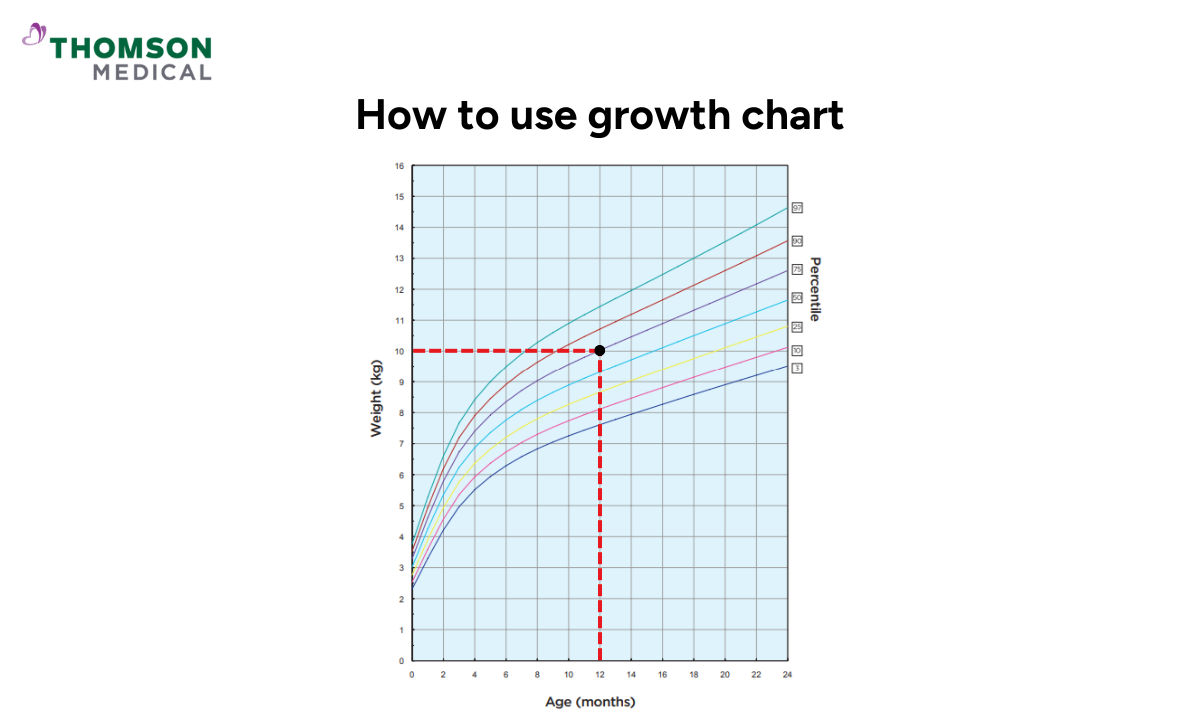
You can refer to the official growth charts found in the Health Booklet by the Health Promotion Board. These charts, beginning on page 26, include percentiles for head circumference, weight-for-age, and height-for-age for boys and girls aged 0 to 18 years.
Here’s a simple way to track your baby’s growth:
Choose the type of chart:
Head circumference
Weight
Length or height
Select the correct age group:
0-24 months
24-72 months
4-18 years
Select the correct gender:
Blue for boys
Pink for girls
Mark your baby’s age on the horizontal axis
Mark your baby’s measurements on the vertical axis
Find the point where the two lines meet:
This is your baby’s percentile.
When tracked regularly, these points connect to form a curve, known as the percentile curve.
What does 'percentile' mean?
Percentiles show how your child's measurements compare with other children of the same age and gender. For example, if your child’s weight is in the 20th percentile, he weighs more than 20% of children their age and gender.
Percentiles don’t judge how “well” your child is growing; they just give us a guide, as there is a wide range of normal. Some healthy children may be in the 10th percentile, while others sit comfortably in the 90th.
Don't be concerned if your child doesn't fall right in the middle of the growth chart. The exact number doesn’t matter as much as your baby growing steadily over time.
If you're unsure how to use growth charts or are worried about your child’s percentile, schedule a consultation at Thomson Medical. Our paediatricians can guide you through your child’s growth and help you track it with confidence and peace of mind.
Our paediatricians
Loading...
Baby development milestones to expect
Besides physical growth, your baby also goes through remarkable developmental milestones, such as mastering fine motor skills and gross motor skills, becoming more aware, and building the foundations of communication and language skills.
Learning these child development milestones can help you create a safe and supportive environment for your baby’s growing brain.
0 to 3 months |
|
4 to 6 months |
|
7 to 9 months |
|
10 to 12 months |
|
13 to 18 months |
|
17 to 24 months |
|
A reminder every parent needs

Sometimes you may feel anxious when you see other children meeting milestones earlier than your own. Perhaps another child is walking steadily at 12 months, while your little one still cannot stand without support even after his first birthday.
This is completely understandable, as all parents worry about it.
But keep in mind that every baby grows at their own pace, and the normal range of development is wide. Your baby may take her first steps at 14 months, while others walk soon after turning one. Both can be completely normal.
As long as your growing child is healthy, responsive, and making steady progress, there is usually no need to worry if they don’t reach every milestone exactly on time.
When to consult a paediatrician
While most babies follow their own pace, there are times when it’s helpful to have developmental screening with a paediatrician. Your baby’s paediatrician may determine whether the delay is simply due to your child’s unique pace of growth or if it may be related to a developmental delay that needs attention.
You may book a check-up if you notice the following developmental red flags:
Little or no response to sounds or visual tracking by 3-4 months
Inability to sit independently by 10 months
Not supporting weight or not using both arms and legs equally by 12 months
Falling significantly behind peers in developmental milestones
Every child is unique, and no two babies develop in exactly the same way. If you have any concerns about your child’s development or suspect a delay, don’t hesitate to schedule an appointment at Thomson Medical. Our paediatricians will carry out a thorough assessment, identify any concerns early, and guide you on how to best support your baby’s development.
FAQ
Why does my baby gain a lot of weight some months and less weight other months?
It’s completely normal. Babies grow in spurts, so their weight gain naturally varies from month to month.
Is it normal if my baby’s weight is in the 20th percentile?
Yes, percentiles simply show how your baby compares with others. As long as growth is steady and your baby is healthy, the 20th percentile is normal.
How do I measure my baby’s length at home?
Place your baby on a flat surface, gently stretch their legs, and measure from the top of the head to the heel. A measuring tape and a second helper make the process easier and more accurate.
Other babies seem to reach milestones earlier than mine. Is something wrong?
Every baby develops at their own pace. There is a broad spectrum of normal development, and slight differences don’t mean there’s a problem.
How can I support my baby’s development?
Give your baby plenty of tummy time, talk and play with them often, offer age-appropriate toys, provide a safe environment, and follow a steady routine. Regular check-ups also help track healthy development.
What do I need to track to ensure my child is growing and developing normally?
Keep an eye on steady weight and length/height gain, your child’s feeding and sleeping patterns, their movement and social skills, and how they respond to sounds, people, and play.
The information provided is intended for general guidance only and should not be considered medical advice. For personalised recommendations and advice based on your unique situation, please consult a specialist at Thomson Medical.Request an appointment with Thomson Medical today.