

Hearing the term "BRCA" for the first time, whether from a doctor or after a loved one's diagnosis, can bring up a lot of questions. It is understandable to feel unsettled, especially when words like "mutation" and "genetic risk" are thrown around.
Having a BRCA mutation does not mean you are guaranteed to get cancer. Understanding what BRCA is, what a mutation actually means, and what your options are can help you make informed decisions about your health.
What is the BRCA gene, and what does a mutation actually mean?
Every person is born with BRCA genes (BRCA1 and BRCA2). These genes act as a natural safeguard, helping to control how cells grow and fixing any damage to your DNA before it can lead to cancer.
A mutation means a change in the genetic code of these genes. When this happens, the gene may not work as well as it should. Your body loses some of its ability to catch and correct abnormal cell growth. Over time, this can raise your risk of developing certain cancers.
BRCA1 vs BRCA2: What's the difference?
Both genes do similar protective work, but the mutations they carry behave differently.
Here is how they compare:
BRCA1 | BRCA2 | |
Breast cancer | More aggressive types | Less aggressive types |
Ovarian cancer | Higher lifetime risk | Lower lifetime risk |
Other cancers | Not commonly linked to other cancers | Prostate cancer in men and pancreatic cancer (less common) |
Both mutations need careful monitoring. Knowing which one you carry helps your doctor tailor your screening and management plan accordingly.
Does a BRCA mutation mean I will get cancer?
No. Carrying a BRCA mutation raises your risk, but it does not guarantee cancer. Many people with BRCA mutations live their lives without developing breast or ovarian cancer.
What cancers are linked to BRCA mutations?
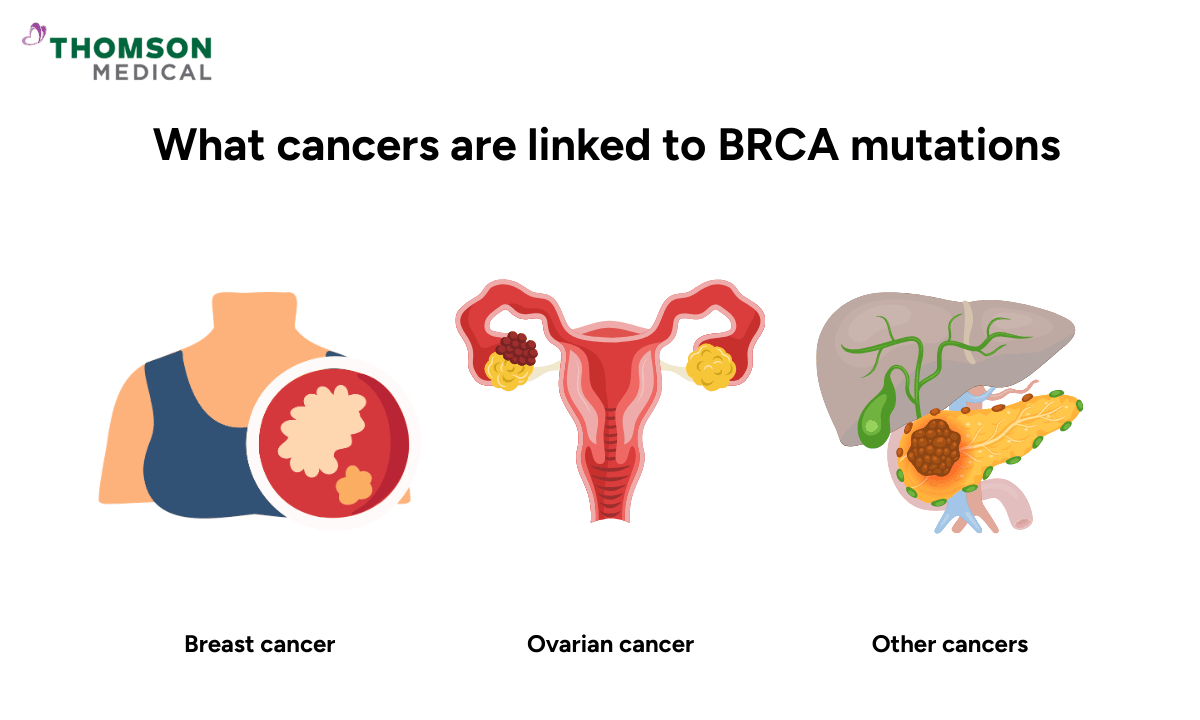
BRCA mutations are linked to several cancers, some more well-known than others. Knowing the connection and which cancers to watch for can help you stay one step ahead.
Breast cancer
In the general population, the lifetime risk of breast cancer is around 12%. For someone with a BRCA1 mutation, that risk can rise to 57-61%. For BRCA2 carriers, it ranges from 43% to 47%.
Those numbers can feel concerning. But if you carry a BRCA mutation and stay closely monitored, changes can often be caught at an earlier stage. Earlier detection opens up more options.
Ovarian cancer
Ovarian cancer is less common overall, but BRCA mutations significantly raise the risk.
Here is a clearer picture of what that risk looks like:
BRCA1 carriers have a lifetime ovarian cancer risk of around 42%
For BRCA2, it's around 20%
Both are considered higher than the general population risk of under 2%
This is one of the most important reasons BRCA testing matters. Ovarian cancer is often difficult to detect in its early stages, and there are currently no routine screening programmes for it. Being aware of your risk gives you and your doctor the opportunity to be proactive.
Other cancers
Breast and ovarian cancer get most of the attention, but BRCA mutations, particularly BRCA2, have also been linked to:
Pancreatic cancer:
The risk is elevated in both BRCA1 and BRCA2 carriers, though still uncommon overall.
Fallopian tube and peritoneal cancer:
Closely related to ovarian cancer and similarly elevated in BRCA1 carriers.
Male breast cancer:
It’s rare, but BRCA2 carriers have a higher risk than the general male population.
If you carry a BRCA mutation, your doctor will discuss which of these warrant additional monitoring in your specific case.
If you have a family history of breast or ovarian cancer and want to understand your risk, schedule an appointment with Thomson Medical. Our specialists will help you assess your personal risk and guide you on the right next steps.
Our specialists in Singapore
Loading...
Who should consider BRCA testing?
BRCA testing is not something everyone needs. But if any of the following sounds familiar to you, it may be worth bringing up with your doctor.
A personal or family history of breast cancer:
Especially if it was diagnosed before age 50, appeared in both breasts, or occurred in a male relative.
A family history of ovarian, fallopian tube, or peritoneal cancer:
On either your mother's or father's side. BRCA mutations can be inherited from either parent, so it is worth looking at both sides of your family history.
Multiple relatives on the same side with breast or ovarian cancer:
Especially if it appears across more than one generation.
A known BRCA mutation in the family:
If a parent, sibling, or close relative has already tested positive, it can be a good idea to discuss testing with your doctor.
Finding out you may be at higher risk is never easy. That said, when you understand your risk, you can make informed decisions about your health, take the right precautions, and work with your doctor on a plan that's right for you.
What does BRCA testing involve?

If you're considering BRCA testing, you may be wondering what the process actually looks like. BRCA testing is usually done through a referral. This means your doctor will recommend that you speak with a genetic counsellor before and after the test.
Genetic counselling helps you understand what the results actually mean, what your options are, and how to process the findings emotionally and practically.
The test itself is straightforward. Your doctor will take your blood or saliva sample and then send it to a laboratory for genetic analysis. Results are usually available within a few weeks.
Your result will fall into one of these categories:
Negative:
No mutation was found.
This is reassuring, though it doesn't eliminate all cancer risk. Your doctor may recommend routine screening to monitor and catch changes early.
Positive:
A BRCA1 or BRCA2 mutation was identified.
Your doctor will discuss a proactive, personalised plan with you. This may include more frequent screenings, referrals to specialists, or conversations about risk-reducing options.
Variant of uncertain significance (VUS):
A change was detected in the gene, but what it means for your cancer risk is not yet fully understood.
This is not the same as a positive result, and most people with a VUS follow standard screening guidelines, though your doctor may adjust this based on your personal or family history.
As research progresses, some variants get reclassified, so your doctor may recommend retesting in the future.
Whatever your result, you do not have to figure out what to do next on your own. Your doctor will help you understand what it means and what steps make sense for you.
If you are considering BRCA testing and want to know whether it is right for you, schedule an appointment with Thomson Medical. Our specialists will walk you through the process and help you make a decision that feels right for you.
FAQ
What does it mean to have the BRCA gene?
Everyone has BRCA genes, and they're a normal part of human DNA. When people say "having the BRCA gene", they usually mean having a mutation in BRCA1 or BRCA2 that stops the gene from working properly and raises the risk of certain cancers.
Is the BRCA mutation inherited or can it develop on its own?
Most BRCA mutations are inherited from a parent. In rare cases, a mutation can develop on its own, but this is uncommon.
If my mother has a BRCA mutation, what is the chance I have it too?
50%. It does not matter whether you are male or female; every child of an affected parent has a 50% chance of inheriting the mutation.
Can men carry or be affected by the BRCA mutation?
Yes. Men can inherit and pass on BRCA mutations just as women can.
How accurate is BRCA genetic testing?
BRCA testing done through a clinical laboratory is highly accurate. That said, no test is 100% comprehensive, so some rare mutations may not be detected. This is why genetic counselling is helpful. It ensures you understand exactly what the test does and does not cover.
Can lifestyle choices reduce my cancer risk if I have a BRCA mutation?
Lifestyle factors won't change a genetic mutation, but maintaining a healthy weight, limiting alcohol, and not smoking can support overall health and may help lower the cancer risk alongside medical monitoring.
The information provided is intended for general guidance only and should not be considered medical advice. For personalised recommendations and tailored advice based on your unique situations, request an appointment with Thomson Breast Centre today.
Reference:
Ho, W., Hassan, N. T., Yoon, S., Yang, X., Lim, J. M., Ishak, N. D. B., Ho, P. J., Wijaya, E. A., Ng, P. P., Luccarini, C., Allen, J., Tai, M., Chiang, J., Zhang, Z., See, M., Thong, M., Woo, Y., Dunning, A. M., Hartman, M., . . . Tho, L. (2024). Age-specific breast and ovarian cancer risks associated with germline BRCA1 or BRCA2 pathogenic variants – an Asian study of 572 families. The Lancet Regional Health - Western Pacific, 44, 101017. https://doi.org/10.1016/j.lanwpc.2024.101017