

Noticing a smooth, round lump in your breast during self-examination can naturally bring some worry.
Don't worry – most breast lumps aren't cancerous, and many turn out to be breast cysts, particularly for women in their 30s to 50s.
A breast cyst is a fluid-filled sac within your breast tissue. While finding a breast cyst may feel concerning at first, they usually resolve on their own and often don't require treatment. Understanding what breast cysts are and recognising their symptoms can help you know when to seek advice and feel more at ease with what's happening in your body.
What are breast cysts?
Breast cysts are fluid-filled sacs that develop within your breast tissue. They vary in size – some are so small you might barely notice them, while others can grow several centimetres across. You might have just one or several across one or both breasts.
Understanding the type of cyst you have helps guide what happens next:
Simple cysts contain clear fluid and have smooth, thin walls. These make up the majority of breast cysts and are always benign.
Complex cysts may have some solid material or debris in the fluid. Most are still benign, though your doctor may suggest additional tests for reassurance.
Breast cysts are particularly common during your 30s, 40s, and early 50s – up to one in four women in this age group will experience them at some point. After menopause, they usually become less frequent, though hormone replacement therapy can sometimes lead to new cysts forming.
Symptoms of breast cysts
Many breast cysts don't cause any noticeable symptoms – you might only discover them during a routine breast check or mammogram.
When symptoms do appear, you might experience:
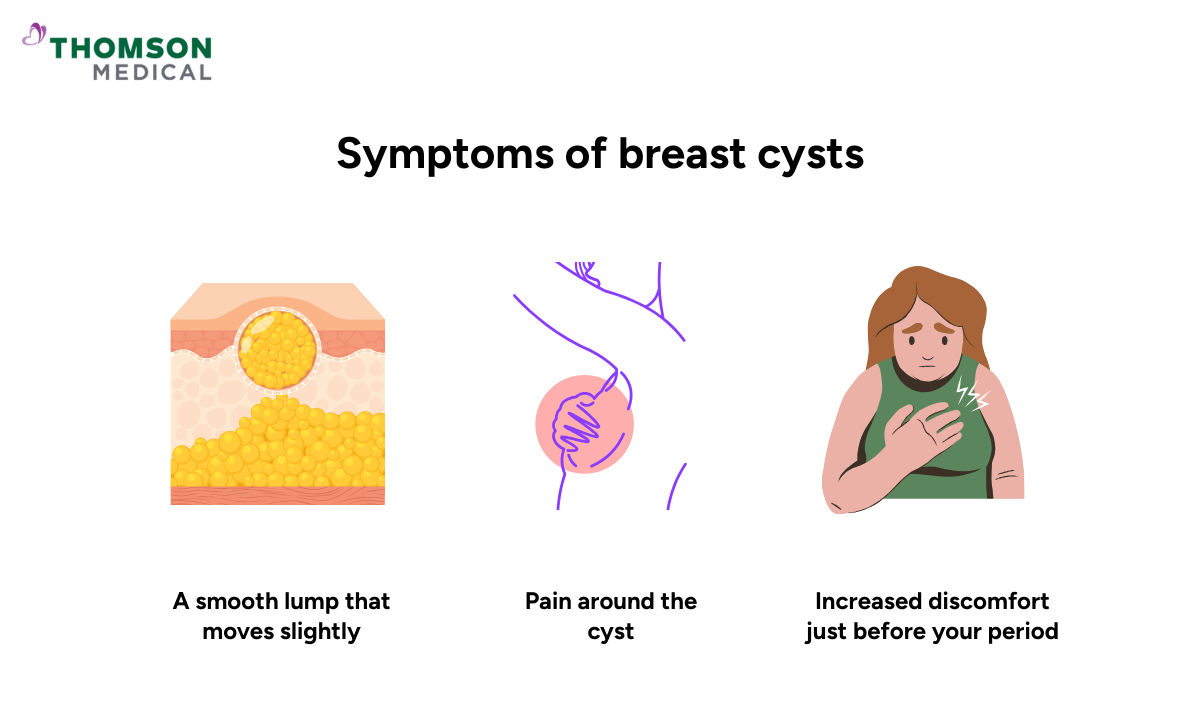
A smooth, round, or oval lump that moves slightly under your fingers
Tenderness or pain in the breast, especially around the cyst
Increased discomfort or swelling of the lump just before your period
A lump that feels firm or soft, depending on the fluid inside
Every woman's experience is different. Some notice mild to moderate pain that ebbs and flows with their cycle, while others feel more constant tenderness. It might affect one of your breasts or both.
Finding a lump can feel unsettling, even when you know cysts are common. If you've discovered a new lump that's still present after your next period, or if a lump has changed in size or feels more tender, connecting with your doctor can bring clarity.
Your doctor can examine your lump and help determine whether it's a cyst or something else. If needed, they'll arrange imaging tests to give you clear answers and the reassurance you're looking for.
If you've found a lump that concerns you or you're experiencing breast discomfort that hasn't resolved, schedule an appointment with Thomson Medical. Our doctors can examine the lump and give you the clarity and reassurance you need.
What causes breast cysts?
When you discover a breast lump, it's natural to wonder what's happening in your body and whether you could have prevented it.
Breast cysts form when fluid collects in small pockets within your breast tissue. It's a natural process that happens as your body responds to hormonal changes throughout your reproductive years, not something you've caused or could have avoided.
Several factors can increase your likelihood of developing breast cysts, such as:
Hormonal fluctuations:
Changes in oestrogen levels during your menstrual cycle can cause breast tissue to swell and block ducts, leading to fluid accumulation.
Age:
Women between 30 and 50 are most likely to develop breast cysts.
Hormone replacement therapy:
Taking hormones after menopause can increase your risk.
Despite common misconceptions, breast cysts are not caused by lifestyle factors such as diet or caffeine consumption. Most cysts fluctuate in size throughout your menstrual cycle, often becoming more noticeable just before your period.
It's worth remembering that having one or more of these factors doesn't mean you'll definitely develop breast cysts. Many women with the same hormonal profile never experience them at all.
How are breast cysts diagnosed?
Discovering a lump in your breast can feel unsettling. Fortunately, determining whether it's a cyst is straightforward, giving you clear answers and the reassurance you need.
Physical examination
Your doctor will begin by examining your breasts and the lump you've noticed.
This clinical breast examination involves:
Gently assessing the lump's size, shape, and texture
Checking whether the lump moves freely or feels fixed
Examining both breasts to compare any differences
Asking about your symptoms, menstrual cycle, and medical history
During this examination, your doctor can often identify telltale signs of a cyst – a smooth, moveable lump that feels distinct from surrounding tissue.
However, a physical examination alone can't always tell a cyst apart from other breast changes, so your doctor will recommend imaging tests to confirm what they've found and give you clearer answers.
Imaging and tests
Following your physical examination, these tests give a clearer picture of what's happening inside your breast tissue:
Breast ultrasound:
Breast ultrasound uses sound waves to show whether the lump is solid or fluid-filled.
It doesn't use radiation and is often the first test arranged.
Mammogram:
A mammogram is a breast X-ray that helps identify cysts and other breast changes.
Your doctor may recommend this if you're over 40 or need additional imaging.
Fine needle aspiration:
If the diagnosis remains unclear, your doctor may use a thin needle to draw fluid from the lump.
If fluid comes out and the lump disappears, this confirms it's a cyst. The fluid is usually clear or slightly yellow.
These tests are quick and straightforward, giving you the clarity and reassurance you need to move forward.
If you're unsure whether you need imaging tests or want to understand what your test results mean, schedule an appointment with Thomson Medical. Our doctors can guide you through the diagnostic process and explain your results in a way that makes sense for your situation.
Treatment options for breast cysts
The good news is that most breast cysts don't require any treatment, especially if they're not causing discomfort. This can feel like a relief after the worry of discovering a lump. Your doctor will recommend the appropriate approach based on your symptoms and what they've found.
Non-surgical treatments
If your cyst isn't bothering you, your doctor may suggest simply monitoring it over time. Many cysts disappear on their own, particularly after menopause when your hormone levels stabilise.
For cysts that are causing discomfort, several straightforward options can help:
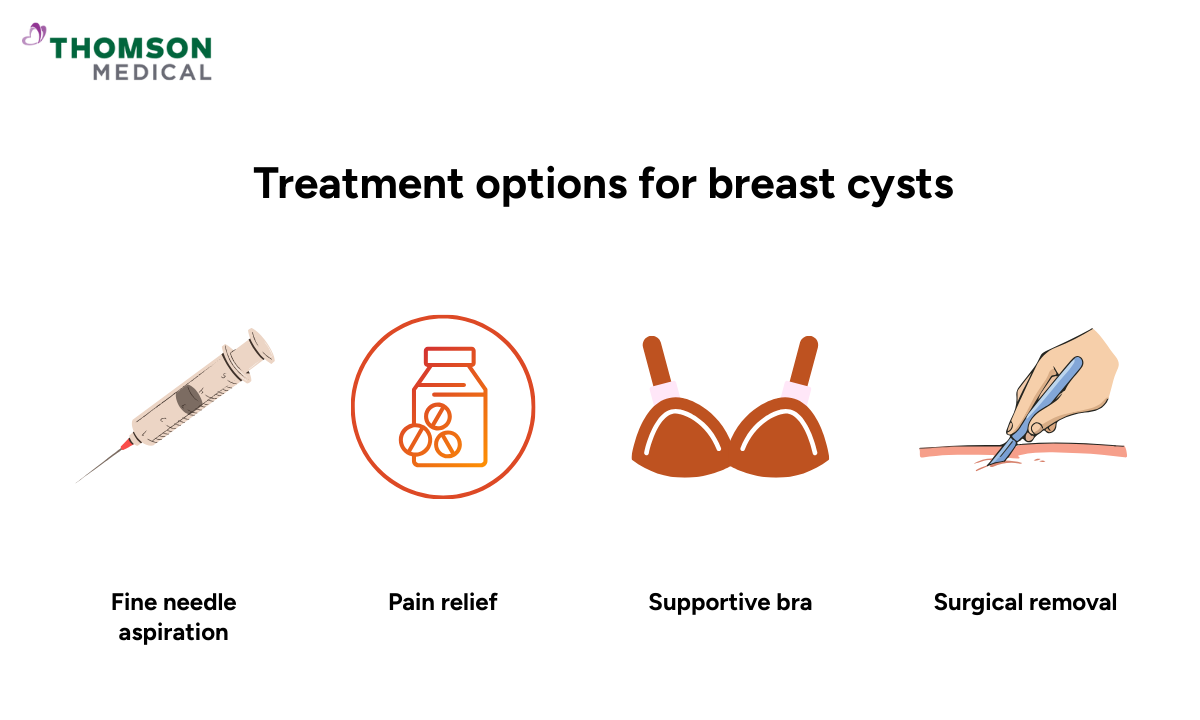
Fine needle aspiration:
Apart from being a diagnostic tool for breast cysts, this is a quick procedure that often provides immediate relief.
Once emptied, most cysts don't return, though some may refill over time.
Pain relief:
Over-the-counter pain relievers can ease breast tenderness, particularly if symptoms worsen before your period.
Supportive bra:
A well-fitted, supportive bra can reduce discomfort, especially if you have multiple or larger cysts.
Your doctor will discuss these options with you and help you find an approach that feels right.
Surgical removal
Surgery is rarely needed for breast cysts and is only considered in specific situations.
Your doctor may recommend surgical removal if:
The cyst keeps refilling with fluid after repeated drainage
The cyst contains blood-stained fluid
The cyst has unusual features on imaging that require further investigation
The cyst is causing significant discomfort that hasn't improved with other treatments
The procedure, called a lumpectomy or cyst excision, involves removing the entire cyst under local or general anaesthesia. It's usually performed as day surgery, meaning you can go home the same day. Recovery is usually quick, with most women returning to normal activities within a few days.
Your doctor will only suggest this procedure if there's a clear medical reason or if the cyst is significantly affecting your quality of life. In most cases, simpler approaches like drainage or monitoring are all you'll need.
Whether your cyst needs monitoring, drainage, or simply no intervention at all, having the right information helps you understand your options and discuss them meaningfully with your doctor. Many women find that once they know what they're dealing with, managing a breast cyst becomes a straightforward part of their health journey.
Our breast specialists in Singapore
Loading...
FAQ
Can breast cysts turn into cancer?
No, breast cysts do not turn into breast cancer. They are benign (non-cancerous) fluid-filled sacs and remain so. However, having breast cysts doesn't mean you can ignore other breast changes. It’s still important to attend regular breast examinations and screenings as recommended by your doctor.
Do breast cysts go away on their own?
Yes, many breast cysts disappear without treatment, particularly after menopause when hormone levels drop. Some cysts may also shrink or resolve after your menstrual period.
Can breast cysts come back after treatment?
Yes, breast cysts can recur even after drainage or removal. Some women are more prone to developing cysts due to hormonal factors. If a cyst returns and causes discomfort, your doctor can drain it again.
Are breast cysts related to breast cancer risk?
Having simple breast cysts does not increase your risk of developing breast cancer. They are a separate, benign condition.
Do I need to avoid caffeine if I have breast cysts?
There's no scientific evidence that caffeine causes or worsens breast cysts. You don't need to eliminate caffeine unless you personally notice it affects your symptoms.
When should I see a doctor about a breast lump?
See a doctor if you notice any new lump, or if an existing lump changes in size, becomes painful, or persists after your next period. Early evaluation is always recommended.
The information provided is intended for general guidance only and should not be considered medical advice. For personalised recommendations based on your medical conditions, request an appointment with Thomson Medical.