

Finding a lump in your breast during a self-examination can be concerning, and it's natural to wonder if it might be cancer. Many women share this same worry when they first notice something unusual.
What's reassuring to know is that most breast lumps are benign and don't increase your cancer risk. Your body creates lumps for many harmless reasons, from hormonal changes during your menstrual cycle to fluid-filled cysts or thickened tissue.
By learning which signs warrant a doctor's visit and which lumps simply need monitoring, you can navigate this situation with clarity and take the right steps for your health.
What is a breast lump?

A breast lump is any area of thickened tissue, swelling, or mass that feels different from the rest of your breast. You might notice it feels firm and rubbery, soft, or hard – lumps can vary quite a bit in how they present themselves.
Your breasts naturally change throughout your cycle, during pregnancy, and as you age. It's common to feel areas of lumpiness or thickness that come and go with your period. These normal fluctuations are part of how breast tissue responds to hormonal changes.
That said, if you've noticed a lump that persists beyond your period or feels distinctly different from your other breast tissue, it's worth having your doctor take a look. Most lumps are benign (non-cancerous), but getting it checked gives you peace of mind – or, if needed, the chance to address it early.
Types of breast lumps
Finding a lump can understandably leave you feeling anxious and searching for answers. The good news is that the majority of breast lumps turn out to be benign.
While it's impossible to self-diagnose, knowing what doctors usually encounter can help ease some of the uncertainty you might be feeling right now.
Common types of breast lumps include:
Fibroadenomas:
These are smooth, rubbery lumps that move easily when you press them.
They're particularly common in women under 30 and often feel like a marble under the skin.
Breast cysts:
These are fluid-filled sacs that can feel soft or quite firm depending on how full they are.
They tend to appear in women aged 35-50 and may become tender or more noticeable just before your period.
Fibrocystic changes:
These create lumpy, rope-like areas of tissue, usually in both breasts.
Many women find these changes fluctuate with their menstrual cycle, becoming more pronounced or uncomfortable in the weeks leading up to their period.
Fat necrosis:
This happens when fatty breast tissue becomes damaged, creating a firm lump.
These are often painless, though they can sometimes cause changes to the skin around them.
While these benign conditions are common and don't increase your cancer risk, any new lump should still be evaluated by your doctor. Some lumps do require prompt medical attention, which is why knowing the warning signs matters.
Breast lump warning signs
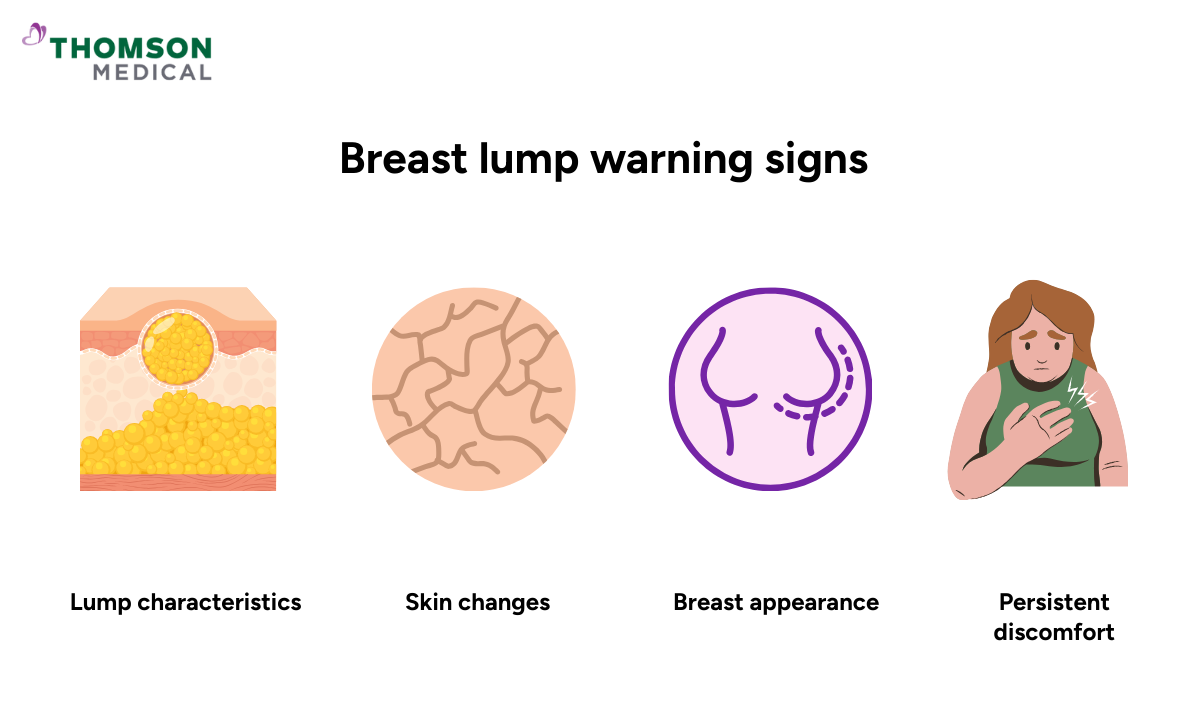
While most lumps are benign, certain characteristics and symptoms suggest a lump needs prompt evaluation. Being aware of these signs helps you recognise when to seek medical care.
Signs that warrant a doctor's visit:
Lump characteristics:
A new lump that feels distinctly different from your surrounding breast tissue – particularly if it's hard, has irregular edges, or stays fixed in place rather than moving freely.
Skin changes:
Dimpling, puckering, or thickening of your breast skin. Some women describe this texture as resembling an orange peel.
Nipple changes:
Discharge from your nipple (especially if it's bloody or clear), a nipple that turns inward when it didn't before, or shifts in how your nipple sits.
Breast appearance:
Unexplained swelling, redness, or warmth in one breast, or changes in size or shape that aren't linked to where you are in your cycle.
Persistent discomfort:
Pain in one specific area of your breast that lingers beyond your period.
It's natural to think that if a lump hurts, it must be more serious – but actually, that’s not always the case. Harmless cysts frequently cause discomfort, while some concerning lumps don't hurt at all initially.
Trust what you're noticing rather than waiting for pain to guide you. If something feels different or doesn't seem right, that's reason enough to get it checked.
If you've noticed any of these warning signs or you're uncertain whether your lump needs evaluation, schedule an appointment with Thomson Medical. Our specialists can examine your breast lump thoroughly and provide the clarity and reassurance you need.
When to see a doctor for a breast lump
Finding a lump naturally brings questions, and knowing when to reach out for professional guidance can help you take appropriate action. If you're unsure, getting it checked is always the right choice.
Contact your doctor if you notice:
A new lump that persists:
Any lump that's still there after your period ends or one that's been present for more than two weeks.
Changes in an existing lump:
If a lump you've been monitoring shifts in size, shape, or how it feels under your fingers.
Concerning symptoms:
Nipple discharge (particularly if it's bloody or clear), skin dimpling, redness, or a nipple that's turned inward.
Persistent pain:
Discomfort in one specific area of your breast that doesn't ease up after your period.
Any breast lump if you're male:
Men should seek prompt evaluation for any breast lump, as the likelihood of it being cancerous is higher in male breast tissue.
It's completely normal to feel apprehensive about that first appointment. The uncertainty of not knowing can weigh heavily, but your doctor is there to help you understand what's happening and guide you through whatever comes next.
Our breast specialists in Singapore
Loading...
Breast lump diagnosis and testing
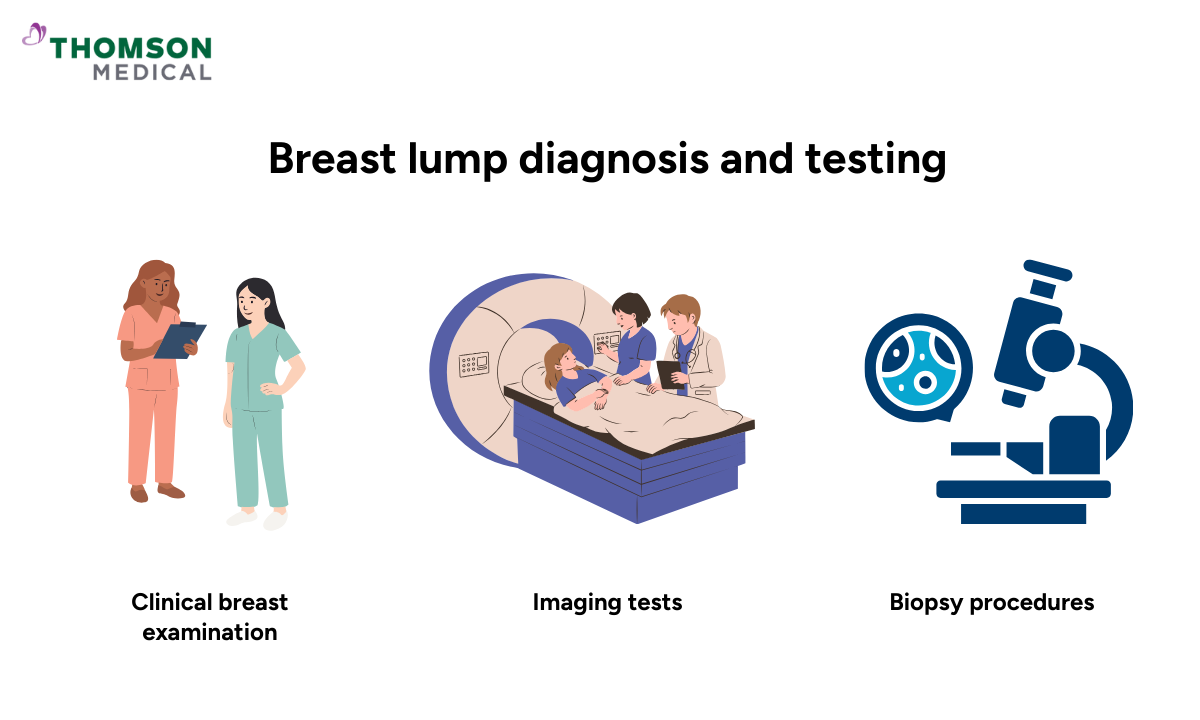
Walking into that appointment can feel daunting, especially when you're not sure what to expect.
Knowing what happens during an evaluation can help ease some of the anxiety around the process. Your doctor will use a combination of methods to understand what type of lump you have and whether any treatment is needed.
Clinical breast examination
This is normally where the diagnostic process begins. During your appointment, your doctor will:
Review your medical history:
You'll be asked about when you first noticed the lump, any symptoms you've experienced, where you are in your menstrual cycle, and whether there's a family history of breast conditions.
Examine both breasts:
Your doctor will check for lumps, skin changes, or enlarged lymph nodes in your breasts and armpits.
They'll assess the lump's size, shape, texture, and whether it moves when pressed.
Look for other signs:
This includes checking for skin dimpling, nipple discharge, or other changes that might give clues about the lump's nature.
Based on this examination, you may learn your lump is a normal hormonal change or benign cyst that needs no further testing. The findings guide your doctor to decide whether additional tests would be helpful or if monitoring the lump over time is the appropriate next step.
Imaging tests for breast lumps
If your doctor needs more information after the clinical examination, imaging tests can provide a clearer view of what's happening.
These tests are straightforward and painless:
Mammogram:
A mammogram is an X-ray of the breast that can detect lumps and abnormalities.
This test is particularly useful for women over 40 or those with a family history of breast cancer.
Breast ultrasound:
Breast ultrasound uses sound waves to create images of your breast tissue.
It's often the preferred option for younger women and is particularly good at distinguishing between solid lumps and fluid-filled cysts.
Breast MRI scan:
A breast MRI scan provides detailed images of breast tissue and may be recommended if you're at higher risk or when other tests haven't given a clear answer.
These tests provide detailed images to help your doctor understand the nature of your lump without any invasive procedures.
Biopsy procedures
The word "biopsy" can sound alarming, and you might immediately assume it means cancer.
A breast biopsy is a procedure that allows your doctor to examine a small sample of tissue more closely and determine what type of lump you have.
There are different types depending on what’s needed:
Fine needle aspiration:
A thin needle removes fluid or cells from your lump. This is often used for cysts and usually provides results quickly.
Core needle biopsy:
This is the most common type of biopsy and can usually be done at the clinic, which involves a slightly larger needle taking small tissue samples.
Surgical biopsy:
In rare cases, the entire lump may be removed for examination.
Most biopsies are performed under local anaesthetic with minimal discomfort. Results usually come through within a few days to a week, giving you and your doctor the information needed to decide on the right path forward.
If you're concerned about a lump that needs further investigation, schedule an appointment with Thomson Medical. Our team will walk you through what to expect, explain each step of the diagnostic process, and answer any questions you have along the way.
FAQ
Can breast lumps be normal?
Yes. Breast tissue naturally changes throughout your menstrual cycle, pregnancy, and with age. These changes can create temporary lumps or areas of thickness that are completely normal. However, any new or persistent lump should be checked by a doctor.
What does a cancerous breast lump feel like?
Cancerous lumps often feel hard, are irregular in shape, and don't move easily under the skin. They may be painless and can be accompanied by skin dimpling, nipple changes, or discharge. However, not all cancerous lumps have these characteristics, which is why any persistent lump needs evaluation.
Can men get breast lumps?
Yes. While less common, men can develop breast lumps. Men should see a doctor promptly for any breast lump, as male breast tissue has a higher likelihood of being cancerous compared to women.
Do breast lumps hurt?
Not always. Benign lumps like cysts often cause pain or tenderness, especially before menstruation. However, some cancerous lumps are painless. Pain alone isn't a reliable indicator of whether a lump is serious.
Can breast lumps go away on their own?
Some can. Lumps caused by hormonal changes or cysts may disappear after your period. However, if a lump persists for more than two weeks or doesn't change with your cycle, see a doctor for evaluation.
At what age should I start checking for breast lumps?
Women should begin monthly breast self-examinations in their 20s. This helps you become familiar with your normal breast tissue, making it easier to notice changes. Regular clinical examinations and mammograms are often recommended starting at age 40.
The information provided is intended for general guidance only and should not be considered medical advice. For personalised recommendations based on your medical conditions, request an appointment with Thomson Medical.