

Finding out you have colon polyps can be unsettling, especially if you're not sure what it means for your health. It's natural to wonder whether they need to be removed and what treatment involves.
The good news is that colon polyps are common and treatable. For most people, they can be safely removed during a routine colonoscopy, often before causing any symptoms or problems.
Understanding when polyps may require treatment, especially if they occur alongside symptoms, can help you know when it is time to seek medical advice.
What are colon polyps?
Colon polyps are small growths on the inner lining of your colon (large intestine). Many people have them without knowing, as they often cause no noticeable symptoms.
While most polyps are benign (non-cancerous) at first, some can slowly turn into colorectal cancer over time. That's why your doctor will recommend removing them once they're found.
Types of colon polyps
Not all colon polyps carry the same risk of colorectal cancer.
The main types include:
Adenomatous polyps (adenomas):
This is the most common type. If left untreated, they may develop into colorectal cancer over time.
Serrated polyps:
This variant may carry a higher cancer risk and require a closer follow-up.
Hyperplastic polyps:
This type is usually small and low-risk, especially when found in the lower part of your colon.
Inflammatory polyps:
These polyps are often linked to inflammatory bowel conditions and are generally benign.
The type of colon polyp you have may not be obvious at first. Once your polyp is removed, your doctor will send it to a laboratory for testing. The results will identify the type and guide any follow-up care you may need.
Benefits of treating colon polyps early
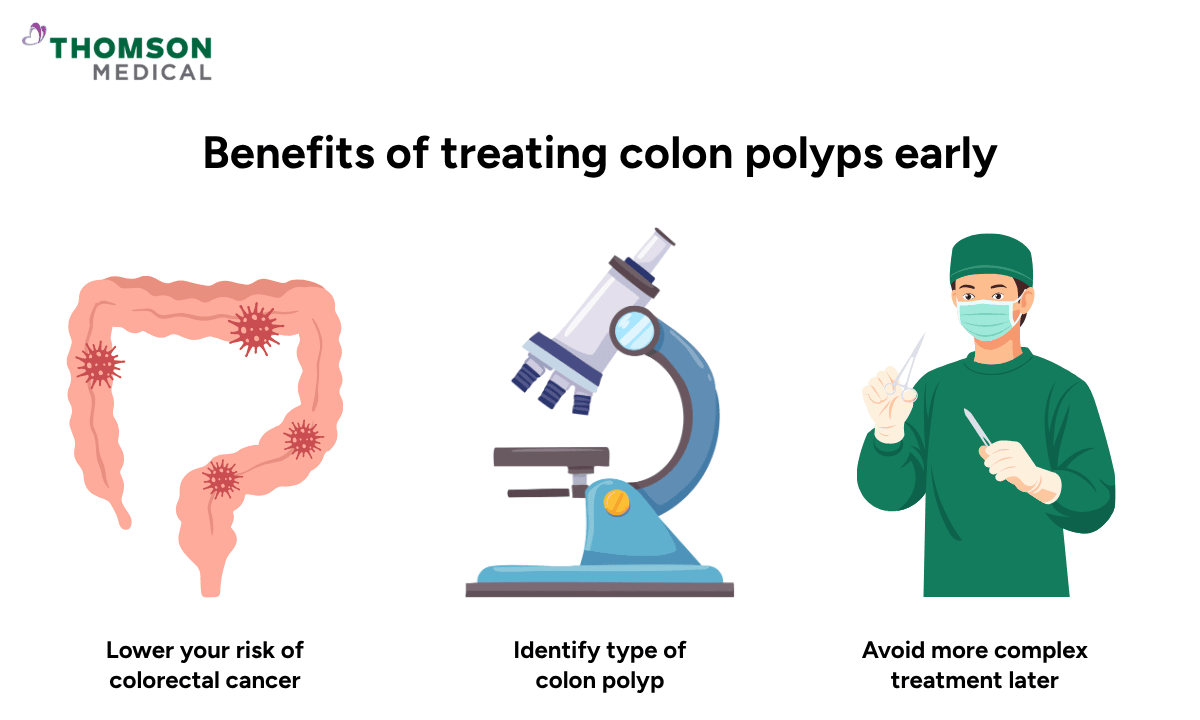
While many polyps are harmless at first, some can develop into colorectal cancer if left untreated, often gradually over several years. Removing them early closes that window of risk.
Here is why your doctors recommend treatment:
It lowers your risk of colorectal cancer:
Removing polyps early reduces the chance of them becoming a more serious problem down the line.
It gives you clear answers:
Once a polyp is removed and tested, your doctor can identify its type and decide whether you need more frequent monitoring.
It can help you avoid more complex treatment later:
Treating polyps early may spare you from more extensive procedures in the future, such as bowel surgery or a longer hospital stay.
Removing colon polyps isn’t just about addressing something that is already there – it is a preventative step to protect your long-term health.
Treatment options for colon polyps in Singapore
In Singapore, most colon polyps are removed during a colonoscopy. This means you often don't need a separate procedure, which makes the whole process more convenient and easier to recover from.
Here are the most common treatment options:
Polypectomy (snare removal)
This is the most widely used method for small- to medium-sized polyps. Your doctor passes a thin wire loop (snare) through the colonoscope to remove the polyp. In some cases, a small electrical current is used to cut through the polyp and reduce bleeding.
Endoscopic mucosal resection (EMR)
EMR is used for larger or flat polyps that can't be removed easily with a snare alone. Your doctor injects a fluid beneath the polyp to gently lift it away from the colon wall, making it safer to remove. The polyp is then taken out in one piece or in sections.
Endoscopic submucosal dissection (ESD)
ESD is a more advanced technique used for larger or more complex polyps, especially when precise removal is important.
Rather than removing the polyp in pieces, your doctor carefully separates it from the deeper layers of the colon wall.
Surgical removal
Surgery is rarely needed, but it may be recommended if:
The polyp is very large
There are signs suggesting early colorectal cancer
Endoscopic removal is not safe or cannot be completed
In these cases, your doctor may remove a section of your colon (partial colectomy).
Your doctor will recommend the suitable approach based on the size, shape, and location of the polyp, ensuring your treatment is both effective and as minimally invasive as possible.
If you’ve been diagnosed with colon polyps or are planning a colonoscopy, request an appointment at Thomson Medical. Our healthcare specialists can walk you through your treatment options, clearly explain your results, and help you understand the next steps forward.
Our gastroenterologist
Loading...
What to expect during colon polyp removal
Knowing what to expect at each step of the process can help you feel more prepared and ease any uncertainty.
This is what the removal usually looks like:
Before the procedure:
Your doctor usually guide you to follow a bowel preparation plan to clear your colon
You may also need to avoid food for several hours before the procedure
During the procedure:
You will receive sedation, so you remain relaxed and comfortable
Your doctor will place a colonoscope to examine your colon
Polyps are removed during the same session
After the procedure:
You may feel bloated or slightly crampy for a short time
Most patients can go home the same day but you will need someone to accompany you due to sedation
Recovery is usually straightforward, and many people can return to their normal routine soon after the procedure.
How much does it cost to remove colon polyps?
The cost of colon polyp treatment can vary depending on where you receive care and how complex the procedure is. In general, a colonoscopy with polyp removal may range from SGD 800 to SGD 3,000 or more in public hospitals (subsidised) and SGD 1,500 to SGD 5,000 in private settings.
Choosing a subsidised route in a public hospital usually lowers the cost but may involve longer waiting times, while private care – either in public or private hospitals – offers shorter wait times, greater flexibility, and the option to choose your doctor, though at a higher cost.
The good news is that Medisave usually can be used for colonoscopy and polyp removal, and many Integrated Shield Plans may help cover additional expenses.
As coverage varies by policy and procedure, it’s worth checking with your insurance provider or hospital in advance to understand what applies to your situation.
Please note that these costs are based on 2026 rates and may vary over time.
Concerned about colon polyps or due for screening?Request an appointment with Thomson Medical, where our doctors can provideaccurate diagnosis, minimally invasive removal and personalised follow-up planning.
FAQ
Can I use Medisave for colon polyp treatment?
Yes, Medisave can generally be used for colonoscopy and polyp removal procedures in accredited facilities, subject to CPF withdrawal limits and scheme criteria. It’s a good idea to check with your clinic or hospital for the exact claimable amount.
Is colon polyp removal painful?
Most patients experience minimal discomfort during the procedure because sedation is used. After the procedure, you may feel some mild bloating or cramping, but this usually settles quickly.
How long does it take to remove colon polyps?
The colonoscopy and polyp removal procedure typically take 30 to 60 minutes. Including preparation and recovery time, you may spend several hours at the clinic or hospital.
Do I need to be hospitalised for colon polyp removal?
For most people, colorectal polyp removal is a day procedure, and you can go home the same day. Hospitalisation is only needed in rare situations, such as very large polyps or complications.
Do colon polyps come back after removal?
Polyp removal does not prevent new polyps from forming. That is why follow-up colonoscopies are recommended – the timing will depend on the type and number of polyps found, and your doctor will advise on an appropriate schedule for your situation.
Are there any side effects after colon polyp removal?
Mild side effects such as cramping, bloating, or light bleeding are relatively common and usually settle on their own. Serious complications, such as heavy bleeding or bowel perforation, are rare but require prompt medical attention.
The information provided is intended for general guidance only and should not be considered medical advice. For personalised recommendations and tailored advice based on your unique situations, please consult a specialist at Thomson Medical.Request an appointment with Thomson Medical today.
For more information, contact us:
Thomson Medical Concierge
- 8.30am - 5.30pm
- WhatsApp: 9147 2051
Need help finding the right specialist or booking for a group?
Our Medical Concierge is here to help you. Simply fill in our form, and we'll check and connect you with the right specialist promptly.
Notice:
The range of services may vary between Thomson clinic locations. Please contact your preferred branch directly to enquire about the current availability.
Get In Touch