

During IVF, your doctor may mention that your ovarian follicles are growing slowly. You may then wonder what this means for your treatment and chances of pregnancy. As follicle growth affects egg development, knowing what influences its growth and processes may help you better understand what these results may mean for your fertility treatment.
What role do follicles play in IVF?
Follicles are fluid-filled sacs inside your ovaries, each containing an immature egg. During a natural menstrual cycle, it’s common for one follicle to grow and release an egg. During in vitro fertilisation (IVF), hormone injections stimulate your ovaries to grow several follicles at the same time. The aim is to collect multiple mature eggs, since a higher number generally increases the chance of embryos developing well.
How do follicles normally grow during IVF?
Once stimulation begins, your doctor will monitor your follicles closely using ovarian follicle ultrasound scans. These scans show how many follicles are growing and how quickly they are increasing in size. Your doctor may also check your hormone levels with blood tests to get a fuller picture of how you are responding.
Follicles are measured in millimetres (mm). Fertility specialists look for follicles that grow by around 1 to 2 mm each day during stimulation. A follicle is usually considered mature and ready for egg collection when it reaches around 17 to 20 mm.
When are follicles considered slow-growing?
A follicle may be considered slow-growing when it grows slower than expected during a given stage of stimulation. Another indication is if growth falls noticeably behind other follicles in the same cycle or does not reach a mature size in time for egg collection.
Why do some follicles grow slowly?
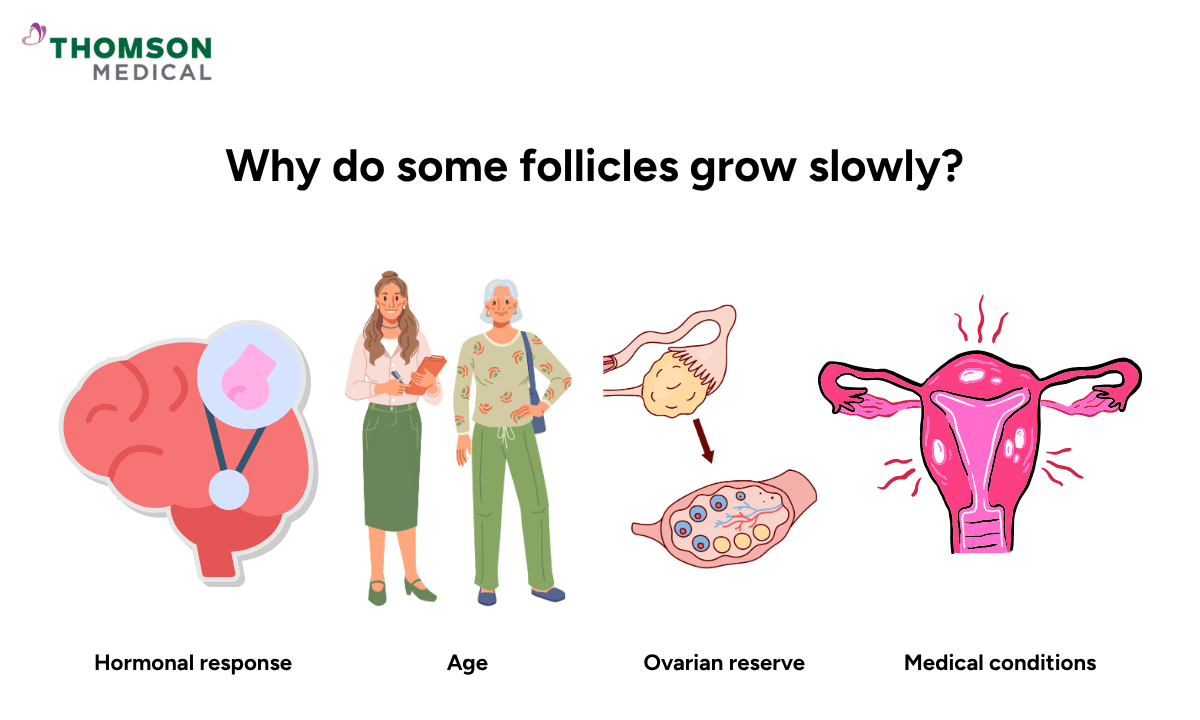
There is no single reason why follicles may grow slowly, and in many cases it is not something that could be predicted or prevented. However, there are several factors that may affect how they respond, which include:
Response to stimulation medication
Sometimes, the ovaries may respond less strongly to the medication than expected. This may be because the follicles have lower sensitivity to follicle-stimulating hormone (FSH), which is the main hormone used to encourage follicle growth.
It may also be because the dose or type of medication needs adjusting to suit your body. However, your doctor may usually make these adjustments as your cycle progresses.
Age
If you are over the age of 35, follicle development may naturally be a little slower. This is common and will be considered by your fertility specialist when planning your fertility journey.
Ovarian reserve
Low ovarian reserve, sometimes seen as low anti-Müllerian hormone (AMH) levels, may affect how your follicles respond to stimulation.
Medical conditions
Certain conditions may contribute to uneven or slower follicular response, including:
Polycystic ovary syndrome (PCOS), currently known as polyendocrine metabolic ovarian syndrome (PMOS), may lead to small follicles
Endometriosis, which could reduce ovarian reserve or impair response, especially after ovarian surgery
Previous ovarian surgery that may lower ovarian reserve and affect response
Having slow-growing follicles does not necessarily mean that your IVF treatment will be unfavourable. However, if you have any concerns about your ovarian response, you may consider speaking to a fertility specialist. Request an appointment with Thomson Medical.
Our fertility doctors in Singapore
Loading...
Is it possible to achieve pregnancy with slow-growing follicles?
Yes, it is possible to achieve pregnancy with slower-growing follicles. Although this may make things more challenging, it does not rule out a positive outcome. In practice, slower growth may mean:
Fewer mature follicles may mean fewer eggs are collected
Some follicles that grow slowly may hold eggs that are not yet fully mature
There may be fewer eggs available to fertilise and fewer embryos available for transfer or freezing.
That being said, even if only a small number of eggs are collected, pregnancy may still be possible if a viable embryo develops. Some women have gone on to have successful pregnancies from just one or two healthy embryos.
How do fertility specialists manage slow-growing follicles?
There are several ways your fertility team might be able to support your follicle development during the cycle.
Depending on your situation, your doctor may:
Adjust your medication by increasing your FSH dose or switching to a different stimulation drug.
Extend the stimulation period to give smaller follicles more time to reach maturity.
Add luteinising hormone (LH) support, as LH works alongside FSH and may improve your response.
Delay the trigger injection to allow more follicles to catch up before collection.
Revise the plan for a future cycle, such as trying a different stimulation protocol if needed.
What could you do to support follicle development during IVF?

While your medical team will manage your treatment, there are steps you might be able to take alongside it to support your body. None of these will guarantee a specific outcome, but they may help support better conditions for follicle growth.
Maintaining healthy habits
Your body's overall health may influence how your ovaries respond to stimulation. Helpful habits include:
Maintain a healthy weight to support the hormonal balance your ovaries need to respond well to stimulation.
Get enough sleep each night, as poor sleep may disrupt the hormonal balance needed for follicle development.
Manage stress where possible, as high cortisol levels may interfere with reproductive hormones.
Eating a balanced diet
The nutrients you take in during stimulation could affect the environment in which your follicles are growing. Helpful choices include:
Plenty of protein, as amino acids help support healthy cell growth and development.
Fruits and vegetables provide antioxidants and nutrients that support general reproductive health.
Healthy fats from oily fish, nuts and seeds, as omega-3s support healthy cell function and egg quality.
Consuming supplements
Some supplements may support egg and follicle health, though it is important to check with your doctor before starting anything new. Your doctor might suggest:
CoQ10, which may support egg quality by helping cells produce energy more efficiently.
Vitamin D, which supports reproductive health, as low levels have been linked to poorer ovarian response.
Pregnancy vitamins, which provide key nutrients, including folate, that support reproductive health.
Avoiding harmful substances
As certain habits may impact your body's response to stimulation, it may be beneficial to reduce or eliminate the following:
Smoking, as it could reduce ovarian reserve and affect egg quality.
Alcohol, which may interfere with hormone levels and egg development.
Excessive caffeine, as high consumption has been associated with poorer IVF outcomes.
Supporting follicle development involves more than lifestyle changes alone, so you may consider consulting a fertility specialist to discuss your treatment response and the options available to support your cycle. Request an appointment with our fertility specialists at Thomson Medical.
FAQ
Can slow-growing follicles still produce viable eggs?
Yes, some of these follicles can still contain mature eggs that can be fertilised, especially if they are given enough time to develop before egg collection.
Why are follicles not growing in IVF?
Several factors can affect follicle growth, including:
- Hormonal imbalances
- Diminished ovarian reserve
- Reduced response to fertility medications
- Conditions such as PCOS or endometriosis
What happens if follicles grow too slowly during IVF?
In some cases, a cycle may be cancelled if your ovaries respond too slowly. However, your fertility specialist may first:
- Extend the stimulation period
- Adjust your medication dose
- Continue monitoring follicle size using transvaginal ultrasound
How many follicles are considered too few for IVF?
Having fewer than 3 to 5 developing follicles is generally considered a low ovarian response. However, pregnancy is still possible, as even one or two good-quality eggs can lead to a successful outcome.
Can you make follicles grow faster during IVF?
You cannot directly speed up follicle growth yourself, but there are still options available. Your fertility specialist may adjust your hormone medications or change the treatment protocol. Taking your medications as prescribed and looking after your overall health can help support your body's response.
What is the ideal follicle size for egg retrieval in IVF?
Follicles measuring around 15 to 20 mm are generally considered suitable for egg collection, though research suggests that follicles from around 14 mm onwards can also yield mature eggs. Eggs collected within this size range are more likely to be mature and ready to be fertilised. Your doctor will assess your follicle sizes alongside other factors to decide on the best time for collection.
The information provided is intended for general guidance only and should not be considered medical advice. For personalised recommendations and tailored advice based on your unique conditions, request an appointment with Thomson Medical.
For more information, contact us:
Thomson Fertility Centre
- Paragon: 6252 7766
- Novena: 6399 3758, 8811 0358 (WA)