

During the stimulation phase of your in vitro fertilisation (IVF) treatment, your doctor monitors your follicle growth to track how they're developing. The rate at which they grow helps determine when to schedule your trigger shot and egg retrieval. Since follicle growth may vary from one woman to another and between follicles in the same cycle, knowing what's typical at each stage could help you make better sense of your treatment plan and what to expect.
What are follicles?
Follicles are small, fluid-filled sacs in your ovaries that hold immature eggs. They play several important roles in your menstrual cycle, such as:
Protecting and nourishing the egg as it grows
Releasing oestrogen to help regulate your menstrual cycle
Preparing the egg for possible release during ovulation
Each month, several follicles begin to grow, but usually only one becomes fully mature and releases an egg. The rest stop develops and gets absorbed back into the body. This process occurs every cycle, whether or not you’re trying to conceive.
How fast do follicles grow during IVF?
In a natural cycle, follicles tend to grow by around 1.4 mm a day. With IVF medication, this often increases slightly to around 1.7 mm a day, and growth may speed up to approximately 2 mm a day in the lead-up to retrieval.
Follicle growth rate per day
Your timeline will depend on your age, ovarian reserve, medication dose, and the protocol your doctor has chosen for you. The table below provides a general estimate of how follicle size may change during stimulation:
| Stimulation phase | What is happening? | Typical follicle size range |
|---|---|---|
Baseline (Day 0 to 2) | Your doctor counts your antral follicles, a small resting follicle seen on an ultrasound scan at the start of your cycle, before medications begin. | Around 2 to 5 mm |
Early stimulation (Days 3 to 5) | Your ovaries begin responding to the medications, and early growth begins. | Around 6 to 10 mm |
Mid-stimulation (Days 6 to 8) | Follicles can now be seen more easily on the scan, and some variation in size may be observed. | From 11 to 14 mm |
Late stimulation (Days 9 to 11) | A leading group, which are the follicles growing fastest and largest, begins to emerge.
Your doctor watches for enough follicles reaching the target range. | From 15 to 18 mm |
Maturation, around trigger day | Your leading group of follicles usually reaches the target size your doctor is looking for before scheduling the trigger shot. | Approximately 18 to 22 mm |
Egg retrieval | Usually scheduled around 36 hours after your trigger shot. | Retrieval window |
However, these ranges are approximate and may vary between individuals and protocols. Your doctor will monitor your progress on a more personalised basis.
If you have questions about follicle size, growth rates, or the timing of egg retrieval, a fertility specialist could be able to explain what your monitoring results mean and how they may affect your treatment. Request an appointment with Thomson Medical's fertility team.
Our fertility doctors in Singapore
Loading...
Why do follicles grow at different rates?
Follicles growing at different rates is called asynchronous follicular growth. It happens for a few reasons:
Each follicle has its own number of receptors, so it responds to medication slightly differently.
One follicle often takes the lead and grows faster than the others.
In a natural cycle, this lead follicle may send signals that slow the smaller ones. During IVF, your medication helps more follicles keep growing together.
What affects how quickly your follicles grow?
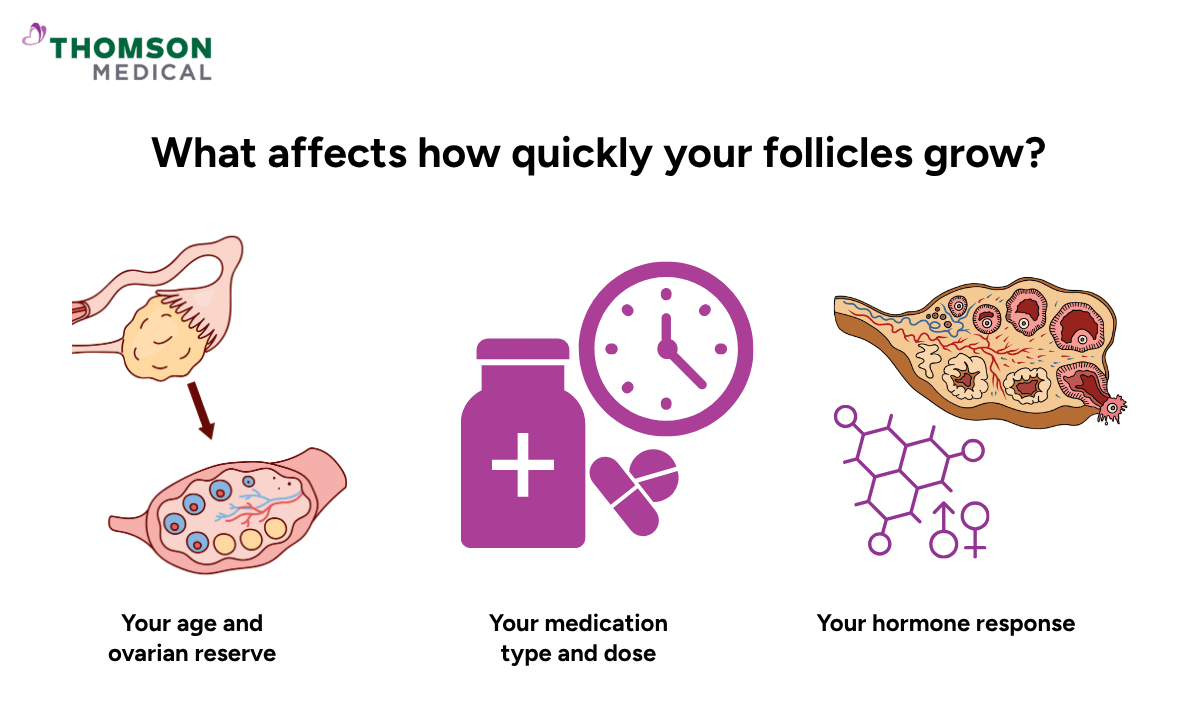
Several factors influence how quickly follicles grow during IVF, and understanding them could help explain why results vary from woman to woman.
Your age and ovarian reserve
As you get older, your ovarian reserve naturally declines. This change often becomes more noticeable after the age of 35.
A lower egg reserve may affect both the number and quality of your eggs, as well as how quickly your follicles grow during stimulation.
Your medication type and dose
IVF medications help stimulate your ovaries to produce more follicles. These are usually given once or twice a day for around 7 to 14 days.
The medications that directly affect follicle growth include:
Gonadotropins: these stimulate your ovaries to develop multiple follicles.
GnRH agonists: this helps control follicle maturation and prevent early ovulation.
GnRH antagonists: whichhelp prevent an early surge in hormones that could trigger ovulation before your eggs are ready.
Your doctor may also prescribe medications that support other parts of the cycle:
Progesterone: which supports the lining of your uterus (womb) ahead of embryo transfer.
Oestrogen: which helps to prepare the uterine lining and is sometimes used to prime your ovaries before stimulation.
Androgens: which may be used to support follicle growth in women who have not responded well to stimulation in previous cycles.
Your dosage will depend on factors such as your AMH level (a marker of your egg reserve), antral follicle count, your age, and your body weight. Your doctor will adjust this based on blood tests and ultrasound results.
Your hormone response
During the stimulation phase, your doctor will order regular blood tests and transvaginal ultrasounds to monitor your response and adjust your medication dose to support healthy follicle development.
What if your follicles grow too slowly or too quickly?
Follicle growth that is faster or slower than expected may affect how your cycle progresses. If follicles grow too slowly, this may lead to:
Fewer mature eggs at retrieval
Lower egg quality, which could affect embryo development
A higher chance of the cycle being cancelled
A need for additional medication to support growth
A lower likelihood of eggs being suitable for fertilisation
If follicles grow too quickly, this may lead to:
A rapid rise in oestrogen levels
A higher risk of ovarian hyperstimulation syndrome (OHSS), which may become serious if left untreated
OHSS happens when growing follicles release substances that make blood vessels more permeable. This causes fluid to leak out of the blood vessels and build up in the abdomen, pelvis or, in more serious cases, around the lungs.
When should you see a doctor?
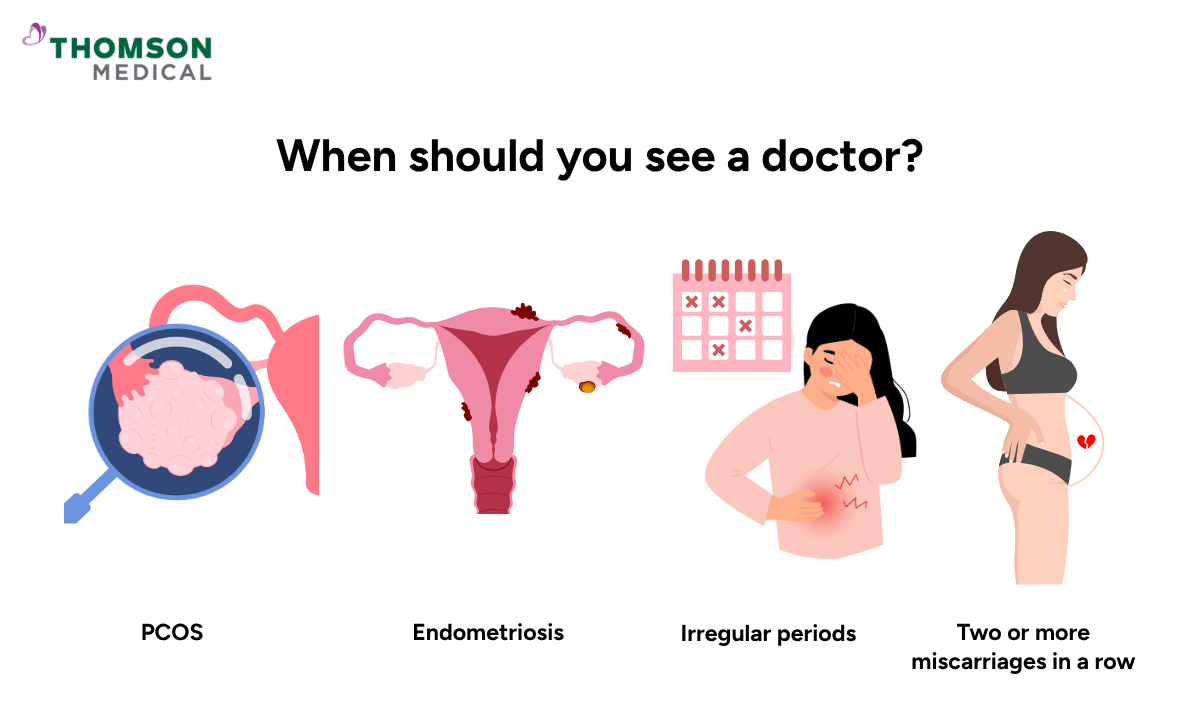
While IVF often follows a period of trying to conceive, certain signs suggest it may be worth consulting a doctor earlier. You may wish to see a doctor if:
You are under 35 and have been trying to conceive for over 12 months.
You are 35 or older and have been trying for over 6 months.
You have a condition such as PMOS (formerly known as PCOS), endometriosis, or irregular periods.
You have had two or more miscarriages in a row.
As follicle growth may vary significantly from one woman to another, a fertility specialist could help assess your follicle development and guide next steps for your IVF cycle. Request an appointment with Thomson Medical to consult with a specialist.
FAQ
Does stress affect follicle growth during IVF?
While ongoing stress can affect your overall wellbeing, everyday stress is unlikely to change how your follicles grow or how your cycle turns out. Your stimulation medications are the main driver of follicle growth, and your care team will monitor your response throughout.
Can diet or lifestyle changes support follicle growth during IVF?
Healthy habits such as eating a balanced diet, exercising regularly, maintaining a healthy weight, getting enough sleep, and avoiding smoking can support overall reproductive health. Ideally, these changes should begin several months before IVF treatment.
What happens if my follicles are growing too slowly?
If your follicles are growing slowly, it could mean your ovaries are responding more gently to the medication. Your doctor may adjust your treatment plan, extend stimulation, or continue monitoring to see whether the follicles catch up before egg retrieval.
How many ultrasound monitoring appointments will I need during IVF stimulation?
You’ll usually need around 3 to 6 monitoring appointments during the stimulation phase. Each one involves a quick transvaginal ultrasound and a blood test to measure your oestrogen and progesterone levels.
Can follicle growth rate affect egg quality?
Follicles that grow too slowly or too quickly may be less likely to contain mature eggs. However, follicle size alone cannot predict egg quality, and some follicles that grow slowly can still produce healthy eggs.
Can a small follicle still produce a mature egg?
A slightly smaller follicle may still contain a mature egg, particularly if it is close to the target size at retrieval. While larger follicles are generally more likely to yield mature eggs, smaller follicles can sometimes contribute viable eggs as well.
The information provided is intended for general guidance only and should not be considered medical advice. For personalised recommendations and tailored advice based on your unique conditions, request an appointment with Thomson Medical.
For more information, contact us:
Thomson Fertility Centre
- Paragon: 6252 7766
- Novena: 6399 3758, 8811 0358 (WA)