

You've noticed something different about your breast. Maybe it's red, warm to the touch, or the skin looks a bit like an orange peel. This could be a sign of inflammatory breast cancer (IBC).
Unlike most breast cancers that start with a lump, IBC shows up differently – through skin changes and swelling that often look like a breast infection. That's exactly why it's so easy to miss or mistake it for something less serious.
Let's take a look at what IBC actually is, how to recognise it, and what treatment looks like. Getting clear information can help you move forward with confidence and make the right decisions for your health.
What is inflammatory breast cancer (IBC)?
IBC isn’t like any breast cancer you’ve heard about. There’s usually no lump or discrete mass you can feel during a self-exam. Instead, it shows up through changes in your breast’s skin and appearance.
This is an aggressive form of breast cancer. However, it’s rare, accounting for only 1-5% of all breast cancer cases. It happens when cancer cells block the lymphatic vessels in your breast skin. As a result, your breast becomes swollen and inflamed, sometimes looking quite similar to a breast infection.
You may be confused about its name, especially with the word "inflammation". What actually happens is far from an inflammation in the traditional sense. IBC behaves differently from other breast cancers and requires a different treatment approach from day one.
Because IBC has distinct signs, your doctor can identify it and begin treatment quickly. They will discuss and guide you through every step of the way and help you understand what to expect at each stage, from diagnosis through treatment and beyond.
What causes IBC?

This may be one of the first questions on your mind, especially if you're worried about your own risk. It's completely natural to want to understand why this is happening.
The truth is, scientists are still working to understand exactly what triggers IBC. While there isn’t a complete answer yet, researchers have found some patterns that help them recognise who might be at higher risk.
Your chance of developing IBC may be higher if you are:
In your 50s:
On average, women diagnosed with IBC tend to be slightly younger than most breast cancer patients. The median age for IBC is 57, compared to 61.9 for breast cancer overall.
Overweight or obese:
Research found that being overweight may increase your chances of developing IBC.
IBC isn't caused by anything you did or didn't do. It's not about your lifestyle choices, your diet, whether you exercised enough, or whether you breastfed in the past.
These risk factors help doctors understand the disease better and identify it earlier. They're not a measure of blame or things you should have controlled. It gives you and your doctor the best possible chance to start treatment promptly.
Signs and symptoms: What does IBC look like?
One of the most concerning aspects of IBC is how quickly symptoms can appear. You may notice changes happen suddenly, sometimes, over just a few weeks. They often look like mastitis (a breast infection that’s common in breastfeeding mums) so it’s easy to mistake one for the other at first.
If you experience IBC, you may notice:
Redness and warmth:
These symptoms often cover at least a third of your breast. Your skin feels hot, like you’re running a fever just in that area.
Swelling:
Your breast may become heavier, larger, or feel different from your other breast. In some cases, you may notice your breast feels firm or hard.
Skin texture changes:
This is the “orange peel” appearance, which is also known as peau d’orange. When this happens, your skin develops a dimpled, thickened texture, creating little pits that look like the surface of an orange.
Nipple changes:
Your nipple may flatten, retract inward, or change shape. You may also notice unusual discharge.
Pain or tenderness:
The discomfort can range from mild to significant.
Some women experience no pain at all, while others find it quite uncomfortable.
Swollen lymph nodes:
You may feel lumps under your arm or near your collarbone.
If you’re experiencing any of these signs, don’t wait to see if things get better on their own. Having these changes doesn’t guarantee you have IBC, as they can also indicate a breast infection like mastitis. But it does mean you should see your doctor promptly. They will help you figure out what’s happening and make sure you get the right care at the right time.
If you notice any changes in your breasts, schedule an appointment with Thomson Medical for thorough evaluations to assess what might be happening with your body.
Our women's cancer specialist
Loading...
How is IBC diagnosed?
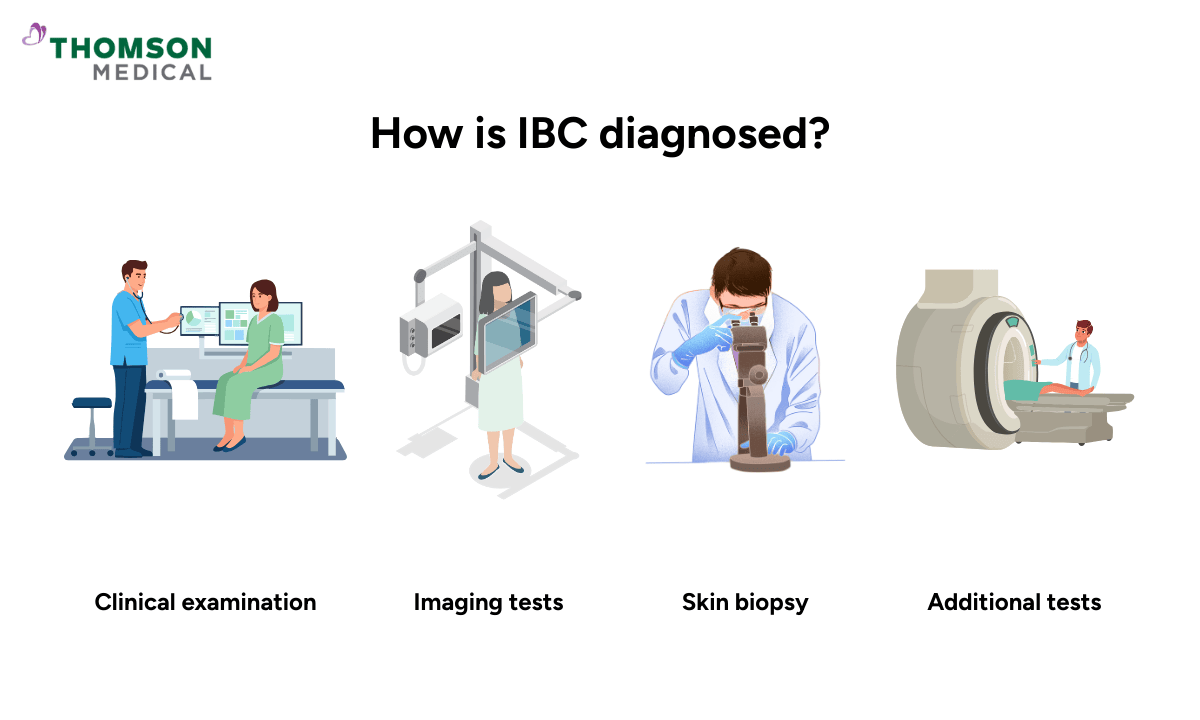
If your doctor suspects IBC, they’ll suggest several tests to understand exactly what’s going on in your body. Each test serves a different purpose, but they all work together to confirm the diagnosis and give your doctor the information they need to plan your treatment effectively.
Here is what you can expect:
Clinical examination:
This test usually comes first. Your doctor will look at your breast, ask about your symptoms, and check your lymph nodes. They’ll also look at how quickly your symptoms appeared and whether these match the IBC pattern.
Imaging tests:
These tests give your doctor a clear picture of what’s happening inside. A mammogram may be first, though IBC doesn’t always show up clearly on standard mammograms.
Ultrasound can examine your breast tissue and lymph nodes. An MRI scan gives even more detailed images and helps your doctor know how far the cancer has spread.
Skin biopsy:
Your doctor removes a small sample of your breast skin and analyses it. This is crucial because IBC cancer cells are often found in the skin’s lymph vessels.
A breast biopsy will give you a definitive answer about whether you have IBC.
Additional tests:
Once you have clear answers, you and your doctor can move forward with a treatment plan that's specific to your situation.
If you're unsure what your results mean or what happens next, don't hesitate to ask. Your doctor will take the time to explain your diagnosis and walk you through what each finding means for your treatment. You're not expected to get through this alone or figure everything out on your own.
Treatment options: What happens next?
If you've just been diagnosed with IBC, it’s natural to have mixed feelings. You may find yourself wondering: So what does treatment actually involve? And what are my chances?
The reality is IBC is treated as locally advanced cancer, at least stage III. This means your treatment will be comprehensive, and your doctor will use a combination of therapies to attack the cancer from multiple angles.
This approach may sound intense, but there's a clear purpose behind each step.
Your treatment plan may include:
Chemotherapy:
Unlike other breast cancers, where surgery may be the first step, IBC treatment starts with chemotherapy. This is because IBC tends to spread early, and your doctor needs to attack cancer cells throughout your body, not just in your breast.
Chemotherapy also shrinks the tumour before surgery, making surgical treatment more effective.
Surgery:
After chemotherapy, you'll have surgery to remove the entire breast. Because IBC spreads through the skin, removing just the tumour isn't effective.
Your doctor will also remove lymph nodes from under your arm to check for cancer spread and reduce recurrence risk.
Radiation therapy:
After surgery, your doctor will use radiation to target your chest wall, the area where your breast was, and your lymph node areas.
This helps remove remaining cancer cells that might be too small to detect on scans but could cause recurrence if left untreated.
Additional therapies:
Your doctor may use additional therapies, including targeted therapy and hormone therapy, to target your cancer's specific characteristics.
Your treatment timeline usually lasts 6-12 months, though this varies based on your individual circumstances. Some therapies may continue longer after the first treatment phase. It's a long road, and there will be difficult days.
But remember: you won't walk this path alone. Your doctor will be with you at every appointment, adjusting your treatment as needed and managing the side effects to keep you as comfortable as possible. Treatment approaches for IBC continue to advance, and you'll have support throughout every step of your journey.
If you've received an IBC diagnosis or want expert guidance on your treatment options, schedule an appointment with Thomson Medical. Our specialists will thoroughly review your case, answer all your questions, and create a personalised treatment plan tailored to your situation.
FAQ
Can you be cured of inflammatory breast cancer?
IBC is aggressive, but with the appropriate treatment you can achieve long-term remission (no detectable cancer for years or decades).
Your outcome depends on:
How well your cancer responds to treatment
Whether it's spread beyond your breast and lymph nodes
Your cancer's characteristics
How quickly treatment starts
Advances in targeted therapies have improved survival rates significantly over the past 20 years.
What can be mistaken for inflammatory breast cancer?
Mastitis is the most common mimic. This breast infection causes similar redness, warmth, and swelling but usually comes with fever, affects one breast area, and clears with antibiotics within days.
Sometimes, breast abscesses and skin conditions can also be mistaken for IBC.
If antibiotics don't work within a week or your breast is rapidly changing, don't hesitate to check with your doctor.
What age is most common for inflammatory breast cancer?
IBC is more common in younger women, with a median diagnosis age of around 57, slightly younger than breast cancer overall.
What is the life expectancy of someone with inflammatory breast cancer?
Five-year survival rates are about 40-50%. If your cancer hasn't spread beyond your breast and lymph nodes, rates improve to 50-60%. For IBC that has spread to other organs at diagnosis (metastatic), rates drop to 15-20%.
Factors that can affect survival rates include:
Early detection
How your cancer responds to chemotherapy
Molecular characteristics
Your age and overall health
What does stage I inflammatory breast cancer look like?
It doesn't exist. IBC is diagnosed as at least stage 3 because cancer cells blocking lymphatic vessels automatically make it locally advanced. If it's spread to distant organs, it's stage IV.
Can inflammatory breast cancer come back after treatment?
Yes. IBC has a higher recurrence rate than other breast cancers, which is why ongoing monitoring is essential. Recurrence can happen locally (in the chest wall area) or distantly (in organs like lungs, liver, or bones). Most recurrences occur within the first 2-3 years after treatment, though they can happen later.
The information provided is intended for general guidance only and should not be considered medical advice. For personalised recommendations based on your medical conditions, request an appointment with Thomson Medical.
Reference:
Di Bonito, M., Cantile, M., & Botti, G. (2019). Pathological and molecular characteristics of inflammatory breast cancer. Translational Cancer Research, 8(S5), S449–S456. https://doi.org/10.21037/tcr.2019.03.24
Anderson, W. F., Schairer, C., Chen, B. E., Hance, K. W., & Levine, P. H. (2006). Epidemiology of Inflammatory Breast Cancer (IBC) 1. Breast Disease, 22(1), 9–23. https://doi.org/10.3233/bd-2006-22103