

In vitro fertilisation (IVF) involves fertilising eggs in a laboratory and placing the embryo directly into your womb, bypassing your fallopian tubes. So when your doctor recommends a hysterosalpingogram (HSG) test to check your tubes before treatment, it's natural to wonder, "Is an HSG test necessary for IVF?"
Knowing what an HSG test is, what it checks and how it may affect your IVF treatment can help you to answer that question.
What is an HSG test?
A hysterosalpingography (HSG) test is a diagnostic imaging procedure used to examine the inside of the uterus (womb) and fallopian tubes. During the test, a contrast dye (which is an iodine-based fluid) is passed through the cervix into the womb. An X-ray then shows whether the fluid passes through the fallopian tubes.
An HSG is commonly used in fertility tests because it checks whether the womb and fallopian tubes have any abnormalities that could make pregnancy difficult.
Doctors perform this test to check:
Tubal blockages or blocked fallopian tubes, which prevent sperm from reaching the egg.
Uterine abnormalities, such as polyps and fibroids, that could interfere with implantation.
Scarring from infections, prior surgeries, or conditions like endometriosis, since they may affect the fallopian tubes’ structure and function.
Is an HSG test necessary for IVF?
An HSG test might be necessary before an IVF treatment for certain purposes, such as:
Assessing the womb and fallopian tubes:
Your doctor may recommend an HSG test if your medical history, symptoms or previous test results suggest a possible issue affecting the womb or fallopian tubes.
Identifying hydrosalpinx:
An HSG test may show hydrosalpinx (a fallopian tube that is blocked and filled with fluid), which may affect the IVF process.
However, an HSG test is a diagnostic step rather than a treatment, so it does not affect IVF outcomes on its own. But it may help doctors identify womb or fallopian tube conditions that could affect this fertility treatment or the chance of pregnancy. The results could also help doctors decide whether further assessment or treatment should be considered before IVF.
For example, if the HSG test identified hydrosalpinx, your doctor may discuss whether other treatments before IVF are appropriate. These treatments may include removing the affected tube (salpingectomy) or blocking the tube close to the womb (proximal tubal occlusion).
If you would like to discuss more about the HSG test and how it may affect your IVF treatment, schedule a consultation with a specialist at Thomson Medical.
Our O&G specialists
Loading...
How is an HSG test performed?
If your doctor recommends an HSG test, knowing what to expect before, during and after the procedure may help you feel more prepared. The test itself usually takes about 15 to 30 minutes.
What to prepare before the test
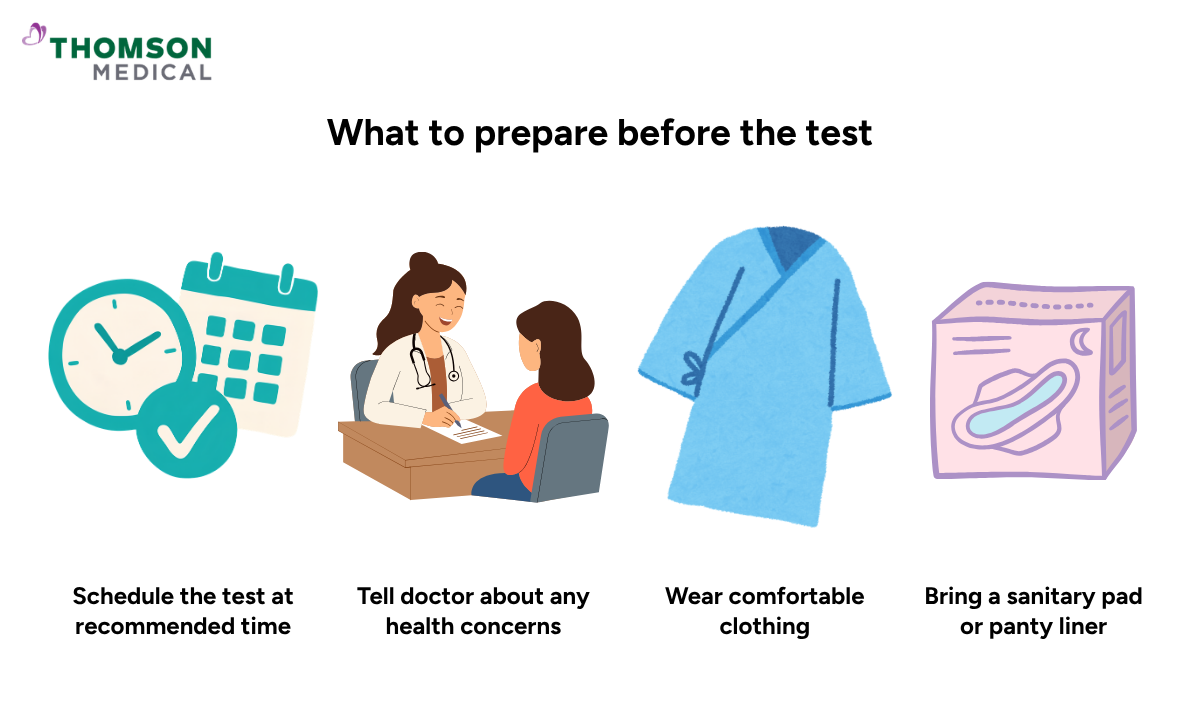
Preparing for an HSG test often involves only a few steps.
Schedule the test at the recommended time:
An HSG is usually performed after your period has ended and before ovulation, when pregnancy is unlikely.
Your doctor will advise you on the most appropriate time in your menstrual cycle.
Tell your doctor about any health concerns:
Let your doctor know if you have concerns, such as symptoms or a history of pelvic infection, allergic reaction to contrast dye, or if you’re currently taking any medications.
Wear comfortable clothing:
You may be asked to change into a hospital gown for the procedure.
Bring a sanitary pad or panty liner:
Light spotting or a small amount of contrast dye leakage could occur after the test, so it is recommended to bring a sanitary pad or panty liner and use it after the procedure.
What to expect during the test
An HSG is usually performed in a radiology department or imaging suite. The procedure usually involves the following steps:
Starting the procedure:
You will lie on an X-ray table, similar to the position for a cervical screening test. A clinician inserts a speculum into the vagina to view the cervix, then cleans the area.
Placing the catheter:
The clinician passes a thin, flexible catheter through the cervix and into the womb.
Injecting contrast fluid:
The clinician usually removes the speculum after placing the catheter. They then slowly inject contrast fluid through the catheter while the radiology team takes X-ray images.
Taking X-ray images:
The radiology team uses fluoroscopy, a type of X-ray imaging, to observe how the contrast dye moves through the womb and fallopian tubes. They may also take still X-ray images to record the findings.
What to expect after the test
After the test, you might be able to return to your usual activities on the same day. But it may depend on how you feel and your doctor’s advice.
Your doctor will explain your test results. They will discuss what the HSG findings may mean for your fertility assessment or treatment plan.
Further assessment or treatment may be considered if the HSG suggests an abnormality in the womb or fallopian tubes.
Is it normal to have pain after an HSG test?

Mild cramping or pelvic discomfort is a common side effect after undergoing an HSG test. You may feel discomfort similar to period pain that may last from a few minutes to several hours. For some, the mild cramps might still be felt for about a day afterwards.
While it’s normal, pain after an HSG test might be concerning and negatively affect your activities. Seek immediate medical attention if you experience:
Severe, worsening, or persistent pelvic or abdominal pain
Heavy vaginal bleeding
Fever or chills
Unusual-smelling vaginal discharge
Fainting, persistent vomiting, or feeling very unwell
These symptoms are not expected after an HSG test and may indicate an infection, a reaction to the contrast dye, or another complication that requires assessment from a doctor.
What happens if your HSG test result is abnormal?
An abnormal HSG result means the test has shown a possible problem in the womb or fallopian tubes. But it does not confirm a diagnosis, nor does it mean that pregnancy is unlikely.
If your HSG result is abnormal, your doctor will consider it alongside your medical history, symptoms, and other fertility test results. Depending on the finding, they may recommend further assessment or discuss whether any treatment or changes to your IVF plan should be considered before IVF.
If you are planning IVF and have had previous fertility tests, including an HSG, a fertility specialist could review your results as part of your treatment planning. Request an appointment with Thomson Medical.
FAQ
Can you do IVF without an HSG test?
Yes, IVF can sometimes be done without an HSG test. This is because an HSG test checks the womb and whether the fallopian tubes are open. As IVF fertilises eggs in a laboratory before transferring an embryo to the womb, it does not rely on the fallopian tubes for fertilisation.
Which is more painful, IVF or HSG test?
Pain and discomfort vary from women to women, so experiences of an HSG test and IVF can differ.
During an HSG test, you may feel cramping or pressure from the contrast dye injection. Meanwhile, IVF may involve brief discomfort from injections, bloating during ovarian stimulation, and cramping after egg retrieval.
Will you get anaesthesia for the HSG test?
Usually, no. Most HSG tests are performed while you are awake and do not require general anaesthesia. But your doctor may discuss pain-relief options when necessary, such as a pain reliever taken before the procedure or local anaesthesia to numb the cervix. Sedation may be considered in selected cases, depending on your needs.
What activities should you avoid after an HSG test?
After an HSG test, it is best to avoid sexual intercourse, using tampons, and vaginal douching for the period advised by your doctor.
Do you need to take an HSG test again if you have done it before?
Not necessarily. If you have had an HSG before, your doctor will decide whether it needs to be repeated before IVF. A repeat test or another scan may be recommended if your previous result was unclear or there are some concerns about your condition.
The information provided is intended for general guidance only and should not be considered medical advice. For personalised advice based on your conditions, schedule a consultation with Thomson Medical.
For more information, contact us:
Thomson Specialists (Women's Health)
Thomson Women's Clinic (TWC)
- Novena:
6592 6686 (Call), 8611 8986 (WA) - Bukit Batok:
6569 0668 (Call), 8686 3525 (WA) - Choa Chu Kang:
6893 1227 (Call), 8282 1796 (WA) Jurong:
6262 8588 (Call), 6262 8588 (WA)- Katong (female doctor):
6970 2272 (Call), 8611 9020 (WA) - Punggol:
6243 6843 (Call), 8811 0328 (WA) - Sembawang: 6753 5228
- Sengkang: 6388 8125
- Serangoon (female doctor): 6382 3313
- Tampines: 6857 6266
- Tiong Bahru: 6276 1525
Dr Tan Heng Hao
Obstetrics & Gynaecology (O&G)
Thomson Fertility Singapore (Novena)
English
Great Eastern, Prudential x TMC
