
_(1).png%3Fbranch%3Dprod&w=3840&q=75)
If you and your partner have been trying to conceive without success, in vitro fertilisation (IVF) may be a next step worth considering. As one of the most widely used assisted reproductive technologies (ART) in Singapore, IVF has helped many couples who face difficulty conceiving naturally.
Knowing how the IVF process works, who is eligible, and how much it costs can help you to feel more prepared and confident during this fertility journey.
What is IVF?
In-vitro fertilisation (IVF) is an ART method that helps individuals and couples achieve pregnancy when conception has not occurred naturally or when other fertility treatments may not be suitable. During IVF, eggs are collected from the ovaries and fertilised with sperm in a specialised laboratory to create embryos, which are then transferred into the uterus (womb).
When is IVF treatment used?
IVF treatment is recommended for couples facing infertility issues, such as the following:
Unexplained infertility conditions
Ovulation disorders
Blocked or damaged fallopian tubes
Low sperm count or poor sperm quality
Conditions such as endometriosis
Genetic conditions or inherited disorders, such as thalassaemia or Huntington's disease.
Who is eligible for IVF treatment in Singapore?
To be legally permitted to undergo IVF treatment in Singapore, couples must meet the following criteria:
The couple must be legally married, and both partners must consent to the treatment.
IVF treatment must be carried out at an assisted reproduction (AR) centre licensed by the Ministry of Health (MOH), which includes both public hospitals and approved private fertility centres.
Both partners must undergo screening for infectious diseases such as HIV, hepatitis B, and hepatitis C to ensure the safety of the pregnancy and the laboratory handling the biological material.
There is no upper age limit for women to be eligible for IVF treatment in Singapore. However, a fertility specialist will assess whether it is medically safe and appropriate for you to proceed with treatment.
Who should you see for an IVF consultation in Singapore?
If you are considering IVF treatment, an initial consultation with an obstetrician and gynaecologist (O&G) or a fertility specialist can help assess your fertility health and discuss the most suitable treatment options for you.
An O&G specialist provides comprehensive care for women's reproductive health, including menstrual conditions, endometriosis, pregnancy care, and the initial assessment and management of fertility concerns.
A fertility specialist is an O&G specialist who has undergone additional subspeciality training in reproductive medicine and infertility. They specialise in diagnosing and managing more complex fertility issues and are experienced in ART procedures such as IVF and intrauterine insemination (IUI).
How much does IVF cost in Singapore?
The cost of IVF in Singapore usually ranges from SGD 20,000 to 25,000 per cycle. But it can be varied based on the healthcare institution (public vs private), medication required, additional procedures, and government co-funding or MediSave.
Public vs private
The cost of IVF treatment in Singapore largely depends on whether you choose to receive treatment at a public hospital or a private fertility centre.
| Expense item | Public hospital | Private clinic |
|---|---|---|
Total cycle cost | Around SGD 12,000 to 18,000 | Around SGD 20,000 to 25,000 |
Ovarian stimulation medication | Usually included in the bundled package | Often billed separately around SGD 3,000 to 8,000 |
Egg retrieval and anaesthesia | Included in the bundled package | Often billed separately around SGD 4,500 to 10,000 |
Fertilisation and lab work | Included in the bundled package | Often billed separately around SGD 1,500 to 3,500 |
Embryo Transfer | Included in the bundled package | Often billed separately around SGD 2,000 to 5,300 |
Please note that these are estimated costs based on the information available at the time of writing (August 2026), and they may have changed since then. These costs may also vary depending on the required treatment, hospital, and location of care.
If you are considering treatment, please contact our medical concierge team at Thomson Medical, who can discuss your specific situation with you and provide personalised cost guidance.
Our fertility doctors in Singapore
Loading...
Government subsidies and co-funding
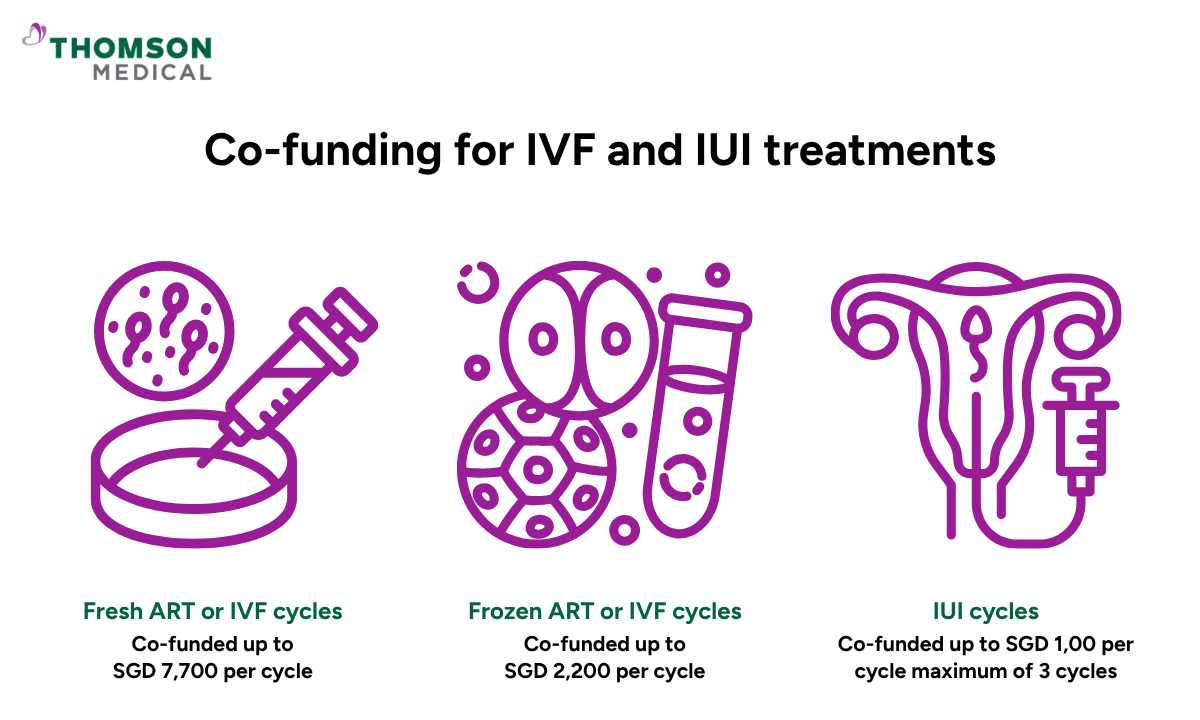
These IVF treatment subsidies and co-funding are generally available only for eligible patients receiving treatment at public hospitals or public AR centres. The co-funding support generally includes:
Up to SGD 7,700 per fresh ART or IVF cycle
Up to SGD 2,200 per frozen ART or IVF cycle
Up to SGD 1,000 per intrauterine insemination (IUI) cycle, for a maximum of 3 cycles
A maximum of 3 fresh and 3 frozen ART cycles per couple under the co-funding scheme
Co-funding amounts may differ depending on whether you are a Singaporean citizen couple, a citizen and permanent resident couple, or a citizen and foreigner couple. It is helpful to check your eligibility with your preferred hospital or clinic so you can better understand what support is available to you.
For the full list of eligibility conditions, visit the MOH Marriage and Parenthood Schemes page.
MediSave
On top of co-funding, you can use your MediSave account to help pay for ART and IUI treatments. MediSave is part of your CPF savings, set aside for healthcare costs. Either you or your spouse can use your MediSave account.
You can use MediSave up to:
SGD 6,000 for the first cycle
SGD 5,000 for the second cycle
SGD 4,000 per cycle for the third cycle and beyond
SGD 15,000 per patient for the lifetime withdrawal limit
Both public hospitals and approved private fertility clinics accept MediSave. You can check directly with your clinic to confirm whether they are an approved provider.
However, as treatment costs and insurance coverage can vary, it is best to check your eligibility and coverage with your hospital, insurer, or financial counsellor before starting treatment.
Where to get IVF treatment in Singapore?
IVF treatment in Singapore is available at both public AR centres and private clinics. The right option for you may depend on factors such as treatment costs, eligibility for government support, and your preferences for personalised fertility treatment.
Public AR centres
Public AR centres offer fertility treatment within Singapore's public healthcare system. The treatment costs are generally lower than those at private fertility centres. However, waiting times for consultations and treatment may be longer due to higher patient demand.
Private fertility centres
Private clinics or private fertility centres offer an alternative for couples seeking shorter waiting times, greater flexibility in appointment scheduling, and more personalised fertility care. In Singapore, these include various private hospitals and specialist centres across the island.
How does the IVF treatment process work?
.png?branch=production)
IVF treatment involves a series of carefully monitored steps. Although the process may seem complex, it is medically safe and highly regulated. The steps involved in an IVF procedure are as follows:
Ovarian stimulation
The IVF procedure begins with fertility hormone medications to stimulate the ovaries (female reproductive organs that produce eggs) to produce multiple mature eggs, rather than the single egg typically released during a natural menstrual cycle. Your fertility specialist will closely monitor follicle development and hormone levels through regular blood tests and transvaginal ultrasound scans.
Egg retrieval
Once the eggs have reached maturity, they are collected through a minor procedure performed under anaesthesia. The eggs are gently retrieved from the ovaries through the vagina in a day surgery setting. The procedure is typically completed within a short period, and most women are able to return home on the same day.
Sperm retrieval
A sperm sample is usually collected from your partner on the same day as the egg retrieval procedure. The sample is then carefully prepared and assessed in the laboratory to select the healthiest sperm for fertilisation.
Fertilisation and embryo culture
The retrieved eggs and sperm are combined in a specialised IVF laboratory to create embryos, which are then cultured for several days. In certain situations, a procedure known as intracytoplasmic sperm injection (ICSI) may be recommended, where a single sperm is injected directly into an egg to support fertilisation.
Embryo transfer
After fertilisation, the embryos (fertilised eggs in the early stages of development) that are considered to have the best potential for implantation are then carefully transferred into the uterus using a catheter (thin, flexible tube). This is a minimally invasive procedure that typically does not require anaesthesia.
If you have questions about the IVF procedure or are unsure if it is the right step for you, request a consultation with our fertility specialists for tailored advice and guidance.
How long does an IVF cycle take?
A complete IVF cycle takes approximately 4 to 6 weeks from the start of ovarian stimulation to embryo transfer. This typically includes:
1 to 2 weeks of ovarian stimulation to encourage the development of multiple mature eggs.
Egg retrieval and fertilisation in the laboratory.
Embryo transfer a few days after fertilisation, depending on embryo development.
If a frozen embryo transfer (FET) cycle is planned, the overall treatment timeline can extend to 6 to 8 weeks or longer.
FAQ
Can you get free IVF if you have endometriosis?
IVF treatment is not free in Singapore, even if you have endometriosis. However, if IVF is recommended as part of your fertility treatment, you may be eligible for government co-funding (at a public hospital) and MediSave support if you meet the relevant eligibility criteria.
How many IVF cycles are allowed in Singapore?
There is currently no regulatory limit on the number of IVF cycles a woman can undergo in Singapore. The Ministry of Health removed the cap in 2020 to give couples more opportunities to conceive. However, government co-funding is only available for a maximum of 3 fresh and 3 frozen cycles.
Can I still work during an IVF cycle?
Yes, many women continue working during IVF treatment. However, you may need time off for appointments, and some women experience temporary side effects such as bloating or fatigue.
Can unmarried women undergo IVF in Singapore?
No, under current Singapore regulations, IVF treatment is generally available only to legally married couples.
Is IVF painful?
Most women tolerate IVF treatment well, although some parts of the process may cause mild discomfort. Fertility injections can cause temporary soreness or bruising, while egg retrieval may result in mild cramping or bloating for a short period afterwards.
The emotional aspects of the IVF journey can also be challenging for individuals and couples. Our fertility specialist and team are here to provide support and guidance throughout the process.
The information provided is intended for general guidance only and should not be considered medical advice. For personalised recommendations and tailored advice based on your unique conditions, request a consultation with Thomson Fertility Singapore today.
For more information, contact us:
Thomson Fertility Centre
- Paragon: 6252 7766
- Novena: 6399 3758, 8811 0358 (WA)