

If your baby was born earlier than expected, it's understandable if you feel shocked, scared, and overwhelmed. However, neonatal care for premature babies today is greatly improved, giving your little one the best possible start in life. Knowing what to expect and how you can support your baby can help you feel more confident and ready to be by their side.
What is a premature birth?
A baby is considered premature (or preterm) if they are born before 37 weeks of pregnancy. While the definitions vary slightly, doctors typically categorise preterm births according to how far along the pregnancy is:
A late preterm birth is defined as a birth occurring between 34 and 36 weeks of pregnancy.
A moderate preterm birth occurs between 32 and 34 weeks.
A very preterm birth occurs between 28 and 32 weeks.
An extremely preterm birth occurs before 28 weeks of pregnancy.
Although these medical terms may seem alarming at first, they are really just a way for doctors to understand what kind of support your baby needs.
How does a premature birth affect your baby's health?

Compared to babies born at full term, premature babies have had less time to develop in the womb. This means that some of their organs may still need time to grow and mature after birth, so additional support is required.
However, with advances in neonatal care and specialised support in neonatal intensive care units (NICUs), premature babies can grow up healthily. That being said, there are some potential challenges associated with premature birth.
Common early challenges
Premature babies may face certain challenges during their first days or weeks of life, such as:
Respiratory distress syndrome:
This syndrome causes babies to have breathing difficulties due to immature lungs and a lack of surfactant, a substance that helps the lungs stay open.
Feeding difficulties and immature digestion:
Premature babies may need tube feeding or expressed breast milk, as they often tire easily and may not yet have a well-coordinated suck–swallow reflex.
Temperature regulation:
Because premature babies have less body fat and immature temperature control, they may struggle to stay warm.
Infection risk:
A premature baby’s immune system is still developing, which makes them more at risk for infections like sepsis, pneumonia, and gut infections.
Bleeding in the brain:
Bleeding in the brain, or intraventricular haemorrhage, is more common in very premature infants because fragile blood vessels in the brain can rupture.
These issues are closely monitored in the hospital and often improve gradually as your baby grows stronger and more stable.
Longer-term health considerations
Although most early challenges improve, some premature babies may face longer-term health issues, such as:
Bronchopulmonary dysplasia:
Bronchopulmonary dysplasia is a chronic condition in babies who need breathing support for a longer time.
Retinopathy of prematurity:
This affects developing blood vessels in the eyes.
Developmental progress:
Many premature babies hit development milestones later but catch up and develop normally.
Cerebral palsy:
Cerebral palsy affects movement and muscle tone and is more common in extremely premature babies.
Although these conditions affect premature babies, not all premature babies will experience them. Your neonatal team will closely monitor your baby and work with you at every stage, from the NICU to longer-term follow-up care.
How NICU can help?
If your baby arrives earlier than expected, they may need some extra support in the hospital during the first days or weeks of life.
Many premature babies stay in a special nursery where doctors and nurses can monitor them closely and respond quickly to their needs. Some require care in the NICU, where they receive round-the-clock support while their bodies continue to mature.
The NICU provides premature babies with the same support they would have received in the womb. Such support comes in the form of machines such as:
Monitors that track heart rate and breathing
Incubators that maintain temperature
Ventilators that support breathing
Since the NICU is equipped with sensors and monitors that alert the medical team to your baby’s condition, you may find the hum of the machines and the sound of alarms frightening or overwhelming at first. However, the NICU staff will help to explain what the different alarms mean and help you feel more familiar and comfortable around the equipment.
Our neonatologist in Singapore
Loading...
How long will your baby need NICU care?
There's no exact timeline. Some babies stay for a few days, while others stay for weeks or months.
How long your baby stays in the NICU depends on several factors, including their birth weight and gestational age, as well as whether they develop complications such as sepsis, bronchopulmonary dysplasia, or retinopathy of prematurity.
Each baby’s journey is unique, and your medical team will closely monitor these factors to guide the safest time to bring your baby home safely.
If you have questions about NICU care or your baby’s progress, our specialists at Thomson Paediatric Centre are here to guide you with clear, compassionate advice. Request a consultation to speak with our neonatologist.
Your role as a parent in the NICU
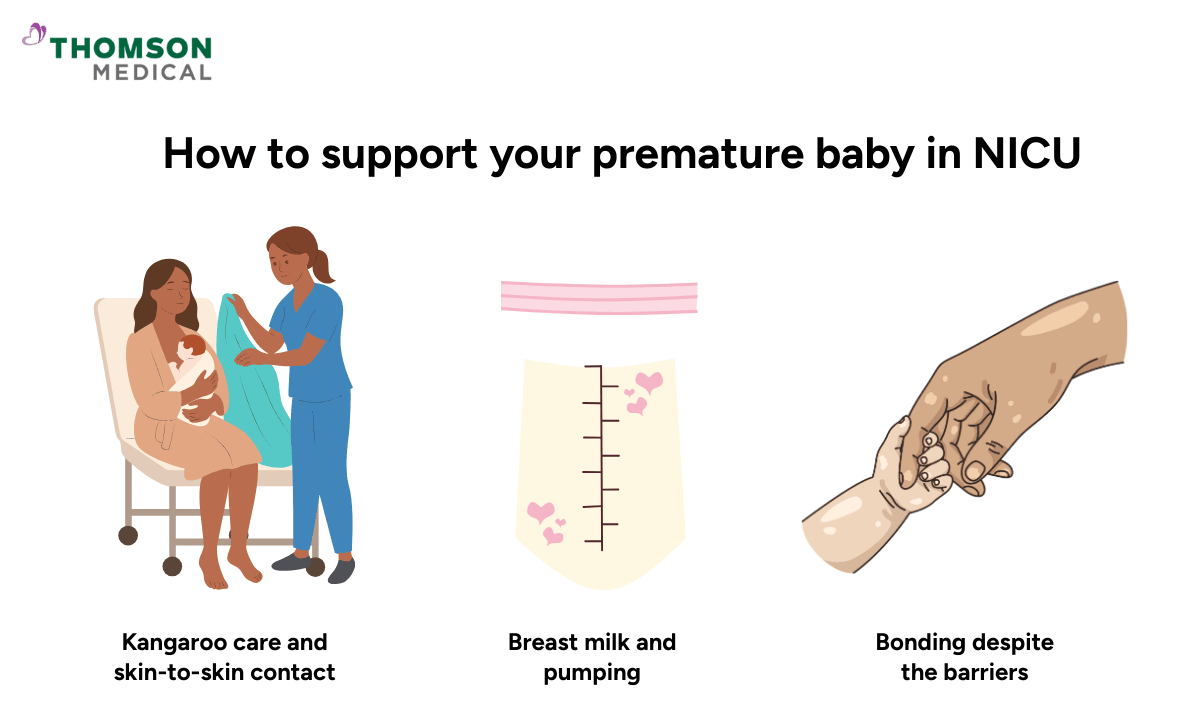
Depending on the hospital and your baby's condition, you might be able to spend many hours with your baby and help with daily care. At other hospitals, you might only be able to visit for short periods each day.
Even if your time at the bedside is short, it still counts. Your baby can hear your voice, feel your touch, and know you're there. The things you do outside the NICU also contribute to your baby’s well-being, such as pumping milk or bonding with them despite the barriers.
Here’s what you can do to support your little one:
Kangaroo care and skin-to-skin contact
Kangaroo care (also called skin-to-skin contact) is when your baby, wearing only a diaper, is placed directly on your bare chest.
Holding your baby skin-to-skin can help:
Regulate your baby’s temperature
Stabilise breathing and heart rate
Support feeding
Help you feel more connected
To practise kangaroo care:
Sit or lie in a comfortable position
Place your baby upright on your chest with their head turned to the side
Cover your baby’s back with a light blanket or your clothing
If kangaroo care isn't possible yet, simply placing your hand gently on your baby or speaking softly still helps.
Breast milk and pumping
If direct breastfeeding isn't possible yet, pumping and providing breast milk can help protect your baby from infections and support their growth and gut development.
Bonding despite the barriers
You can talk, sing, touch your baby’s hand, or sit quietly beside the incubator. Your baby can recognise familiar voices and may feel calmer when they hear you.
If visiting time is limited, you might:
Record your voice or a lullaby (if the NICU allows)
Bring a small cloth with your scent to place near your baby
Ask the care team how you can be involved in small ways, such as diaper changes or temperature checks when possible
Every gentle touch, every drop of milk, and every moment of rest you take to stay strong for your baby makes a real difference. Your bond with your baby continues to grow, even through glass, wires, and short visits.
Caring for yourself while caring for your baby
Having a premature baby can bring a mix of difficult emotions. Some parents feel emotionally overwhelmed, while others feel numb or constantly anxious about their baby’s condition.
When you can, try to:
Rest, even if it’s in short moments
Talk openly with your partner, family, or a trusted friend
Reach out to a counsellor or support group if you feel overwhelmed
Accept help with meals, chores, or daily tasks so you can save your energy
Looking after your own wellbeing helps you stay steady and present for your baby.
Request a consultation with Thomson Paediatric Centre to receive gentle guidance and support as you care for your premature baby.
FAQ
What happens if a baby is premature?
Premature babies may need extra medical support for breathing, feeding, temperature control, and monitoring in the NICU (neonatal intensive care unit). Many grow stronger with time and specialised care.
Can premature babies have a normal life?
Yes, many premature babies grow up healthy and reach development milestones, especially with early medical care and follow-up support.
How many kilograms is a premature baby?
Premature babies can weigh less than 2.5 kg, and very early preterm babies may weigh much less. Weight varies depending on how early your baby is born.
Can parents hold premature babies?
Many neonatal units encourage kangaroo care (skin-to-skin contact) when the baby is stable, as it supports bonding and growth. Visiting policies may vary by hospital.
How to avoid premature birth?
Not all preterm births can be prevented, but regular prenatal care, managing chronic conditions, avoiding smoking and infections during pregnancy, and reducing stress can lower the risk.
At what age can a premature baby survive?
In specialised centres, some extremely premature babies born as early as 22 to 24 weeks can be cared for outside the womb with intensive support.
The information provided is intended for general guidance only and should not be considered medical advice. For personalised recommendations and tailored advice based on your little one’s situations, consult a neonatologist specialist at Thomson Paediatric Centre.