

If you've noticed a new growth or mole that looks unusual on your skin, it's normal to worry that it might be skin cancer. However, most skin changes are harmless and a natural part of ageing. That said, there is no harm in getting it checked, as skin cancer is highly treatable when caught early.
Knowing what to look for can give you peace of mind and help you recognise when you should see a doctor.
Why screening matters in Singapore
Living in Singapore's tropical climate means that you're exposed to sunlight all year round. This constant exposure to ultraviolet radiation can damage the DNA of your skin cells over time, leading to abnormal growth. As a result, skin cancer rank as the sixth most common cancer in men and the eighth most common in women in Singapore.
Is skin cancer screening right for you?
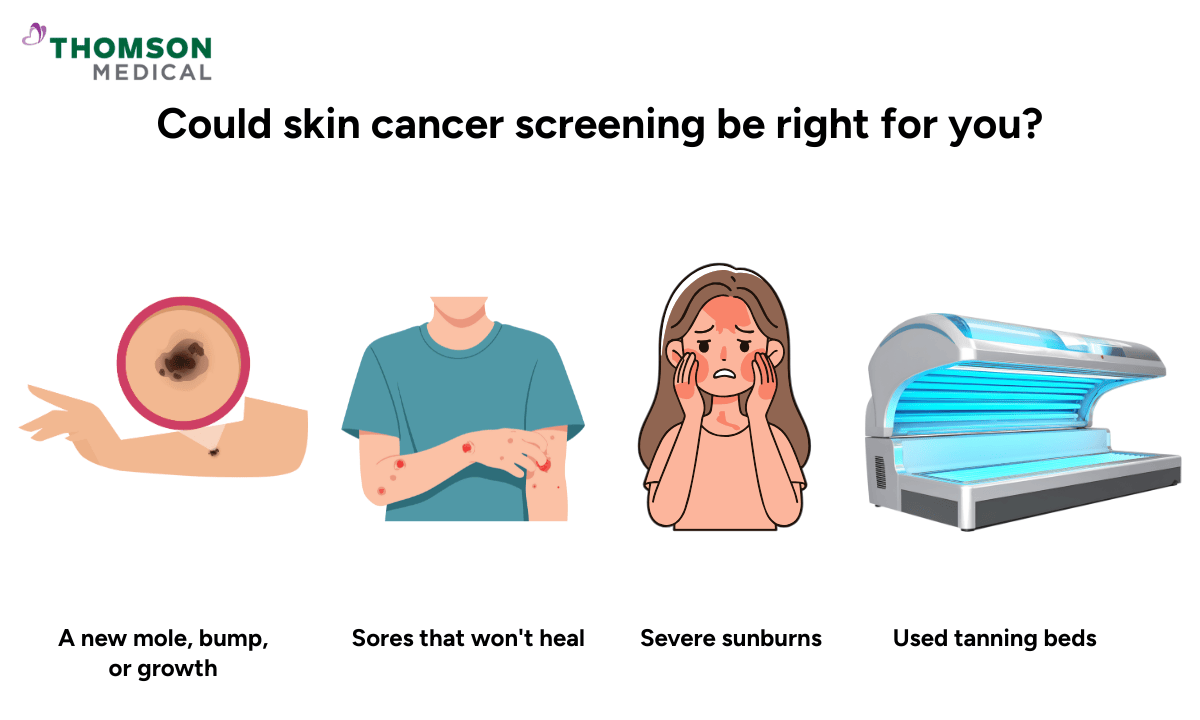
A skin cancer screening can provide answers and peace of mind if you notice any unusual changes to your skin. Consider getting screened if you have noticed any of the following:
A new mole, bump, or growth
Changes in existing moles (size, shape, colour, or texture)
Pink or scaly patches that won't go away
Sores that won't heal after a few weeks
Spots that bleed, itch, or feel uncomfortable
Your risk of skin cancer increases if you:
Tend to get a sunburn rather than a tan
Have a family history of skin cancer
Have had severe sunburns or used tanning beds
Take medications that weaken your immune system
For most people, an annual skin check is an effective preventive measure, especially if your skin type burns easily in the sun. If you have high-risk factors such as a personal or family history of skin cancer, your doctor may recommend more frequent screenings every 3 to 6 months.
While most skin growths are harmless, it is best to get any potential abnormalities checked early on, before they get worse.
If you’ve noticed unusual changes on your skin, request an appointment with Thomson Medical. An early assessment can help identify any signs of skin cancer and ensure you receive the right treatment as soon as possible.
Our skin cancer specialists in Singapore
Loading...
How do you prepare for your appointment?
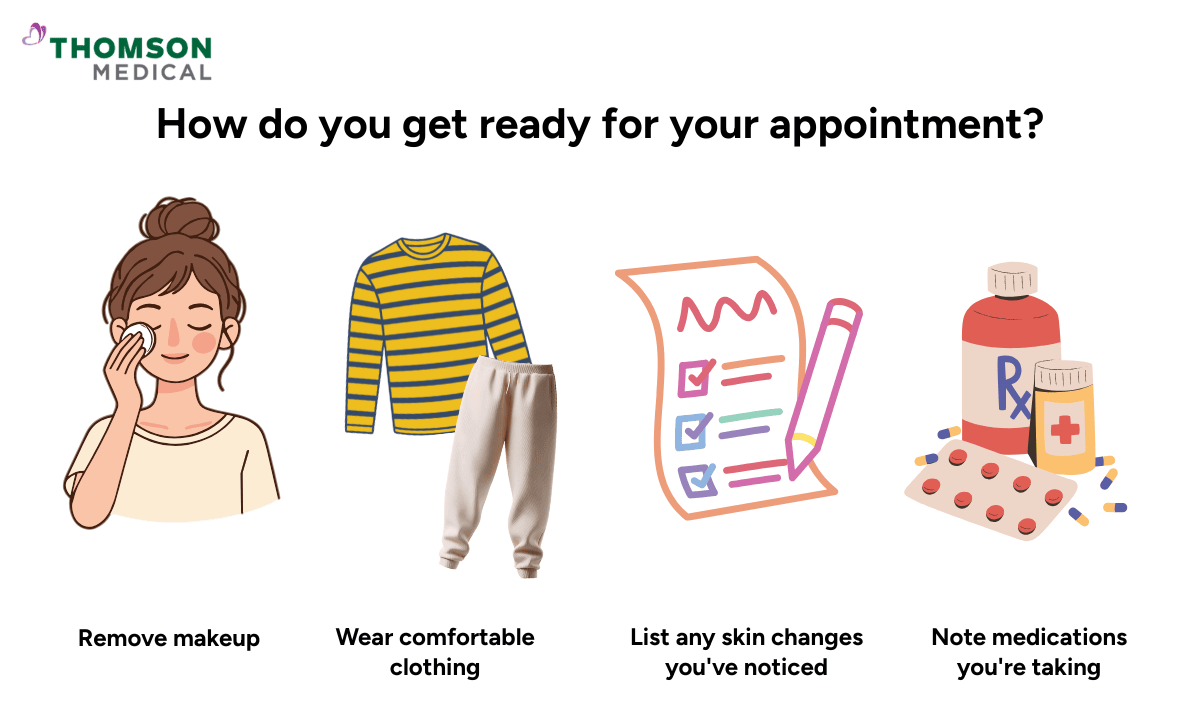
Preparing for a screening appointment is straightforward and requires minimal effort. It mainly helps your dermatologist to conduct an examination and provide the most accurate assessment. Here's a guide on what to do before your appointment:
Remove makeup, nail polish, and self-tanner
Wear comfortable and easy-to-remove clothing
Bring photos of any spots you've been monitoring
List any skin changes you've noticed and when they started
Note medications you're taking
Avoid using body lotion or cream prior to your appointment
Avoid complex hairstyles that would make a scalp examination difficult
What happens during your screening
A skin cancer screening usually takes about 15 to 30 minutes. Here's what you can expect during your appointment:
- Your doctor will first consult with you:
- Ask about spots that concern you
- Review your family health history and sun exposure
- Check what medications you're taking
- During the skin examination:
- You will be asked to change into a gown or uncover the areas to be examined
- Your dermatologist will use a dermatoscope (a magnifying tool) to examine any concerning spots more closely
- Your dermatologist will examine your entire body, from your scalp to your toes, and the examination will be painless
- If you have many moles:
- Photographs may be taken to track changes over time
- Creates a visual record for future comparison
- If treatment is needed immediately:
- Pre-cancerous spots can be frozen with liquid nitrogen, which is a quick procedure that may briefly stings
- If a biopsy is recommended:
- The area is numbed first
- Your dermatologist removes the spot or part of it
- The sample is sent to a lab for examination
- Results typically arrive within a week
If you wish to undergo a skin cancer screening, request an appointment with Thomson Medical. Our specialists can guide you through each step, explain what your results mean, and ensure you receive timely care if anything needs follow-up.
What type of skin cancer screening will you receive?
The type of skin cancer screening you receive will depend on your needs. While most people start with a basic check, others may benefit from a more comprehensive assessment.
Basic screening:
Visual examination by dermatologist
Dermatoscope examination of concerning spots
Suitable for routine checks or specific concerns
Comprehensive screening:
Full-body examination with dermatoscope
Digital photography and detailed mole documentation
Recommended for high-risk individuals or those with many moles
What your dermatologist is looking for
Your dermatologist checks for specific warning signs. They're watching for small smooth bumps with tiny blood vessels, flat reddish patches, rough or scaly areas on sun-exposed skin, or white patches that look like scars.
For suspicious mole checks, they use the ABCDE rule:
A - Asymmetry:
The two halves don't match if you imagine a line through the middle
B - Border:
Edges are irregular, jagged, or blurred instead of smooth
C - Colour:
Multiple colours or uneven shading rather than one uniform tone
D - Diameter:
Larger than 6 mm (about the size of a pencil eraser)
E - Evolving:
Changing in size, shape, colour, height, or starting to bleed or itch
Understanding your results
After your screening, your dermatologist will go through the findings with you so you know what to expect next.
If everything looks normal:
Your dermatologist will advise when to return for your next check-up and how to keep an eye on your skin at home.
If something needs a closer look:
Your dermatologist will explain what they’ve noticed and whether a biopsy would help clarify things.
If a biopsy is done, results typically come back within five to seven working days.
Where to get skin cancer screening in Singapore
Skin cancer screenings are available at various healthcare facilities in Singapore, with costs depending on the type of service and the type of facility you visit.
Private dermatology clinics:
Offer first visits with basic screening at SGD 150 to 300
Offer comprehensive screening with photography at SGD 250 to 500
These clinics typically have shorter waiting times and advanced tracking technology
Specialist skin centres:
Focus on dermatological care with the latest diagnostic tools
The pricing is similar to private clinics
Public hospitals:
Provide more affordable rates with subsidies available for Singapore Citizens and PRs
You may need a referral from your GP for appointments
Polyclinics:
Can conduct initial assessments and provide referrals to specialists if needed
Additional procedures may be required during your visit. Biopsies typically cost SGD 500 to 600, removing a skin lesion ranges from SGD 800 to 1,200, and freezing treatment varies by clinic.
How to check your skin at home
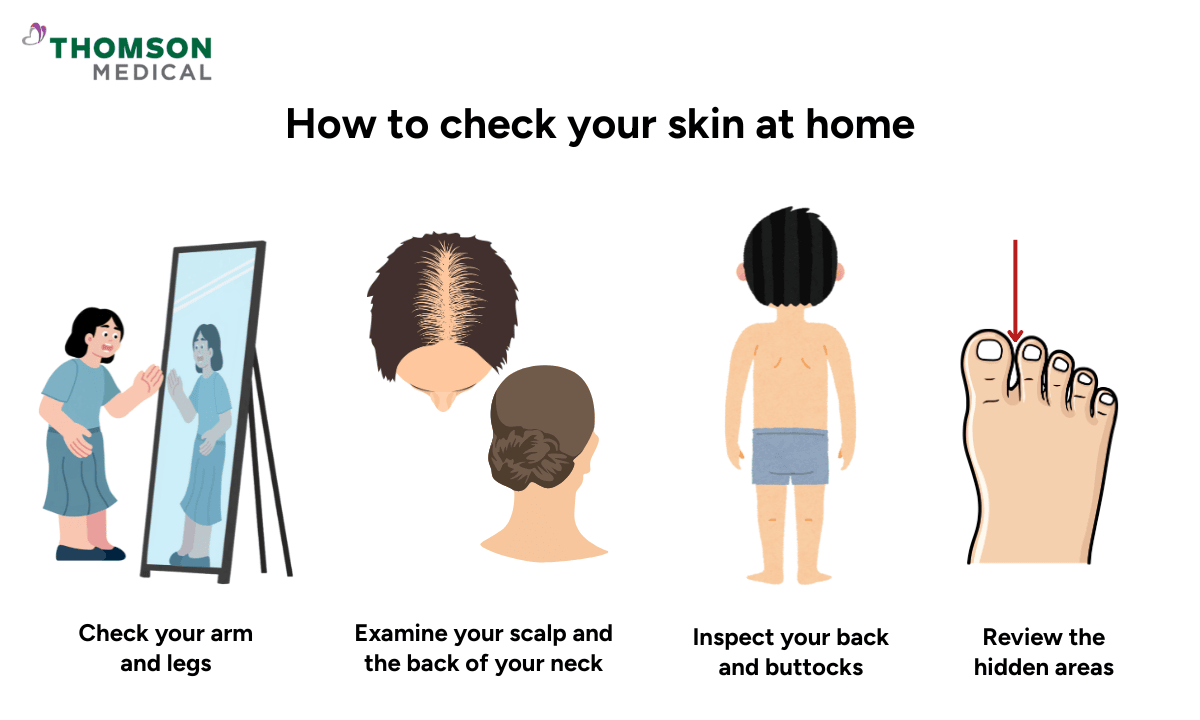
A monthly skin check helps you learn what's normal for you, making changes easier to spot. Keep an eye out for new or changing moles, persistent pink scaly spots, new growths, unexplained itchy areas, bleeding spots, or sores that won't heal.
Here's a simple routine:
Stand before a full-length mirror and carefully examine your arms and legs
Use a handheld mirror to check your scalp, the back of your neck, and your buttocks
Don't forget between your toes, under your nails, and other easy-to-miss spots
If you have many moles or hard-to-see areas, ask someone to help with your scalp and back
If you notice any atypical moles or unusual spots during your home skin check, request an appointment with Thomson Specialist Skin Centre. Our specialists can examine your skin thoroughly and ensure timely follow-up if anything requires further attention.
FAQ
What screening is done for skin cancer?
If your doctor identifies a suspicious spot, they will recommend a biopsy to remove part or all of the growth for examination under a microscope. You can receive the results within about a week, along with guidance on what to do next.
How can I identify skin cancer early?
Watch for atypical moles, bumps, rough patches, or sores that won't heal. Observe changes in existing moles, such as their size, colour, itching, or discomfort. Monthly skin checks help you catch changes when they're easiest to treat.
How can I avoid getting skin cancer?
Protect yourself from the sun and its UV radiation by avoiding direct sunlight during peak hours (10am-4pm), seeking shade, and wearing protective clothing, a wide-brimmed hat, and UV-blocking sunglasses. Use SPF 30+ sunscreen and reapply every two hours or after swimming. Avoid tanning beds and check your skin monthly.
What does the first spot of skin cancer look like?
Many melanomas start as dark spots that change shape or grow over time, often spreading outward along the skin's surface. Some develop from existing moles, but many appear as completely new growths. This is why tracking new or changing spots are important.
Can a blood test detect skin cancer?
No, you need a skin biopsy for diagnosis. However, if you're being treated for advanced melanoma, your doctor might use blood tests (like lactate dehydrogenase or LDH) to monitor how treatment is working.
Which type of skin cancer spreads the fastest?
Melanoma needs the quickest attention because it can grow faster and spread to other parts of your body. The good news is that it responds very well to treatment when caught early, which is why regular screenings are so important.
The information is intended for general guidance only and should not be considered medical advice. For personalised recommendations and advice based on your unique situation, please consult a specialist at Thomson Medical. Request an appointment with Thomson Medical today.
Reference:
Duarte, A. F., Sousa-Pinto, B., Azevedo, L. F., Barros, A. M., Puig, S., Malvehy, J., Haneke, E., & Correia, O. (2021). Clinical ABCDE rule for early melanoma detection. European Journal of Dermatology, 31(6), 771–778. https://doi.org/10.1684/ejd.2021.4171
Dr Tan Hiok Hee
Dermatology (Skin)
Thomson Specialist Skin Centre (Novena Specialist Center)
English, Mandarin
.png%3Fbranch%3Dprod&w=640&q=75)