
.png%3Fbranch%3Dprod&w=3840&q=75)
If you've got an urgent health concern, one of the first questions that often comes to mind is, "How long will I need to wait at the A&E?"
Uncertainty about the waiting time can add more stress to an already difficult situation.
In Singapore, A&E waiting times are based on urgency rather than arrival time, and can vary depending on how busy a hospital is. Understanding how the system works, when it’s typically less crowded, and what alternatives are available can help you get the care you need with less uncertainty.
How do A&E waiting times in Singapore work?
When you arrive at an Accident & Emergency (A&E) department, a nurse will assess your condition through a triage process and assign you an urgency category based on your medical needs. This means you won't necessarily be seen in the order you arrived.
The triage system prioritises patients with life-threatening conditions, ensuring they receive immediate attention. If your condition is less urgent, you may experience longer waits – particularly during busy periods. This approach is designed to save lives by treating the most critical patients first.
Several factors influence how long you'll wait, namely:
Severity of your condition:
Patients with critical conditions (such as chest pain, difficulty breathing, or severe bleeding) are prioritised over less urgent cases.
Time of day:
A&E departments tend to be busier during evenings, weekends, and public holidays when GP clinics are closed.
Hospital capacity:
Bed availability and staffing levels can affect how quickly patients move through the system.
Number of patients:
A sudden influx of emergencies can delay treatment for less urgent cases.
It's important to know that even if you've been waiting for hours, a newly arrived patient with a more serious condition will be seen before you. While this can feel frustrating sometimes, the triage system ensures that patients who need urgent medical intervention receive it without delay.
Average waiting times by urgency category
Once you've been assessed through triage, you'll be assigned to one of four priority categories.
Each has different expected waiting times, such as:
P1 (Critical):
Immediate attention for life-threatening conditions such as heart attacks, severe bleeding, or difficulty breathing.
P2 (Emergency):
Care within 30 minutes for serious conditions requiring urgent treatment, such as suspected fractures or severe pain.
P3 (Urgent):
Expected waiting time of 1-2 hours for conditions that need medical attention but aren't immediately life-threatening.
P4 (Semi-urgent):
Expected waiting time of 2-3 hours for minor injuries or conditions that could be managed at a GP clinic.
These are general timeframes. During busy periods or when there's a sudden influx of critical cases, your actual wait may be longer.
Peak hours vs off-peak hours
Beyond your urgency category, the time you visit A&E also influences how long you'll wait. Patient volumes fluctuate throughout the day and week, with certain periods consistently busier than others.
Here are the common peak hours and off-peak hours:
Peak hours, which normally have longer waiting times, include:
Evenings between 6.00 p.m. and 12.00 a.m., when GP clinics close
Weekends and public holidays
Monday mornings, as patients who waited out the weekend seek care
During disease outbreaks or flu season
Off-peak hours, usually offering shorter waiting times, include:
Weekday mornings between 8.00 a.m. and 12.00 p.m.
Early afternoons on weekdays
Late night to early morning hours (12.00 a.m. to 6.00 a.m.)
Which hospital has shortest A&E waiting time Singapore
.png?branch=production)
A&E waiting times fluctuate throughout the day depending on patient volume and staffing, so there isn't one hospital that consistently has shorter waits than others.
If your condition needs medical attention but isn't immediately life-threatening, you have several options to consider. Urgent Care Centres (UCCs) are designed to manage acute conditions such as minor injuries, infections, and sudden illnesses. Thomson Urgent Care Centre (UCC) is one such facility available for these types of medical needs.
Public hospitals across Singapore serve different regions and experience varying patient volumes:
Singapore General Hospital (SGH) is the largest hospital and handles high patient volumes.
Ng Teng Fong General Hospital (NTFGH) serves the western region.
National University Hospital (NUH) serves the western region.
Tan Tock Seng Hospital (TTSH) serves the central and northern regions.
Changi General Hospital (CGH) serves the eastern region.
Private hospitals such as Mount Elizabeth, Gleneagles, and Raffles Hospital operate with different patient volumes compared to public hospitals, though treatment costs are considerably higher and may not be fully covered by insurance or government subsidies.
Patient volumes can change significantly within hours – a hospital with minimal wait at 2.00 p.m. could be much busier by 8.00 p.m.
If you're dealing with an emergency, the most important thing is to seek care at the nearest appropriate facility.
Our specialists in urgent care
Loading...
When to go to A&E vs GP clinic
.png?branch=production)
Knowing whether your condition needs A&E or can wait for a GP appointment can save you hours and help you get the right level of care.
Medical emergencies that need A&E
Head to A&E immediately (or call 995) if you're experiencing these symptoms:
Chest pain or severe breathing difficulties, particularly chest pressure, tightness, or shortness of breath
Stroke symptoms, such as sudden weakness on one side, difficulty speaking, facial drooping, or severe headache
Severe bleeding that won't stop after you've applied pressure for 10-15 minutes
Loss of consciousness or seizures, especially if it's the first time or lasts longer than 5 minutes
Severe injuries, including suspected broken bones, deep wounds, or head injuries with confusion or vomiting
Poisoning or overdose from medications, chemicals, or substances
Severe allergic reactions with swelling of your face, lips, or tongue
Severe abdominal pain, particularly if it's sudden and intense, or accompanied by vomiting blood
If you're unsure whether your condition is an emergency, it's safer to seek immediate medical attention rather than wait.
Conditions suitable for GP or urgent care
Many conditions feel urgent but don't actually require a hospital A&E.
You will often get faster, more cost-effective treatment at a GP clinic or UCC for:
Common infections, such as fever, colds, flu, sore throat, ear infections, urinary tract infections
Minor injuries, including small cuts, minor burns, sprains and strains, minor falls without head injury
Digestive issues, like mild food poisoning or gastroenteritis without severe dehydration
Skin problems, namely rashes, minor infections, allergic reactions without breathing difficulties
Aches and pains, including back pain, muscle aches, toothaches
Medical certificates and acute medication needs
UCCs are walk-in medical facilities that treat acute conditions requiring prompt attention but aren't life-threatening emergencies. They can be particularly helpful when GP clinics are closed during evenings, weekends, and public holidays, offering you another option for timely care when you need it.

Tips to reduce your A&E waiting time
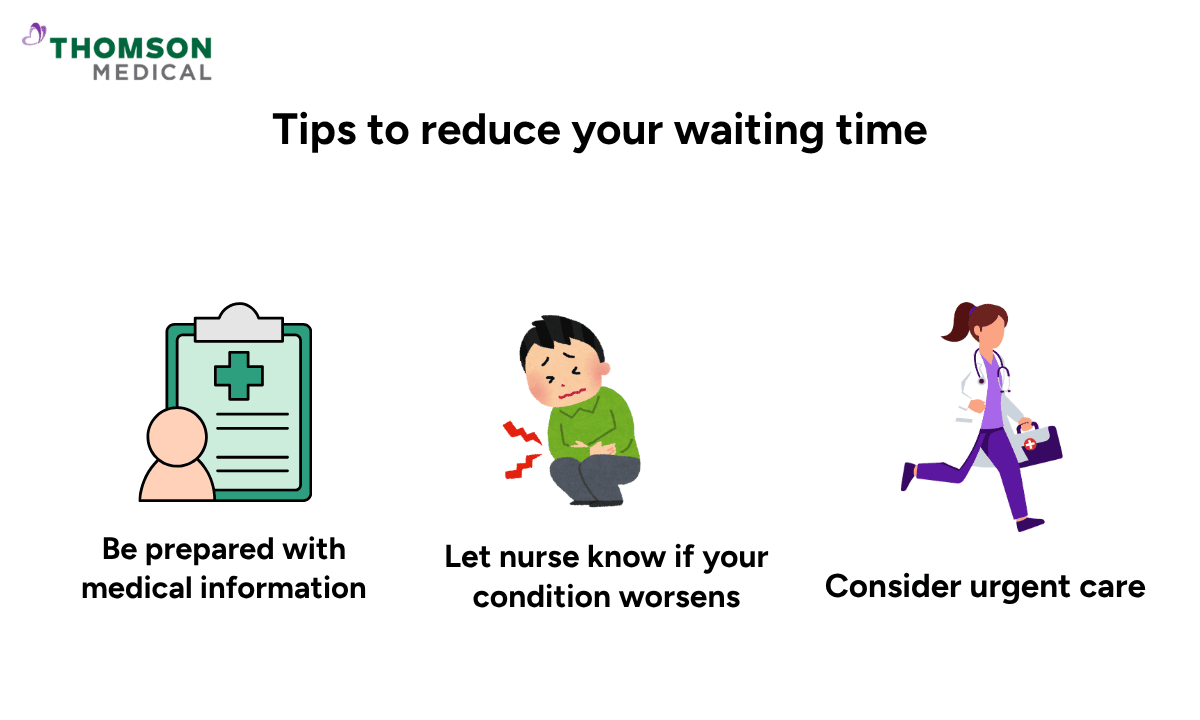
While you can't control how busy an A&E department is or how the triage system prioritises patients, there are a few practical steps you can take to minimise delays.
Consider urgent care for non-emergencies
If your condition doesn't need hospital-level emergency care, UCCs can treat many acute conditions with wait times measured in minutes rather than hours.
Be prepared with medical information
Have your identity card, insurance details, medication list, and any relevant medical records ready. Being able to quickly provide accurate information during triage and registration helps speed up the process.
If your condition worsens while waiting
Let the triage nurse know immediately. Changes in your symptoms may warrant reassessment and a higher priority category.
These strategies can help you feel more prepared and in control during an already stressful situation. Knowing your options ahead of time – whether that's understanding triage categories or knowing where your nearest A&E is – means you'll have one less thing to figure out when you actually need care.

FAQ
What is the average A&E waiting time in Singapore?
Average A&E waiting times vary by triage category and hospital. Non-urgent cases (P3 and P4) usually wait 1 to 3 hours, though this can extend to 4-6 hours during peak periods. Urgent cases (P2) are normally seen within 30 minutes to an hour, while critical patients (P1) receive immediate attention. Check current wait times on the HealthHub app for specific hospitals.
Why is my A&E wait so long even though I arrived early?
A&E departments don't work on a first-come, first-served basis. Your waiting time depends on the severity of your condition, not arrival time.
If you're classified as non-urgent (P3 or P4), you'll wait while doctors attend to critical and urgent cases first. A newly arrived patient with a heart attack will be seen before you, even if you've been waiting for hours.
Will I be seen faster if I call an ambulance?
No, arriving by ambulance doesn't guarantee faster treatment. You'll still go through the same triage process based on the severity of your condition, not your mode of arrival. Ambulances should only be called (995) for genuine emergencies where immediate medical attention is needed.
Can I leave A&E if the wait is too long and come back later?
Yes, you can leave at any time. However, you'll need to go through the entire triage and registration process again if you return.
If you're considering leaving, speak to the triage nurse first. They can reassess your condition and advise whether it's safe to leave or if you should seek care at an urgent care centre or GP clinic instead.
Are A&E waiting times longer on weekends and public holidays?
A&E departments often see higher patient volumes on weekends and public holidays because most GP clinics are closed.
The busiest periods are Friday evenings through Sunday nights and days around public holidays. For shorter waits when dealing with a non-life-threatening condition, consider seeking treatment at an urgent care centre.
Do private hospital A&Es have shorter waiting times than public hospitals?
Not necessarily. Both private and public A&Es use the triage system, so your waiting time depends on your condition's severity. Private A&Es may be less crowded during off-peak hours but can have similar wait times during busy periods or when handling critical cases.
The information provided is intended for general guidance only and should not be considered medical advice. For personalised recommendations based on your medical conditions, request an appointment with Thomson Medical.
For more information, contact us:
Thomson Medical 24-Hour Urgent Care Centre (Novena)
- Call: 6350 8812
Notice:
The range of services, vaccinations, and tests may vary. Please contact us directly to enquire about the current availability.
Request an Appointment