

Your ankle has been hurting for weeks, forcing you to take the stairs one step at a time, cutting your walks short, and standing with your weight shifted to one side. An ankle MRI scan may show what's happening in the tendons, ligaments, and cartilage that don't show on other scans, so you may get a clearer answer than "give it more time".
What is an ankle MRI scan?
An ankle magnetic resonance imaging (MRI) scan is an imaging test that produces detailed pictures of the structures inside your ankle. It uses magnets and radio waves to capture your bones, ligaments, tendons, cartilage, and soft tissues.
An MRI scan does not use ionising radiation, which makes it a safer option when your doctor requires a clearer picture of soft tissue injuries, such as ligaments and tendons, which often do not show up clearly on other imaging tests.
Why might your doctor recommend an ankle MRI?

Your doctor may recommend an ankle MRI when a standard X-ray has not fully explained your symptoms.
Common reasons include:
Persistent ankle pain that has not improved with rest or treatment
Ligament tears, such as injuries to the anterior talofibular ligament, one of the main stabilising ligaments on the outer side of your ankle
Tendon injuries, including the Achilles tendon at the back of your heel or the peroneal tendons (the tendons that run along the outer side of your ankle)
Cartilage damage to the joint surface
Stress fractures (small cracks in the bone caused by repeated strain)
Unexplained swelling or inflammation
Suspected infection or growths
The detailed images from an MRI scan allow your doctor to understand the specific cause of your symptoms and plan the most appropriate treatment.
Whether it is a suspected ligament injury, tendon issue, or unexplained swelling, accurate diagnosis matters. Request an appointment with Thomson Medical to determine if an ankle MRI is the right next step.
Our ankle doctor in Singapore
Loading...
How to prepare for your ankle MRI
Preparing for an ankle MRI is straightforward. A few simple steps beforehand can help things go smoothly on the scan day.
What to wear
Wearing the right clothing on the day helps the scan run more smoothly.
On the day of your scan:
Choose loose, comfortable clothing that you can move around in easily
Avoid anything with metal zippers, snaps, or underwire, as these can interfere with the scan
Remove all jewellery, watches, hearing aids, and piercings before your appointment
You may be asked to change into a hospital gown when you get there
Metal objects can disrupt the magnetic field used during the scan, so it is best to remove them before you go in. If you are unsure about anything you are wearing, you may ask the imaging team for advice.
Food, drink, and medications
Most ankle MRIs do not require fasting, so you can eat and drink as normal before your appointment. You can also continue taking your regular medications unless your doctor has told you otherwise.
Medical history and implants
Before you go in for your MRI, your care team will ask you a few questions about your health history.
Please let your care team know if any of the following apply to you:
A pacemaker or implanted defibrillator (a device used to regulate or correct heart rhythm)
Metal implants, screws, or plates anywhere in your body
A cochlear implant (a device implanted in the ear to help with hearing)
Metal fragments anywhere in your body
Kidney disease
Pregnancy or suspected pregnancy
Sharing this information helps your care team ensure the scan is suitable for you or arrange another option.
What to expect during the scan?
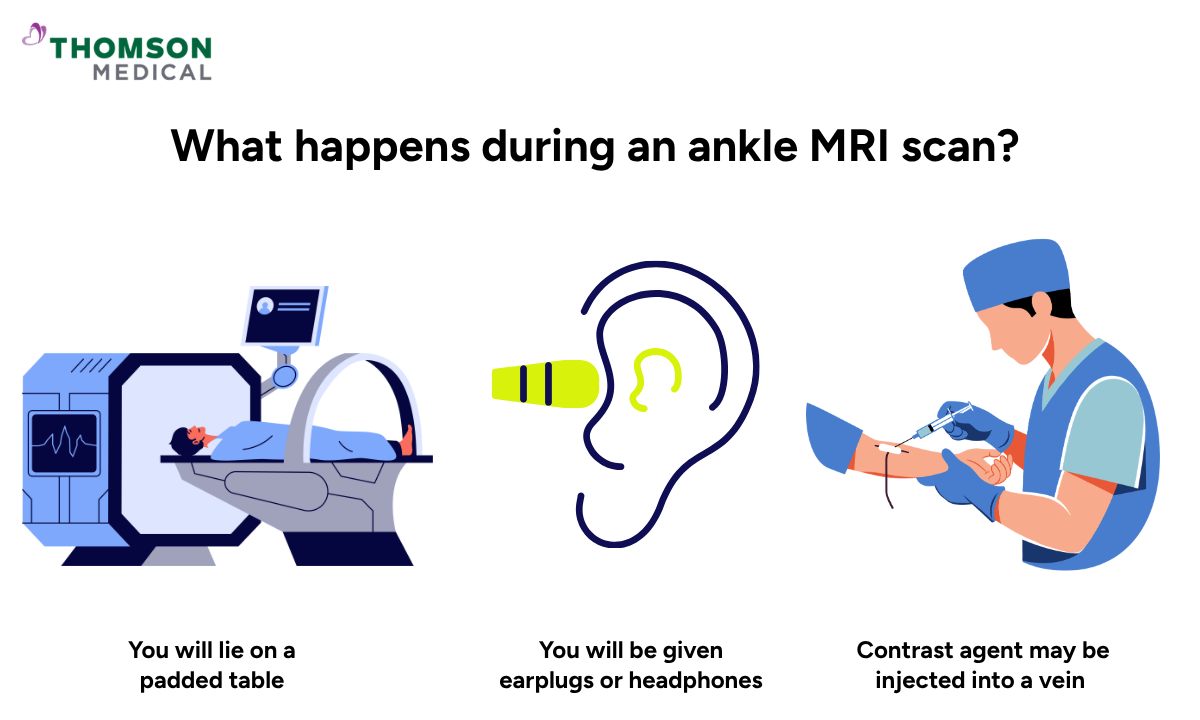
Knowing what to expect during the scan can help the whole experience feel more manageable. The process is painless, and the team will be with you throughout.
Positioning and how long it takes
When you arrive, a radiographer will explain what to expect.
During your scan:
You will lie on a padded table that slides gently into the MRI machine
Your ankle will be placed in a specialised coil, a device that wraps around the area being scanned and helps produce sharper images
The scan itself usually takes between 30 and 45 minutes, depending on the level of detail required and whether a contrast agent is used.
Staying as still as possible during the scan helps the machine capture the clearest images
If you need a break at any point, let your team know. They can pause the scan and continue once you are comfortable again.
Noise and comfort
MRI machines are known for being noisy. You will hear loud tapping and thumping sounds throughout the scan, which is a normal part of how the machine works. To help with this, you will usually be given earplugs or headphones to reduce the noise.
Your care team will be able to hear you at all times. Let them know at any point if you feel uncomfortable.
Will you need contrast dye?
Not every ankle MRI includes contrast dye (gadolinium). This is a substance injected into your vein that makes certain areas show up more clearly on the scan, such as inflammation, infection, or subtle injury.
Your doctor will let you know in advance if contrast dye is needed, along with any preparation steps you should follow.
How are your results interpreted?
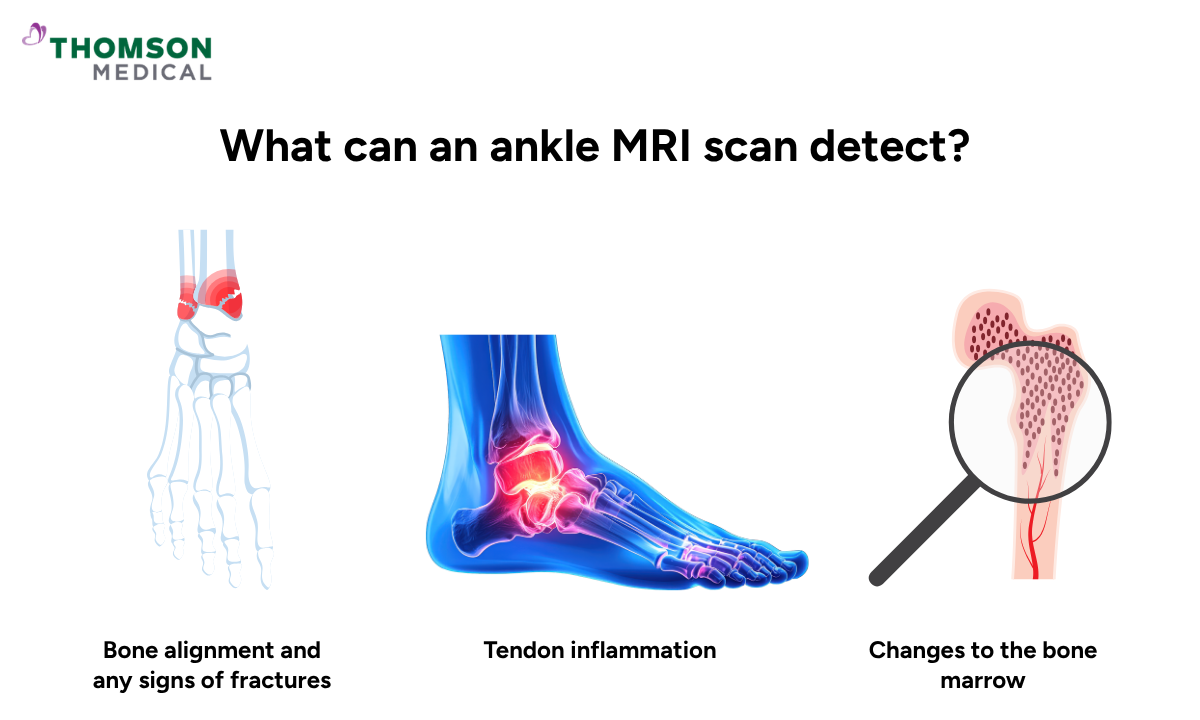
Once the scan is complete, the images are reviewed by a radiologist, usually within a few days.
What the radiologist looks for
The radiologist examines your images in detail, looking at a range of structures and signs.
These include:
Bone alignment and any signs of fractures
Ligament tears or sprains
Tendon inflammation or rupture
Cartilage damage to the joint surface
Fluid build-up around the joint
Changes to the bone marrow, which can indicate stress reactions or early injury
Any signs of infection or abnormal tissue growth
This detailed review will be sent to your referring doctor. The results are usually available within a few days of your scan. Your doctor will then go through the findings with you and recommend the next steps.
Is an ankle MRI safe?
MRI does not use ionising radiation, making it a safe and widely used imaging method. Most people go through the scan without any issues. However, there are specific circumstances where MRI requires extra care or may not be suitable.
Anxiety or claustrophobia
Feeling nervous about being in an enclosed space is more common than many people realise. If this is a concern for you, let your care team know before your scan.
They may suggest:
An open MRI machine, which has a wider, less enclosed design
A mild sedative to help you feel calm and relaxed during the scan
Simple breathing or relaxation techniques you can use while you are inside the machine
These options are available to help make the scan feel as comfortable as possible for you.
Contrast dye reactions
Allergic reactions to contrast dye are uncommon, but they can occur, especially for those with kidney problems. If you have had a reaction to contrast dye in the past, it’s important to let the team know before your scan.
They will take the appropriate steps to keep you safe and may discuss whether contrast is necessary in your case.
How much does an ankle MRI cost in Singapore?
Ankle MRI scans at public healthcare facilities in Singapore typically cost between SGD 900 and SGD 1,000. For Singapore citizens and permanent residents, MediSave may be used to help cover the cost.
At private hospitals, the costs can be from SGD 900 to over SGD 2,500, depending on your subsidised status and whether additional services are required.
The cost may vary depending on:
Use of contrast agent
Type of MRI machine
Urgency or after‑hours scheduling
Additional consultations or sedation
Please note that these are general estimates. For up-to-date figures and information on insurance eligibility, contact our medical concierge team.
FAQ
Is an ankle MRI painful?
No, an ankle MRI is not painful. The scan itself is non-invasive, though you may feel mild discomfort from lying still for an extended period during the procedure.
Can I walk after the scan?
Yes, you can usually walk and resume normal activities immediately after the scan, unless you have been given sedation.
Can MRI detect all ankle injuries?
MRI provides detailed imaging and is well-suited for assessing soft tissues, but no imaging test is perfect. Very small or early-stage injuries may occasionally be missed.
MRI is highly useful for ligament, tendon, cartilage, bone marrow, and many occult bone injuries, but some subtle, early, or motion-degraded findings may be missed.
How accurate is an ankle MRI?
An ankle MRI is a well-established tool for detecting ligament tears, tendon injuries, cartilage damage, and stress fractures. However, accuracy can vary depending on image quality and the timing of the injury.
Is MRI safe during pregnancy?
MRI does not use ionising radiation and may be performed during pregnancy when clinically necessary. Non-urgent scans are often deferred during the first trimester when possible. A contrast agent is usually avoided unless necessary, and your doctor will always weigh the benefits against any potential risks before proceeding.
The information provided is intended for general guidance only and should not be considered medical advice. For personalised recommendations and tailored advice based on your unique conditions, request a consultation with Thomson Medical.
For more information, contact us:
Thomson Medical Concierge
- 8.30am - 5.30pm
- WhatsApp: 9147 2051
Need help finding the right specialist or booking for a group?
Our Medical Concierge is here to help you. Simply fill in our form, and we'll check and connect you with the right specialist promptly.
Notice:
The range of services may vary between Thomson clinic locations. Please contact your preferred branch directly to enquire about the current availability.
Get In TouchDr Tang Zhi Hao
Orthopaedic Surgery
English, Mandarin
Prudential x TMC, Income, MHC, Alliance MediNet and 3 others
