

You’re standing in front of the mirror, and something catches your eye. A small indentation in your breast that wasn't there before. Or maybe it was, and you're only noticing it now?
Either way, your mind probably went straight to the worst-case scenario. When it comes to changes in your breasts, it's hard not to worry.
Here's what you need to know: breast dents are common and often have benign causes. Understanding what you're seeing, knowing when to worry, and taking the right steps can help you take control of your breast health and guide you toward the right care.
What does a breast dent actually look like?
A breast dent, sometimes called "dimpling" or "skin retraction", looks like a small indentation or hollow area on your breast. The skin may appear pulled inward, creating a dimple-like appearance. In some cases, the texture around that area may change, too. Your doctor may describe it as “peau d’orange” or an “orange peel” appearance.
The thing is, not all indentations look the same. Some are subtle and only show up when you move your arms a certain way. Others are more obvious. You may notice a dent near your nipple, along the side of your breast, or underneath it.
Here is a simple way to check whether you have indentation:
Stand in front of a mirror with good lighting
Raise your arms above your head
Press your hands on your hips
Look at both breasts from different angles
Making this a monthly habit, ideally a few days after your period ends, means you'll get to know what's normal for your body and notice anything new or different. That said, self-examination is a helpful starting point, not a replacement for regular screenings or check-ups with your doctor.
Changing positions can make dimpling easier to spot. What you’re looking for is any pulling, puckering, or unusual indentation that feels different from your breast’s normal shape. If you notice one breast looking noticeably different from the other, it’s a good idea to see your doctor.
Breast dimpling doesn't always mean something serious, but it's worth paying attention to. Most cases turn out to be benign. Even when treatment is needed, catching changes early often gives you more effective options.
Common benign causes of breast dents
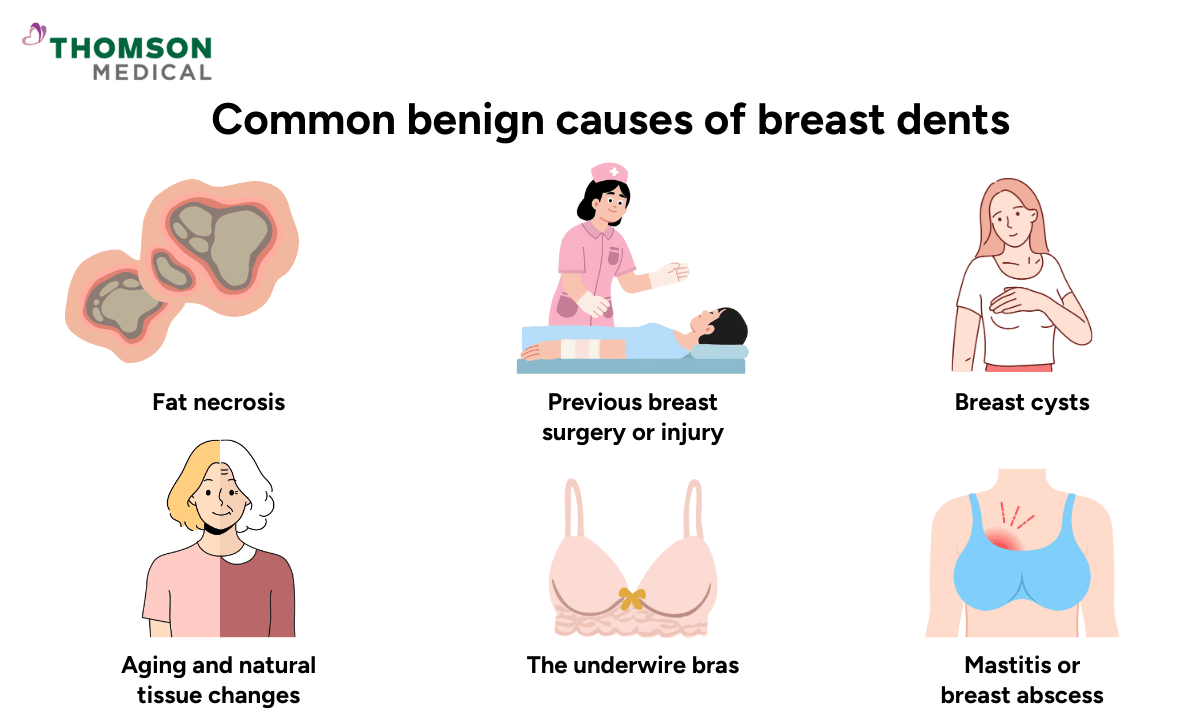
It’s natural to feel anxious when you notice a change in your breast. The reassuring news is that many things can cause a dent in your breast that aren’t related to cancer at all. In fact, benign causes are quite common, and they’re often manageable with simple treatment or monitoring.
Common reasons include:
Fat necrosis
Although the name may sound alarming, fat necrosis is usually harmless. It happens when fat tissue in your breast dies after an injury or surgery. Maybe you had a biopsy in the past, or you bumped your breast hard during exercise.
The dead tissue can create a firm lump and visible dimpling. You may feel tender at first; then it becomes less noticeable. Some fat necrosis even goes away on its own.
However, on imaging tests such as a mammogram, fat necrosis can sometimes look like cancer. That’s why your doctor may want to do additional tests to confirm the diagnosis.
Previous breast surgery or injury
Breast surgery, breast reduction, or even a simple biopsy can create scarring that pulls on surrounding tissue. That pulling can cause visible indentations that may not appear until months or even years after the procedure.
Breast cysts
Breast cysts are fluid-filled sacs that are very common, especially in women in their 30s and 50s. Large cysts can create visible changes in your breast’s shape. You may feel a smooth, moveable lump along with the indentation.
Most of the cysts are harmless. They can be uncomfortable, but they’re not dangerous.
Ageing and natural tissue changes
Breasts change as you age. Your skin loses some of its elasticity, and the internal tissue structure shifts. All these normal changes can create shadows, indentations, or areas that look different than they used to.
Sometimes, what looks like a new dent is just your breast responding to its natural ageing process.
Underwire bras
An ill-fitting bra, especially one with tight underwires, can press into your breast tissue, creating temporary indentations. Once you take off the bra, the dent usually disappears within a few hours.
If a dent only shows up when you’re wearing your bra, it may be a good idea to switch to a better-fitting style for a week and see if it improves.
Mastitis or breast abscess
If you’re breastfeeding or have recently stopped, an infection can be the culprit. Mastitis causes swelling and inflammation that can change how your breast looks. When it happens, you may also have other symptoms such as pain, redness, or fever.
A breast abscess – a collection of pus from infection – can also create visible changes in your breast contour.
These conditions may worry you, but both are very treatable.
Knowing what may be behind a breast dent helps you see that not every change means something serious. Many of these causes are simply part of how your body responds to life, such as ageing, hormones, or everyday activities.
Still, it’s important to take note of any unusual changes to your body. Early detection gives you and your doctor the best chance to address them effectively, whether they turn out to be something that just needs monitoring or something that requires treatment.
If you’ve noticed a breast dent and you're unsure what's causing it, schedule an appointment with Thomson Medical. Our specialists will help you understand exactly what's happening with your breast health.
When breast dents could be serious
While many breast dents have harmless causes, some do signal conditions that need medical attention. Being aware of these warning signs helps you know when to seek help and act quickly.
Inflammatory breast cancer (IBC)
Inflammatory breast cancer (IBC) is a rare but aggressive form of cancer that causes the skin of your breast to become dimpled, red and swollen. Your breast may also feel warm or heavy.
What makes it different from other types of breast cancer is that there’s often no distinct lump. Instead, you see rapid changes in your breast’s appearance. The dimpling happens because cancer cells block lymph vessels – the tiny channels that drain fluid from your breast tissue – causing fluid to build up and the skin to pucker.
If your breast changes appear suddenly and are getting worse, don't wait to see if they improve on their own. Early evaluation can make a real difference in your treatment outcome and recovery.
Other types of breast cancer
Sometimes, a tumour within your breast can pull on nearby tissue and ligaments. This pulling effect can create a visible dent or dimpling on the outside. It usually happens when the cancer has reached or attached to the skin.
You may feel a lump alongside the dimpling, or you may not notice one at all. Sometimes, that dimpling is the very first sign that something needs attention.
Warning signs that need immediate attention
Most breast changes aren't cancerous. But the reliable way to know for sure is through a medical evaluation.
Contact your doctor right away if you notice:
A new, persistent dimple that doesn't go away after a few weeks
Dimpling accompanied by a lump or thickening in your breast
Changes to your nipple, such as unusual discharge, scaling or crusting
Skin changes beyond the dimple, such as redness, warmth, thickening
One breast that's significantly larger or shaped differently than the other
Swelling in your armpit or above your collarbone
Dimpling that appeared suddenly and is getting worse
It's okay if you're feeling anxious right now. Not every dent means cancer, but every concerning change deserves professional attention. The sooner you know what's causing a breast dent, the more options you'll have and the better your outcome is likely to be.
If something feels different or wrong, seeing your doctor will give you answers, peace of mind and the right care you need.
Our breast specialists in Singapore
Loading...
How is breast dimpling diagnosed?

Walking into the appointment may make you anxious, especially if this is your first time or you’re not sure what to expect. Let’s take a closer look at what usually happens during your visit so you can feel more prepared.
The process may include:
Medical history discussion:
Your doctor will start with questions to understand your situation. These questions may include:
When did you first notice the change?
Any pain or other symptoms?
Do you have a family history of breast cancer?
These questions help paint a clearer picture of what might be going on.
Physical examination:
Your doctor will examine your breasts, check for any lumps or thickening, and assess the lymph nodes in your armpit and neck.
It may feel awkward, but it’s a necessary part of figuring out what’s happening.
Imaging tests:
Mammogram to look inside your breast tissue for any abnormalities.
Ultrasound to create detailed images of your breast. This test is often recommended if you're younger or have dense breast tissue, as it can show things a mammogram might miss.
MRI scan to get an overall view of your breast. It may be used if your doctor needs a closer look at suspicious areas.
Biopsy (if needed):
If something looks suspicious on imaging, your doctor may recommend a biopsy to examine tissue more closely. During the procedure, your doctor will take a small sample of tissue to examine under a microscope.
This test will help determine whether cells are cancerous or benign.
Going through these tests can feel overwhelming. But each step brings you closer to answers and, if needed, the right treatment plan. Your doctor will gently guide you through every part of this process, answer your questions, and make sure you understand what's happening at each stage.
What are the treatment options for breast dents?
After getting your diagnosis, it's normal to wonder what happens from here. The path forward depends entirely on what's causing your breast dent, but the reassuring news is that there are effective treatments available for each scenario.
Fat necrosis or an old injury:
You may not need any treatment at all. Your doctor will suggest regular monitoring to make sure nothing changes.
Cysts:
They can be drained if they're causing discomfort, but small ones are often just left alone.
Mastitis and breast abscess:
Your doctor may prescribe antibiotics to help you deal with mastitis. But if it’s a breast abscess, you may need drainage.
Cancer:
If cancer is found, your treatment plan will be tailored to your specific situation. Surgery, chemotherapy, radiation therapy, or a combination of treatments may be recommended.
It’s completely normal to feel uncertain about what lies ahead. But no matter what your diagnosis is, your doctor will work closely with you. They will help create a treatment plan that makes sense for your specific situation, your health, and your life. You'll get through this with the support and expertise you need.
If you’re experiencing any breast changes or dimpling that concerns you, schedule an appointment with Thomson Medical. Our specialists will guide you through every step of diagnosis and treatment, ensuring you receive personalised care tailored to your specific needs.
FAQ
Is a dent in my breast always a sign of cancer?
No. Most breast dents are caused by benign conditions like fat necrosis, cysts, or previous injuries.
However, dimpling can be a symptom of breast cancer. It’s best to consult your doctor to have a clear answer and peace of mind.
What is peau d'orange, and how does it look different from normal dimpling?
"Peau d'orange" means "orange peel" in French. It describes skin that looks thick and dimpled, like the surface of an orange. This texture happens when fluid builds up in your breast, often because of inflammatory breast cancer or advanced breast cancer blocking lymph vessels.
Regular dimpling is usually a single indentation, while peau d'orange affects a larger area with multiple small dimples.
Can wearing an underwire bra cause breast indentation?
Yes, temporarily. A tight or ill-fitting underwire bra can create indentations in your breast tissue. However, they usually disappear after you remove the bra.
If the dent doesn't go away within a few hours of taking off your bra, it's not from the underwire.
What's the difference between a dent, dimple, and skin retraction?
These terms are often used to describe the same thing: an inward pulling or depression of breast tissue. Skin retraction specifically refers to the skin being pulled inward, usually by underlying tissue changes. Either way, the medical significance is the same.
Can breast indentation appear and disappear on its own?
Yes, sometimes. Temporary causes like bra pressure or certain positions can make indentations more or less visible. Hormonal changes during your menstrual cycle can also cause temporary tissue swelling that masks or creates indentations.
However, if you're consistently seeing a dent in the same spot, you should see your doctor.
Can breastfeeding or pregnancy cause temporary breast indentation?
Yes. Pregnancy and breastfeeding cause significant changes to breast tissue that can temporarily affect how your breasts look and feel.
When your breasts are engorged, you may notice temporary dimpling that goes away once the swelling comes down. Mastitis can also cause visible indentations along with pain and redness.
While these changes are often benign, any new breast symptom during pregnancy or breastfeeding should still be checked by your doctor.
The information provided is intended for general guidance only and should not be considered medical advice. For personalised recommendations and advice based on your unique situation, please consult a specialist at Thomson Medical. Request an appointment with Thomson Medical today.