

It's easy to dismiss hand pain as something minor until you find yourself unable to go about your usual daily activities like opening a jar or picking up a bag.
In addition to a specialist review, a hand MRI scan can identify any underlying issues and guide your treatment plan for a faster recovery.
What is a hand MRI scan?
A hand MRI (magnetic resonance imaging) scan is a safe, non-invasive imaging test. It uses strong magnets and radio waves to produce detailed images of your thumb, fingers, hand and/or wrist, showing your bones, joints, tendons, ligaments, and even nerves or blood vessels clearly.
Unlike X-rays or CT scans, an MRI scan does not use ionising radiation, meaning that it can be repeated when clinically necessary.
Why might you need a hand MRI?
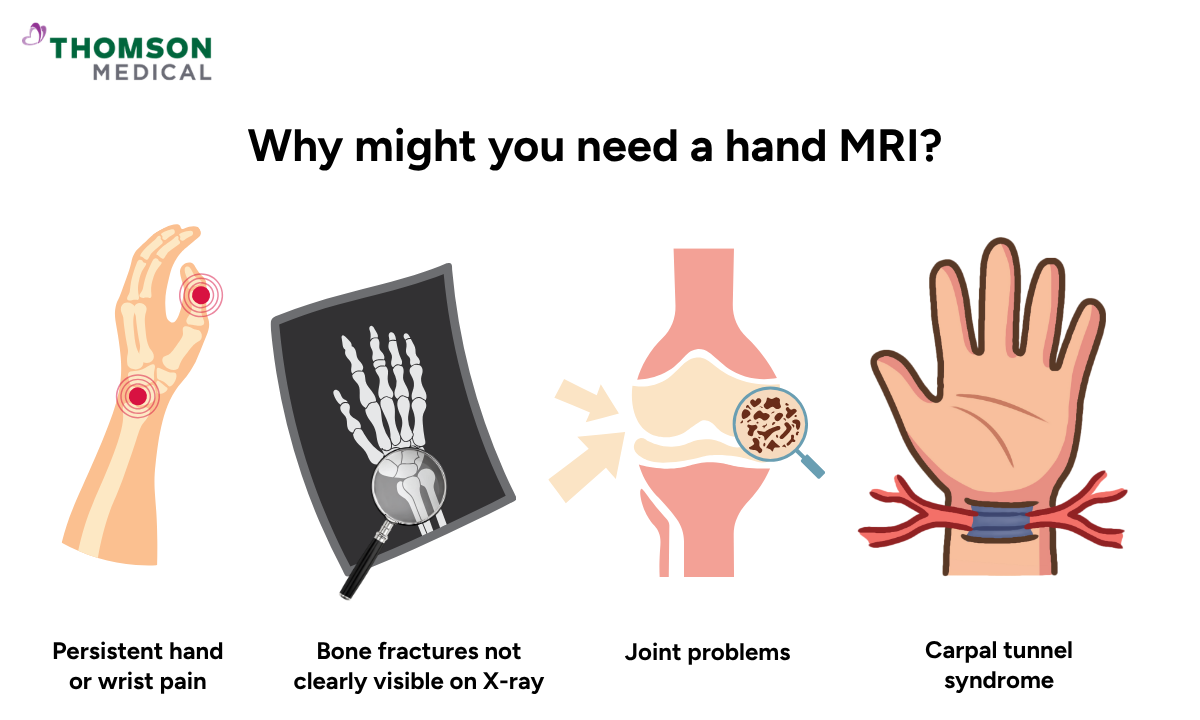
You may be recommended a hand MRI following your initial assessments. This helps your doctor to identify the cause of your symptoms more precisely and develop a more targeted treatment plan.
Common reasons include:
Suspected tendon injuries or ligament tears
Joint problems, such as arthritis
Bone fractures not clearly visible on X-ray
Inflammation or infection
Cysts or growths, such as a ganglion cyst
Nerve compression, such as carpal tunnel syndrome
Sports-related injuries such as ligament sprains, tendon injuries, or cartilage damage
Unexplained swelling
Our hand specialists in Singapore
Loading...
How to prepare for your hand MRI scan
.png?branch=production)
The preparation for the scan is straightforward. Your imaging centre will provide you with specific instructions ahead of your appointment.
What to wear and what to remove
Wear loose, comfortable clothing to your appointment. You may be asked to change into a hospital gown.
Before entering the scan room, you will need to remove all metal items, including:
Jewellery and watches
Rings
Hairpins
Metal braces or supports
If you wear a hearing aid, let your care team know in advance. They will advise you on whether it needs to be removed before the scan.
Medical implants and conditions to disclose
Certain medical implants and conditions may affect whether an MRI is suitable for you or whether any adjustments are needed before the scan.
Always tell your care team if you have:
Pacemakers or defibrillators
Cochlear implants
Aneurysm clips
Metal fragments, especially near the eyes
Joint replacements, metal pins, plates, or screws
Kidney problems
Undergoing pregnancy
Although most modern surgical implants work well with MRI scans, letting your team know beforehand helps them check whether any precautions are needed.
Fasting and medications
For most hand MRIs, you do not need to fast beforehand. If a contrast agent is being used as part of your scan, you may be asked to avoid food for a few hours prior to the procedure.
If you are unsure whether any of your medications or supplements may affect the scan, do consult with the imaging centre beforehand. Certain medications can interact with contrast agents, and your team will advise you if any temporary adjustment is needed.
Proper preparation helps ensure a smooth and safe hand MRI scan. Request an appointment with Thomson Medical for guidance on what to expect before your appointment.
What happens during a hand MRI scan?
Knowing what to expect can help you feel more comfortable during the procedure. The process is straightforward, and your care team will guide you through each step.
Positioning and duration
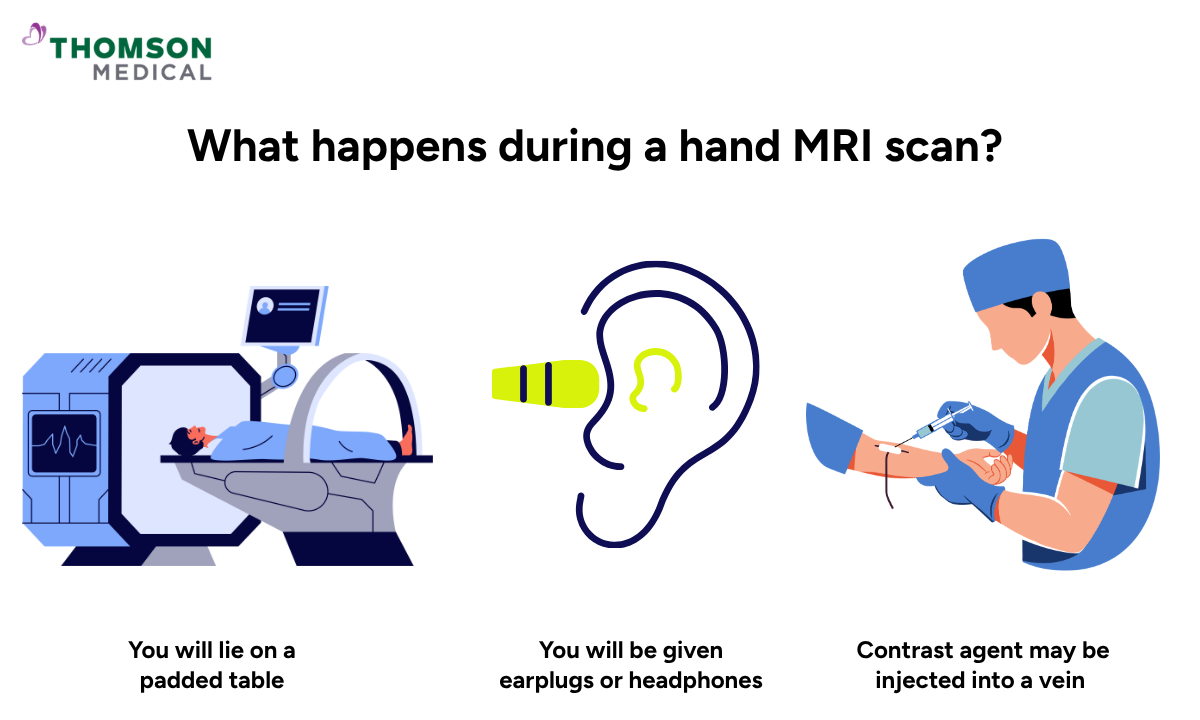
The scan usually takes between 30 and 45 minutes. You will lie on a padded table that slides into the MRI machine. Your hand will be placed into a small imaging coil, a device that helps capture detailed pictures.
In some scans, only your arm needs to go inside the machine. Keeping as still as possible during the scan is important, as movement can blur the images and some steps may need to be repeated.
Sound and comfort
MRI machines make loud tapping and knocking sounds during the scan. This is perfectly normal, and you will usually be given earplugs or headphones to help you feel at ease.
If the noise or enclosed space feels uncomfortable, slow and steady breathing can help. The team will be nearby and can speak with you throughout via intercom.
Contrast dye
Most hand MRIs do not require intravenous contrast. In some cases, a contrast agent called gadolinium may be injected into a vein before or during the scan. This helps certain structures appear more clearly on the images.
A contrast agent may be used to:
Detect areas of inflammation
Identify growths or tumours
Assess infection
Evaluate blood supply to tissues
For most people, contrast agents are generally well tolerated. However, if you have kidney problems, please let your care team know beforehand, as contrast agents can sometimes affect kidney function. Your team will advise you accordingly.
If you have ever had an allergic reaction or sensitivity to a contrast agent in the past, do mention this before your scan so your care team can take the appropriate steps to keep you comfortable during the scan.
What do hand MRI scan results show?
You will be able to leave as soon as the scan is done. After your scan, the images are sent to a radiologist, who writes a report for your referring doctor.
The radiologist will look for a range of possible findings, including:
Bone alignment and any fractures
Tendon or ligament tears
Cartilage damage
Joint inflammation
Fluid build-up
Nerve compression
Cysts or abnormal growths
Your results are typically available within a few days to a week, and your doctor will discuss the findings once the report has been reviewed.
Are there any side effects or risks?
For most people, a hand MRI is a comfortable experience with no after-effects. However, some people may find certain aspects of the scan more challenging.
Anxiety or claustrophobia
For some, enclosed spaces can cause anxiety or discomfort. If this applies to you, the following options may help:
An open MRI machine, which is less enclosed
Mild sedation in some cases
Relaxation techniques before and during the scan
For hand MRIs in particular, your whole body is often not fully inside the scanner, which can make the experience easier to manage for those who feel uneasy in tight spaces.
Reactions to contrast dye
Allergic reactions to contrast dye are rare. When they do occur, they are usually mild, such as a rash or slight itching. Always inform your care team if you have experienced a reaction to a contrast agent in the past.
Feeling unsure about the risks or side effects of a hand MRI is understandable. Request an appointment with Thomson Medical to discuss your concerns and understand what to expect.
FAQ
Is a hand MRI painful?
No, a hand MRI is not painful. The scan itself is non-invasive. Some people may experience mild discomfort from staying still throughout the scan or from a contrast injection if one is needed.
Can a hand MRI detect tendon or ligament tears?
Yes. A hand MRI is well-suited to detecting tendon tears, ligament injuries, and soft tissue damage, as it provides detailed images of the muscles, tendons, and ligaments.
How long does it take to get results?
Results are usually available within 1 to 3 days, although urgent cases may be reviewed sooner. A radiologist will interpret the scan and send the report to your doctor, who will discuss the findings with you.
Can I use my hand immediately after the scan?
Yes. If no sedation was used, you can return to your normal activities immediately after the scan. If a contrast dye has been administered, your care team will advise you to drink plenty of fluids to help flush it out of your system.
Do I need a doctor's referral for a hand MRI?
Yes, in most cases a doctor's referral is required. This ensures the scan is appropriate for your condition and that the results are properly interpreted within a clinical context.
Is MRI safe if I have metal pins or screws in my hand?
Most modern surgical implants are MRI-compatible, but please do inform the radiology team beforehand so they can verify compatibility and ensure your safety. It is also helpful to bring any implant cards or documentation to your appointment.
The information provided is intended for general guidance only and should not be considered medical advice. For personalised recommendations and tailored advice based on your unique conditions, request a consultation with Thomson Medical.
For more information, contact us:
Thomson Medical Concierge
- 8.30am - 5.30pm
- WhatsApp: 9147 2051
Need help finding the right specialist or booking for a group?
Our Medical Concierge is here to help you. Simply fill in our form, and we'll check and connect you with the right specialist promptly.
Notice:
The range of services may vary between Thomson clinic locations. Please contact your preferred branch directly to enquire about the current availability.
Get In Touch