

An IVF cycle moved through a set sequence, from an initial consultation, ovarian stimulation, egg retrieval, fertilisation in the laboratory, embryo transfer, and then the two-week wait until your pregnancy test. Each stage has its own timeline, and some involve waiting on results before the next test can begin.
So how long does IVF take from your first appointment to the pregnancy test? Here’s what each stage involves and roughly how long it takes, along with the things that can shift the timeline.
What is IVF?
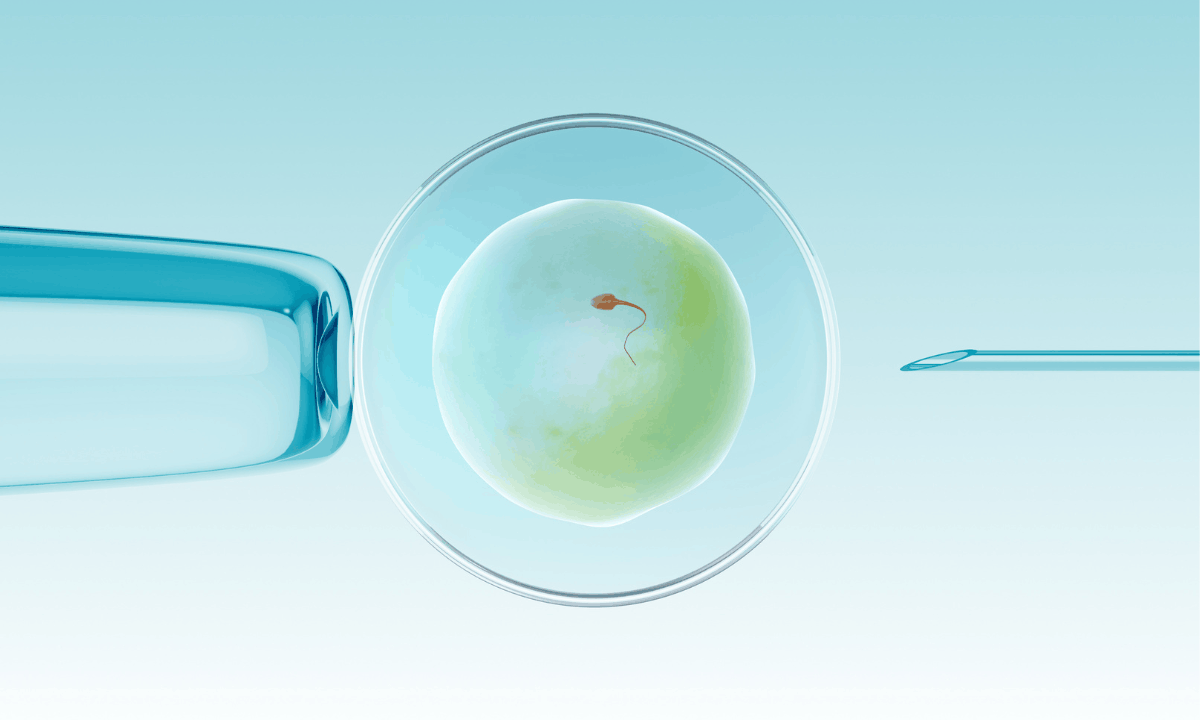
In vitro fertilisation (IVF) is a fertility treatment where eggs and sperm are brought together outside of the uterus (womb). Instead of fertilisation occurring inside the fallopian tube, eggs are retrieved directly from the ovaries after hormonal stimulation. These eggs are then combined with sperm in a laboratory environment, either through conventional insemination or intracytoplasmic sperm injection (ICSI).
Once fertilisation occurs, embryos are cultured for several days until they reach a suitable stage (often blastocyst stage). A selected embryo is then transferred into the uterus (womb), and if implantation occurs, the embryo attaches to the uterine lining, and pregnancy may begin.
IVF may be recommended when natural conception is difficult or when other fertility treatments are unlikely to help or have not worked. Whether it is suitable depends on the possible cause of infertility and your individual circumstances.
How long does IVF take from the first appointment?
The IVF process may take several weeks to a few months from your first appointment. IVF may take several weeks because this fertility treatment involves a series of carefully timed phases, where each phase needs to be completed before the next phase begins.
In some cases your fertility specialist may need to adjust each phase’s schedule depending on how your body responds to treatment.
Generally, IVF treatment may follow these phases and timing.
| Phase | Timing |
|---|---|
Initial consultation and assessment | About 2-6 weeks |
Stimulation phase | About 8-14 days |
Trigger injection to egg retrieval | About 34-36 hours |
Fertilisation and embryo culture | About 1-6 days |
Embryo transfer (fresh transfer) | Usually 3-5 days after egg retrieval |
Pregnancy test | Usually about 9-14 days after embryo transfer |
The duration for each phase in IVF may vary from woman to woman, so IVF may not follow the same timeline for everyone. Your fertility specialist will time each stage according to your response to the treatment.
Here are what may be involved during each stage of your IVF treatment.
Initial consultation and fertility assessment
The first stage of IVF is an initial consultation and fertility assessment. During your consultation, your fertility specialist will review your medical and reproductive history. This may include previous pregnancies, fertility treatments, and how long you have been trying to conceive.
Your doctor may also discuss your fertility goals and explain whether IVF or another fertility treatment may be suitable. Your fertility assessment may include:
Blood tests to assess reproductive hormones, ovarian reserve, and certain infectious diseases.
A pelvic or transvaginal ultrasound to assess the ovaries, womb, and uterine lining.
Semen analysis to assess sperm morphology (shape) and motility (movement).
Further tests based on your medical history, symptoms, and previous fertility results.
Initial consultation and fertility assessment may take several weeks, as some blood tests and scans need to be performed at specific times in the menstrual cycle for more accurate results.
Your doctor may also need to review the results to assess whether you may need additional tests or treatments before your IVF begins.
Stimulation phase
In a natural menstrual cycle, the ovaries may develop one dominant follicle containing an egg. During IVF, however, your fertility specialist may use fertility medications or ovarian stimulation to encourage several follicles to develop at the same time, which helps increase the number of eggs that may be available for retrieval.
During the stimulation phase, your fertility specialist may prescribe hormone injections that you will give yourself at scheduled times each day. These medications help multiple eggs develop before egg retrieval. Other medications may also be prescribed to prevent ovulation from occurring too early.
Your fertility specialist will monitor how your ovaries respond throughout this phase. This may involve:
Ultrasound scans every few days to measure the number and size of developing follicles.
Blood tests to monitor hormone levels and help your doctor assess how the ovaries are responding.
Medication adjustments if the follicles are developing more quickly or slowly than expected.
Once enough follicles have reached an appropriate stage of development, your fertility specialist may give you a final trigger injection to help the eggs mature.
Egg retrieval
Your doctor may schedule an egg retrieval approximately 34-36 hours after the trigger injection. They might perform it as a short procedure under sedation.
During the procedure, your fertility specialist uses an ultrasound probe to guide a fine needle through the vaginal wall and into the ovarian follicles. They remove fluid from each follicle and examine it in the laboratory to identify the eggs.
After retrieval, your fertility specialist prepares the mature eggs for fertilisation in the laboratory. They may perform fertilisation using:
Conventional IVF: the fertility specialist places the eggs with prepared sperm in the laboratory.
ICSI: an embryologist injects a single sperm directly into a mature egg.
The laboratory will check the eggs the following day to determine how many of them have fertilised normally.
Fertilisation and embryo culture
Fertilisation and embryo culture take place after egg retrieval. On the egg retrieval day, the embryologist combines mature eggs with prepared sperm in the laboratory.
The next day, they check whether fertilisation has occurred. A normally fertilised egg usually shows two pronuclei, one from the egg and one from the sperm.
Afterwards, the resulting embryos are cultured in a specialised incubator for around 3 to 5 days. During this time, the embryologists monitor how they divide and develop:
Day 1: checking for fertilisation
Day 2-3: early embryo development
Day 5-6: some embryos may reach the blastocyst stage
Embryos that develop appropriately may undergo a biopsy, where they send the cell samples to a laboratory for genetic analysis, such as preimplantation genetic testing (PGT).
If PGT is part of your treatment plan, this stage may add approximately 1-3 weeks or longer, depending on the type of testing and laboratory processing time.
Because the results may not be available immediately, your fertility specialist may freeze the biopsied embryos. The embryo transfer therefore may take place in a later cycle once the results are available and an appropriate embryo has been selected.
Embryo transfer
Once an embryo has developed sufficiently, the next stage is embryo transfer. Depending on your treatment plan, this may take place during the same IVF cycle or during a later menstrual cycle.
There are two main approaches for embryo transfer, which are a fresh embryo transfer and frozen embryo transfer.
Fresh embryo transfer:
Your fertility specialist transfers a fresh embryo without first freezing the embryo. It typically takes place around 3-5 days after egg retrieval, depending on how the embryo develops.
They may consider this approach when the uterine lining and hormone levels are suitable and there is no medical reason to postpone transfer.
Frozen embryo transfer:
Your fertility specialist transfers the suitable embryos that are frozen during a later cycle. This means the overall IVF process may take several additional weeks or longer.
They may consider a frozen transfer for several reasons. For example, it is required when the embryos undergo genetic testing.
They may also recommend it when your hormone levels, the uterine lining, or the risk of ovarian hyperstimulation syndrome (OHSS) may make a fresh transfer less appropriate.
Two-week wait
After the embryo transfer procedure comes the period to wait until your scheduled pregnancy test, also known as the two-week wait. Depending on the type and timing of the embryo transfer, your fertility specialist may schedule a pregnancy blood test around 9-14 days after your embryo transfer.
If implantation happens during this time, the embryo may attach to the uterine lining. Afterwards, it starts making human chorionic gonadotropin (hCG), the hormone that pregnancy tests detect.
Your fertility specialist may prescribe progesterone or other medication to support the uterine lining during this stage.
Early pregnancy
After the two-week wait, your fertility specialist may confirm your pregnancy with a hCG blood test to measure beta-hCG. In some cases, the test may be repeated after a few days to assess how the hCG level is changing.
Afterwards, your fertility specialist may arrange an early pregnancy ultrasound at around 6-7 weeks of pregnancy. This allows them to confirm that the pregnancy is located within the womb and assess early development.
If you have been considering IVF treatment after trying natural conception for a while, or you want to know more about this fertility treatment, visit a fertility specialist to discuss whether it may be appropriate for you. Schedule an appointment at Thomson Fertility Singapore.
Our fertility doctors in Singapore
Loading...
Other factors that may affect your IVF timeline
There are several factors that may affect your IVF treatment duration. These factors include:
Biological factors
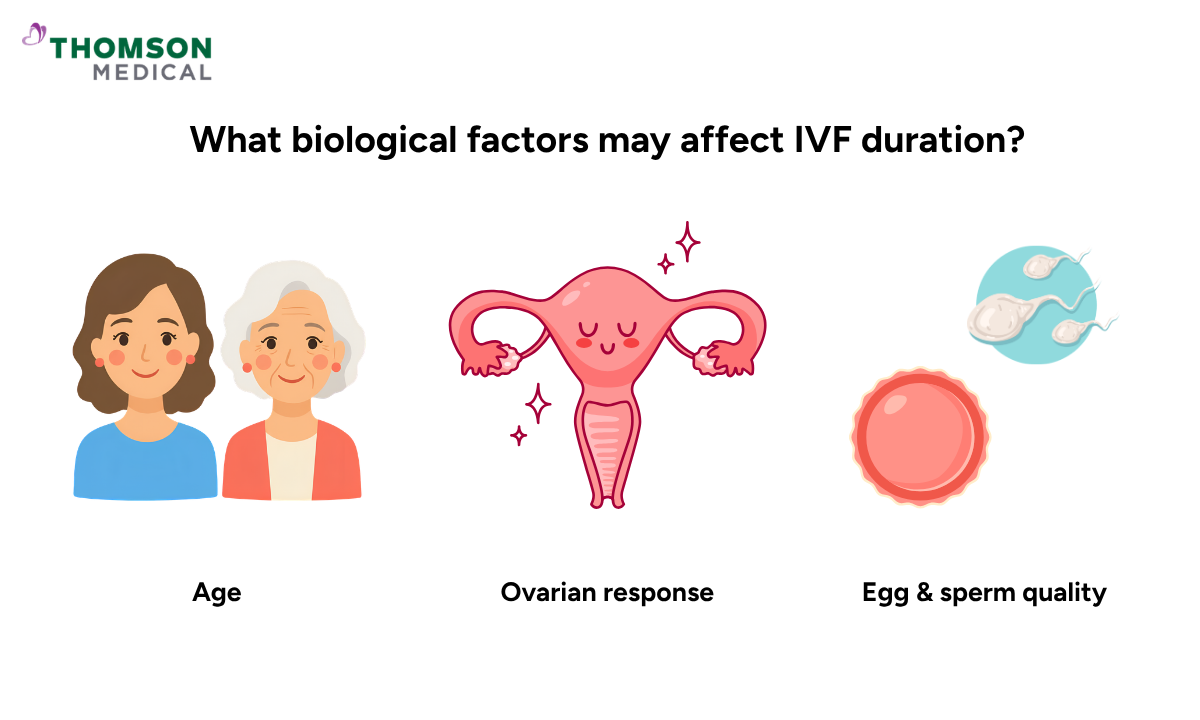
Biological factors may influence the IVF cycle duration and whether more than one cycle is needed.
Age:
Ovarian reserve and egg quality may decline with age, which may affect the number of eggs retrieved and how many develop into suitable embryos.
Some women may therefore require more than one stimulation or retrieval cycle before an embryo is available for transfer.
Ovarian response:
If your ovaries respond more slowly than expected, the stimulation may need to continue for additional days or medication doses may need to be adjusted.
If the response is unexpectedly high or low, your doctor may also modify or occasionally postpone parts of the treatment plan for safety reasons.
Egg and sperm quality:
Not every retrieved egg will mature or fertilise successfully, and not every fertilised egg will continue developing into a suitable embryo.
Similarly, sperm-related factors may affect fertilisation and may lead your fertility specialist to recommend techniques such as ICSI. If no suitable embryos develop, another IVF cycle may be required.
Your fertility specialist may review these factors before and during the treatment, and they may adjust your treatment plan where needed.
Medical conditions
Certain medical conditions may require additional assessment or treatment before or during IVF. This may add time before ovarian stimulation begins or before an embryo transfer.
These medical conditions include:
Endometriosis:
Endometriosis is a condition where tissue similar to the lining of the womb grows outside the womb. It may affect IVF by reducing ovarian response or making egg retrieval more difficult.
Because of this, your doctor may recommend additional imaging, medication, or occasionally surgery before IVF, depending on the severity of the condition and your treatment plan.
Diabetes:
Diabetes may affect your IVF by impairing ovarian function and endometrial receptivity, which may lower implantation chances.
Your medical team may need to ensure that your blood glucose levels are adequately controlled before your IVF treatment.
Hormonal disorders:
Conditions affecting hormones, such as thyroid disorders or polyendocrine metabolic ovarian syndrome (PMOS), formerly known as polycystic ovarian syndrome (PCOS), may influence ovulation or the response to ovarian stimulation.
Your doctor may need to identify and treat the underlying hormonal conditions, then adjust the IVF stimulation and monitoring plan.
Tips to prepare before IVF
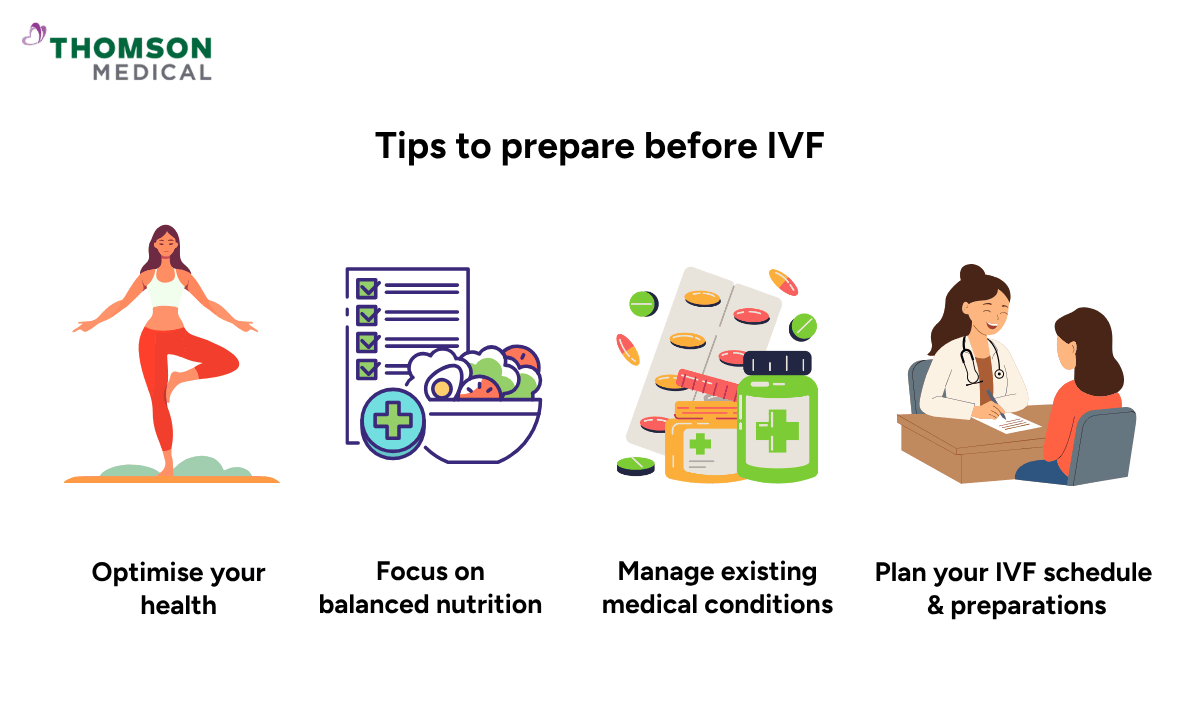
Before undergoing this fertility treatment, there are several measures that may help to prepare for the treatment.
Optimise your health
You may start preparing for IVF even before the treatment cycle begins; your doctor may advise when to start based on your condition. To help support your general health, you may practise the following:
Aim for an ideal body weight through a balanced diet and regular physical activity.
Stop smoking, as smoking may affect fertility in both women and men.
Avoid or limit alcohol, particularly as you approach embryo transfer and pregnancy.
Start a folic acid supplement based on your doctor’s advice.
Review your medications and supplements with your doctor to make sure they are suitable when trying to conceive.
Focus on balanced nutrition
Aiming for a balanced diet may help your preparation. This balanced diet may include:
Protein from sources such as fish, eggs, poultry, beans, lentils, or tofu.
Healthy fats from foods such as nuts, seeds, avocado, and olive oil.
Whole grains, fruits, and vegetables.
Adequate fluids throughout the day.
Additionally, try to limit ultra-processed foods and foods high in added sugar, salt, or saturated fat.
Manage existing medical conditions
If you have a medical condition such as diabetes, high blood pressure, or a thyroid disorder, speak with your doctor before starting IVF. Your doctor may need to:
Check that the condition is adequately controlled.
Review your current medications.
Perform additional tests or monitoring before or during treatment.
Managing your medical conditions before IVF may help reduce avoidable health risks and determine whether any adjustments are needed before IVF begins.
Plan your IVF schedule and preparations
IVF may involve regular appointments and medications that often need to be taken at specific times, so some advance planning may make the process smoother. Here are some measures that may help you:
Arranging the schedule for ultrasound scans, blood tests, and egg retrieval.
Learning how and when to administer hormone injections.
Preparing your medications and supplies in advance.
Reviewing treatment costs and any additional fees.
Planning who you may turn to for practical or emotional support during treatment.
If you are still unsure or want to further discuss your IVF treatment plan, consult a fertility specialist to review your plan based on your condition. Schedule an appointment at Thomson Fertility Singapore.
FAQ
Can the IVF timeline be shortened?
IVF timelines generally cannot be shortened significantly, as several stages depend on biological processes that need time to occur.
For example, the ovaries need several days to respond to stimulation medication and develop mature eggs. Meanwhile, the embryos require time to fertilise and develop before transfer. After embryo transfer, implantation and the production of enough hCG to confirm pregnancy also take time.
However, your fertility specialist may be able to make some of the administrative or scheduling easier or faster.
How soon can you try again after an unsuccessful IVF cycle?
The timing to start another cycle may be individualised based on your condition. That being said, in general, you may be able to start another IVF cycle after your next menstrual period, particularly if you have recovered well and there are no complications from the previous treatment.
However, your fertility specialist may recommend waiting longer if you:
- Need more time for your ovaries or hormone levels to return to normal.
- Experienced complications such as ovarian hyperstimulation syndrome (OHSS).
- Require additional tests or changes to your treatment plan before trying again.
Does the IVF timeline differ for men and women?
IVF timing may differ between men and women because the women undergo more procedures, such as ovarian stimulation, monitoring, egg retrieval, and embryo transfer. Meanwhile, men undergo fewer procedures, including a semen analysis and providing a sperm sample around the time of egg retrieval.
At what age is IVF recommended?
There is no specific age where IVF is recommended. To assess whether IVF is suitable for you, your fertility specialist may consider your age, ovarian reserve, how long you have tried to conceive, and the possible underlying cause of infertility.
The information provided is intended for general guidance only and should not be considered medical advice. For personalised advice based on your conditions,schedule an appointmentwith Thomson Medical.
For more information, contact us:
Thomson Fertility Centre
- Paragon: 6252 7766
- Novena: 6399 3758, 8811 0358 (WA)