

If you’re preparing for in vitro fertilisation (IVF), you may be wondering what you could do to support your egg quality before treatment begins. And if a previous IVF didn’t end the way you hoped, egg quality is often one of the first things that comes to mind.
Here’s what affects egg quality, how it’s assessed during IVF, and what the findings say about supporting your reproductive health in the months before a cycle.
What is egg quality?
Egg quality describes how likely an egg is to mature normally, be fertilised, and support early embryo development. It is not the same as egg quantity, which refers to the estimated number of eggs remaining in the ovaries, also known as ovarian reserve.
One important aspect of egg quality is whether the egg has the correct number of chromosomes. A mature egg normally contains 23 chromosomes, and during fertilisation, these combine with 23 chromosomes from the sperm, resulting in an embryo that normally has 46 chromosomes.
An egg with too many or few chromosomes is described as aneuploid, meaning it has an abnormal number of chromosomes. Aneuploid eggs may still be fertilised, but the resulting embryo is more likely to stop its development early on, fail to implant in the womb, or result in a miscarriage.
Why is egg quality important during IVF treatment?
Egg quality may affect the likelihood of fertilisation, embryo development, and implantation. This is because, for an embryo to develop normally, it needs the correct number of chromosomes, which are partly determined by the genetic conditions carried by the egg.
A high-quality egg contains the necessary genetic material and the correct number of chromosomes for normal embryo development. If an egg has missing or extra chromosomes, this could disrupt embryo development and increase the risk of early miscarriage.
How to improve egg quality for IVF treatment?
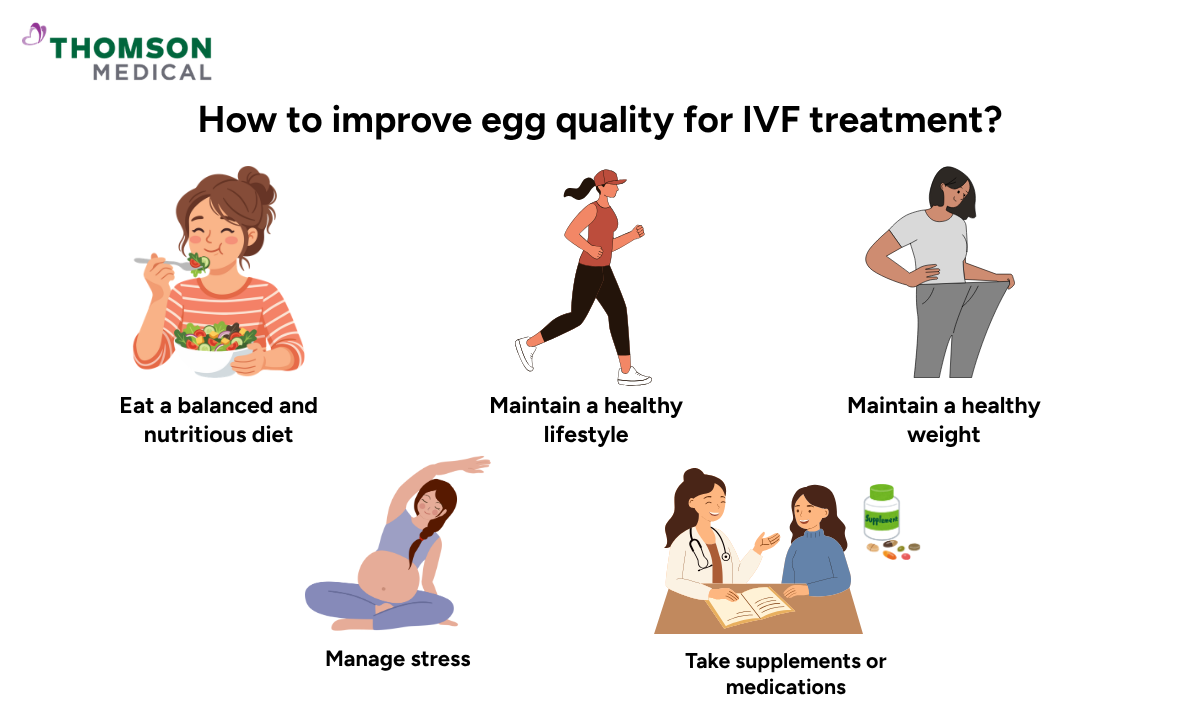
Although you could not reverse age-related changes in egg quality, maintaining a healthy lifestyle may support your overall reproductive health in the lead-up to IVF. Some steps you could consider include:
Eat a balanced and nutritious diet:
Choose a variety of nutrient-rich foods, such as vegetables, fruits, whole grains, lean proteins including fish and eggs, nuts, and seeds. These foods provide vitamins, minerals, protein and healthy fats that support overall health.
Try to limit highly processed foods, foods high in saturated or trans fats, and excessive added sugar.
Maintain a healthy lifestyle:
Do light to moderate physical activities such as walking, swimming, or cycling to support your overall health and wellbeing.
Get enough sleep, aiming for around 7-9 hours each night, and stay hydrated by drinking around 6-8 glasses of fluids a day.
Avoid smoking, vaping, alcohol, and other harmful substances, as these may affect your reproductive health.
Maintain a healthy weight:
Avoid significant weight changes, as these may affect your menstrual cycle and reproductive hormones.
Being overweight may also be associated with changes in egg quality, potentially due to increased oxidative stress hormones (an imbalance that may damage cells) and changes in mitochondrial function (how cells produce the energy needed to function properly).
Manage stress:
Going through IVF could be a demanding process, both physically and emotionally, so finding ways to manage stress may help support your overall wellbeing.
Activities such as walking, meditation, yoga, breathing exercises, or spending time with family and friends may help you relax.
Take supplements or medications:
Some supplements may contain nutrients or antioxidants that support normal cell function and reproductive health. However, evidence that supplements could directly improve egg quality remains limited.
That is why it is usually recommended that you speak with your fertility specialist before taking any supplements or fertility medications. Because they could assess your individual needs and advise whether supplementation may be appropriate as part of your IVF treatment.
What factors may affect egg quality in IVF treatment?
Egg quality could be influenced by several factors, with age being one of the main factors. As women get older, changes in the eggs may make chromosomal abnormalities more common. There are other factors that may also influence egg quality, such as:
Age:
Women are born with a finite number of eggs, and both the number and quality of these eggs naturally decline with age. This decline is usually more noticeable from around age 32 and may become more pronounced after age 35.
As women get older, eggs are also more likely to have aneuploidy (an abnormal number of chromosomes), which could affect embryo quality and development.
Biological and genetic factors:
Certain genetic changes or chromosomal abnormalities may also affect the normal development and quality of an egg.
These factors are not always within your control and may not cause noticeable symptoms. Your fertility specialist may consider your medical and reproductive history to determine whether further assessment is appropriate.
Lifestyle factors:
Lifestyle habits may affect the environment in which eggs develop and your overall reproductive health.
Smoking, excessive alcohol, recreational drug use, poor nutrition, and an unhealthy weight may affect reproductive function and contribute to oxidative stress (an imbalance that could damage cells), inflammation, and hormonal balance.
Medical conditions
Certain medical conditions may affect ovarian function, hormone levels, or the development of eggs. These may include polyendocrine metabolic ovarian syndrome (PMOS, formerly known as PCOS), endometriosis, thyroid disorders, and some autoimmune conditions.
Previous medical procedures such as chemotherapy or radiotherapy involving the pelvic area may also affect ovarian function and reduce the available egg supply, which may lead to diminished ovarian reserve (a lower number of eggs remaining in the ovaries).
If you are concerned about factors that may affect your egg quality during IVF, speak with an O&G doctor. They could help you understand your individual circumstances and discuss whether any further assessment or treatment may be appropriate. Schedule an appointmentwith Thomson Medical.
Our fertility doctors in Singapore
Loading...
How is egg quality diagnosed?
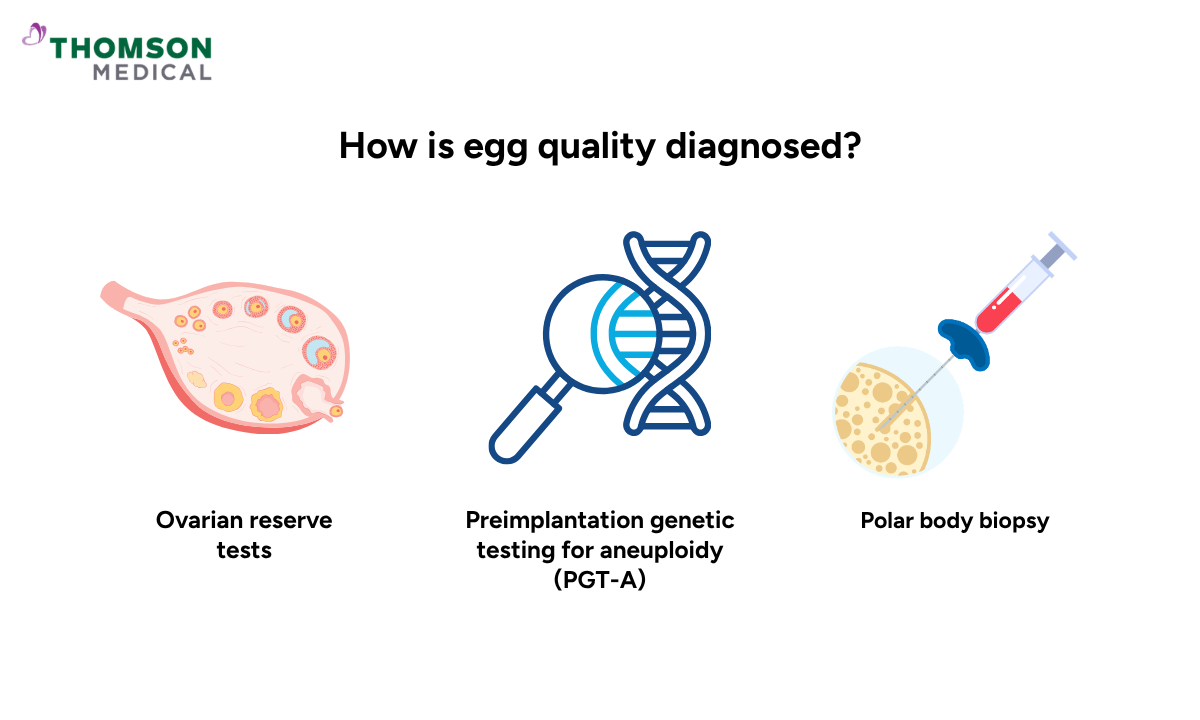
There is currently no single test that could directly measure overall egg quality. Fertility specialists usually assess egg quality by considering several factors, such as your age, medical and reproductive history, as well as how your eggs or embryos develop during IVF.
However, there are some tests that may provide useful information, even though each has its limitations. These tests include:
Ovarian reserve tests:
These include an anti-Müllerian hormone (AMH) blood test and an antral follicle count.
These tests may help to estimate the number of eggs that may be available or collected during IVF, but they do not directly measure egg quality.
Preimplantation genetic testing for aneuploidy (PGT-A):
This test is performed on an embryo, usually at the blastocyst stage (around day 5 of early embryo development), to check for an abnormal number of chromosomes.
As the test is performed on the embryo rather than the egg, it provides information on both the egg and sperm quality.
Polar body biopsy:
The polar body carries genetic information related to the egg and could be analysed for certain chromosomal abnormalities. Unlike PGT-A, it looks specifically at the egg's contribution rather than the embryo's.
However, it does not provide a complete assessment of egg quality and is not routinely performed. It may be considered in specific situations, such as when there is a known maternal genetic or chromosomal condition.
When to seek medical help?
If you are concerned about your egg quality or planning to undergo IVF, speaking with a fertility specialist could help you understand your individual circumstances. While healthy lifestyle habits may support your overall reproductive health, they may not address factors such as age, medical conditions, or genetic factors that may affect egg quality.
You may consider seeking medical advice if:
You have been trying to conceive without becoming pregnant:
Fertility assessment is generally recommended after 12 months of trying if you are under 35 or after 6 months if you are 35 or older.
Earlier assessment may be appropriate if you have known fertility concerns.
You have irregular periods or a known fertility condition:
Conditions such as PMOS, endometriosis, or thyroid disorders may affect reproductive function and may require medical interventions.
You are planning fertility treatment:
If you are considering IVF, intrauterine insemination (IUI), or egg freezing, a fertility specialist could help assess your ovarian reserve, medical history, and other factors to help determine the most appropriate approach.
You have concerns about your previous IVF cycle:
If you have experienced poor fertilisation, limited embryo development, or other concerns during a previous cycle, your fertility specialist may review your treatment history and discuss whether further assessment may be appropriate.
If you are concerned about your egg quality for IVF, speak with an O&G doctor to understand the factors that may affect it and discuss suitable tests based on your individual circumstances. Schedule an appointment with Thomson Medical.
FAQ
Can egg quality be improved at any age?
Age is one of the main factors affecting egg quality, and the natural decline in egg quality with age cannot be reversed. However, lifestyle modifications and appropriate medical care may support your overall health in the months leading up to IVF, which may also support the environment where the eggs will develop.
Steps to support egg quality may be implemented at any age, but they cannot reverse the underlying age-related changes in egg quality.
How long does it take to improve egg quality before IVF treatment?
There is no proven timeframe for improving egg quality before IVF. The eggs that mature during an IVF cycle have been developing in the ovaries for several months beforehand. For this reason, fertility specialists may recommend adopting healthy lifestyle habits several months leading up to IVF, rather than only in the days or weeks before treatment.
Can egg quality affect the number of IVF cycles needed?
Egg quality is one of several factors that may influence how an IVF cycle progresses. Because egg quality affects whether eggs fertilise normally and how the resulting embryos develop, it may play a role in how many IVF cycles a woman may need.
Generally, younger women tend to have a higher proportion of eggs with the expected number of chromosomes, and these eggs generally decrease with age. However, the number of cycles varies from women to women and cannot be predicted based on egg quality alone. Sperm quality, embryo implantation, and other individual factors may also contribute.
Can IVF treatment itself improve egg quality?
IVF works with the eggs produced by your ovaries, and it does not change their underlying quality. Instead, IVF allows a fertility specialist to monitor fertilisation and the development before the embryo transfer procedure begins.
Any steps taken to support egg quality are generally considered in the months leading up to IVF, rather than during the IVF cycle itself.
The information provided is intended for general guidance only and should not be considered medical advice. For personalised advice based on your conditions, schedule a consultation with Thomson Medical.
For more information, contact us:
Thomson Fertility Centre
- Paragon: 6252 7766
- Novena: 6399 3758, 8811 0358 (WA)