

If you and your partner are considering in vitro fertilisation (IVF), you may notice that much of the physical treatment centres on her, from hormone injections for ovarian stimulation to egg retrieval. So what part do you, as the male partner, play during the IVF procedure?
Here’s what you need to know about your role in IVF, including sperm collection and how you may support your partner throughout this treatment.
What role do men have in IVF?

During IVF treatment, most of the medical process happens to women's bodies, but that does not mean that men have no role in this procedure. Your role starts with providing a sperm sample with a healthy sperm count, motility (movement), and morphology (shape) for the IVF process.
It does not stop there, showing support for your loved one during the treatment is equally as important as things may not go as planned, and it's during these moments that being in the room together with your partner could make the difference.
One of the most practical ways to be involved is to take charge of the logistics, which includes:
Keeping track of medication schedules
Making phone calls to the clinic
Picking up prescriptions
Sorting out paperwork
Additionally, you could also help with injections at home if your partner requires it and your doctor has shown you how to do it.
What tests are done for men before IVF?
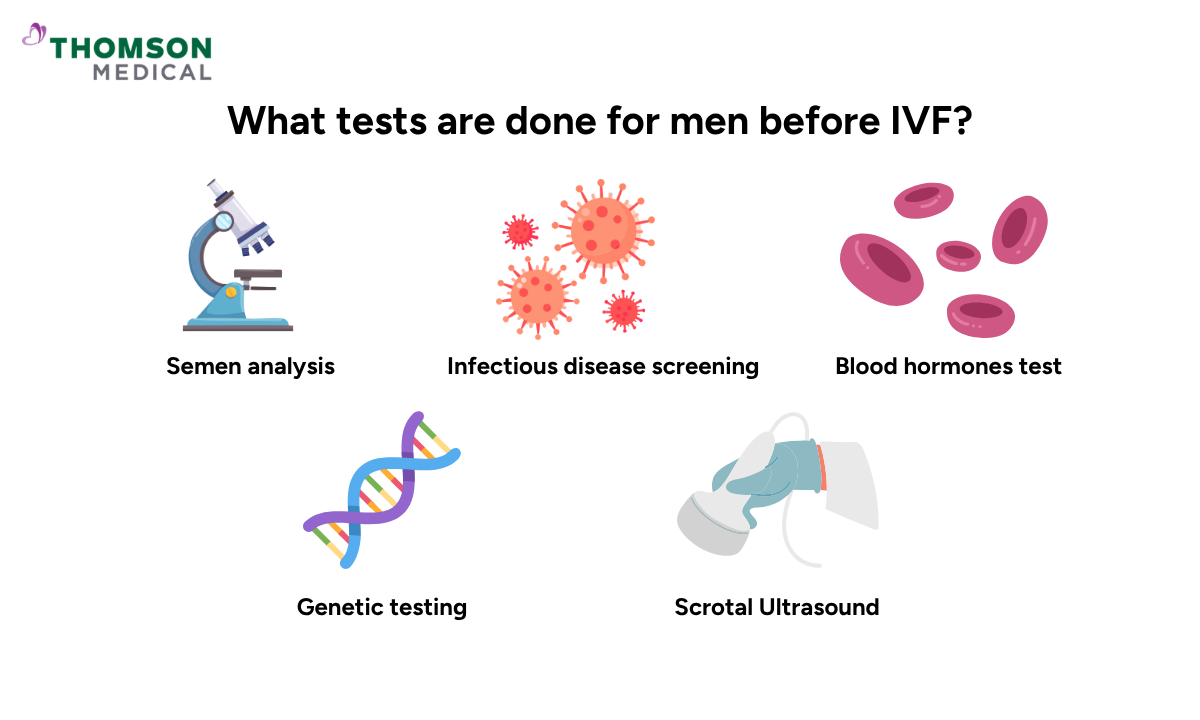
Before IVF, your doctor may recommend tests to assess possible male-factor issues and plan the treatment. These help your doctor understand the full picture and plan the treatment approach for you as a couple.
Semen analysis:
A semen analysis test is usually the first test that your doctor requests, which checks for semen volume, sperm concentration, motility, and morphology.
Infectious disease screening:
Blood hormone test:
Certain hormonal imbalances may affect sperm production. Your doctor may recommend hormone tests if your symptoms, examination findings, or semen analysis suggest a hormonal cause.
A simple blood test to measure hormones that influence sperm production, including testosterone, follicle-stimulating hormone (FSH), and luteinising hormone (LH). In some cases, your doctor may also check prolactin or thyroid levels.
Genetic testing:
Your doctor may recommend genetic testing in specific situations, such as severe low sperm count, to help identify an underlying cause and inform counselling.
These could help explain certain male fertility issues and give you and your partner useful information for planning ahead.
Scrotal ultrasound:
Your doctor may recommend a scrotal ultrasound when the examination or clinical history suggests a condition such as varicocele (enlarged veins within the scrotum) or another structural concern.
It is a scan that uses sound waves to create images of the testes (male sex glands) and scrotum (external pouch of skin that holds testicles).
Physical examination:
Your doctor may examine the testes and surrounding structures for signs such as a varicocele or testicular size changes.
These help identify factors affecting fertility, including past illnesses, sexual history, medication use, lifestyle habits, and general men’s health.
Because healthy sperm also plays an important role in conception during IVF, getting a clear picture of your reproductive function is important. Request an appointment with Thomson Fertility Singapore for a consultation with a fertility specialist.
Our fertility doctors in Singapore
Loading...
What happens if there are sperm quality or quantity issues?
A semen analysis is one of the key tests before IVF, and your results may show medical issues that could make conception more difficult. However, these results don’t, on their own, predict whether an IVF pregnancy is possible.
Common findings on sperm issues may include:
Oligozoospermia or low sperm count, where the sperm count is below 16 million sperm per millilitre.
Asthenozoospermia, where the sperm have reduced movement, occurs when fewer than 42% of sperm demonstrate normal movement.
Teratozoospermia, where the sperm have an unusual shape, occurs when less than 4% of sperm have a normal form.
Azoospermia, a condition where there are no sperm detected in the semen.
In this case, your doctors may consider the appropriate sperm retrieval procedure based on your condition.
How is sperm collected for IVF?
Before undergoing an IVF treatment, your doctor may collect and freeze sperm beforehand or collect it on the day of egg retrieval. They will first assess your condition to decide whether they could collect sperm from a standard semen collection or a surgical retrieval procedure.
Standard semen collection
During a standard collection, you will usually be instructed to collect your sperm sample in a private room at the clinic or at home. The sample is typically collected by masturbating into a sterile container provided by the clinic or laboratory.
Before the sperm is extracted, your clinic will give you specific guidelines, which may include:
Avoid ejaculation for 2 to 5 days before collection to make sure there is enough sperm in the sample.
To avoid contamination, the sample must not touch lubricants, water, or other foreign substances during the extraction process.
If your clinic approves home collection, use the sterile container provided by them and return the sample within the specified time. Keep it close to your body during transport and avoid extreme temperatures.
Surgical sperm retrieval
When standard semen collection does not provide a satisfactory sperm sample for planned fertility treatment, your doctors may consider surgical sperm retrieval. They will recommend a method based on the likely cause and individual clinical circumstances.
The available surgical sperm retrieval methods include:
Testicular sperm aspiration (TESA):
TESA uses a fine needle to retrieve sperm directly from the testicle.
Doctors may consider TESA for men with obstructive azoospermia, where a blockage in the reproductive tract prevents sperm from entering the semen.
Percutaneous epididymal sperm aspiration (PESA):
PESA uses a fine needle to collect sperm from the epididymis – a small, coiled tube behind each testicle where sperm mature and are stored.
Doctors may consider PESA for men with obstructive azoospermia.
Testicular sperm extraction (TESE):
TESE involves making a small incision in the scrotum and testicle to remove a small sample of testicular tissue. Then, an embryologist examines the tissue in the laboratory to look for sperm.
Doctors may use TESE in selected circumstances, including some cases where sperm production is reduced.
Microepididymal sperm aspiration (MESA):
MESA involves making a small incision and using an operating microscope to collect sperm-containing fluid from the epididymis.
Doctors may consider MESA for men with obstructive azoospermia.
Microdissection TESE (microTESE):
Micro-TESE involves making a small incision in the testicle and using an operating microscope to identify tissue that may contain sperm.
Doctors may consider micro-TESE for men with non-obstructive azoospermia, which occurs when no sperm are found in the semen because the testicles produce very few or no sperm.
After the doctor retrieves sperm, an embryologist may use them in the IVF fertilisation process. The embryology laboratory may also freeze the sperm for possible future treatment, depending on the treatment plan.
How is sperm used in the fertilisation process?
After the semen sample is collected, the embryologist then prepares it in the laboratory. This process helps to separate and concentrate motile sperm from seminal fluid and other cells in the sample.
They then use the prepared sperm to fertilise the eggs in one of two ways:
Conventional IVF:
This is a procedure where the embryologist places prepared sperm together with the eggs in a culture dish to do the fertilisation process.
Conventional IVF treatment may be considered when the prepared sperm sample is appropriate for fertilisation without direct injection into the egg.
Intracytoplasmic sperm injection (ICSI):
ICSI is a procedure where an embryologist selects a single sperm and injects it directly into a mature egg using specialised equipment.
ICSI may be considered in situations such as reduced sperm count, movement, or normal form. It may also be considered where there has been a previous fertilisation concern.
The laboratory then checks the eggs for signs of fertilisation and monitors any resulting embryos as they develop.
Are there any risks or side effects for men during IVF?
Generally, providing a semen sample is painless and carries no physical risk. However, if surgical sperm retrieval is required, there are different risks involved, such as:
Temporary bruising
Swelling and discomfort
Bleeding
Infection
Prolonged pain
Failure to retrieve sperm
However, there are also some emotional aspects that you need to consider. That's because the result may not be what you expected, and it may be difficult to process. Some men even describe feelings of guilt or shame, or a sense that they have let their partner down.
While the situation is indeed difficult, having those feelings is understandable, but you need to understand that this is not your fault. To help you through this challenging period, you could try:
Talking openly with your partner may help you better understand each other’s concerns and decide how you would like to approach fertility testing or treatment together.
Some people also find it helpful to speak with a fertility counsellor, psychologist, or other mental-health professional who has experience supporting people through fertility-related challenges.
It may also help to focus on the next practical step, such as discussing the results with a fertility specialist, asking questions about possible causes and learning about the options available.
What could you do to help optimise sperm quality before IVF?
Making lifestyle changes to improve sperm quality is one way to support your partner through IVF treatment. Here are some things you could try to help improve sperm quality:
Eat a diet rich in antioxidants: as fruit, vegetables, nuts and oily fish may help protect sperm from damage.
Maintain a healthy weight: being overweight could affect hormone levels and sperm production.
Stop smoking and vaping: both are linked with a lower sperm count, reduced sperm motility and DNA damage.
Cut back on alcohol: since heavy drinking may lower testosterone levels and affect sperm production.
Avoid high temperatures: those in saunas, hot tubs and long hot baths, for example. This is because sperm production works best when it is slightly below body temperature.
Keep laptops off your lap: as extended use could warm the testicle area more than expected.
If you and your partner have been considering IVF for your fertility treatment, consider a consultation with a fertility specialist. Request an appointment at Thomson Fertility Singapore.
FAQ
How much sperm is required for IVF?
The amount of sperm needed for IVF treatment depends on how the embryologist fertilises the eggs. In conventional IVF, the laboratory places many moving sperm with each egg and allows fertilisation to occur in the laboratory.
Meanwhile, with ICSI, the embryologist injects one selected sperm directly into each mature egg, so fewer sperm may be needed.
Can men with low sperm counts still do IVF?
IVF treatment may still be possible with a low sperm count. Doctors often discuss ICSI in this situation, which involves injecting one sperm into a mature egg, if it is appropriate for your semen analysis results and treatment plan.
What if you can't produce a sperm sample during sperm collection day?
You can tell your clinic as soon as possible. Depending on your treatment plan, they may be able to discuss options such as collecting and freezing a backup sample in advance, rescheduling collection, or considering surgical sperm retrieval when appropriate.
Can you still have IVF if you have had a vasectomy?
Although a vasectomy prevents sperm from making its way to the seminal fluid during ejaculation, it does not usually stop sperm production. Your doctor may discuss surgical sperm retrieval for use with ICSI, vasectomy reversal, or both, depending on your circumstances and goals.
The information provided is intended for general guidance only and should not be considered medical advice. For personalised recommendations and tailored advice based on your unique conditions,schedule an appointmentwith Thomson Medical.
For more information, contact us:
Thomson Fertility Centre
- Paragon: 6252 7766
- Novena: 6399 3758, 8811 0358 (WA)
Dr Tan Heng Hao
Obstetrics & Gynaecology (O&G)
Thomson Fertility Singapore (Novena)
English
Great Eastern, Prudential x TMC
