
.png%3Fbranch%3Dprod&w=3840&q=75)
You may imagine surgery as something that involves a long recovery, noticeable scars, and major disruption to daily life, but does that always have to be the case?
Laparoscopic surgery offers a less invasive option for many gynaecological conditions. Using small incisions, doctors can treat issues such as fibroids, ovarian cysts, and endometriosis with care and precision.
Many women find that recovery is more comfortable and quicker compared to traditional open surgery, allowing them to return to everyday activities sooner. While recovery experiences vary, laparoscopic techniques are designed to minimise tissue disruption while effectively treating the underlying condition.
What is laparoscopic surgery?
Laparoscopic surgery – also called keyhole or minimally invasive surgery – is a technique where operations are performed through small incisions rather than one large cut.
Your surgeon inserts a thin tube with a camera (the laparoscope) and specialised instruments through these tiny openings, allowing them to view your internal organs on a screen and complete the procedure.
This approach differs from traditional open surgery in several ways, such as:
Incision size:
Your surgeon makes several small cuts (usually 0.5–1.5 cm) instead of one large incision.
Visual approach:
Your surgeon uses a camera and monitor rather than looking directly at the surgical site.
Tissue impact:
There is less disruption to your surrounding muscles and tissues.
Recovery:
You usually experience faster healing compared to open surgery.
That said, laparoscopic surgery isn't suitable for every situation. Open surgery may be recommended instead if you have extensive scar tissue from previous operations, very large masses that require removal, or certain emergency conditions where a larger surgical view is needed.
Your doctor will assess your individual condition and recommend the approach that is safest and most appropriate for your needs.
Benefits of laparoscopic surgery
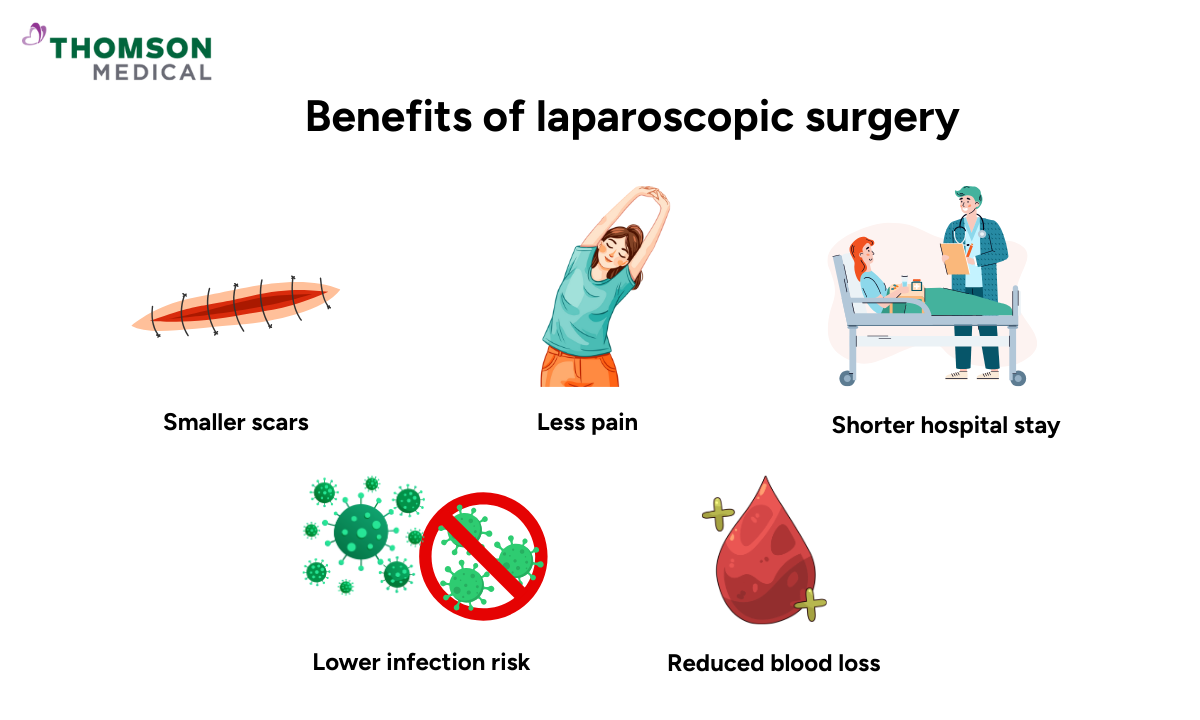
If you're considering surgery, it’s natural to wonder how it will affect your body and your return to normal life.
Laparoscopic surgery offers several advantages that can make your surgical experience and recovery more comfortable, including:
Smaller scars:
The tiny incisions leave minimal scarring, which many patients appreciate
Less pain:
You'll likely experience less discomfort after surgery and may need fewer pain medications
Shorter hospital stay:
Many patients go home the same day or within 1-2 days
Lower infection risk:
Smaller incisions mean less exposure and reduced chance of infection
Reduced blood loss:
The precise nature of the procedure normally results in minimal bleeding
If you have concerns about how surgery might impact your fertility, work commitments, or daily routine, these advantages can make a real difference to your recovery journey.
If you're unsure whether laparoscopic surgery is right for your situation, schedule an appointment with Thomson Medical. Our gynaecologists can assess your condition and explain which approach would be suitable for you.
Our keyhole surgeon in Singapore
Loading...
Common laparoscopic procedures in Singapore
Laparoscopic surgery can address many gynaecological conditions, from painful symptoms to concerns affecting your fertility. Some of the procedures commonly performed using this minimally invasive approach include:
Ovarian cyst removal:
This procedure removes cysts on your ovaries that may be causing pain, bloating, or fertility concerns.
Your surgeon can often preserve healthy ovarian tissue during the removal, which is particularly important if you're planning to have children.
Fibroid removal (myomectomy):
If you have uterine fibroids causing heavy bleeding, pelvic pain, or fertility difficulties, laparoscopic myomectomy allows your surgeon to remove the growths while preserving your uterus.
This approach often results in less scarring compared to traditional open surgery.
Endometriosis treatment:
Laparoscopic surgery in Singapore is one of the most effective ways to diagnose and treat endometriosis.
Your surgeon can remove endometrial tissue growing outside your uterus and clear adhesions that may be causing pelvic pain or affecting your ability to conceive.
Tubal surgery:
Damaged or blocked fallopian tubes are a common cause of infertility.
Through laparoscopic surgery, your doctor can repair tubal damage, remove blockages, or reverse tubal ligation when appropriate for your reproductive goals.
Hysterectomy:
When medical management hasn't worked for your condition, laparoscopic hysterectomy offers a less invasive option for removing your uterus.
The smaller incisions mean you'll likely experience less pain after the surgery and return to your daily activities sooner.
Ectopic pregnancy treatment:
When a pregnancy develops in your fallopian tube or elsewhere outside the uterus, prompt laparoscopic intervention can help to remove ectopic pregnancy tissue and preserve your fallopian tube when possible for future fertility.
During your consultation, your gynaecologist will take time to understand your symptoms and concerns before recommending the right treatment procedure for your situation.
Recovery and what to expect
Most patients find recovery from laparoscopic surgery more comfortable than traditional open surgery. While everyone heals at their own pace, knowing what to expect can help you prepare and feel more at ease.
Depending on your procedure, you may go home the same day or stay for one to two nights. Your medical team will make sure you're comfortable and ready before discharge.
In the first few days, your body will be adjusting and starting to heal:
You'll likely feel tired and need plenty of rest
Some pain or discomfort around the incision sites is normal
Light walking is encouraged to support healing
You may experience mild shoulder or abdominal discomfort from the gas used during surgery – this usually resolves within a day or two
Taking care of your wound is straightforward – keep your incision sites clean and dry, and watch for signs of infection such as increased redness, swelling, or discharge.
You'll ease back into your routine at a comfortable pace. Try to avoid heavy lifting and strenuous exercise for the first one to two weeks. Most patients return to their normal activities within two to four weeks, depending on their procedure.
Your surgeon will schedule a follow-up appointment to check your healing and address any questions or concerns you may have.
If you have concerns about your recovery timeline or how surgery might affect your daily routine, schedule an appointment with Thomson Medical. Our team can walk you through what to expect and answer your questions about your healing process.
Laparoscopic surgery cost in Singapore
Understanding the cost of your procedure helps you plan ahead and explore your payment options. The cost of laparoscopic surgery in Singapore varies depending on the type of procedure, your choice of hospital, the surgeon's fees, and the length of hospital stay.
You can expect these typical cost ranges for gynaecological laparoscopic procedures:
Simpler procedures such as ovarian cyst removal range from SGD 8,000 to SGD 15,000
More complex surgeries like myomectomy or endometriosis treatment cost between SGD 15,000 and SGD 30,000 or more
Public hospitals generally offer lower costs due to government subsidies, while private hospitals may have higher fees but often provide shorter waiting times and more personalised care.
To help manage the cost of your treatment, you may use MediSave, MediShield Life, Integrated Shield Plans, or your private health insurance. It’s recommended to request a detailed cost estimate from your hospital or clinic before your surgery. This helps you plan financially and understand what's covered by your insurance or government schemes.
Where to get laparoscopic surgery in Singapore
.png?branch=production)
Laparoscopic surgery is widely available across Singapore in both public and private healthcare facilities. Your choice will depend on factors such as your surgeon's experience, hospital location, waiting times, and costs.
You can also consult private specialist gynaecologists who perform laparoscopic procedures at various hospitals. Many experienced surgeons work across both public and private settings.
If you're considering laparoscopic surgery, the first step is scheduling a consultation with a gynaecologist who can assess your condition and discuss whether this approach is right for you. During this appointment, you'll have the opportunity to ask questions about the procedure, recovery, and what to expect throughout your treatment journey.
FAQ
How long does laparoscopic surgery take?
The duration varies depending on the procedure. Simple operations like appendectomy (the surgical removal of the appendix, a small pouch in your lower right abdomen) may take 30 minutes to 1 hour, while more complex surgeries can take 2-3 hours or longer.
Who is suitable for laparoscopic surgery?
Most patients can undergo laparoscopic surgery, but it may not be suitable for everyone. Your doctor will assess factors such as your overall health, previous surgeries, the complexity of your condition, and any medical conditions you have. They'll recommend the safest approach for your specific situation.
Is laparoscopic surgery painful?
Most patients experience less pain compared to open surgery. You may feel some discomfort around the incision sites and mild shoulder pain from the gas used during surgery, but this usually improves within a few days. Pain medication will be provided to keep you comfortable.
What are the risks of laparoscopic surgery?
While laparoscopic surgery is generally safe, possible risks include bleeding, infection, injury to nearby organs, and complications from anaesthesia. In rare cases, the surgeon may need to convert to open surgery for safety reasons. Your surgeon will discuss specific risks based on your procedure.
When can I return to work after laparoscopic surgery?
Most patients can return to work within 1-2 weeks, depending on the type of surgery and your job requirements. If your work involves heavy lifting or strenuous activity, you may need 3-4 weeks off. Your doctor will provide specific guidance based on your recovery.
What should I avoid after laparoscopic surgery?
Avoid heavy lifting, strenuous exercise, and driving while on strong pain medication for the first 1-2 weeks. Don't smoke or drink alcohol during early recovery, and make sure to follow your wound care instructions carefully.
The information provided is intended for general guidance only and should not be considered medical advice. For personalised recommendations based on your medical conditions, request an appointment with Thomson Medical.
Citations
Bills and fee benchmarks. (n.d.-b). Ministry of Health. https://www.moh.gov.sg/managing-expenses/bills-and-fee-benchmarks/
For more information, contact us:
Thomson Specialists (Women's Health)
Thomson Women's Clinic (TWC)
- Novena:
6592 6686 (Call), 8611 8986 (WA) - Bukit Batok:
6569 0668 (Call), 8686 3525 (WA) - Choa Chu Kang:
6893 1227 (Call), 8282 1796 (WA) - Jurong:
6262 8588 (Call), 6262 8588 (WA) - Katong (female doctor):
6970 2272 (Call), 8611 9020 (WA) - Punggol:
6243 6843 (Call), 8811 0328 (WA) - Sembawang: 6753 5228
- Sengkang: 6388 8125
- Serangoon (female doctor): 6382 3313
- Tampines: 6857 6266
- Tiong Bahru: 6276 1525
Notice
The range of services may vary between TWC/TS locations. Please contact your preferred branch directly to enquire about the current availability.
Request an Appointment