

You’ve completed the egg retrieval procedure for your in vitro fertilisation (IVF) treatment, and you may now wonder if your menstrual cycle is proceeding normally. Knowing what to expect from your menstrual cycle after IVF may help you understand your body’s natural adjustments and recognise when to simply wait and when it is time to speak to your doctor.
Could you have a menstrual cycle after IVF?
Following an IVF treatment, it is normal to have a menstrual cycle. Your period is a typical part of the process, especially if you do not become pregnant. If the cycle is unsuccessful, your body will shed the uterine lining, leading to a period. However, if the cycle is successful and implantation occurs, your period will stop due to pregnancy hormones.
How does IVF affect your menstrual cycle?
To understand how IVF might affect your cycle, it helps to look at the typical stages of IVF treatment.
Ovarian stimulation:
You’ll receive hormone injections and fertility medications for 1 to 2 weeks to encourage your ovaries to produce multiple eggs, rather than the usual single egg.
This step gives your doctor the best chance of selecting high-quality eggs for fertilisation.
Egg retrieval:
Just before natural ovulation occurs, your doctor uses transvaginal ultrasound-guided aspiration to retrieve the eggs from your ovarian follicles.
You will receive anaesthesia to ensure you are comfortable during this 15 to 30 minute procedure.
Sperm preparation:
Your clinic collects and prepares quality sperm from your partner, either provided on the day of retrieval or thawed from a frozen sample.
Fertilisation:
The mature eggs and sperm are combined in an incubator. If there are concerns about semen quality, your doctor may use intracytoplasmic sperm injection (ICSI) to inject a single sperm directly into an egg. The fertilised eggs then develop into embryos over 2 to 5 days.
Embryo transfer:
During this procedure, your doctor will carefully perform an embryo transfer into your uterine cavity using a catheter (a thin, flexible tube). If the embryo successfully implants into the uterine lining, pregnancy occurs.
The two-week wait:
After the transfer, you may have most daily routines, though you should avoid vigorous activities while your ovaries remain enlarged.
You will then wait approximately two weeks before taking a pregnancy test.
During the IVF cycle, your body undergoes hormonal stimulation, which could temporarily disrupt your natural cycle. Because of this, your body may need time to recalibrate hormonally after the cycle, causing your next few periods to be different from your usual pattern in terms of timing, flow, and symptoms.
When will your first period arrive?
The timing of your first period depends on what happened during your cycle. You could expect:
If your cycle ended without an embryo transfer, your period may arrive around 1 to 2 weeks after egg collection.
If you had an embryo transfer but did not fall pregnant, your period may start within 3 to 7 days of stopping progesterone support.
If IVF was successful, your period will not come.
If your period has not returned as expected after IVF, or if you are unsure whether your recovery is on track, consult a fertility specialist. Schedule an appointment with Thomson Medical to discuss your symptoms and find out what the next steps in your care are.
Our fertility doctors in Singapore
Loading...
What changes might you notice?
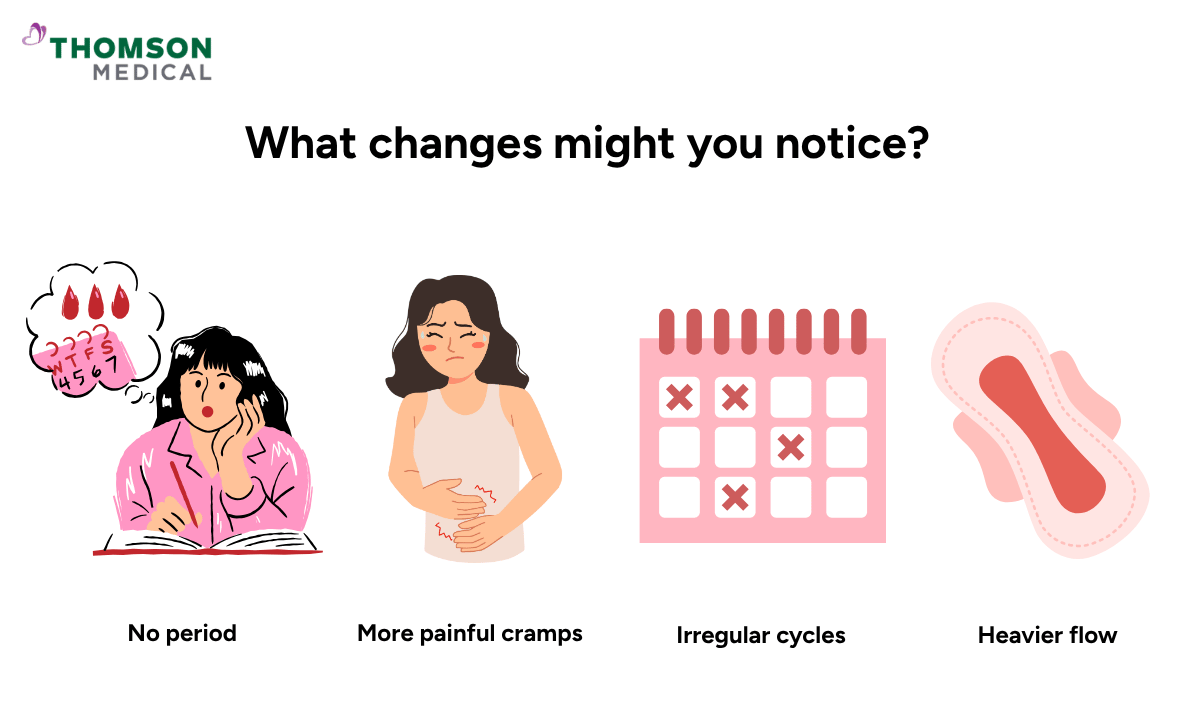
Your first period after IVF, and sometimes the next few, may feel different from your usual cycle. These changes are common and resolve within a few period cycles.
Early period
Your period may arrive sooner than you expect, which could happen because of hormonal changes after treatment. Or when stopping progesterone support, this signals your body to begin shedding the uterine lining. It’s usually temporary and not a cause for concern.
Late period
A delayed period is also possible, as your body may need more time to adjust after IVF, or ovulation in your next cycle may take a little longer. Leftover hormones from your fertility medicines may also play a part. Some variation in timing during the first one to two cycles is common as hormone levels return to their baseline.
No period
If your period has not arrived and you’re not pregnant, hormonal changes or delayed ovulation may be the reason. Conditions such as polyendocrine metabolic ovarian syndrome (PMOS), previously known as PCOS, could also play a part, as your cycles may be irregular and take longer to regulate.
Should several weeks pass without a period, a medical evaluation is recommended to identify any underlying cause.
More painful cramps
You might notice that menstrual cramps feel more intense than usual, a common occurrence driven by the ovarian stimulation medications used during IVF. This process could leave the ovaries temporarily enlarged, leading to increased discomfort that usually subsides as your body normalises in the following cycles.
Irregular cycles
It’s common for your cycle length and ovulation timing to vary for one to three months after IVF. Your body is returning to its natural cycle, and most women return to their usual pattern over time.
Heavier flow
Your first period after IVF may be heavier than usual, as the uterine lining was built up with hormone support during treatment, causing more to be shed. A heavier menstruation for one cycle is not usually clinically significant, but speak to your doctor if the bleeding is very heavy or accompanied by other concerns.
How to support your body after IVF
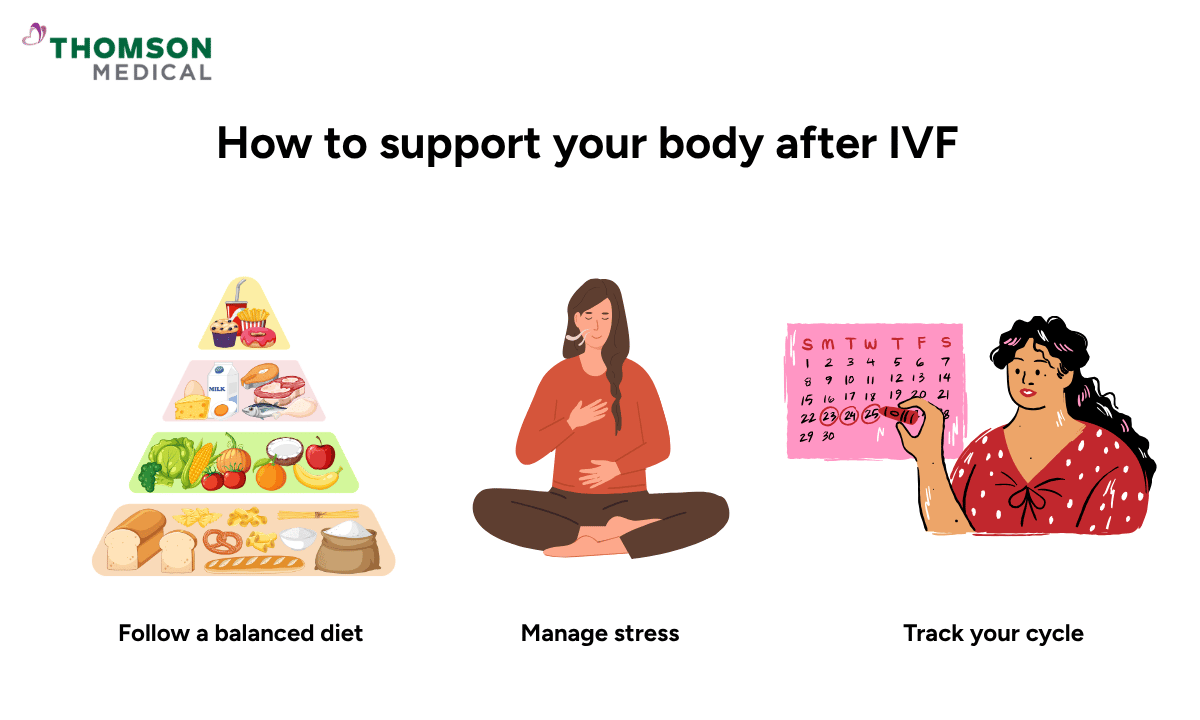
Certain steps may support your body's recovery after IVF and help your menstrual cycle return to its usual pattern. You could support your recovery by:
Allow time to recover, as hormone levels need time to settle after fertility treatment.
Follow a balanced diet to support hormonal balance and overall recovery.
Manage stress where possible, as emotional and physical stress could affect how quickly your cycle regulates.
Prioritise adequate sleep, which plays an important role in hormonal balance.
Follow your doctor's advice, including taking any prescribed hormone therapy and attending scheduled appointments.
Track your cycle to help you and your doctor identify patterns and monitor your recovery.
When to see your doctor
Most changes to your menstrual cycle after IVF are temporary and not a cause for concern. However, there are times when it’s important to get checked. Speak to your doctor if you notice:
No period for 4 to 6 weeks after IVF, and you’re not pregnant
Bleeding heavily enough to soak through a pad within an hour
Severe or worsening pain
Persistent irregular cycles beyond 2 to 3 months
Fever, dizziness, or unusual discharge
In some cases, severe pelvic pain or bloating after ovarian stimulation may be linked to ovarian hyperstimulation syndrome (OHSS), which your doctor will want to assess. Seeking advice early means any concerns might be identified and addressed promptly.
Whether you’re recovering after an IVF cycle or preparing for another round of fertility treatment, knowing changes to your menstrual cycle is important. Schedule an appointment with our fertility specialist at Thomson Medical for a diagnosis.
FAQ
Can IVF change your menstrual cycle?
Yes. IVF may temporarily affect your menstrual cycle because of the hormones used during treatment. Your first one or two periods may be earlier or later than usual, heavier, or come with stronger cramps. Most cycles return to their usual pattern within a few months.
When do you get your period after IVF?
If you are not pregnant, your first period will usually start within 1 to 2 weeks of egg collection, depending on your treatment plan and how your body responds. After that, your second period will usually arrive 4 to 6 weeks later. Your cycle length may vary slightly while your hormones return to their usual pattern.
Is your first period heavier after IVF?
It can be. Women may notice that their first period after IVF is heavier, lasts longer, or brings stronger cramping than usual. These changes are usually temporary and improve over the cycles that follow.
Why might your period be delayed after IVF?
A delayed period after IVF may be caused by lasting hormonal effects from your trigger shot, delayed ovulation, or natural cycle variation as your body recovers. Less commonly, it may be a sign of pregnancy, so your fertility clinic may suggest testing your hCG levels if your period does not arrive as expected.
Can I get my period during the two-week wait after IVF?
Not usually. Your period should not normally begin during the two-week wait if you’re still taking progesterone as prescribed. If you notice bleeding before your pregnancy test, it may be due to implantation or your hormonal medications. Please contact your fertility clinic to confirm the cause of the bleeding.
The information provided is intended for general guidance only and should not be considered medical advice. For personalised recommendations and tailored advice based on your unique conditions, schedule an appointment with Thomson Medical.
For more information, contact us:
Thomson Fertility Centre
- Paragon: 6252 7766
- Novena: 6399 3758, 8811 0358 (WA)