

Back pain, stiffness or discomfort in the middle of your back that won't go away can be frustrating, especially when you're not sure what's causing it. However, a thoracic spine MRI scan can offer insights into what is happening in the middle section of your spine.
Knowing what the scan involves, why it might be recommended and what it can detect can help you feel more informed before undergoing this procedure.
What is a thoracic spine MRI scan?
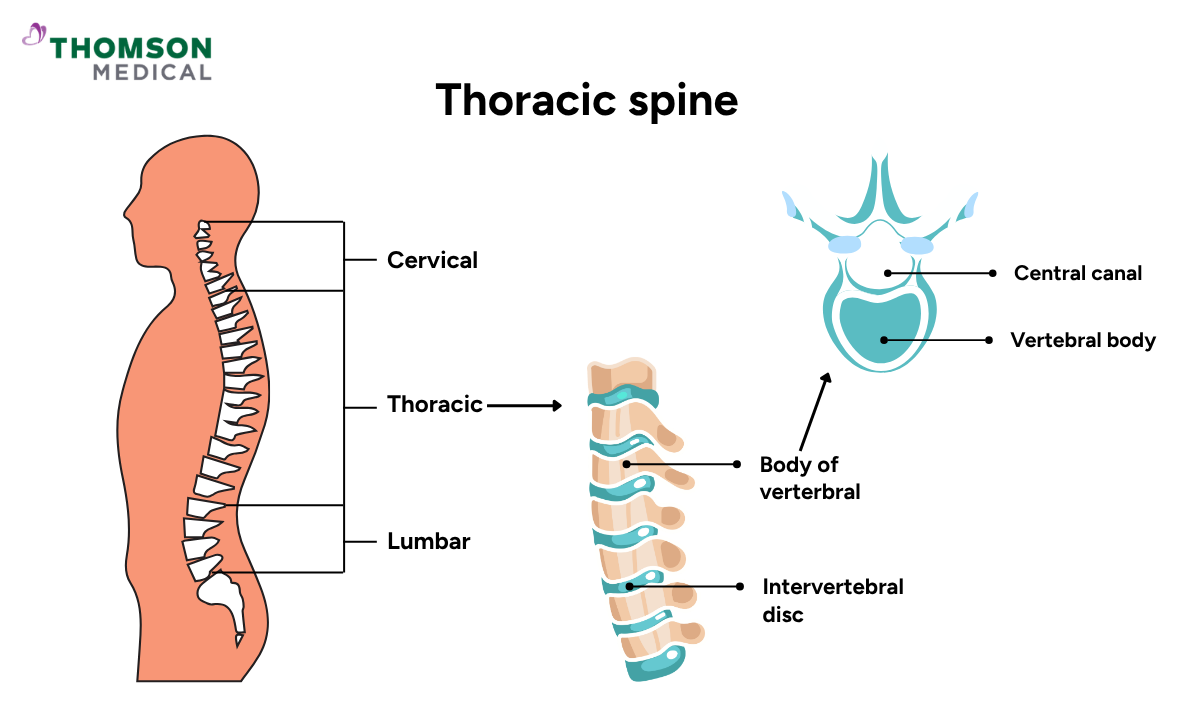
Magnetic resonance imaging (MRI) uses magnetic fields and radio waves to produce clear images of your bones, soft tissues, and nerves, with no radiation involved. A thoracic spine MRI involves taking detailed pictures of the middle section of your back.
Your thoracic spine is the section of your back that runs from the base of your neck to your lower chest. It includes 12 vertebrae, spinal discs, the spinal cord, muscles, and nerves.
Because this part of the spine sits near the chest, symptoms in this area can sometimes overlap with rib, muscular, or chest discomfort, making it harder to diagnose any issues. An MRI of this area gives your doctor a level of detail that a physical examination or X-ray alone cannot provide.
Why might you need a thoracic spine MRI?
There are several reasons your doctor might recommend a thoracic spine MRI. Most often, it is to get a clearer picture of what is causing your symptoms so that the right care can be given for you.
Common reasons include:
Ongoing mid-back pain that has not improved with rest or treatment
Numbness, tingling, or weakness in your arms or legs
Possible disc problems, such as a slipped or bulging disc
A past injury to your mid-back
Checking on a known condition, like a tumour or infection
Being referred for an MRI does not necessarily mean something serious is suspected. It’s often the most thorough way to assess an area that a physical examination alone cannot fully evaluate.
What can a thoracic spine MRI detect?
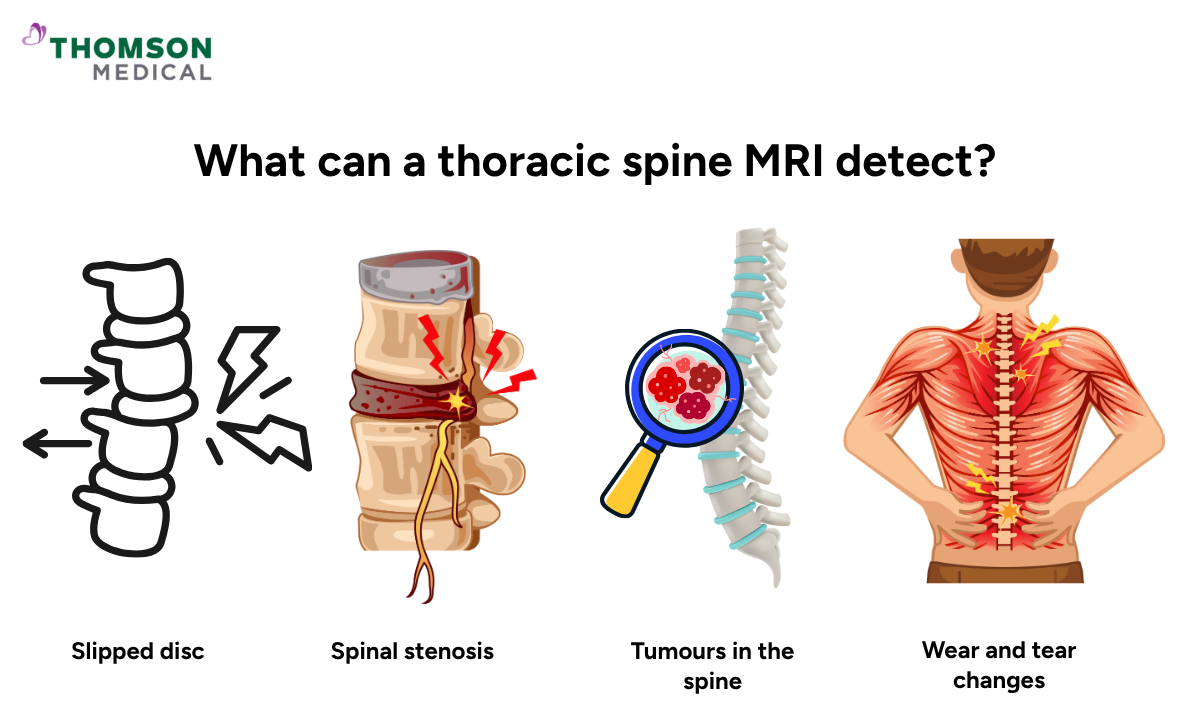
An MRI scan is able to reveal in-depth detail of the spinal cord, discs, nerves, ligaments, bone marrow, and surrounding soft tissues. However, a CT scan or X-ray may still be preferred for certain fracture patterns or fine bony detail.
MRI scans can help detect:
Slipped or bulging discs that may press on nerves
Narrowing of the spinal canal (spinal stenosis)
Problems affecting the spinal cord, such as compression or injury
Tumours in the spine or ones that have spread there
Inflammatory conditions like ankylosing spondylitis (a type of arthritis affecting the spine)
Small fractures that may not show on an X-ray
Wear and tear changes that happen over time
This level of detail matters because the same symptom, such as pain in the middle of your back, can have very different underlying causes.
Persistent mid-back pain or unexplained symptoms may require detailed imaging. Request an appointment with Thomson Medical to find out if a thoracic spine MRI is suitable for you.
Our thoracic spine surgeon
Loading...
Is a thoracic spine MRI safe?
A thoracic spine MRI is considered safe for most people. It does not use radiation and is non-invasive.
Safety during pregnancy
Although thoracic spine MRI does not use ionising radiation and may be performed during pregnancy, non-urgent scans are often deferred during the first trimester when possible. In such cases, contrast is generally avoided unless clearly needed.
Your doctors will check on the clinical needs before recommending imaging during your pregnancy.
Metal implants and medical devices
While most implants cause no issues during an X-ray, the strong magnetic field used in an MRI can affect certain devices, such as pacemakers, cochlear implants, and some spinal cord stimulators.
If you have any implants, a history of metal fragments in your body, or are unsure, let your doctor or radiographer know well in advance. They will check whether your specific implant is MRI-safe before proceeding.
Contrast dye and kidney function
If contrast dye is used for your scan, your doctor may check your kidney function beforehand. This is because gadolinium (the agent most commonly used) is processed by the kidneys, and extra care may be needed if you have an existing kidney condition.
Mild allergic reactions to contrast dye are possible, although they are uncommon. Your team will ask about your allergy history before the scan.
Patients with severe kidney disease may require additional review before contrast is used, but most people complete the scan without any difficulties. Serious complications are uncommon, and your team will take every step to ensure you feel informed and comfortable throughout.
How to prepare for your scan

Your doctor will provide specific instructions ahead of your appointment.
To help your scan go smoothly:
Follow any specific instructions from your doctor or the imaging centre
Let your care team know if you are pregnant or think you might be
Tell them about any allergies, especially if contrast dye is planned
Let them know about any metal implants, pacemakers, or medical devices
Avoid wearing jewellery or clothing with metal fastenings on the day
Arrive a little early to allow time for any paperwork
Most people can eat and drink as normal before the scan. However, if contrast dye has been planned for, the imaging centre will let you know in advance if fasting is required.
What happens during your scan
The scan is non-invasive and straightforward. Before the scan begins, you will be asked to remove any metal objects. If contrast dye is needed, a thin tube will be placed into your arm to deliver it.
During the scan:
You will lie on a padded table that slides gently into a large, tunnel-shaped machine
You will need to stay still throughout so the images are captured properly
The machine makes loud knocking sounds, and this is completely normal
You will be given earplugs or headphones to wear
A radiographer will monitor you throughout and can speak with you at any time
The scan usually takes between 30 and 60 minutes
Some people find the enclosed space uncomfortable or feel anxious about staying still for an extended period. If this concerns you, let our team know in advance. Depending on your needs, mild sedation, an open MRI, or additional support from the radiographer may be considered.
How much does a thoracic spine MRI cost in Singapore?
The cost of an MRI scan can vary depending on where it is done, whether contrast dye is required, and your insurance or subsidy eligibility.
At subsidised rates in public hospitals, an MRI scan typically ranges from SGD 400 to SGD 1,000, with higher costs for non-subsidised patients or private referrals. In private facilities, prices are generally higher and may range from SGD 900 to over SGD 2,500.
For Singapore citizens and permanent residents, MediSave may be used to help offset costs if you are eligible.
Please note that these are general estimates. For up-to-date figures and information on insurance eligibility, contact our medical concierge team.
What happens after the scan
Once the scan is complete, you can leave immediately. The images will be reviewed by a radiologist, who will send a written report to your referring doctor. Your doctor will go through the findings with you at a follow-up appointment.
Your follow-up appointment may include:
Discussion of normal findings and what they mean for your symptoms
Further tests or imaging if more information is needed
A treatment plan based on what the scan shows
A referral to a specialist such as an orthopaedic surgeon or neurologist
Your results will not usually be available on the same day as your scan. Turnaround times vary by centre, but your referring doctor will let you know once the radiologist's report is ready.
Your follow-up appointment is the time to run through the findings, ask questions, and discuss any next steps.
FAQ
Do I need a referral for a thoracic spine MRI in Singapore?
Yes, in most cases a referral from a doctor is required. This helps ensure the MRI is medically appropriate and allows the radiology team to perform the required type of scan based on your condition.
What conditions can a thoracic spine MRI show?
A thoracic spine MRI can detect a range of conditions affecting both bones and soft tissues. These include slipped or bulging discs, spinal stenosis, spinal cord compression, infections, fractures, and tumours, as well as inflammatory or degenerative spine conditions.
Can I drink water before an MRI?
In most cases, you can drink water before an MRI. However, if contrast dye or sedation is required, you may be asked to avoid food and drinks for a few hours beforehand. Always follow the specific instructions given by your imaging centre.
What if I need the toilet during the MRI scan?
It is best to use the toilet before your scan begins. If you feel uncomfortable during the MRI, you can alert the radiographer using the call button, and the scan can be paused if necessary.
Do you wear a bra during a thoracic spine MRI?
You may be asked to remove your bra, especially if it contains metal components like underwire or hooks, as these can interfere with the scan. You will usually be provided with a gown to wear instead.
Can I use MediSave for MRI scans?
Yes, in Singapore, MediSave can typically be used to help cover the cost of MRI scans if they are medically necessary and performed at approved institutions. The claimable amount depends on current guidelines and your specific situation.
The information provided is intended for general guidance only and should not be considered medical advice. For personalised recommendations and tailored advice based on your unique conditions, request a consultation with Thomson Medical.
For more information, contact us:
Thomson Medical Concierge
- 8.30am - 5.30pm
- WhatsApp: 9147 2051
Need help finding the right specialist or booking for a group?
Our Medical Concierge is here to help you. Simply fill in our form, and we'll check and connect you with the right specialist promptly.
Notice:
The range of services may vary between Thomson clinic locations. Please contact your preferred branch directly to enquire about the current availability.
Get In Touch