

Persistent vulval itching is common, and the usual explanations are benign: such as fungal infections, eczema, or allergic reactions. Vulvar cancer is rare by comparison, accounting for a small proportion of gynaecological cancers and occurring most often after menopause.
What the common conditions share with the rare ones is how they present, which is why itching that persists despite treatment, or a lump, ulcer or patch of changed skin that doesn’t settle, is worth having examined rather than left alone. Here’s what vulvar cancer is, the symptoms it can cause, the different types, and how it’s diagnosed.
What is vulvar cancer?
Vulvar cancer is a type of gynaecological cancer that starts in the vulva, the outer part of the female genitals. The vulva includes:
Clitoris: which is a small, sensitive organ at the top of the labia surrounding the vagina.
Labia majora: which are the outer folds of skin of the vulva.
Labia minora: which are the two thin folds of skin located inside the vulva, beneath the outer lips.
Bartholin's glands: which are the small glands producing mucus on either side of the vaginal opening.
Vulvar cancer may affect any part of the vulva, but it often affects the labia majora or labia minora.
What causes vulvar cancer?
Vulvar cancer begins when cells in the vulva mutate and grow uncontrollably. These abnormal cells can form a tumour, invade nearby tissue, and, in some cases, spread to other parts of the body in a process called metastasis.
The exact cause of this gynaecologic cancer is not always clear, but many vulvar cancers are linked to human papillomavirus (HPV), a common virus spread through sexual or skin-to-skin contact.
What are the risk factors for vulvar cancer?
While the exact cause of vulvar cancer is not fully understood, several factors could increase the risk. These risk factors include:
Older age: because vulvar cancer is more common in older women.
HPV infection: which may cause long-term cell changes that may lead to cancer.
Smoking: because it exposes your body to carcinogens (harmful chemicals that may contribute to cancer development).
A weakened immune system: because it could make it harder for the body to clear HPV or control abnormal cells.
A history of vulvar precancer, such as vulvar intraepithelial neoplasia (VIN): a precancerous condition when abnormal cells grow in the top layer of vulvar skin.
Lichen sclerosus: which is a vulvar skin condition that may damage vulvar skin over time and increase the risk of cancer.
Our gynaecological oncologist
Loading...
What are the symptoms of vulvar cancer?
Vulvar cancer may appear with several symptoms, which include:
A lump, wart-like bump, or open sore on your vulva.
Bleeding from the vulva that is not
- related to your period.
Itching on your vulva that does not go away.
Pain or tenderness in your vulva.
Changes in vulvar skin colour or texture, including thickening of the vulvar skin.
You should see a doctor if you notice unusual changes in your vulva or have any of these symptoms, especially if they last longer than two weeks or keep coming back.
If you have been noticing these vulvar cancer symptoms for a while, consider a consultation with a gynaecological oncologistwho may diagnose your condition and discuss possible next steps. Schedule an appointment with Thomson Women's Clinic & Cancer Surgery.
Types of vulvar cancer
Vulvar cancers come in several types, from the common to rare ones.
Vulvar squamous cell carcinoma
Vulvar squamous cell carcinoma is the most common type of vulvar cancer. It starts in the squamous cells (the flat cells that line the surface of the vulva), and it may grow into nearby tissue if left untreated.
Vulvar squamous cell carcinoma could develop through two main ways:
HPV-associated: which is linked to persistent infection with high-risk HPV and usually affects younger women.
HPV-independent: which is not linked to HPV. It occurs more often in older postmenopausal women and often develops in vulvar skin affected by long-term inflammatory conditions such as lichen sclerosus.
Verrucous carcinoma
Verrucous carcinoma of the vulva is a rare subtype of squamous cell carcinoma that grows slowly. It often looks warty or cauliflower-like, and it usually stays local rather than spreading to lymph nodes or distant organs.
Compared with vulvar squamous cell carcinoma, verrucous carcinoma is usually less aggressive. Doctors often treat it with surgical procedures, but if the tumour is not completely removed, it could become large and recur.
Vulvar melanoma
Vulvar melanoma is a rare type of cancer that starts in the pigment-producing cells, called melanocytes, in the vulva. It often appears as a dark brown or black patch, but it may also be red, pink, white, or amelanotic, which means it has little or no colour.
Because it could look like a harmless mole or skin change, doctors usually need a biopsy to confirm the diagnosis.
Extramammary Paget disease of the vulva
Extramammary Paget disease of the vulva is a rare skin cancer that usually affects postmenopausal women. It often appears with these following symptoms:
Persistent redness
Scaling
Itchiness
Eczema-like patches
With these signs, this type of vulvar cancer may be mistaken for dermatitis, psoriasis, or a fungal infection.
At first, the disease may stay in the top layer of the skin, but in some cases it may grow into the deeper tissue underneath. When that happens, it has a greater chance of spreading and recurring after treatment.
Sarcomas
Sarcomas are rare cancers that start in the connective tissues of the body, such as muscle, fat, blood vessels, or fibrous tissue. When they occur in the vulva, doctors call them vulvar sarcomas, and they make up only a small proportion of vulvar cancers.
Basal cell carcinoma
Basal cell carcinoma in the vulva is a rare skin cancer that usually grows slowly and is less likely to spread. It may appear as a small bump, patch, lump, or dark spot that does not go away.
Because it could look like a harmless skin change or another vulvar condition, your doctor usually needs to take a biopsy to confirm the diagnosis.
What are the stages of vulvar cancer?
There are 4 stages of vulvar cancer according to the FIGO system (International Federation of Gynecology and Obstetrics). The stage of cancer depends on the tumour’s size and depth, whether it has spread into nearby structures or lymph nodes, and whether it has spread to distant parts of the body.
Stage 1
Stage 1 vulvar cancer happens when the cancer is limited to the vulva or the skin between the vagina and anus, and it has not spread to the lymph nodes. It is the earliest invasive stage. Doctors divide this stage into two sub-stages:
Stage 1A: this is when the tumour is 2 cm or smaller and it grows 1 mm or less into the vulvar tissue.
Stage 1B: this is when the tumour is larger than 2 cm, or it grows more than 1 mm into the tissue.
Stage 2
Stage 2 vulvar cancer happens when the cancer has grown from the vulva into nearby tissues, but it has not reached the lymph nodes. At this stage, it may affect the lower part of the vagina, urethra, or anus.
Stage 3
Stage 3 vulvar cancer happens when the cancer has spread to nearby lymph nodes. It may also have grown into nearby tissues. Doctors divide stage 3 into:
Stage 3A: which is when the cancer has spread to one or two nearby lymph nodes, and the spread in the nodes is 5 mm or less.
Stage 3B: this is when the cancer has spread to lymph nodes, and the spread in the nodes is more than 5 mm.
Stage 3C: which is when the cancer has spread through the outer covering of a lymph node.
Stage 4
Stage 4 vulvar cancer happens when the cancer has spread further or is more advanced. Doctors divide this stage into two sub-stages:
Stage 4A: which is when the cancer has grown into the upper part of the urethra, the upper part of the vagina, the bladder lining, or the rectal lining. It may also be fixed to the pelvic bone, or the groin lymph nodes may be fixed or ulcerated
Stage 4B: this is when the cancer has spread to distant organs or lymph nodes.
How is vulvar cancer diagnosed?
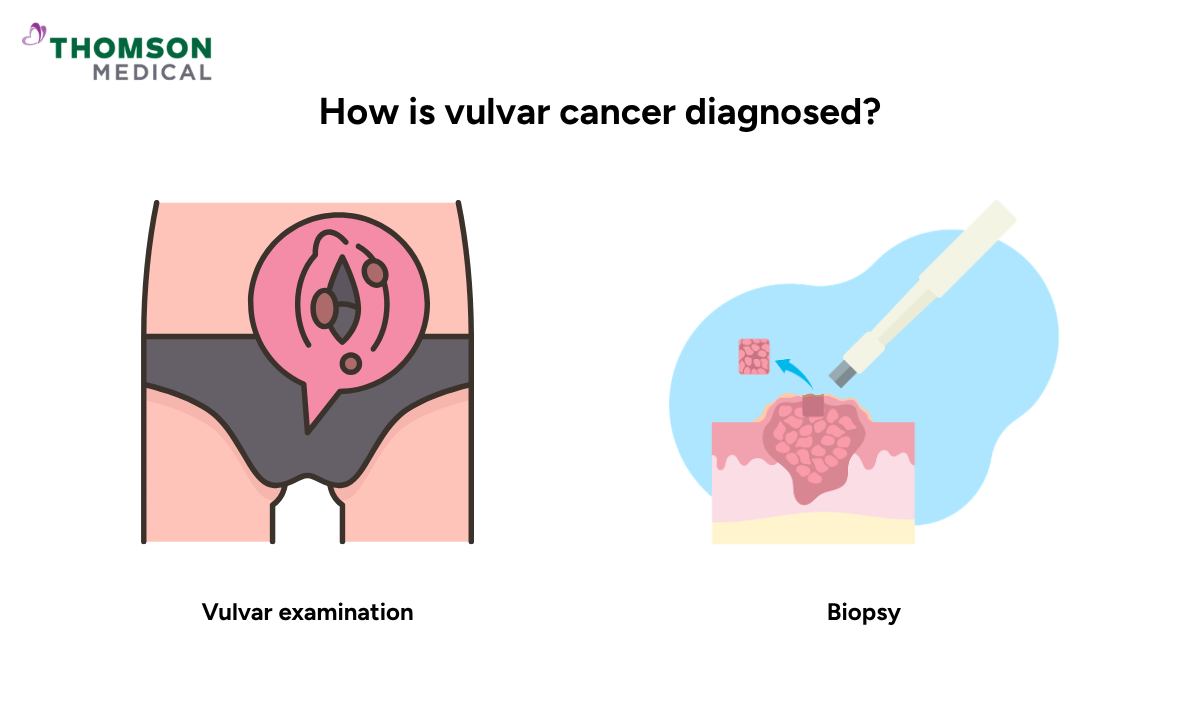
Your doctor usually diagnoses these cancerous conditions through a vulvar examination and a biopsy.
Vulvar examination: which involves a visual and physical check of the vulva to detect lumps, sores, colour changes or thickened skin.
Biopsy: which is when a doctor removes a small piece of tissue from the vulva and sends it to a laboratory. This procedure checks whether the suspicious area is cancer, precancer, or another vulvar condition.
Available treatment options
Vulvar cancer treatment varies based on the stage of the disease and may include several options for your consideration:
Surgery:
Surgery is often the first treatment for vulvar cancer, especially in early stages. Doctors usually remove the tumour and some healthy tissue around it.
In some cases, they also remove part or all of the vulva, including the labia minora, labia majora, and sometimes the clitoris. If they think the cancer may have spread, they may also remove lymph nodes from the groin.
Chemotherapy:
Chemotherapy uses anti-cancer drugs to destroy cancer cells. For vulvar cancer, it is not usually the main treatment on its own. Doctors more often use it to shrink the cancer, support radiotherapy, or treat advanced or recurrent disease.
Radiation therapy:
Radiation therapy uses high-energy rays to kill cancer cells or shrink the tumour. Doctors usually use radiation therapy to shrink the cancer before surgery, treat any cancer left after surgery, or treat cancer that has spread to lymph nodes or cannot be removed safely.
Immunotherapy:
Immunotherapy uses medicines that help your immune system recognise and attack cancer cells. Doctors usually consider it for advanced, recurrent, or metastatic vulvar cancer.
If you are unsure which vulvar cancer treatment is right for you, schedule an appointment at Thomson Women's Clinic & Cancer Surgery. A gynaecology specialist may help you understand your options based on your cancer type and stages.
How to reduce the risk of vulvar cancer?
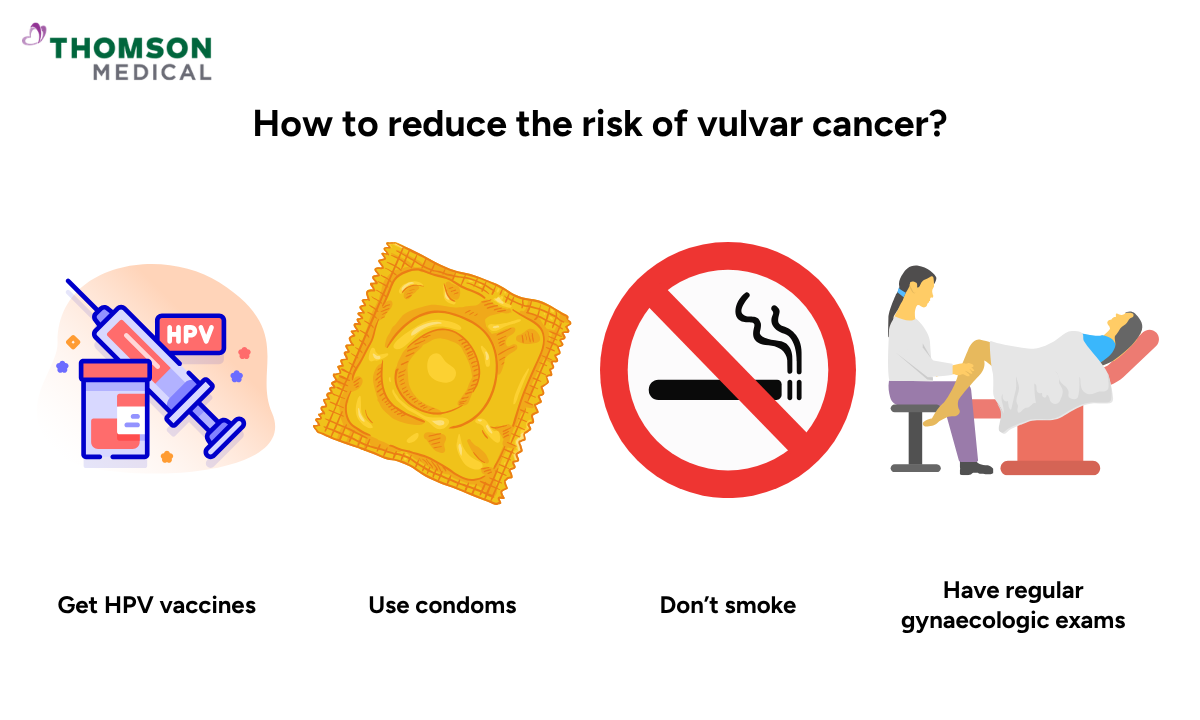
To help reduce the risk of vulvar cancer, you could try to avoid certain risk factors and ensure that any pre-cancerous conditions are treated before they develop into invasive cancer.
Consider getting the HPV vaccines, which helps to prevent HPV infection.
Use condoms during intercourse, as they lower the risk of HPV infection.
Do not smoke, because smoking exposes you to carcinogens.
Have regular gynaecological exams, which help check the health of your vulva and detect problems early.
FAQ
What conditions are often mistaken for vulvar cancer?
Several common non-cancerous conditions can look like vulvar cancer, especially when they cause itching, redness, sores, bumps, or a lump. The conditions include:
- Yeast infection
- Eczema
- Psoriasis
- Genital herpes
- Contact dermatitis
- Genital warts
- Lichen sclerosus
- Bartholin gland cysts
Can you do a self-examination to check for potential vulvar cancer?
Yes, you can do a self-exam to help notice changes that might need a doctor’s evaluation, but it does not replace a clinical exam or biopsy. It’s mainly for spotting new lumps, sores, colour changes, thickened skin, itching areas, or spots that do not heal.
To do it, you can use a mirror, good lighting, and clean hands. Check your whole vulvar area from the top of the vulva to the anus. Look and gently feel for bumps, sores, ulcers, redness, white patches, dark patches, or areas that are rough or thickened.
What happens if you don't treat vulvar cancer?
If you don't treat vulvar cancer, it can grow locally, causing more pain, itching, sores, bleeding, and damaging nearby tissue. Over time, it can spread to the surrounding organs and eventually to other body parts through the bloodstream.
It can lead to harder treatment in the future and complications, such as severe pain or urinary and bowel problems. Eventually, untreated vulvar cancer can become life-threatening.
Does vulvar cancer spread quickly?
Vulvar cancer usually spreads slowly and may take several years to get worse without treatment. However, some types of this cancer, such as melanoma, can spread more quickly. Additionally, if the cancer has spread to the lymph nodes, there is a higher risk of it spreading further to the other part of the body.
The information provided is intended for general guidance only and should not be considered medical advice. For personalised advice based on your unique conditions, schedule an appointment with Thomson Medical.
For more information, contact us:
Thomson Specialists (Women's Health)
Thomson Women's Clinic (TWC)
- Novena:
6592 6686 (Call), 8611 8986 (WA) - Bukit Batok:
6569 0668 (Call), 8686 3525 (WA) - Choa Chu Kang:
6893 1227 (Call), 8282 1796 (WA) Jurong:
6262 8588 (Call), 6262 8588 (WA)- Katong (female doctor):
6970 2272 (Call), 8611 9020 (WA) - Punggol:
6243 6843 (Call), 8811 0328 (WA) - Sembawang: 6753 5228
- Sengkang: 6388 8125
- Serangoon (female doctor): 6382 3313
- Tampines: 6857 6266
- Tiong Bahru: 6276 1525