

There is no routine screening test for vulvar cancer in Singapore or elsewhere. Unlike cervical cancer, which has pap smears and HPV testing, or breast cancer with mammography, vulvar cancer has no equivalent screening programme, largely because it’s uncommon enough that population screening wouldn’t be effective.
What takes place is simpler. Vulvar cancer is usually found because someone notices a change and has it examined, so the practical equivalent of screening here is knowing what's normal for you and getting persistent changes looked at. Here's why there's no screening test, what's checked during a routine gynaecological examination, and which changes are worth acting on.
What is vulvar cancer?

Vulvar cancer is a type of gynaecological cancer that starts in the vulva, the outer part of the female genitals. The vulva includes:
Clitoris: a small, sensitive organ at the top of the labia that surrounds the vagina.
Labia majora: which are the outer folds of skin of the vulva.
Labia minora: two thin folds of skin located inside the vulva, beneath the outer lips.
Bartholin's glands: small glands that produce mucus on either side of the vaginal opening.
Vulvar cancer could affect any part of the vulva, but it often affects the labia majora or labia minora.
Is there any vulvar cancer screening option?
Currently, there is no routine screening for vulvar cancer. To confirm whether you have this cancer, you will need a vulvar cancer diagnosis.
You should consider getting a diagnosis if you experience symptoms or have risk factors that may indicate vulvar cancer.
Symptoms
Vulvar cancer may appear with several symptoms, such as:
A lump, wart-like bump, or open sore on your vulva.
Bleeding from the vulva that is not related to your period.
Itching on your vulva that does not go away.
Pain or tenderness in your vulva.
Changes in vulvar skin colour or texture, including thickening of the vulvar skin.
It is best to see a doctor if these symptoms last longer than two weeks or keep coming back.
Risk factors
It is usually recommended to seek a diagnosis if you have symptoms and one or more of these risk factors:
Older age: because vulvar cancer is more common in older women.
Human papillomavirus (HPV) infection: this condition may cause long-term cell changes that may lead to cancer.
Smoking: it may expose your body to carcinogens (harmful chemicals that could contribute to cancer development).
A weakened immune system: that may make it harder for the body to clear HPV or control abnormal cells.
A history of vulvar precancer: for example, vulvar intraepithelial neoplasia (VIN) – a precancerous condition when abnormal cells grow in the top layer of vulvar skin.
Lichen sclerosus: a vulvar skin condition that could damage the skin over time and increase the risk of cancer.
How is vulvar cancer diagnosed?
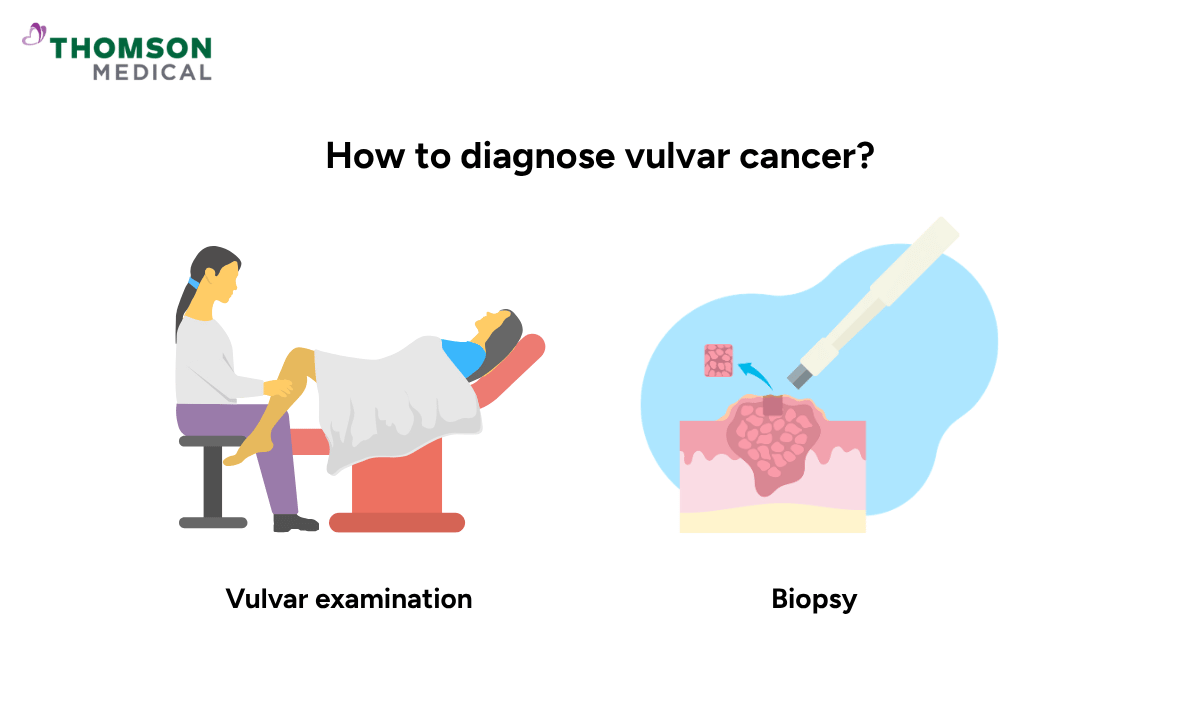
Your doctor usually diagnoses this cancerous condition with a vulvar examination and a biopsy.
Vulvar examination
A vulvar examination is a visual and physical check of the vulva to spot lumps, sores, colour changes, thickened skin, or other abnormalities.
Doctors usually follow these steps when performing a vulvar examination:
First, they observe the vulva from the outside.
They then check the skin for any changes, such as redness, swelling, sores, lumps, or discharge.
They may also gently separate the labia to see the area more clearly.
In some cases, they also do a pelvic examination to examine the inside of the vagina.
If needed, your doctor may also do a bimanual examination (checking inside the vagina and on the abdomen at the same time) or a rectovaginal examination (checking through the vagina and rectum at the same time) to assess nearby organs and tissue.
Vulvar biopsy
A vulvar biopsy is a procedure where a doctor removes a small piece of tissue from the vulva and sends it to a laboratory. This procedure checks whether the suspicious area has cancer, precancer, or another vulvar condition.
Vulvar biopsy usually follows these steps:
You lie down on the examination couch with your legs spread apart.
Your doctor then cleans a small area of vulvar skin where the biopsy will be performed.
After that, a local anaesthetic is injected to numb the skin.
Once the area is numb, your doctor will take a small sample, usually around 3 to 5 mm, of tissue from the vulva using a small biopsy tool or a scalpel.
After taking the sample, they may place one or two dissolvable stitches if needed.
They then send the tissue sample to a laboratory to be examined.
A vulvar biopsy is a minor procedure, and you may be able to go home the same day.
If you are considering a vulvar cancer diagnosis, schedule an appointment at Thomson Women's Clinic & Cancer Surgery, where a gynaecology specialist could assess your symptoms and guide you through the diagnostic process.
Our gynaecological oncologist
Loading...
How can vulvar cancer be prevented?
There is no procedure that guarantees prevention of vulvar cancer. However, as some high-risk HPV types, such as HPV 16, 33, and 18, could increase your risk, having the HPV vaccination may also help to prevent this cancer. The vaccine works best before exposure to HPV because it prevents new infections rather than treating existing ones.
According to Singapore’s National Childhood Immunisation Schedule (NCIS) and National Adult Immunisation Schedule (NAIS), females aged 9 to 26 are recommended to receive HPV vaccination. Some adults up to age 45 may also benefit from HPV vaccination after discussing it with their healthcare professional.
If you are considering HPV vaccination in Singapore, these vaccines are available. Each one offers protection against different HPV types:
Cervarix (HPV2): which protects against HPV types 16 and 18.
Gardasil (HPV4): which protects against HPV types 16 and 18, as well as types 6 and 11, which cause most genital warts.
Gardasil 9 (HPV9): provides broad protection against HPV types 6, 11, 16, 18, 31, 33, 45, 52, and 58. It helps protect against a wide range of HPV-related cancers and genital warts.
There are available subsidies for the HPV2 vaccine from the Singapore government. However, government subsidies and MediSave are not available for vaccination with HPV9 (Gardasil 9) and HPV4 (Gardasil), but you have the option to go for this vaccination at your own cost. Please check with the clinic directly on the pricing.
Please note that these subsidies are based on the information available on the MOH website at the time of writing, and they may have changed since then.
If you are considering HPV vaccination, please contact our medical concierge team at Thomson Medical, who could help discuss your specific situation with you and provide personalised cost guidance.
Vulvar cancer diagnosis costs in Singapore
Vulvar cancer diagnosis costs depend on whether you choose a public or private facility.
Vulvar examination costs
There is no single standard price for a vulvar examination on its own, because clinics often include it as part of a pelvic examination or women’s health screening package.
Private clinics:
A full women’s health or pelvic screening package, which usually includes a consultation, vulvar and pelvic examination, and other tests, typically ranges from SGD 250 to 580.
Public clinics:
The costs are usually lower if the visit is part of a subsidised screening or specialist appointment in public hospitals or polyclinics.
For an exact price, it is best to check with the clinic before booking, because fees may vary between providers and depend on what is included.
Unfortunately, vulvar examinations are generally not covered by MediSave, MediShield Life, or CHAS. However, some private health insurance policies may cover parts of its costs, depending on your plan.
Biopsy costs
Vulvar biopsy costs depend on whether you have the procedure in a public or private facility and whether the biopsy is done on its own or as part of a larger procedure. If the biopsy does not come with other procedures, the vulvar biopsy cost may range from around SGD 1,000 to 2,100 in private hospitals and clinics.
According to the CPF website, vulvar biopsies are classified under table 1, with a MediSave claim limit up to SGD 490.
Please note that these are estimated costs based on the information available at the time of writing, and they may have changed since then. These costs may also vary depending on the required treatment, hospital, and location of care.
Available treatments for vulvar cancer
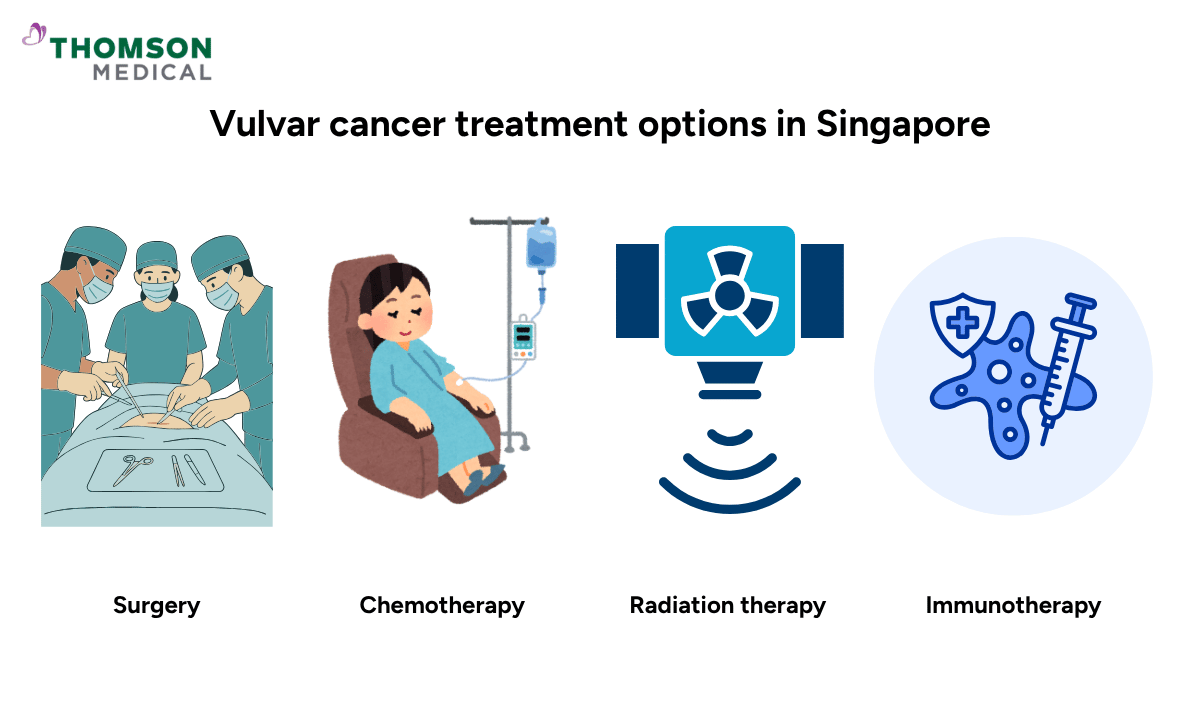
Vulvar cancer treatment varies based on the stage of the disease and may include several options:
Surgery:
Surgery is often the first treatment for vulvar cancer, especially in early stages. Doctors usually remove the tumour and some healthy tissue around it.
In some cases, they also remove part or all of the vulva, including the labia minora, labia majora, and sometimes the clitoris. If they think the cancer may have spread, they may also remove lymph nodes from the groin.
Chemotherapy:
Chemotherapy uses anti-cancer drugs to destroy cancer cells. For vulvar cancer, it is not usually the main treatment on its own. Doctors more often use it to shrink the cancer, support radiotherapy, or treat advanced or recurrent disease.
Radiation therapy:
Radiation therapy uses high-energy rays to kill cancer cells or shrink the tumour.
Doctors usually use radiation therapy to shrink the cancer before surgery, treat any cancer left after surgery, or treat cancer that has spread to lymph nodes or cannot be removed safely.
Immunotherapy:
Immunotherapy uses medicines that help your immune system recognise and attack cancer cells. Doctors usually consider it for advanced, recurrent, or spreading (metastatic) vulvar cancer.
If you are unsure which vulvar cancer treatment is right for you, schedule an appointment at Thomson Women's Clinic & Cancer Surgery. A gynaecology specialist could help you understand your options based on your cancer type and stages.
FAQ
Why is there no screening for vulvar cancer?
There is no routine screening test for vulvar cancer, because there is no simple and reliable way to detect this cancer early in women without symptoms.
At what age should you get a check for vulvar cancer?
There is no recommended age at which you should start a vulvar cancer check. Doctors usually check the vulva when you have symptoms or when they do a pelvic examination for other reasons.
What are the symptoms of early-stage vulvar cancer?
Early-stage vulvar cancer often causes few or no symptoms at first. When symptoms do appear, they usually involve:
- Persistent itching or burning on the vulva.
- A lump, bump, wart-like growth, or thickened area of skin.
- A sore, ulcer, or open patch that does not heal.
- Skin colour changes, such as red, white, pink, darker, or lighter patches.
- Bleeding or blood-stained discharge that is not related to periods.
- Pain or tenderness, especially when urinating or during intercourse.
Can a Pap smear detect vulvar cancer?
No, a Pap smear cannot detect vulvar cancer. The test collects cells from the cervix and upper vagina, not from the vulva. Vulvar cancer starts in the outer skin of the vulva, so a Pap smear does not normally reach the area where this cancer develops.
What are the signs that vulvar cancer has spread?
If vulvar cancer has spread, the signs often depend on where it has spread to. Possible signs include:
- A lump or sore on the vulva that grows, ulcerates, or does not heal.
- Worsening itching, burning, pain, or bleeding on the vulva.
- A swollen lump in the groin, which may suggest the cancer cells have spread into nearby lymph nodes.
- Pain when you are urinating or having intercourse, especially if the cancer has spread to the urethra, vagina, or anus.
- Tiredness, weight loss, or bone pain if the cancer has spread to distant parts of the body, such as the lungs, liver, or bones.
The information provided is intended for general guidance only and should not be considered medical advice. For personalised advice based on your unique conditions, schedule an appointment with Thomson Medical.
For more information, contact us:
Thomson Specialists (Women's Health)
Thomson Women's Clinic (TWC)
- Novena:
6592 6686 (Call), 8611 8986 (WA) - Bukit Batok:
6569 0668 (Call), 8686 3525 (WA) - Choa Chu Kang:
6893 1227 (Call), 8282 1796 (WA) Jurong:
6262 8588 (Call), 6262 8588 (WA)- Katong (female doctor):
6970 2272 (Call), 8611 9020 (WA) - Punggol:
6243 6843 (Call), 8811 0328 (WA) - Sembawang: 6753 5228
- Sengkang: 6388 8125
- Serangoon (female doctor): 6382 3313
- Tampines: 6857 6266
- Tiong Bahru: 6276 1525