

Vulvar cancer is treated in both the public and private clinics in Singapore, and the approach follows a broadly similar pattern, which is surgery in most cases, with radiotherapy or chemotherapy added depending on the stage and whether lymph nodes are involved.
What varies more is the cost and how it’s covered. Here’s what treatment for vulvar cancer involves, how the plan is shaped by stage and spread, what it typically costs in Singapore, and how MediShield Life, MediSave and private insurance may apply.
Where to go for vulvar cancer treatment in Singapore?
When deciding to go for a treatment in Singapore, you will need to discuss your diagnosis results or warning symptoms of vulvar cancer with a gynaecological oncologist. They are specialists who focus on female reproductive cancers, including vulvar cancer, and will usually oversee your treatment.
In Singapore, you could see a gynaecological oncologist and receive vulvar cancer treatment at:
Public hospitals
Public hospitals provide specialist cancer care within Singapore’s restructured healthcare system. Eligible Singaporean citizens and permanent residents may receive subsidised care for procedures related to vulvar cancer treatment. In this setting, the waiting times for consultations or treatment may vary depending on demand, appointment type, and clinical urgency.
Private hospitals
Private hospitals offer another option for vulvar cancer treatment, with greater flexibility in choosing your specialist and potentially faster access to consultations and treatment. However, treatment costs are generally higher, and the amount covered will depend on your insurance policy, benefit limits, and any co‑payments required.
Vulvar cancer treatment options in Singapore
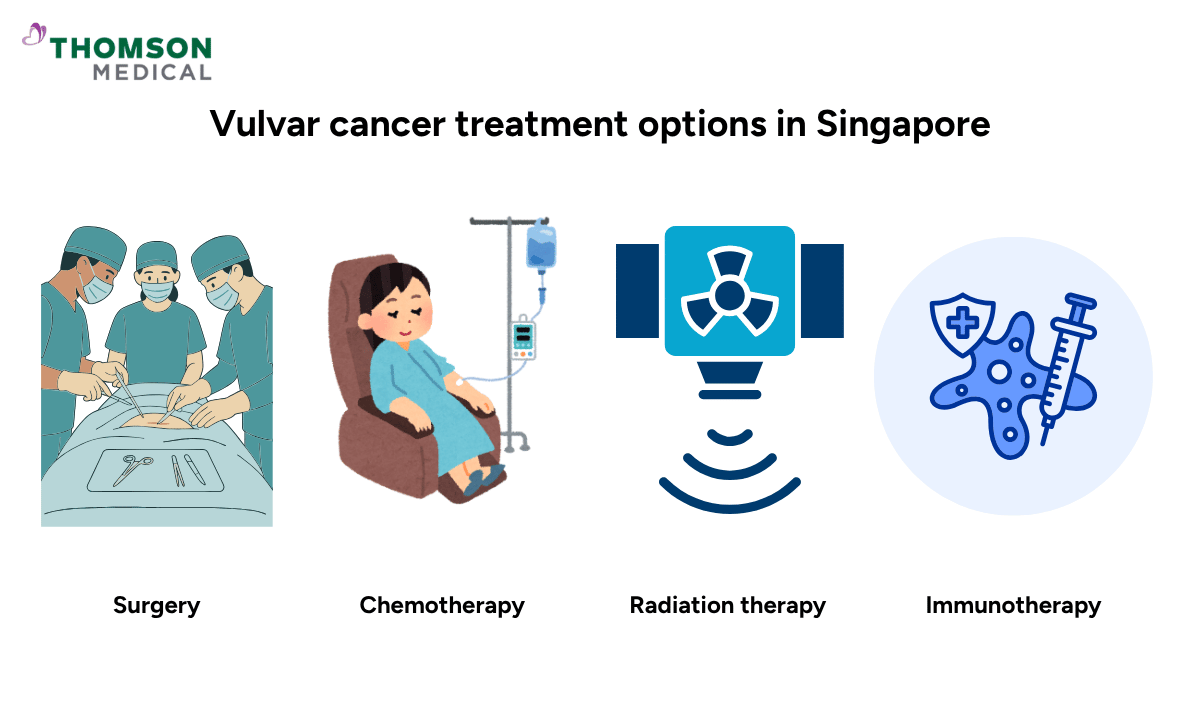
There are several vulvar cancer treatment options available in Singapore. Each medical treatment is suitable for different conditions.
Surgery
Surgery is the main treatment for this gynaecological cancer. In this treatment, surgeons remove the cancer and try to preserve as much healthy tissue as possible.
The type of vulvar cancer surgery that you need depends on these factors:
The tumour location and size
How far the cancer has spread
The depth of the cancer
Your general health
There are several types of surgery for vulvar cancer.
Wide local excision:
In the procedure, the surgeon removes the cancer along with the healthy tissue around it and nearby lymph nodes in some cases. This reduces the chance of the cancer recurring.
Surgeons often perform wide local excision for small and early-stage vulvar cancers.
Partial vulvectomy:
In the operation, your surgeon removes some part of the vulva that is affected by the cancer. If there is a high risk of the cancer spreading, they may also remove nearby lymph nodes.
Radical vulvectomy:
Doctors usually consider radical vulvectomy when the cancer is larger and invasive, because this procedure will remove the whole vulva.
Pelvic exenteration:
In the operation, surgeons may remove the vulva and other organs in the pelvis, such as the vagina, bladder, or rectum. They usually perform it for advanced or recurrent vulvar cancer, especially when the cancer has spread to nearby pelvic organs or when radiotherapy is not an option.
Vulvar reconstruction:
Doctors usually consider this reconstructive surgery to restore shape and function as much as possible.
The procedure is usually performed after larger operations, such as a partial or total vulvectomy, or when simple closure would put too much strain on the wound.
Chemotherapy
Chemotherapy is a type of treatment that uses anti-cancer drugs. Doctors usually give it by injection into a vein, by mouth, or, less commonly, as a topical (cream) treatment.
Doctors may use chemotherapy to:
Shrink the tumour before surgery.
Treat the cancer along with radiotherapy, which doctors call chemoradiation or chemoradiotherapy.
Reduce the risk of recurrence after surgery.
Control advanced, recurrent, or spreading (metastatic) vulvar cancer.
Ease symptoms such as pain, bleeding, or discomfort.
Radiation therapy
Radiation therapy, also called radiotherapy, uses high-energy rays to kill cancer cells or stop them growing.
Doctors may use radiotherapy:
After surgery, if the operation could not fully clear the cancer or if cancer is found in the lymph nodes.
For locally advanced or recurrent vulvar cancer.
To treat groin or pelvic lymph nodes, especially when cancer has spread there or node removal is not enough.
Before surgery in selected cases.
Immunotherapy
Immunotherapy uses medicines that help your immune system recognise and attack cancer cells.
Doctors may consider immunotherapy:
After the cancer comes back.
When the cancer has spread, because surgery alone may not control the disease.
In selected human papillomavirus or HPV-positive cancers.
If you are unsure which treatment is right for you, schedule an appointment at Thomson Women's Clinic & Cancer Surgery. A gynaecology specialist could help you understand your options based on your cancer type and stage.
Our gynaecological oncologist
Loading...
How is a vulvar cancer treatment plan determined?

Your doctor will help you plan your treatment. They will assess the stage of the cancer, your general health, the tumour’s position and spread, and your personal preferences before recommending a treatment plan.
Staging the vulvar cancer
Your doctor stages the cancer by checking how far it has spread. This helps them choose an appropriate and suitable treatment.
They may use imaging scans such as MRI scans, CT scans, or PET scans when they need to assess local spread or lymph node involvement, but the exact tests depend on the stage and clinical findings.
Identifying the cancer type
Your doctor confirms the cancer type by analysing a biopsy sample. This helps the team decide which treatment is suitable for you.
Health evaluation
Before treatment starts, your team checks your overall health to make sure you could tolerate treatment safely. They may use blood tests, a review of your medical history, and a physical examination.
Setting treatment goals
Your doctors will discuss the aim of treatment with you. The goal may be to cure the cancer, control it, or ease symptoms, while also protecting your quality of life as much as possible.
Treatment recommendation
After the assessment, your doctor will recommend the treatment option that fits your cancer stage and your overall health.
Vulvar cancer treatment cost in Singapore
Vulvar cancer treatment costs in Singapore may vary based on the type of procedure and whether it is a public or private hospital. Below is an approximation of typical costs for common vulvar cancer treatment in Singapore:
Wide local excision, around SGD 10,100-15,300
Radical vulvectomy, around SGD 8,900-12,900
Partial vulvectomy, around SGD 10,100-15,300
Pelvic exenteration, around SGD 24,400-29,500
Vulvar reconstruction, around SGD 6,700-12,200
Chemotherapy,around SGD 328-565 in public hospitals (subsidised) and SGD 10,544-14,289 in private hospitals
Radiation therapy, around SGD 721-1,061 in public hospitals (subsidised)
Surgeries may require hospitalisation, but the length of stay could vary a lot by procedure and extent of surgery. The typical costs for inpatient fees in private hospitals are around SGD 230-450 per day.
Available insurance
Singapore residents may be able to use MediSave, MediShield Life, and Integrated Shield Plans to help cover part of the costs. The exact claim amount depends on your ward type and your insurance plan, so the figures below are intended as estimates only.
MediSave:
The approximate vulvar cancer treatment MediSave claim limits are from around SGD 600 to 5,290, depending on the type of treatment.
MediShield Life:
The approximate vulvar cancer treatment MediShield claim limits are from around SGD 200 to 15,700, depending on the type of treatment.
These estimates are based on the information provided by the CPF website. Alternatively, you may try the CPF calculator to check the amount you are eligible to claim for your treatment.
Integrated shield plans
Additionally, you may use integrated shield plans (IPs), which are private insurance policies that sit on top of MediShield Life and offer additional coverage beyond what is provided. However, you will still need to pay some money out of pocket as a co-payment.
Please note that these are estimated costs based on the information available at the time of writing, and they may have changed since then. Actual bills may vary depending on the required treatment, hospital, and location of care.
If you are considering treatment, please contact our medical concierge team at Thomson Medical, who could discuss your specific situation with you and provide personalised cost guidance.
What are the potential complications and side effects of the treatments?
The potential complications and side effects of vulvar cancer treatment depend on the treatment type.
Surgery-related
Surgery may lead to these potential complications:
Infection
Wound breakdown
Bleeding
Chronic pain
Lymphoedema (a condition causing swelling and fluid build-up, most often in the arms or legs)
Chemotherapy-related
Chemotherapy may cause these side effects:
Infection
Digestive problems, such as nausea and vomiting
Mouth sores
Appetite loss
Tiredness
Radiotherapy-related
Radiotherapy may cause these potential complications:
Skin irritation
Fatigue
Diarrhoea
Bladder irritation
Vaginal stenosis (the vagina becomes narrower and shorter)
Fibrosis (scar-like tissue builds up that becomes thick and stiff)
Tissue damage, such as osteoradionecrosis (bone tissue is damaged by radiation and loses its blood supply)
Immunotherapy-related
There are several potential complications from immunotherapy:
Skin reactions, such as itching, rash, or vulvar inflammation
Digestive problems
Hormone problems, such as thyroid dysfunction (the thyroid gland makes too much or too little thyroid hormone)
Inflammation in other organs
Tiredness and body aches
What results could you expect after vulvar cancer treatment?
If doctors find your vulvar cancer early and remove it completely, vulvar cancer treatment may result in more favourable outcomes. However, some patients later could develop a recurrence, most often in the vulva or groin.
Recurrence is more likely in the first two years after treatment, especially when the original cancer is more advanced or the lymph nodes are involved.
How to manage your health after treatment?
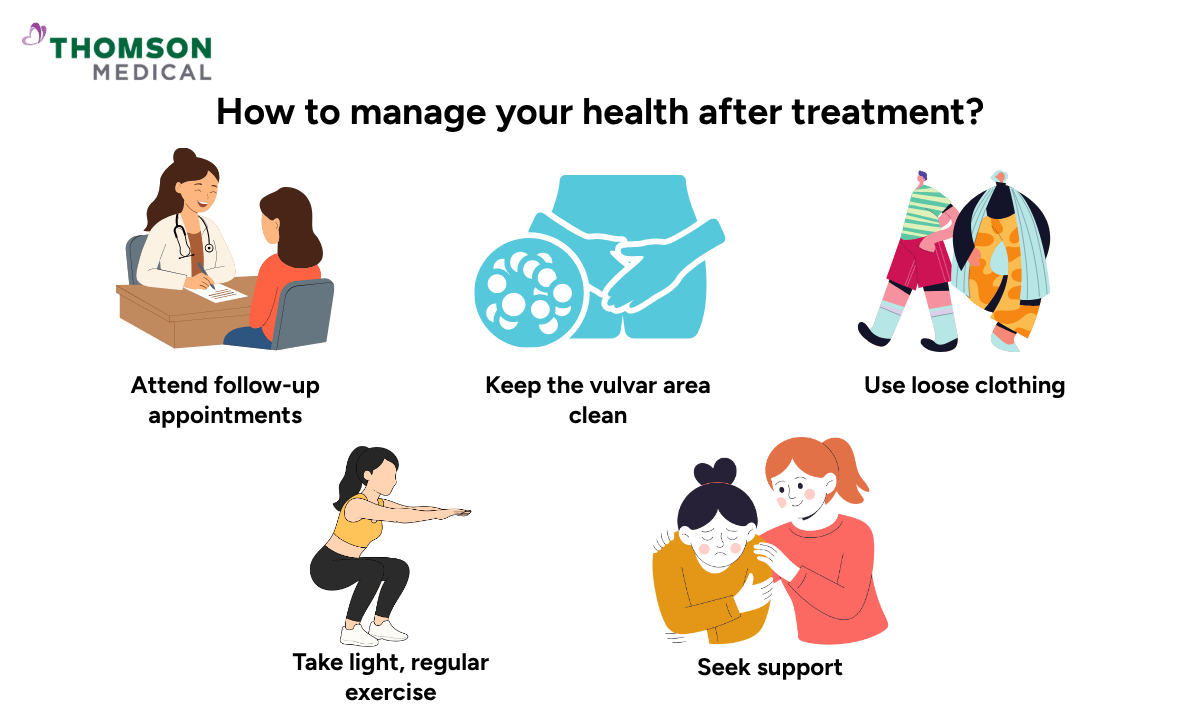
After vulvar cancer treatment, you will need follow-up care to check for recurrence, manage side effects, and support your recovery. After the treatment it is best for you to:
Attend every follow-up appointment, because doctors use these visits to check for recurrence.
Keep the vulvar area clean and use gentle, fragrance-free products, because treatment could make the skin more sensitive.
Use loose clothing, because tight clothing may rub against your sensitive skin after some treatments.
Take light, regular exercise to help increase your energy and mobility.
Seek support from counselling, friends, and family if you feel anxious.
If you are still unsure about your vulvar cancer treatment plan, schedule an appointment at Thomson Women's Clinic & Cancer Surgery. Our gynaecology specialists could help arrange your treatment plan based on your conditions.
FAQ
What are the symptoms of vulvar cancer?
Vulvar cancer may appear with several symptoms, such as:
- A lump, wart-like bump, or open sore on your vulva.
- Bleeding from the vulva that is not related to your period.
- Itching on your vulva that does not go away.
- Pain or tenderness in your vulva.
- Changes in vulvar skin colour or texture, including thickening of the vulvar skin.
How is vulvar cancer diagnosed?
Your doctor usually diagnoses this cancer with a vulvar examination and a biopsy:
- Vulvar examination: which is a visual and physical check of the vulva to spot lumps, sores, colour changes, or thickened skin.
- Biopsy: which is when a doctor removes a small piece of tissue from the vulva and sends it to a laboratory. This procedure checks whether the suspicious area is cancer, precancer, or another vulvar condition.
How treatable is vulvar cancer?
Vulvar cancer is often treatable, particularly when it is diagnosed at an early stage and the cancer is localised. However, if the cancer has spread to the lymph nodes or other areas in the body, treatment becomes more difficult.
How soon can I return to normal activities after vulvar cancer treatment?
It depends on the treatment, because each treatment affects your body in different ways. After vulvar cancer surgeries, you may need about 6 to 8 weeks for recovery. Although recovery can take longer if the operation is extensive or if it involves lymph node removal.
Meanwhile, after radiotherapy or chemotherapy, you may need a longer time to return to normal life because treatment continues over time and side effects of the treatments can build up.
What is the common type of vulvar cancer?
The most common type of vulvar cancer is vulvar squamous cell carcinoma. It starts in the squamous cells (the flat cells that line the surface of the vulva), and it can grow into nearby tissue if left untreated.
The information provided is intended for general guidance only and should not be considered medical advice. For personalised advice based on your unique conditions, schedule an appointment with Thomson Medical.
For more information, contact us:
Thomson Specialists (Women's Health)
Thomson Women's Clinic (TWC)
- Novena:
6592 6686 (Call), 8611 8986 (WA) - Bukit Batok:
6569 0668 (Call), 8686 3525 (WA) - Choa Chu Kang:
6893 1227 (Call), 8282 1796 (WA) Jurong:
6262 8588 (Call), 6262 8588 (WA)- Katong (female doctor):
6970 2272 (Call), 8611 9020 (WA) - Punggol:
6243 6843 (Call), 8811 0328 (WA) - Sembawang: 6753 5228
- Sengkang: 6388 8125
- Serangoon (female doctor): 6382 3313
- Tampines: 6857 6266
- Tiong Bahru: 6276 1525