

If you and your partner are considering fertility treatment, such as IUI, one of the questions you might have is, "What age is best for IUI?" After all, you want to maximise your chances of success. Although age is certainly an important factor affecting IUI outcomes, but it's not the only one that matters. Let's take a look at how age affects your chances so you can make informed decisions about your fertility journey.
What is IUI?
Intrauterine Insemination (IUI) is a fertility treatment where washed and concentrated sperm are placed directly into your uterus (womb) during ovulation. By bringing sperm closer to the egg, IUI increases your chances of getting pregnant.
Your doctor usually uses this treatment for:
Unexplained infertility
Mild male factor infertility
Cervical mucus problems
Ovulation disorders (sometimes with medication)
Why does age matter for IUI?
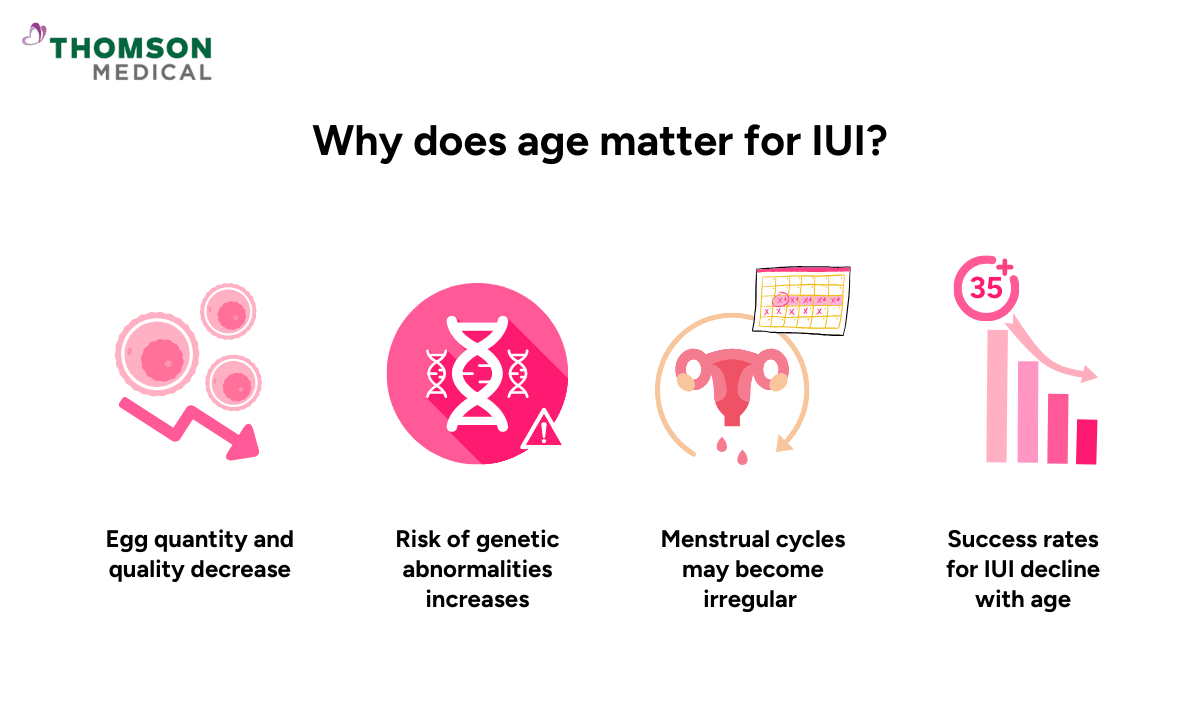
Age plays an important role in reproductive health and fertility, especially for women. When you get older, several changes occur that can affect your ability to get pregnant, such as:
Decreased egg quantity and quality
Increased risk of genetic abnormalities
Irregular period cycles
Age can also impact the quality of sperm in men, but the change is slower than in women.
Best age range for IUI success in women
Understand how age affects the success rates of IUI, can help you and your partner to set realistic expectations and plan your treatment timeline.
Here’s how age affects your chances of getting pregnant with each IUI cycle:
| Age group | Average IUI success rate per cycle |
|---|---|
Under 35 | 10-20% |
35-37 | 10-15% |
38-40 | 7-10% |
40-42 | 5-7% |
Over 42 | <5% |
IUI works best between the ages of 25 and 35 with regular ovulation and no major fertility issues. However, this doesn’t mean that IUI will not work if you’re above 35. Your doctor will assess your circumstances to help you decide whether to try IUI or explore other options that might be more effective for you.
How your partner's age affects IUI success
Age also has an effect on male fertility, even though it doesn’t decline as sharply as female fertility. Men over 40-45 may experience:
Reduced sperm quality (including shape and movement)
Increased risk of DNA fragmentation
Higher risk of genetic issues in offspring
These changes can lower IUI success rates. If your partner is older, your doctor may suggest a sperm analysis or DNA fragmentation test first to check the sperm quality before proceeding with IUI.
Every fertility journey is different, and age is just one piece of the puzzle. If you're unsure if IUI is right for you, schedule an appointment with Thomson Medical for a personalised treatment plan.
Our IUI specialists in Singapore
Loading...
When to skip IUI and consider IVF based on age
IUI is a good starting point for many women, but it might not be the most effective choice for everyone. In some cases, your doctor may recommend that you move directly to IVF (in vitro fertilisation), especially if:
You are over 38-40 years old:
IVF may be more effective and time-efficient, especially if you want to conceive as soon as possible.
Your ovarian reserve is low:
If tests show low egg quantity or quality, it might be better to skip IUI and move to IVF.
With IVF, your doctor can retrieve and select the healthiest eggs to improve your success rate.
How do doctors decide if IUI is right for you?

To determine whether IUI is right for you, your doctor will consider your age and success rates along with other key factors, which include:
Ovarian reserve testing (age-dependent)
As you get older, both the quantity and quality of eggs go down. To check your ovarian reserve and hormone levels, your doctor might order:
AMH (Anti-Müllerian Hormone):
An AMH test is a simple blood test that can provide insight on how many of your eggs (ovarian reserve) remain.
FSH (Follicle-Stimulating Hormone):
Higher levels of FSH usually mean a lower ovarian reserve.
Antral Follicle Count (AFC):
Your doctor uses an ultrasound to count the follicles in your ovaries.
If these numbers are low, especially if you’re over 35-38 years old, IUI may be less effective. In this case, you may be suggested IVF instead.
Time trying to conceive
Your doctor will also consider how long you have been trying to get pregnant:
Under 35 and trying for less than 1 year:
Your doctor usually encourages you to keep trying naturally or begin with IUI.
Over 35 and trying for more than 6 months:
You will be advised to start IUI earlier due to age-related decline.
Over 38 or nearing 40:
Your doctor may skip IUI unless tests are favourable and time is not a critical factor.
Based on your age and how long you've been trying, your doctor may recommend:
| Age range | IUI suitability |
|---|---|
Under 35 | IUI is often the first-line treatment |
35-37 | IUI is still a good option. However, you should try 3-4 cycles before considering IVF |
38-40 | Try 1-3 IUI cycles only if your ovarian reserve is good |
Over 40 | IUI is usually not recommended unless you have exceptional circumstances (e.g., donor sperm, good ovarian reserve) |
If you are considering IUI or want to know if it’s the right choice for your age and circumstances,schedule an appointment with Thomson Medical. Our fertility specialists will assess your specific situation, discuss your options, and create a personalised treatment plan that can help improve your chance of success.
FAQ
Who is not suitable for IUI?
IUI might not be the best choice for:
Women over 40 with low ovarian reserve
Couples with severe male factor infertility
Women with blocked fallopian tubes or uterine health issues
Women who have experienced multiple unsuccessful IUIs
To find out if IUI is right for you, your doctor will work with you and suggest assessments based on your situation.
Is 37 too old for IUI?
No, 37 is not too old for IUI. Although IUI success rates start to decline after 35 (around 10-15% per cycle), your doctor may suggest that you try 3-4 cycles if your egg reserve and ovulation are good before considering IVF.
Can IUI work at 40 or above?
Yes, but chances are lower, about 5-7% for each cycle. At this stage, IVF is often suggested after 1-2 IUI attempts, especially if time is a concern and you want to maximise your chances of conception.
Is it better to freeze eggs in your 30s and delay IUI?
Yes, this is a viable option if you're not yet ready to start a family. Freezing your eggs in your early 30s helps preserve fertility and offers better egg quality for future IUI or IVF treatments when you’re ready to start your family.
How does age affect egg quality and IUI outcomes?
As you get older, a number of things change, including:
Your eggs are more likely to have genetic problems
There are fewer healthy eggs available
These changes lead to lower fertilisation, implantation, and pregnancy rates with IUI, especially after age 35. That’s why your doctor might recommend IVF if you’re in your late 30s and 40s.
Do I need ovulation stimulation with IUI?
It depends on your situation. If you ovulate regularly, you may not need medication. However, your doctor may recommend mild ovulation stimulation to increase the number of eggs released, which can improve your IUI success rates, especially if you're over 35 or have irregular cycles.
The information provided is intended for general guidance only and should not be considered medical advice. For personalised recommendations and tailored advice based on your unique situation, please consult a specialist at Thomson Medical.Schedule an appointment with Thomson Medical today.
For more information, contact us:
Thomson Fertility
- Paragon: 6252 7766
- Novena: 6399 3758, 8811 0358 (WA)
Thomson Specialists (Women's Health)
Request an Appointment