

When pain shows up suddenly in your lower right abdomen, it's hard not to worry. You're not sure if it's something you ate, trapped gas, or something that needs urgent attention. The uncertainty is almost as uncomfortable as the pain itself.
Your appendix could be the cause, and it’s worth understanding what that means. Understanding appendix pain, what it feels like, what causes it, and when to seek help is the first step to getting the right care.
What is appendix pain?
Your appendix is a small, finger-shaped pouch attached to your large intestine, sitting in the lower right corner of your abdomen.
For most of your life, it doesn't cause any trouble, and you may never even think about it. But when it becomes inflamed, blocked, or irritated, you'll notice the discomfort right away.
If you or someone you care about experiences pain in the lower right abdomen, it’s worth visiting your doctor. An early check-up means you and your doctor can figure out the underlying cause and take care of it before it gets worse.
What does appendix pain feel like?
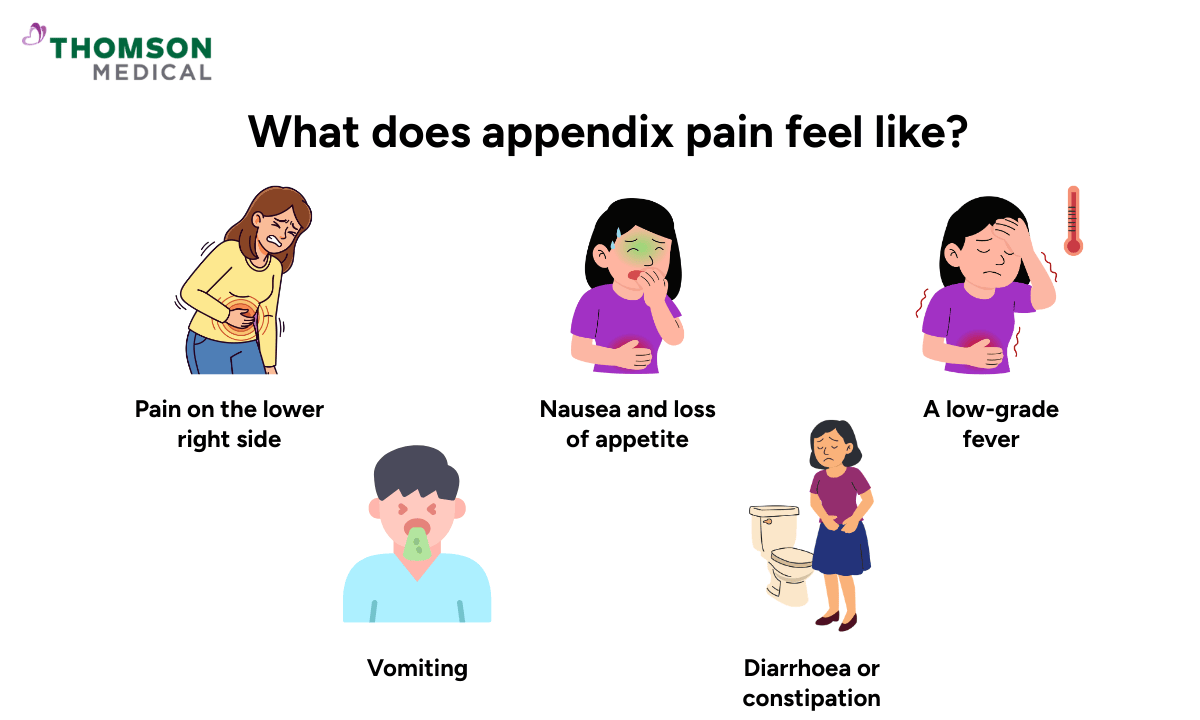
It's not always easy to tell what's going on inside your body. Appendix pain doesn’t always show up the way you may expect.
It often begins around your belly button. It can feel like a dull, uncomfortable ache that's easily mistaken for indigestion or hunger.
Over the next several hours, the pain spreads down and to the right of your abdomen and becomes sharper and harder to ignore.
Beyond the pain, you may also notice:
Nausea and loss of appetite
A low-grade fever
Vomiting
Diarrhoea or constipation
Pain that worsens when you move
These symptoms don’t always appear all at once. But even one or two of them alongside abdominal pain is worth checking with your doctor.
If the pain suddenly eases, this doesn't necessarily mean the problem has resolved. If it is appendicitis, early treatment can significantly affect your recovery – so it's always worth getting checked.
Common causes of appendix pain
When something doesn’t feel right in your body, it’s natural to seek for answers. Understanding what might be behind the pain can help you feel more informed and less anxious.
Most of the time, appendix pain points to one thing: appendicitis (inflammation of the appendix).
It usually starts when a blockage forms inside your appendix, often from:
Hardened stool
A buildup of mucus
Parasites (less common)
When this happens, bacteria multiply inside the appendix, causing it to swell and triggering the pain you feel.
Appendicitis can happen to anyone, though it’s most common between the ages of 10 and 30. That said, children, older adults, and pregnant women can develop it too.
In rare cases, the discomfort around your appendix can be related to a growth or tumour in the area, though this is uncommon. If you’re experiencing pain that persists or feels unusual, getting it checked by your doctor can give you clarity and peace of mind.
If you're unsure what's causing your abdominal pain, schedule an appointment with Thomson Medical. Our specialists can assess your symptoms and help you understand what's going on.
Our Gastrointestinal Surgeons
Loading...
How is appendix pain diagnosed?

Appendix pain can sometimes look similar to other conditions, so your doctor will take a thorough evaluation to make sure they get the full picture of what’s happening.
The process is more straightforward than you may think, and here’s what you can expect:
Physical examination:
Your doctor will gently press on specific areas of your abdomen to check for tenderness or rigidity.
They’ll ask about your symptoms, when the pain started, and how it’s changed.
Blood test:
Your doctor may suggest a blood test to check your white blood cell count. A raised level can indicate that your body is fighting an infection.
Urine test:
This test helps rule out kidney stones or a urinary tract infection (UTI), which can cause similar pain, especially in women.
Imaging tests:
Your doctor will choose the appropriate imaging based on your situation, and you won't necessarily need all of them.
Ultrasound checks whether your appendix is swollen or inflamed. In many cases, this is all you need.
A CT scan gives a more detailed picture of your appendix and the surrounding area if the ultrasound results aren’t clear enough.
An MRI scan may be performed when radiation exposure is a concern, such as during pregnancy.
Being assessed when you're already in pain and feeling anxious can feel like a lot. But your doctor will guide you through every step, explain what each test means, and make sure you have the answers you need.
Treatment options for appendix pain
Once your doctor has a clear picture of what's going on, they'll walk you through the next steps. Treatment for appendix pain is well-established, and your care will be tailored to your specific situation.
For most cases of appendicitis, the recommended treatment is an appendectomy, a procedure to remove the appendix.
This is usually done laparoscopically (keyhole surgery), which means:
Your doctor will make small incisions in your abdomen
They’ll use a tiny camera and thin instruments to remove the appendix.
This generally means a shorter recovery compared to open surgery. The exact time can vary from person to person, but most people are back to their normal routine within a few weeks.
If the appendix has already ruptured or an infection has developed nearby, your doctor may need to drain the area and prescribe antibiotics before removing the appendix. This simply means a few more steps in your care plan and your doctor will manage each stage carefully.
For milder cases, antibiotics alone may be enough to resolve the inflammation. Your doctor will check whether this approach is right for your situation.
It's natural to feel nervous about surgery. But it helps to know that appendectomies are among the most commonly performed procedures. Your doctor will be with you every step of the way to support you and ensure your recovery goes smoothly.
If you're worried about your appendix pain, schedule an appointment with Thomson Medical. Our specialists can help assess your situation and guide you through the next steps.
FAQ
Can appendix pain come and go?
Yes. Some people experience recurring episodes of mild pain in the lower right abdomen that resolve on their own, only to return later. This is called chronic appendicitis. If this sounds familiar, mention it to your doctor.
How do I know if it's my appendix or just gas?
Gas pain tends to move around and often eases after passing wind or having a bowel movement.
Appendix pain, on the other hand, is more localised. It settles in your lower right abdomen and doesn't get better with time or position changes.
Can I have appendix pain without a fever?
Yes, especially in the early stages. Fever typically develops as the inflammation worsens, so not having a fever doesn't mean your appendix is fine. If the other symptoms are there, particularly that lower right abdominal pain and nausea, it’s worth checking with your doctor.
Can appendix pain be mistaken for period pain?
Yes. The locations overlap, and both can cause cramping, nausea, and general abdominal discomfort.
The difference is usually in the character of the pain: period cramps tend to come in waves and ease with heat or pain medication. Appendix pain is more constant, and it worsens over time rather than fluctuating with your cycle.
How quickly does appendicitis get worse?
Faster than most people expect. Appendicitis can go from mild discomfort to rupture within 24 to 72 hours in some cases, though the timeline varies.
Will I need surgery if my appendix hurts?
Not always immediately, and not necessarily for every cause of appendix pain. But if you're diagnosed with appendicitis, surgery is usually recommended. Your doctor will discuss what's right for your situation.
The information provided is intended for general guidance only and should not be considered medical advice. For personalised recommendations and advice based on your unique situation, please consult a specialist at Thomson Medical. Request an appointment with Thomson Medical today.
For more information, contact us:
Thomson Medical Concierge
- 8.30am - 5.30pm
- WhatsApp: 9147 2051
Need help finding the right specialist or booking for a group?
Our Medical Concierge is here to help you. Simply fill in our form, and we'll check and connect you with the right specialist promptly.
Notice:
The range of services may vary between Thomson clinic locations. Please contact your preferred branch directly to enquire about the current availability.
Get In Touch