

If your mother, aunt, or sister has been diagnosed with breast or ovarian cancer, it's natural to find yourself wondering: could this happen to me too?
BRCA gene testing exists to answer exactly that. It looks at two specific genes that, when mutated, are linked to a higher lifetime risk of breast and ovarian cancer. Understanding what BRCA genes are, whether testing is right for you, and what your results actually mean can help you take the next step with confidence.
What is the BRCA gene?
Everyone has two BRCA genes: BRCA1 and BRCA2. They help prevent cancer by stopping cells from growing out of control.
Sometimes, a small change in the gene's structure (called a mutation) can affect how well these genes work. When this happens, your body loses some of its natural protection, especially against issues such as breast cancer and ovarian cancer.
However, simply having a BRCA mutation does not mean you will definitely get cancer. Many people with this mutation never develop cancer at all. But knowing your BRCA status gives you and your doctor the chance to plan ahead, whether that involves regular check-ups, lifestyle adjustments, or any other steps that feel right for you.
Who should consider BRCA genetic testing?

BRCA gene testing is the only way to know for sure if you carry a mutation.
Not everyone needs it, but your doctor may recommend it if:
Your close relative has been diagnosed with breast or ovarian cancer, particularly if:
They were diagnosed before age 50.
Multiple relatives on the same side of your family have been affected.
The relative is male (while breast cancer is uncommon in men, it is strongly associated with BRCA mutations)
You've had breast or ovarian cancer:
Particularly if you are diagnosed at a young age or if cancer develops in both breasts.
Your family member has already tested positive:
If your first-degree relative (parent, sibling, or child) carries a mutation, there is a chance you may have inherited it too.
BRCA testing isn’t a routine screening for everyone. It’s most meaningful when there’s a reason to explore a hereditary pattern. Your genetic counsellor or specialist can help you review your family history and decide whether testing makes sense for your situation.
If you are wondering whether BRCA gene testing is right for you, schedule an appointment with Thomson Medical. Our specialist will review your family history, discuss your personal risk, and help you decide on the appropriate next steps.
Our specialists in Singapore
Loading...
How BRCA gene testing works
If your doctor recommends BRCA testing, it’s natural to feel anxious about what the process involves. The test itself is actually straightforward, and knowing what to expect can make the whole experience feel more manageable.
Here is what you can expect:
Conversation:
Before testing, you will usually meet with a genetic counsellor or your doctor to go through your family history, understand what the test can and can’t tell you, and make sure you feel prepared for any outcome.
Testing process:
Your doctor will take your blood or saliva sample and then send it to a laboratory.
A specialist will analyse your DNA for known mutations in the BRCA1 and BRCA2 genes.
Results:
The result will usually be available within 2 to 4 weeks.
Your doctor or genetic counsellor will walk you through the findings in a follow-up consultation.
Whatever the results show, your doctor will be there to help you understand what they mean and what options are available to you.
What do BRCA gene test results indicate?
When your results are ready, your doctor will go through them with you in detail. But having a general sense of what the possible outcomes look like can help ease some of your uncertainty beforehand.
If your result is negative or inconclusive
A negative result means no known BRCA mutation was detected. Still, it doesn’t eliminate all cancer risk. BRCA mutations are responsible for only a proportion of all breast and ovarian cancers, but other genes and factors also play a role. Regular screenings and check-ups are still recommended, especially if you have a strong family history of cancer.
Sometimes, results may come back as a variant of uncertain significance (VUS). This means a change is detected in the gene, but it’s not yet clear whether it increases risk. Your doctor will explain clearly what it means for your situation.
If your result is positive
A positive result means a BRCA1 or BRCA2 mutation was found. This may sound overwhelming at first, but this doesn’t mean you have cancer or you will definitely get it. Instead, it means your lifetime risk is higher than average (for ovarian cancer, BRCA1 carriers have a lifetime risk of around 42%, and for BRCA2, it is around 20%, compared to under 2% in the general population).
From here, your doctor will work with you on a personalised plan that may include closer monitoring, prevention options, or guidance on what to look for. The news is not easy, but your uncertainty now is replaced by something you can act on.
What happens after a positive BRCA result?
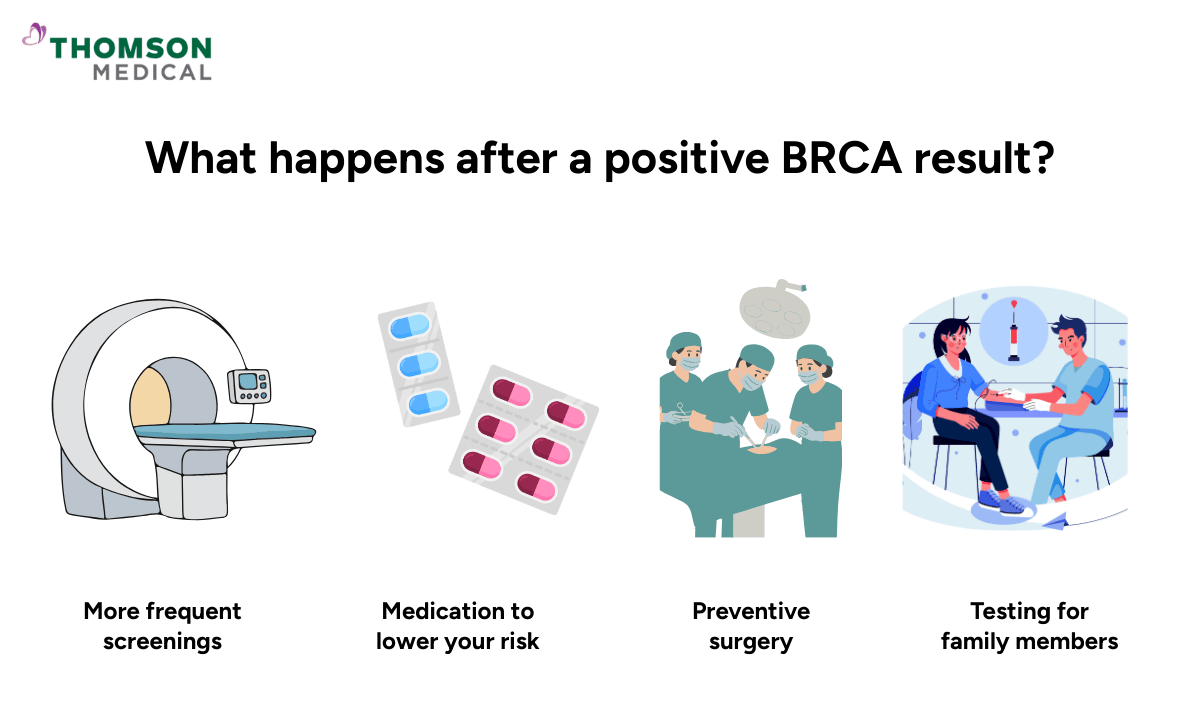
It is okay to take a moment to process the news. When you are ready to take the next step, your doctor will walk you through the options available, based on your age, health history, and personal circumstances.
Some of the options your doctor may discuss with you:
More frequent screenings:
Your doctor may recommend regular mammograms, breast MRI scans, and gynaecological check-ups to catch any changes early.
Medication to lower your risk:
Certain medications may help reduce the chances of developing breast cancer. Your doctor will advise whether this is a suitable option for you.
Preventive surgery:
Some women choose to have surgery to reduce their risk, such as a preventive mastectomy (removal of breast tissue) or oophorectomy (removal of the ovaries).
This is a deeply personal decision that you and your doctor will consider carefully together.
Testing for family members:
Because BRCA mutations run in families, your close relatives, such as parents, siblings, and children, may also want to get tested. Your genetic counsellor can help you navigate those conversations.
Your doctor and care team are with you every step of the way. There is generally no strict timeline you need to follow and no decision you need to rush. What matters most is that you feel informed, supported, and comfortable moving forward at a pace that feels right for you.
If you have received a positive BRCA result and are unsure where to go from here, schedule an appointment with Thomson Medical. Our specialist will walk you through your options, answer any questions you may have, and work with you to put together a plan that feels right for you.
FAQ
What does it mean if I test positive for a BRCA mutation?
It means you carry a gene mutation that increases your lifetime risk of breast and ovarian cancer. It is not a cancer diagnosis. Many women with BRCA mutations never develop cancer.
Does a negative BRCA result mean I won't get breast cancer?
Not exactly. A negative result means no BRCA mutation was found, but breast cancer can develop for reasons unrelated to BRCA. For that reason, regular screenings are still recommended, especially if you have other risk factors or a family history.
Will my children inherit a BRCA mutation if I test positive?
Each child has a 50% chance of inheriting the mutation. It can be passed on regardless of whether your child is a son or a daughter.
Should I tell my sisters or mother if I test positive for a BRCA mutation?
This is one of the harder questions, and there's no single right answer. Many women choose to share their results, as a positive result has direct implications for first-degree relatives. Your genetic counsellor can help you think through how to approach those conversations and what support is available for your family members if they decide to test.
What is genetic counselling, and do I need it before BRCA gene testing?
Genetic counselling involves meeting with a specialist who helps you understand your family history, what the test can tell you, and how to interpret the results. It's strongly recommended before BRCA testing, not because the test is complicated, but because the results can raise questions that are much easier to navigate when you're prepared.
How much does BRCA gene testing cost in Singapore?
BRCA gene testing costs in Singapore typically range from SGD 1,000 to SGD 5,000 without subsidies, depending on the healthcare provider and the lab used.
Please note that these costs are based on 2026 rates and may vary over time.
The information provided is intended for general guidance only and should not be considered medical advice. For personalised recommendations and tailored advice based on your unique situations, request an appointment with Thomson Breast Centre today.
Reference:
Ho, W., Hassan, N. T., Yoon, S., Yang, X., Lim, J. M., Ishak, N. D. B., Ho, P. J., Wijaya, E. A., Ng, P. P., Luccarini, C., Allen, J., Tai, M., Chiang, J., Zhang, Z., See, M., Thong, M., Woo, Y., Dunning, A. M., Hartman, M., . . . Tho, L. (2024). Age-specific breast and ovarian cancer risks associated with germline BRCA1 or BRCA2 pathogenic variants – an Asian study of 572 families. The Lancet Regional Health - Western Pacific, 44, 101017. https://doi.org/10.1016/j.lanwpc.2024.101017