

Learning you have cervical cancer can stir up many emotions at once – fear, confusion, disbelief, and even a sense of losing control. You may find yourself searching for answers about your future, wondering whether the disease can be cured or if life will ever feel normal again.
These thoughts are completely natural, and many women experience the same worries in the early days after diagnosis. It’s important to remember that cervical cancer can be cured, especially if it is detected early. Many women live long, healthy, fulfilling lives with no recurrence after treatment.
Cervical cancer can be cured if detected early
Early-stage cervical cancer is highly treatable. When the cancer is confined to your cervix, treatment is usually effective, and most women achieve complete remission.
What is early-stage cervical cancer?
'Early-stage' usually refers to stage 0, stage 1A, and stage 1B. At these stages, cancer cells remain within your cervix and haven’t spread to surrounding tissues or organs.
Stage 0 (carcinoma in situ):
Abnormal or precancerous cells are on the surface of your cervix.
Stage 1A:
Microscopic cancer cells are still confined to your cervix.
Stage 1B:
Your tumour is visible and hasn’t spread to nearby tissues or organs.
Survival rates of early-stage cervical cancer
At an early stage, cervical cancer treatment, like surgery or localised radiation, can usually remove all cancer cells. The chances of a cure for these stages are very promising.
Stage 0 has an almost 100% cure rate.
Stage 1A ranges from 95% to 100%.
Stage 1B usually achieves 90–95%.
If you’ve been diagnosed early, this is encouraging news – treatments at this stage are highly effective, and many women return to their normal routines after recovery. Many women with early-stage cervical cancer haven’t experienced recurrence and are able to resume their normal life without long-term complications.
Survival for more advanced stages are still improving

When cervical cancer is diagnosed at a later stage, the prognosis may require more intense treatment. However, advanced does not mean incurable, nor does it mean that there is no hope. Many women with stage 2 or stage 3 cervical cancer respond very well to modern treatment and go on to enjoy a good quality of life for many years.
What is advanced-stage cervical cancer?
Advanced cervical cancer refers to the cancer that has spread beyond your cervix, including:
Stage 2:
The cancer has grown into the surrounding tissues but has not reached the pelvic wall or distant organs.
Stage 3:
Cervical cancer has spread to the lower part of your vagina, pelvic wall, or nearby lymph nodes.
Stage 4:
This stage involves distant organs, such as your bladder, rectum, lungs, liver, or bones.
Your doctor will tailor your treatment closely to your needs, and many women respond far better to treatment than the numbers alone may suggest.
Survival rates of advanced-stage cervical cancer
Five-year survival rates reflect these increasing levels of spread, ranging from approximately 60–75% in stage 2 to 30–50% in stage 3 and around 15–25% in stage 4.
Although these numbers may feel overwhelming at first, it’s important to remember that they reflect large groups of patients, not your individual future.
Every woman’s situation is different. Your outlook depends on many personal factors, such as your age, overall health, the specific characteristics of your tumour, and how well your body responds to treatment.
What truly matters is that treatment for cervical cancer continues to improve every year. With modern chemotherapy, targeted therapy, and immunotherapy, many women – even those with more advanced stages – are living longer, responding better to treatment, and enjoying a good quality of life. Your prognosis may be far more hopeful than the statistics suggest.
Understanding your condition is the first step toward healing. If you’d like clearer answers about your prognosis, treatment options, or what these statistics mean for you personally, our specialists are here to help. Request an appointment with Thomson Medical today.
Our cervical cancer specialist
Loading...
Cervical cancer recurrence
After finishing treatment, it is natural to wonder whether the cancer might come back. While recurrence is possible, especially in more advanced stages, many women never experience it again. If cervical cancer does return, it may appear in your pelvis or in distant organs such as your lungs, liver, or bones.
Risk of recurrence
The risk of recurrence depends largely on the stage at which your cancer was first diagnosed. In early-stage disease (stage 0 and stage 1), recurrence is very rare, usually under 5%. Most women in these stages go on to live the rest of their lives without the cancer ever returning.
In stage 2, the recurrence risk rises to around 10–20%. For stage 3, the risk is higher, approximately 30–40%. Stage 4 carries the greatest risk, often above 50%, because the cancer had already spread beyond the cervix when you were first diagnosed.
However, even in higher-stage cancers, many women do not experience recurrence – and with close follow-up, any changes can often be caught early.
How to lower your recurrence risk?
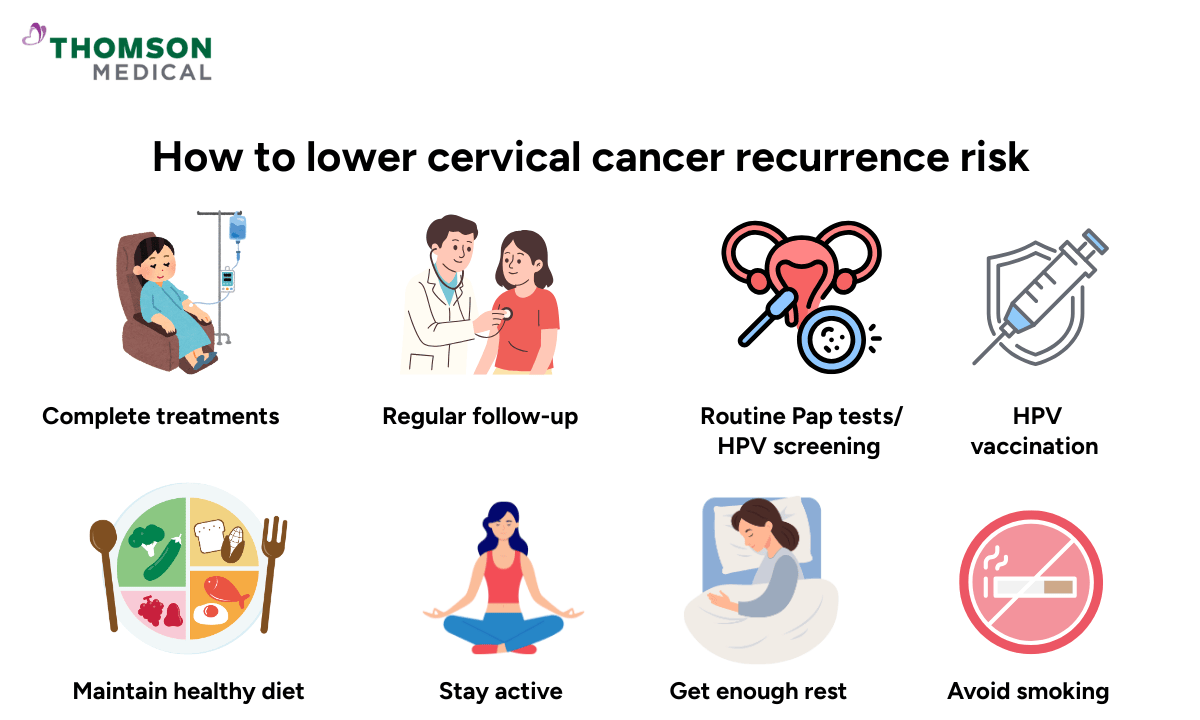
Despite these figures, it is essential not to let worry dominate your daily life. Many women live confidently after treatment, focusing on recovery, well-being, and the meaningful parts of life that bring them joy. You can also lower your recurrence risk and improve your long-term health by doing these following things:
Complete all recommended treatments and stick to your follow-up schedule
Keep up with routine Pap tests or HPV screening as advised
Discuss HPV vaccination with your doctor to lower the risk of reinfection
Avoid smoking to support healing and reduce recurrence risk
Nourish your body with a balanced, healthy diet
Stay active with regular, moderate exercise
Make sure you get enough rest and good-quality sleep
Making small, consistent changes can help you feel more in control of your health as you move forward.
Living beyond cervical cancer
Although any cancer diagnosis is life-altering, it does not define you. After treatment, many women regain their sense of normalcy and rebuild their routines before returning to work, family life, and personal goals. Others discover new resilience and a renewed appreciation for their health.
Advances in cervical cancer therapies are ongoing, and survival rates continue to improve as treatments become more targeted, effective, and personal. With early detection, appropriate treatment, and consistent follow-up care, the outlook for cervical cancer is more hopeful today than ever.
Your physical health and peace of mind matter. If you have questions about recurrence, recovery, or next steps after treatment, schedule an appointment at Thomson Medical. Our gynaecological oncologist is ready to support you with clarity and compassionate care.
FAQ
Can cervical cancer be completely removed?
Yes, if cervical cancer is detected early, treatments such as surgery or local excision can remove all abnormal cells. In many of these cases, women are considered fully cured and go on to live long, healthy lives.
Can cervical cancer be cured without a hysterectomy?
Yes, early-stage cervical cancer, which includes stage 0, stage 1A, or small stage 1B, can be treated with cone biopsy (removal of a cone-shaped wedge of abnormal tissue from your cervix) or trachelectomy (removal of your cervix). These approaches remove only the affected tissue and allow you to keep your womb and preserve fertility.
Does removing the cervix get rid of cervical cancer?
Removing the cervix through a trachelectomy or a hysterectomy can completely cure cervical cancer if the cancer is still confined to your cervix. When the cancer has spread further, treatment usually requires additional chemotherapy or radiation.
At what stage is cervical cancer not curable?
Stage 4B cervical cancer, in which the cancer has spread to distant organs such as the lungs or liver, is very difficult to cure. Even so, treatment can slow the cancer’s growth, reduce your symptoms and help you maintain your quality of life.
Can cervical cancer return after treatment?
Yes, recurrence can happen, most commonly within the first two to three years after treatment. Regular follow-up monitoring is so important, as early detection gives you the best chance of successful treatment if the cancer returns.
Is it possible to recover from cervical cancer if it comes back?
Yes, many women can be treated successfully again, depending on where the cancer returns and how early it is found. Local recurrences may be removed surgically or treated with radiation or chemotherapy. More advanced recurrences may respond to newer treatments such as targeted therapy or immunotherapy.
The information provided is intended for general guidance only and should not be considered medical advice. For personalised recommendations and advice based on your unique situation, please consult a specialist at Thomson Medical.Request an appointment with Thomson Medical today.
For more information, contact us:
Thomson Fertility
- Paragon: 6252 7766
- Novena: 6399 3758, 8811 0358 (WA)
Thomson Specialists (Women's Health)
Thomson Women's Clinic
- Novena:
6592 6686 (Call), 8611 8986 (WA) - Bukit Batok:
6569 0668 (Call), 8686 3525 (WA) - Choa Chu Kang:
6893 1227 (Call), 8282 1796 (WA) Jurong:
6262 8588 (Call), 6262 8588 (WA)- Katong (female doctor):
6970 2272 (Call), 8611 9020 (WA) - Punggol:
6243 6843 (Call), 8811 0328 (WA) - Sembawang: 6753 5228
- Sengkang: 6388 8125
- Serangoon (female doctor): 6382 3313
- Tampines: 6857 6266
- Tiong Bahru: 6276 1525