

Trying to conceive can be an emotional journey, filled with hope one month and quiet disappointment the next. If you have been trying for some time, it is natural to wonder whether there are gentle ways to better support your body along the way.
Some people explore Traditional Chinese Medicine (TCM) either before starting fertility treatment or alongside medical care. You may have come across Chinese herbs that are commonly used to support cycle balance and overall reproductive health.
Understanding how these herbs are traditionally used, and whether they are suitable for you, can help you make thoughtful and informed decisions as you move forward.
What are Chinese herbs?
Chinese herbs are the most commonly prescribed treatments in TCM. They are derived from natural sources, mainly plants, and may include roots, leaves, stems, flowers, seeds, or bark.
How Chinese herbs are classified
Chinese herbs come in many different forms, and they are classified in some ways to guide how they are used in practice.
The four natures
Each herb is classified according to its nature, which describes how it affects your body’s internal balance:
Hot and warm herbs:
Theyare used to treat conditions associated with “cold”, such as poor circulation or low energy.
Cool and cold herbs:
These herbs are used for “heat” conditions, like inflammation, restlessness, or hormonal imbalance in TCM terms.
These terms do not refer to actual temperature but rather to the herb’s effect on your body.
The five flavours
Chinese herbs are also categorised by flavour, which indicates their therapeutic action:
Sweet:
Nourishes and harmonises the body
Pungent:
Promotes circulation and regulates Qi and Blood
Sour:
Has astringent properties, helping to conserve fluids
Bitter:
Clears heat and dries dampness
Salty:
Softens hardness and promotes downward movement
Meridians (energy pathways)
In TCM, herbs are linked to specific meridians, or energy pathways, such as the Kidney, Liver, or Spleen Meridians systems closely associated with reproductive health. This allows TCM physicians to tailor herbal prescriptions to your individual’s underlying pattern rather than just your symptoms.
Do Chinese herbs support fertility?
If you’re exploring different ways to support fertility, it’s natural to wonder whether Chinese herbs are effective or whether they’re just another passing rumour.
In TCM, herbs are widely used as a natural treatment for many gynaecological disorders that accompany and contribute to female infertility, such as irregular menstruation, amenorrhoea, endometriosis, uterine fibroids and heavy bleeding due to anovulation.
Along with physical complications and an imbalance of hormones, these disorders can affect a woman’s ability to conceive.
From a TCM perspective, infertility may be caused by an imbalance of Qi (vital energy) in the body, especially in the three organs largely responsible for reproduction (Kidney, Liver, and Spleen). Chinese herbs are used to restore the balance of Qi in the body and reproductive organs.By treating the root causes of infertility through Chinese herbs, some women may become pregnant naturally without the need for invasive procedures or hormonal therapy. For others, the chance of a successful in vitro fertilisation (IVF) can be increased when Chinese herbs are prescribed as a complementary treatment.
Our TCM physicians
Loading...
Benefits of Chinese herbs for fertility support
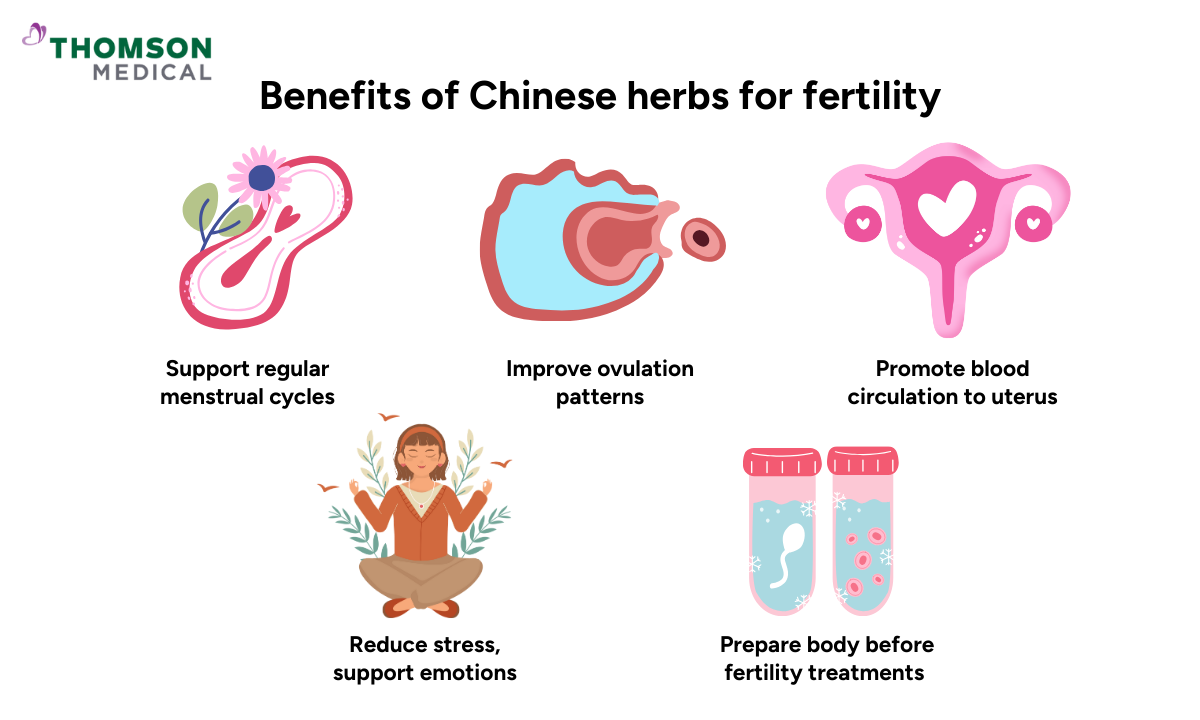
When you’ve been trying to conceive, it’s normal to feel both hopeful and hesitant at the same time. You may want to explore every possible option while still wondering whether it’s truly safe and right for you.
When prescribed appropriately by a qualified TCM physician, Chinese herbal therapy is safe and may help to:
Support more regular menstrual cycles
Improve ovulation patterns
Promote healthy blood circulation to the uterus
Reduce stress and support emotional wellbeing
Prepare the body for fertility treatments such as IVF
One more reason that Chinese herbal therapy is often considered is its holistic and personalised approach, which looks beyond symptoms to include your sleep, digestion, stress levels, and overall vitality.
If you are considering Chinese herbs as part of your fertility journey, our TCM physicians at Thomson Chinese Medicine can help you explore this option safely and thoughtfully alongside your existing care plan. Request an appointment today.
Common Chinese herbs for fertility treatments
Many people worry that Chinese herbs are “one-size-fits-all”, but that’s rarely the case. In TCM, herbs are usually prescribed as customised formulas and adjusted over time.
| Fertility treatment for | Chinese herbs |
|---|---|
Blood Deficiency |
|
Spleen and Kidney Deficiency |
|
Kidney-yin Deficiency |
|
Kidney-yang Deficiency |
|
Liver Stagnation |
|
Blood Stasis |
|
Important considerations before using Chinese herbs
When you’re thinking about using TCM to support fertility, it’s worth pausing to consider what your body truly needs. Chinese herbs may be natural, but they still require thoughtful, personalised use.
It’s best to:
Consult a qualified TCM practitioner with experience in fertility care
Avoid self-prescribing, especially based on online information
Inform your doctor or fertility specialist if you are taking herbal medicine, especially if you are undergoing IVF or taking hormonal medications
Some herbs may interact with fertility drugs or may not be suitable during early pregnancy
At Thomson Chinese Medicine, we emphasise an integrated approach, where traditional therapies are used thoughtfully alongside evidence-based medical care. Request an appointment with our TCM physicians to discuss how this approach can support you on your fertility journey.
FAQ
What is the cause of infertility?
In TCM, infertility is often linked to an imbalance in the body, such as insufficient Kidney energy, poor blood circulation, Qi stagnation, or disharmony between organ systems that support reproduction.
Can TCM improve egg quality?
TCM does not change egg quality directly, but it aims to nourish the Kidney system, regulate Qi and blood, and create a more balanced internal environment to support your reproductive health.
Do Chinese herbs help you get pregnant?
Chinese herbs do not guarantee pregnancy, but they may help support the body by regulating menstrual cycles, supporting ovulation, and improving overall wellbeing when prescribed appropriately.
What is the Chinese herb for getting pregnant?
There is no single Chinese herb for getting pregnant. Herbs are usually prescribed as personalised formulas based on your individual’s specific pattern and fertility needs.
What herbs should be avoided while trying to conceive?
In TCM, some herbs that strongly move blood or clear heat may not be suitable when trying to conceive. This is why herbal treatment should always be guided by a qualified practitioner.
How long does TCM take to work for fertility?
TCM works gradually by restoring balance over time. You may notice changes after some menstrual cycles, depending on your constitution and underlying pattern.
The information provided is intended for general guidance only and should not be considered medical advice. For personalised recommendations and advice based on your unique situation, request an appointment with Thomson Chinese Medicine today.
Physician Jun Negoro
Traditional Chinese Medicine
Thomson Chinese Medicine (TCM Paragon Medical Centre) and 1 other
English, Mandarin
Alliance MediNet
