
.png%3Fbranch%3Dprod&w=3840&q=75)
Learning you have an ovarian cyst can bring unexpected worries. You may be wondering whether surgery is necessary, how it might affect your fertility, and what recovery will involve. These concerns are completely understandable, especially when your reproductive health is involved.
A cystectomy is a surgical procedure that removes the ovarian cyst while aiming to preserve as much healthy ovarian tissue as possible. Understanding when cystectomy is recommended, how the procedure is performed, and what recovery typically looks like can help you make informed decisions and approach treatment with greater clarity.
What is an ovarian cystectomy surgery?
An ovarian cystectomy surgery is a surgical procedure designed to remove ovarian cysts while preserving your healthy ovarian tissue. Unlike procedures that remove the entire ovary, cystectomy surgery focuses on taking out just the cyst itself, protecting your ovarian function and fertility potential.
Your gynaecologist may recommend cystectomy surgery in Singapore if you have cysts that are:
Showing concerning features on imaging
Causing symptoms that affect your daily life
Not improving with observation over time
The procedure aims to address your immediate health concerns while safeguarding your reproductive health for the future.
Types of cystectomy surgery in Singapore
.png?branch=production)
Understanding your treatment options can help you feel more prepared and confident about your care. When you're considering cystectomy surgery in Singapore, your gynaecologist will work with you to determine the most suitable approach for your individual needs.
Laparoscopic ovarian cystectomy
Laparoscopic surgery is a commonly performed technique for cystectomy surgery.
Your surgeon makes a few small incisions in your abdomen and uses a tiny camera (laparoscope) along with specialised instruments to carefully separate the cyst from your healthy ovarian tissue. The cyst is then removed through these small ports.
This approach offers several benefits, such as:
Quicker recovery time
Less post-operative discomfort
Smaller, less noticeable scars
Shorter hospital stay
Most women who undergo laparoscopic cystectomy surgery find they can return to their daily routines relatively quickly, which can be an important consideration when planning your treatment.
Open ovarian cystectomy (laparotomy)
This approach involves a larger incision in your lower abdomen.
Your gynaecologist may recommend this method if:
The cyst is very large
There are concerns about malignancy
Previous abdominal surgery has caused significant scarring
Recovery from open cystectomy surgery usually takes longer and requires a few days in hospital for monitoring and pain management.
Whatever approach is recommended, your surgical team will take time to discuss your options thoroughly and address any concerns you may have. You'll receive the right care tailored to your circumstances, ensuring you feel supported throughout your treatment journey.
If you're uncertain which surgical approach is right for you or have concerns about your ovarian cyst, schedule a consultation with Thomson Medical. Our gynaecologists can assess your specific situation and recommend the right treatment approach for your needs.
What to expect: your cystectomy surgery journey
Knowing what to expect at each stage – from your initial preparations through to your recovery – can help you feel more prepared and at ease as you navigate your treatment for ovarian cysts.
Before your surgery
Your journey begins with a consultation with your gynaecologist, who will review your medical history and may arrange imaging tests such as a pelvic ultrasound or MRI scan. Blood tests may also be needed to assess your overall health and hormone levels.
As your surgery date approaches, your surgical team will provide clear guidance on:
When to stop eating and drinking
Which medications to pause or continue
What to bring to hospital
Arranging transport and support for your first few days at home
Taking time to prepare your home environment and arrange help for the first few days can make your recovery more comfortable. Your healthcare team is always available to answer any questions that arise as your surgery date approaches.
During your surgery
You'll be under general anaesthesia throughout your cystectomy surgery, which means you'll be comfortably asleep and won't feel anything during the procedure. Your surgical team will perform either laparoscopic or open surgery based on what was discussed during your consultation.
The procedure normally takes between one and three hours, depending on the size and complexity of the cyst. After being removed, the cyst is often sent to pathology to confirm its type and ensure there are no concerns.
Throughout the procedure, your anaesthetist monitors your vital signs closely, ensuring your comfort and safety. Once the surgery is complete, you'll be moved to a recovery area where the medical team will monitor you as you wake from anaesthesia.
After your surgery
Following your cystectomy surgery, you'll spend some time in a recovery area where nurses will monitor your comfort and vital signs. It's completely normal to experience mild pain, bloating, or cramping, and your medical team will ensure you have effective pain relief.
Most patients who undergo laparoscopic cystectomy surgery in Singapore can return home the same day or after an overnight stay. Open surgery usually requires a few days in hospital for monitoring.
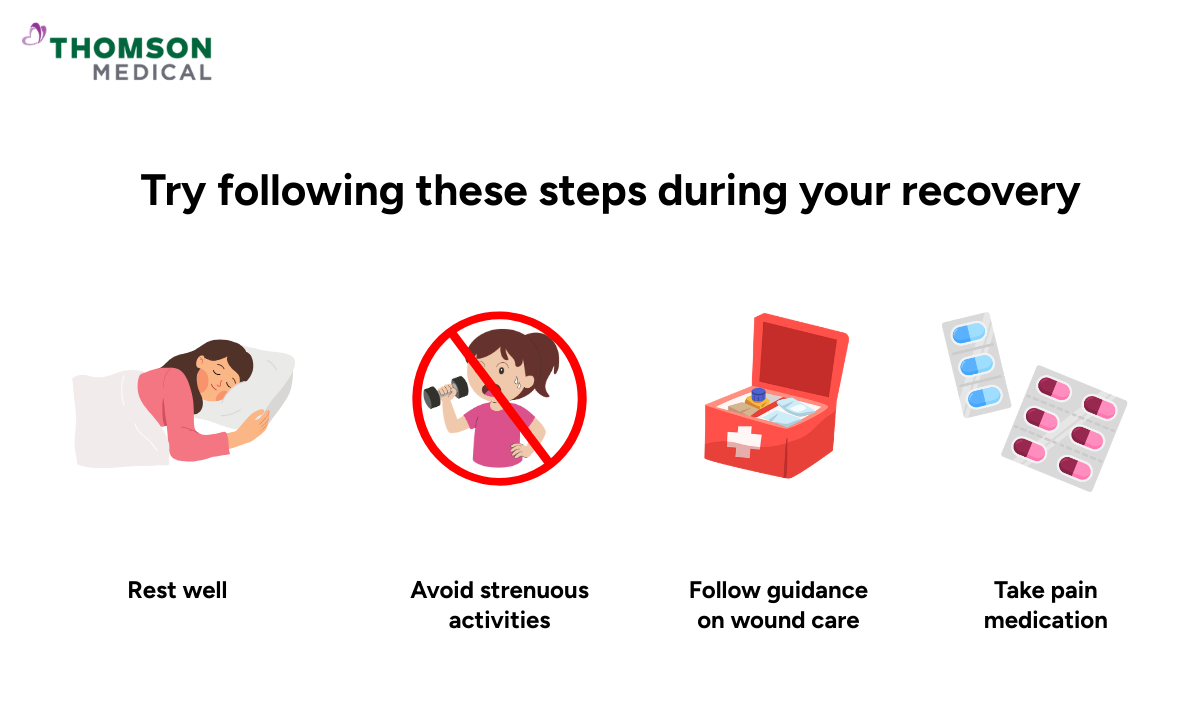
Try following these steps during your recovery at home:
Rest while staying gently active
Avoid heavy lifting and strenuous activities
Follow your surgeon's guidance on wound care
Take pain medication as prescribed
Full recovery often takes one to two weeks for laparoscopic surgery and four to six weeks for open surgery. Your gynaecologist will schedule follow-up appointments to monitor your healing and discuss your results.
Healing takes time, and everyone's journey is different. Your healthcare team understands this and will support you every step of the way. If something doesn't feel quite right or you simply need reassurance, don't hesitate to get in touch.
If you're feeling worried about the recovery process or have questions about what to expect after cystectomy surgery, request an appointment at Thomson Medical. Our team will walk you through each step of your recovery journey and provide the support you need.
Cystectomy surgery costs in Singapore
Understanding the financial aspect of your treatment can help you plan ahead with greater confidence.
The cost of cystectomy surgery in Singapore varies depending on several factors, including whether you choose public or private healthcare, the complexity of your cyst, and whether you require a day surgery or inpatient stay.
In private hospitals, costs usually include surgeon fees, anaesthetist fees, and hospital and facility costs.
The total estimated cost is:
For simple cysts (day surgery):
SGD 9,600 to SGD 14,500
For complex cysts (requiring hospital stay):
SGD 15,100 to SGD 21,500 or more
Public hospitals with government subsidies generally offer lower costs for Singapore citizens and permanent residents.
Please note that these costs are based on 2025/2026 rates and may vary over time.
During your consultation, your healthcare team will provide a more accurate cost estimate based on your specific situation and discuss payment options available to you. Many patients find it helpful to check with their insurance provider about coverage for cystectomy surgery before proceeding.
Seeking treatment for ovarian cysts is an important step in caring for your health. While surgery can feel daunting, cystectomy procedures are well-established, and you'll have experienced professionals supporting you throughout.
Taking the time to understand your options and asking questions during your consultation can help you feel more confident about your treatment journey
Our women’s health specialist
Loading...
FAQ
Is there any risk with ovarian cystectomy?
Like any surgery, ovarian cystectomy carries some risks, though serious complications are uncommon. The most common include bleeding, infection, or injury to nearby organs. There's also a small risk related to anaesthesia.
Sometimes, if the cyst is difficult to separate from healthy tissue, a small portion of the ovary may need to be removed. Your surgeon will carefully assess these risks and take steps to minimise them.
Can ovarian cysts come back after surgery?
Yes, ovarian cysts can recur. Functional cysts may develop again as part of your normal menstrual cycle. Other types, such as endometriomas, can also return, though the likelihood varies.
Recurrence depends on factors like hormonal balance, underlying conditions such as endometriosis, and whether the cyst was completely removed. Regular follow-up appointments help detect any recurrence early.
How soon can I return to work after cystectomy surgery?
After laparoscopic cystectomy, most patients return to light work within a few days and resume normal activities within one to two weeks.
Open surgery requires a longer recovery – usually four to six weeks, especially if your job involves physical activity. Your surgeon will provide guidance based on your individual recovery.
Will I have scars after ovarian cyst removal?
Yes, but the extent depends on your surgical approach. Laparoscopic surgery leaves small scars (0.5 to 1 cm) that often fade over time. Open surgery requires a longer incision across the lower abdomen, which may leave a more noticeable scar. Most scars become less visible with proper wound care.
Can ovarian cystectomy affect my menstrual cycle?
In most cases, no. The surgery preserves healthy ovarian tissue, allowing normal hormone production to continue.
You may experience irregular cycles for a month or two after surgery, but most women resume normal periods within a few months. Significant changes are rare unless substantial ovarian tissue needs to be removed.
The information provided is intended for general guidance only and should not be considered medical advice. For personalised recommendations and tailored advice based on your unique situations, please consult a specialist at Thomson Medical. Request an appointment with Thomson Medical today.
For more information, contact us:
Thomson Specialists (Women's Health)
Thomson Women's Clinic (TWC)
- Novena:
6592 6686 (Call), 8611 8986 (WA) - Bukit Batok:
6569 0668 (Call), 8686 3525 (WA) - Choa Chu Kang:
6893 1227 (Call), 8282 1796 (WA) - Jurong:
6262 8588 (Call), 6262 8588 (WA) - Katong (female doctor):
6970 2272 (Call), 8611 9020 (WA) - Punggol:
6243 6843 (Call), 8811 0328 (WA) - Sembawang: 6753 5228
- Sengkang: 6388 8125
- Serangoon (female doctor): 6382 3313
- Tampines: 6857 6266
- Tiong Bahru: 6276 1525
Notice
The range of services may vary between TWC/TS locations. Please contact your preferred branch directly to enquire about the current availability.
Request an Appointment