
.png%3Fbranch%3Dprod&w=3840&q=75)
If your dentist has suggested a dental X-ray, you may be wondering what it involves, whether it's safe, and how much it might cost. However, X-rays are one of the most widely used tools in dentistry, providing a view of what's happening beneath your teeth and gums that can't be seen during a regular examination.
Knowing the different types of dental X-rays, when they're needed, and what to expect can help you feel more confident and make informed decisions about your oral health.
What are dental X-rays?
Dental X-rays, also known as dental radiographs, are images of the teeth and surrounding structures that are captured through the use of X-ray technology. These images are an essential tool in dentistry, as they provide valuable information that is not visible during a regular dental examination. Dental X-rays can help dentists diagnose and treat various oral health issues.
What different types of dental X-ray are available?
.png?branch=production)
Dental X-rays fall into two main categories, each designed to capture different views of your oral health.
Intraoral X-rays position the X-ray film or sensor inside your mouth, while extraoral X-rays capture images from outside. Both techniques serve distinct diagnostic purposes and use different imaging approaches.
Intraoral X-rays
Your dentist may use several types of intraoral X-rays, each offering a different perspective on your teeth and surrounding structures.
- Bitewing (interproximal) X-rays:
- These X-rays help identify decay developing between teeth and reveal changes in bone density that may signal gum disease.
- During the procedure, you'll bite down on a specialised film holder while the X-ray machine aligns to photograph your upper and lower teeth in the targeted region.
- Periapical X-rays:
- This technique captures your entire tooth – from crown to root – helping detect irregularities in root structure and the surrounding bone tissue.
- The X-ray film rests inside your mouth beside the tooth being examined, recording its full length and the tissues around it.
- Occlusal X-rays:
- These images reveal your complete upper or lower dental arch, identifying concerns such as extra teeth, missing teeth, or developmental variations. They're particularly useful for locating teeth that haven't yet emerged through the gum.
- To capture this view, you'll bite down on an X-ray film or digital sensor whilst the machine positions itself above or below your mouth, capturing either your upper or lower teeth depending on what your dentist needs to assess.
Extraoral X-rays
When a broader view is needed, your dentist will turn to extraoral X-rays that capture images from outside your mouth.
- Panoramic X-rays:
- This type of medical imaging provides a wide-angle view of your entire mouth, including teeth, jaw, sinuses, and nasal cavity. It's valuable for evaluating impacted teeth, jaw conditions, and your overall oral health.
- During a panoramic X-ray, you'll stand or sit as a rotating arm circles your head, capturing a complete panoramic image.
- Lateral cephalometric X-rays (orthodontic X-rays):
- These side-view images of your head and jaw support orthodontic treatment planning by showing how your teeth align and relate to your facial structure.
- Your head rests against a positioning device called a cephalostat whilst the X-ray machine photographs your entire head from the side.
- Cone beam computed tomography (CBCT):
- This advanced scan creates a three-dimensional view of your teeth and surrounding structures, providing detailed information essential for complex procedures such as dental implants and oral surgery.
- You'll stand or sit as a rotating arm circles your head, capturing hundreds of images with a cone-shaped X-ray beam focused precisely on the area being examined.
If you're unsure which type of dental X-ray is right for your needs, request an appointment with Thomson Dental Centre. Our dentists can recommend the appropriate imaging technique for your conditions.
Our dental specialists in Singapore
Loading...
Are dental X-rays necessary and why?
.png?branch=production)
As X-rays reveal what's hidden beneath your teeth and gums, this medical imaging are essential for:
Detecting tooth decay:
X-rays can reveal areas of decay between teeth or beneath existing restorations (such as fillings). They help dentists identify cavities in their early stages when they are smaller and easier to treat.
Examining tooth roots:
X-rays allow dentists to evaluate the roots of teeth and surrounding bone structure. This is crucial for diagnosing issues such as infections, abscesses, and abnormalities in the root canal.
Monitoring teeth development:
X-rays are commonly used to track the development of teeth in children and adolescents. They help dentists ensure that teeth are growing properly and identify potential issues early on.
Assessing gum health:
X-rays can reveal the level of bone around your teeth, helping dentists diagnose conditions like periodontal disease. This information is vital for developing an effective treatment plan.
Detecting impacted teeth:
X-rays are instrumental in identifying impacted teeth, particularly wisdom teeth. Impacted teeth can cause pain, swelling, and damage to adjacent teeth, and X-rays help dentists determine the appropriate course of action.
It is important to note that the frequency of dental X-rays depends on your individual health, age, and risk factors. Your dentists will follow guidelines to minimise radiation exposure and recommend X-rays when they are necessary.
How much radiation is there in a dental X-ray?
Dental X-rays expose you to very low levels of radiation, measured in microsieverts (μSv). Here's what you can expect from common dental X-rays:
- Bitewing (4 films), approximately 5 μSv
- Periapical (2 to 4 films), approximately 3 μSv
- Panoramic, approximately 10 to 30 μSv
- Cone Beam CT (CBCT), approximately 100-200 μSv
To put this in perspective, the average person is naturally exposed to about 3500 μSv of radiation each year from everyday sources – including sunlight, soil, and air travel.
However, current dental X-ray technology is designed with your safety in mind. Modern equipment, protective lead aprons and digital radiography all work together to minimise radiation exposure. Digital X-rays, in particular, emit significantly less radiation than traditional film-based methods.
Your dentist will only recommend X-rays when necessary to assess your oral health. These images play a vital role in identifying problems early, often before you experience any symptoms, helping you to avoid more extensive treatment in the future.
When is a dental X-ray not recommended?
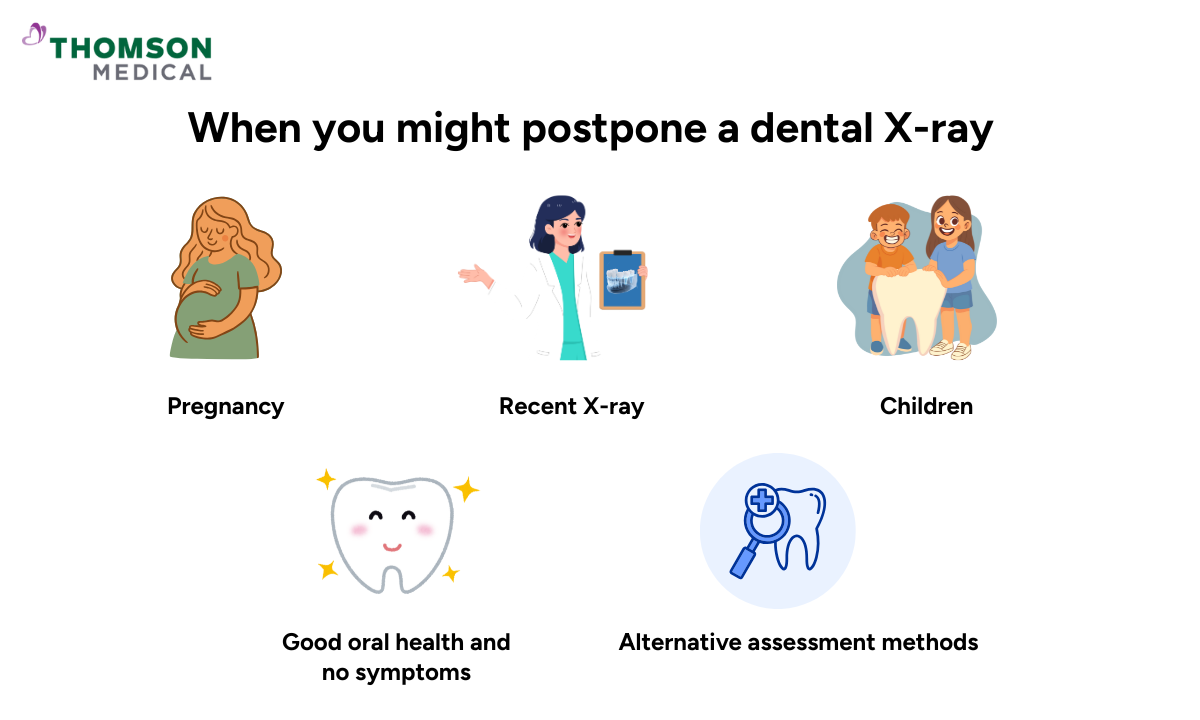
Dental X-rays are generally safe, but there are times when your dentist may recommend postponing them. Open communication about your health and any concerns helps your dentist make the best decision for your care. Here are some situations where caution may be warranted:
Pregnancy, particularly in the first trimester:
If you're pregnant, your dentist will usually avoid routine X-rays unless they're essential for diagnosis or treatment. When X-rays are necessary, protective lead aprons and thyroid collars help shield you and your baby.
Recent X-rays:
Your dentist will check when you last had X-rays to avoid unnecessary exposure.
Children:
Dentists take extra care with younger patients, often using alternative diagnostic approaches or limiting X-rays to when they're truly needed.
Low risk and no symptoms:
If you maintain good oral health and have no symptoms requiring investigation, your dentist may decide X-rays aren't necessary at that visit.
Alternative methods:
Sometimes a thorough visual examination provides enough information, particularly for localised concerns that don't require detailed imaging.
Your dentist is your partner in making informed decisions about your dental care. Share any health changes, concerns, or previous radiation exposure so together you can determine the most appropriate diagnostic approach for your individual needs.
If you have concerns about radiation exposure, schedule an appointment with Thomson Dental Centre. Our dentists can provide consultations for your specific circumstances, helping you to make informed decisions about your dental care.
How much is a dental X-ray in Singapore?
The cost can range from SGD 20 to SGD 300, depending on various factors. Public institutions like polyclinics may charge less, but private clinics often have shorter waiting times.
Can you use CHAS or MediSave for dental X-rays?
For dental X-rays, CHAS subsidies are available, limited to 6 X-rays per calendar year. For the CHAS Orange card, there are no subsidies. For the CHAS Blue Card, you can claim $11 per X-ray, and here are additional details on CHAS subsidies.
MediSave often does not cover general dental treatments, such as dental X-rays, unless they involve surgical procedures deemed medically necessary. Non-surgical dental treatments, including routine dental check-ups, are not eligible for claims under the MediSave scheme.
FAQ
How often should I get dental X-rays?
The frequency of dental X-rays depends on factors such as your age, oral health, and risk for dental issues. For adults, bitewing X-rays are typically taken every 1-2 years, while full-mouth X-rays (panoramic) may be taken every 3-5 years.
Are dental X-rays safe?
Yes, dental X-rays are generally considered safe. The amount of radiation exposure is minimal, and dentists take precautions such as using lead aprons and collars to protect patients from unnecessary radiation.
Can you have dental X-rays during pregnancy?
While routine X-rays are generally avoided during pregnancy, if there is a dental issue that requires diagnostic imaging, your dentist can take precautions to minimise radiation exposure to the foetus, such as using lead aprons.
Do dental X-rays cause cancer?
The risk of developing cancer from dental X-rays is low. The benefits of early diagnosis and treatment of dental issues generally outweigh the minimal risks associated with the low-dose radiation exposure.
How do you prepare for dental X-rays?
Usually, there is no special preparation. You may be asked to remove jewellery or accessories from your head and neck area, and your dentist will provide protective gear such as lead aprons.
Is it possible to refuse dental X-rays?
You have the right to make informed decisions about your healthcare. If you have concerns about dental X-rays, discuss them with your dentist. They can explain the necessity based on your oral health needs and address any specific concerns you may have.
The information provided is intended for general guidance only and should not be considered medical advice. For personalised recommendations and tailored advice based on your unique situation, please consult a specialist at Thomson Dental Centre. Schedule an appointment with Thomson Dental Centre today.