
.png%3Fbranch%3Dprod&w=3840&q=75)
Missing a tooth affects more than just your smile – it changes how you eat, speak, and feel about yourself. Dental implants offer a permanent solution that works like your natural teeth, restoring both function and confidence in ways that bridges and dentures simply can't match. Understanding how they work and what to expect can help you decide if this life-changing treatment is right for you.
What are dental implants?
.png?branch=production)
A dental implant is a titanium post carefully placed into your jawbone, where it takes the place of your missing tooth root. Over time, it fuses naturally with your bone. Once healing is complete, a custom-made dental crown is attached, giving you a prosthetic tooth that blends seamlessly with your smile.
Unlike bridges or dentures that rely on neighbouring teeth for support, implants stand on their own. This means your surrounding teeth remain untouched and healthy.
Benefits of dental implants
Dental implants are designed to look and feel just like your natural teeth. You'll regain the freedom to eat the foods you enjoy without worry or discomfort – something that's often challenging with removable dentures or bridges.
Beyond restoring your smile, implants help protect your facial structure. When you have a tooth loss, your jawbone gradually weakens over time due to bone loss, which can lead to changes in your appearance. Implants work like natural tooth roots, preventing further bone loss, stimulating bone growth and maintaining your jaw's strength, so your face keeps its natural shape.
With proper care, dental implants can last 20 years or longer. It's an investment not just in your oral health, but in your confidence and quality of life for years to come.
Am I a candidate for dental implants?
Most adults with missing teeth are suitable candidates for dental implants, so there's a good chance this solution could work for you. Your dentist will assess a few key factors to determine if implants are the right fit for your situation.
You'll need adequate jawbone to support the implant. If you've been missing teeth for some time, your jawbone may have weakened, but bone grafting (a procedure that adds bone material or a bone substitute to strengthen your jaw) can address this. Your gums should also be healthy and free from active gum disease, though mild cases can usually be treated beforehand.
Your dentist will also consider these following factors:
Your overall health and any chronic conditions, such as diabetes
Whether you smoke, as this can affect healing
Medications that might interfere with bone healing
Your dental and medical history to assess overall suitability
If you're worried about any of these factors, know that many patients share these same concerns. The reassuring news is that solutions are often available. A thorough consultation will help clarify your options, so you can move forward with confidence.
If you're uncertain whether dental implants are right for you, schedule a consultation with Thomson Dental Centre. Our doctors can assess your individual situation and create a treatment plan that addresses your specific needs.
Dental implant procedure: what to expect
.png?branch=production)
Getting a dental implant is a multi-step process that usually takes several months, and we understand that might feel like a significant commitment. Each stage is designed to give your implant the best chance of success and longevity. Knowing what to expect at each step can help you feel more at ease throughout your journey.
Initial consultation and planning
Your journey begins with a thorough examination where your dentist takes the time to understand your needs. X-rays or 3D scans will show the health of your jawbone and help determine the best position for your implant. From there, your dentist will create a treatment plan tailored to your unique needs.
The surgical process
The implant surgery is performed under local anaesthesia, often by an oral surgeon or experienced dentist, which means you'll be comfortable throughout. Your dentist will make a small incision in your gum, then carefully place the titanium implant post into the jawbone.
After implant placement, a healing cap may be attached to protect the site while it heals. Many patients find that any discomfort afterwards is much more manageable than they'd expected.
If your jaw isn't quite thick enough to support an implant, don't worry – procedures like surgical bone augmentation or sinus augmentation (a procedure to add bone material below the sinus cavity in the upper jaw) can be done first to build up the bone you need.
Healing and bonding
After surgery, your body begins its natural healing work. Your jawbone gradually grows around and bonds with the implant over the next three to six months – this process is what makes implants so stable and long-lasting.
During this time, you'll be fitted with a temporary crown, so there's no need to worry about gaps in your smile. You can go about your daily life with confidence whilst your implant settles in.
Crown placement
Once healing is complete, you'll return for the final step – adding your permanent crown. Your dentist will take impressions to craft a custom dental crown that blends naturally with your other teeth.
Your final prosthetic tooth is made from synthetic material designed to look and function like natural tooth enamel. This appointment is quick and comfortable, bringing you to the end of your journey with a smile that feels completely your own.
If the multi-step process seems complex or you have questions about what to expect during surgery and recovery, schedule an appointment with Thomson Dental Centre. We'll walk you through each stage in detail and ensure you feel comfortable before beginning your treatment.
Types of dental implants
Dental implants come in different types to suit various needs. Your dental specialists will recommend the best option based on your jawbone condition, how many teeth you're replacing, and your overall oral health.
Endosteal implants are the most common type, placed directly into your jawbone. They work well for most patients with adequate bone density.
Subperiosteal implants sit under the gum but above the jawbone, offering an alternative for patients who don't have sufficient healthy bone and prefer to avoid bone grafting.
Depending on how many teeth you're replacing, your options include:
Single-tooth dental implants for one missing tooth
Implant-supported bridges to replace several adjacent teeth
All-on-4 or All-on-6 implants to support a full arch of replacement teeth
Implant-supported overdenture for removable yet stable tooth replacement
What is the price for dental implants?
The cost of dental implants varies depending on the number of implants you need, the type of implant, and whether you require additional dental procedures like bone grafting. In Singapore, a single dental implant usually ranges from SGD 1,500 to SGD 6,000 per tooth. Public institutions like polyclinics may charge less, though private clinics often have shorter waiting times and more flexible scheduling.
Can I use MediSave or CHAS to pay for dental implants?
MediSave can be used to cover part of your dental implant treatment, as the procedure involves surgery. However, CHAS subsidies are not available for dental implants. Many dental insurance plans do provide partial coverage, so it's worth checking with your provider to understand what support is available to you.
Recovery and aftercare for dental implants
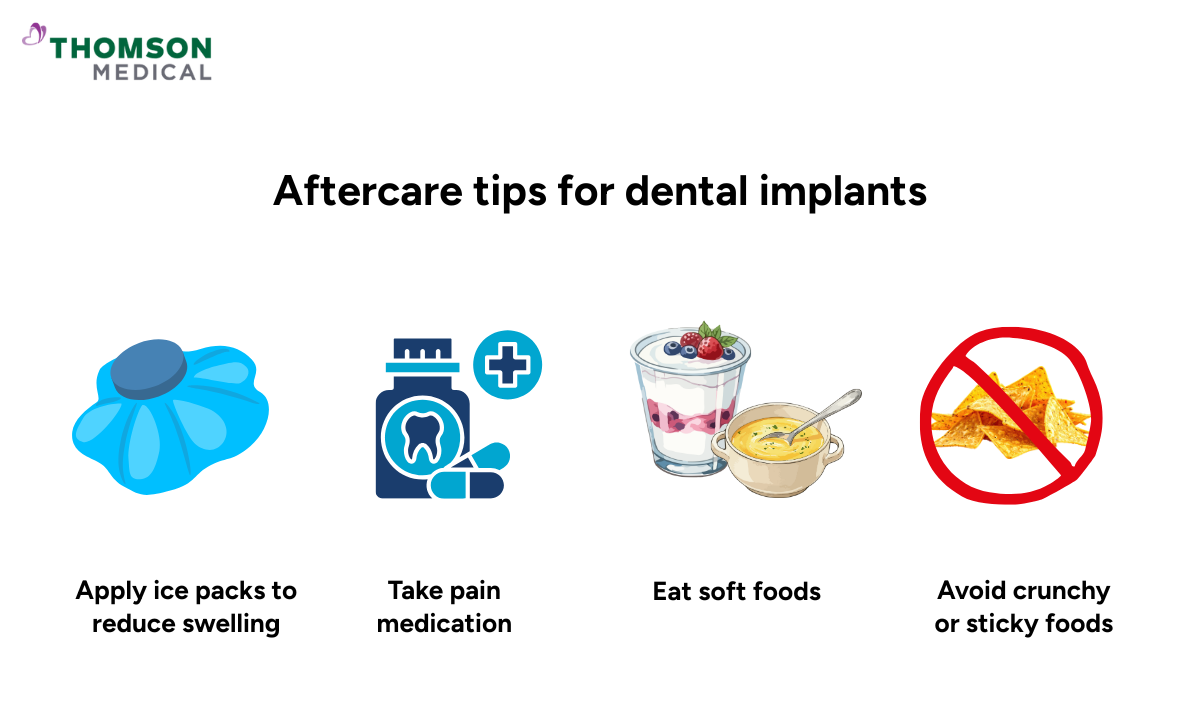
The first few days after implant surgery are important for healing, but most patients find the recovery process manageable. You may experience some swelling, minor bleeding, and discomfort, though these symptoms normally subside within a week. Knowing what to expect can help you feel more prepared and reassured during this time.
To support your recovery, try these approaches:
Apply ice packs to reduce swelling in the first 24 to 48 hours
Take prescribed pain medication as directed
Eat soft foods like soups, yoghurt, and mashed potatoes
Avoid hard, crunchy, or sticky foods
You should also avoid smoking and drinking through a straw, as these can interfere with healing. Most patients can return to work within one to two days, though it's perfectly fine to take extra time if you've had multiple implants placed or simply want to rest.
Long-term care for your implant is similar to caring for natural teeth. Brush twice daily, floss regularly, and visit your dentist every six months for dental check-ups. With proper care, your implant can last 20 years or more – making it a worthwhile investment in your smile and quality of life.
If you notice persistent pain, severe swelling, or loosening of the implant, don't hesitate to reach out to your dentist – they're here to support you.
Our dental implant specialists
Loading...
FAQ
How painful is getting a dental implant?
Most patients report minimal discomfort during the implant since it's done under local anaesthesia. After oral surgery, you may feel some soreness similar to a tooth extraction, but this can be managed with prescribed pain medication. The discomfort usually subsides within a few days.
How long do dental implants last?
With proper care, dental implants can last 20 years or more. Some implants can even last a lifetime. The key is maintaining good oral hygiene and having regular dental visits.
Can dental implants get cavities?
No, the implant crown cannot develop cavities since it's made of artificial material. However, you still need to maintain good dental care to prevent gum disease, which can affect the tissue and bone supporting your implant.
What is the success rate of dental implants?
Dental implants have a high success rate of about 95-98%. However, success also depends on factors like your overall health, oral hygiene habits, and following your dentist's aftercare instructions.
How long does it take to recover from dental implant surgery?
Initial healing takes about 1-2 weeks, though most people return to work within 1-2 days. Complete healing and osseointegration (bone fusion) take 3-6 months before the final crown can be placed.
Can I get dental implants if I have gum disease?
Active gum disease needs to be treated before you can get implants. Once your gums are healthy, you can proceed with the implant procedures. Your dentist will assess your gum health during the consultation.
What are sinus procedures in dental implants?
Sinus procedures (or sinus augmentation) are needed when you don't have enough bone height in your upper jaw to support an implant. The dentist gently lifts the sinus lining and adds bone material below it, creating more space for a secure implant.
The information provided is intended for general guidance only and should not be considered medical advice. For personalised recommendations and tailored advice based on your unique situation, please consult a specialist at Thomson Dental Centre. Schedule an appointment with Thomson Dental Centre today.
Citations
The Dental Implant Osseointegration Timeline – What to expect after implant surgery | Mandeville Center of Dental Excellence. (n.d.). https://www.charlesschof.com/post/how-long-does-it-take-for-gums-to-heal-after-dental-implants
Ferreira, T., Ferreira, T., & Ferreira, T. (2025, September 2). Understanding dental implant success rates: What you need to know - Arvada Dental Center & Implants. Arvada Dental Center & Implants. https://arvadadentalcenter.com/understanding-dental-implant-success-rates
Dr Charlotte Goh
Dentistry
Thomson Dental Centre (Novena Specialist Center)
English
AIA Dental PPO, Alliance MediNet, IHP, Inova Care and 2 others
