

Your due date is here, and nothing is happening yet. After everything it took to get to this point through in vitro fertilisation (IVF), the last stretch of waiting may be the hardest, and it’s natural to wonder whether IVF babies are more likely to go overdue.
Here’s how IVF due dates are worked out, what going past your due date means for you and your baby, and when your doctor may suggest an induction.
What does going overdue mean in pregnancy?
A pregnancy is considered overdue when it continues beyond the estimated due date (EDD), which is typically around 40 weeks. However, full term begins at 39 weeks, so the EDD is best considered a midpoint estimate rather than a fixed deadline.
Nevertheless, babies typically arrive within two weeks of their EDD, and only a small percentage of pregnancies exceed 42 weeks. Doctors divide the final weeks of pregnancy into distinct stages to guide clinical monitoring and the timing of delivery. These stages are as follows:
Early term: 37 weeks 0 days to 38 weeks 6 days
Full term (due date): 39 weeks 0 days to 40 weeks 6 days
Late term: 41 weeks 0 days to 41 weeks 6 days
Post-term: 42 weeks and more
How is the due date calculated for an IVF pregnancy?

For an IVF pregnancy, the EDD could be calculated more precisely compared to a naturally conceived pregnancy. This is because the timing of egg retrieval and embryo transfer is known, rather than estimated from the first day of your last menstrual period.
The calculation is based on the stage of the embryo at the time of transfer and allows doctors to determine the number of weeks you have been pregnant. A pregnancy is generally estimated to last around 266 days (38 weeks) from the time of fertilisation. However, as the embryo is transferred a few days after fertilisation, its age at the time of transfer is also considered when calculating the estimated due date.
For example, for a day-3 embryo, the estimated due date is 263 days after the embryo transfer. This is because the embryo is already 3 days old when it is transferred, so 3 days are subtracted from the 266 days typically counted from fertilisation. For a day-5 embryo (blastocyst), the estimated due date is 261 days after the embryo transfer.
Do IVF babies go overdue?
Although the due date for an IVF pregnancy may be calculated more precisely because the embryo’s age and transfer date are known, this does not mean that labour will start exactly on the estimated due date. An IVF pregnancy could continue past the estimated due date, just like any other pregnancy.
An IVF baby may arrive before, on, or after the estimated due date, just like a baby conceived without fertility treatment. Only a small proportion of babies are born on their exact due date. As such, passing the due date does not necessarily mean that something is wrong.
However, going past your due date could gradually increase the risks associated with continuing the pregnancy. In such cases, your doctor may recommend medical induction, a process involving the use of medication or medical procedures to artificially induce labour.
What factors could increase the chance of going overdue?
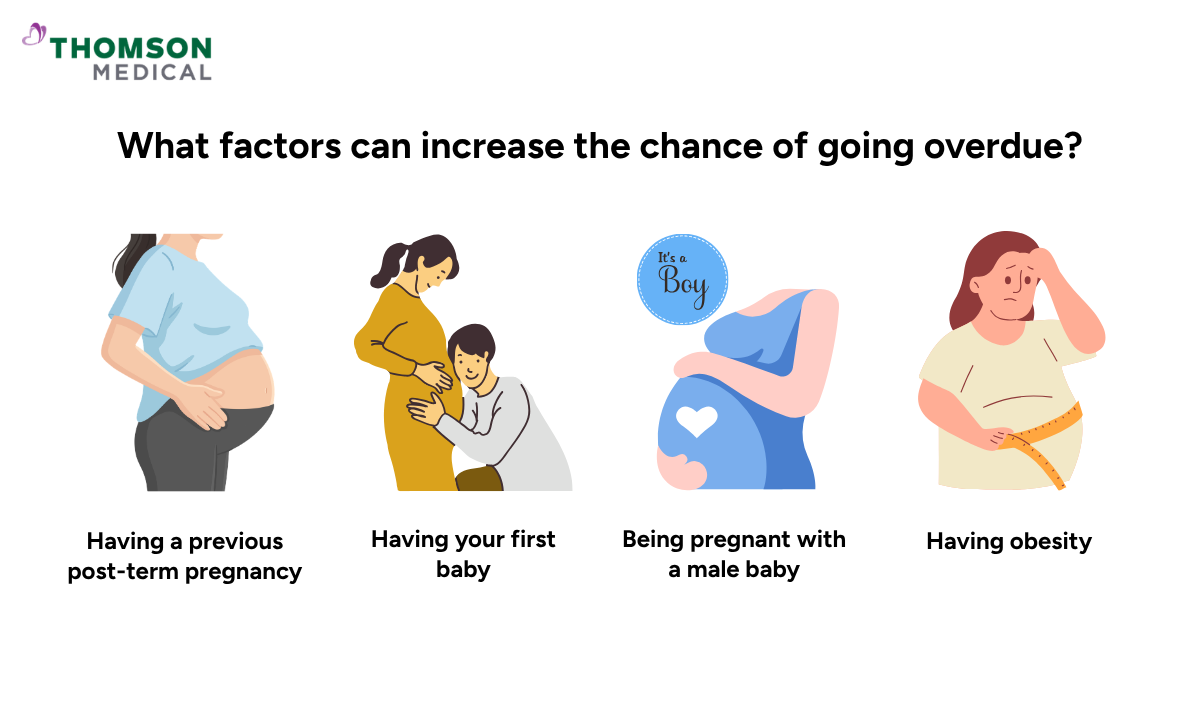
As of now, there is no clear explanation for why some pregnancies continue past the estimated due date. While genetics may have a role, there are other factors that may increase the chance of going overdue, such as:
Having a previous post-term pregnancy:
Women who have previously experienced a post-term pregnancy are more likely to experience it again in a subsequent pregnancy.
Having your first baby:
First-time mothers are more likely to go past their due date compared to women who have given birth before.
The reason for this is not fully understood, but it is thought that the cervix and uterus in a first pregnancy respond differently to the hormonal signals that trigger labour, resulting in a longer pregnancy period.
Being pregnant with a male baby:
Pregnancy with a male baby may last slightly longer than with a female baby. This difference is usually just a few days and may be related to variations in the hormonal signals between the baby, placenta, and mother.
Being obese:
Women with obesity may have a higher chance of their pregnancy continuing past 41 weeks.
This may be linked to changes in how hormones such as oestrogen and progesterone are processed by the body, which could affect the hormonal changes that help trigger labour.
Changes in inflammation and signals from body fat may also play a role, although the exact reasons remain unclear.
Since every pregnancy is different, speaking with an O&G doctor may help you understand whether you have factors that may increase the chance of going overdue and how your pregnancy may be monitored. Schedule an appointment with Thomson Medical.
Our fertility doctors in Singapore
Loading...
What are the risks of an IVF pregnancy going overdue?
A prolonged pregnancy may be associated with the following risks:
Stillbirth:
Stillbirth is a rare complication where a baby does not make it to birth, either before or during the process, and the risk increases as pregnancy continues past 41 weeks.
The risk could vary depending on individual factors, including maternal age, medical conditions, foetal growth, and placental function (how well the placenta continues to support the baby).
A larger baby (macrosomia):
The longer a pregnancy continues, the more time the baby has to grow, which may increase the risk of macrosomia (a condition where the baby is larger than average).
A larger baby may make vaginal delivery more difficult and increase the likelihood of complications during birth, such as shoulder dystocia (when the baby’s shoulder becomes stuck during delivery).
Reduced amniotic fluid:
Amniotic fluid (the fluid that surrounds and protects the baby in the womb) may decrease as pregnancy continues.
Low amniotic fluid, known as oligohydramnios, may increase the risk of the umbilical cord becoming compressed, which may affect the baby’s blood and oxygen supply.
Meconium in the amniotic fluid:
A baby may pass meconium (their first stool) into the amniotic fluid before birth, which is more likely when the pregnancy continues past the due date.
If the baby breathes meconium into their lungs around the time of birth, it could lead to breathing difficulties.
Reduced placenta function:
The placenta provides your baby with oxygen and nutrients throughout pregnancy.
However, as pregnancy continues past term, the placenta may become less effective at supporting the baby.
How is an IVF pregnancy monitored in the final weeks?
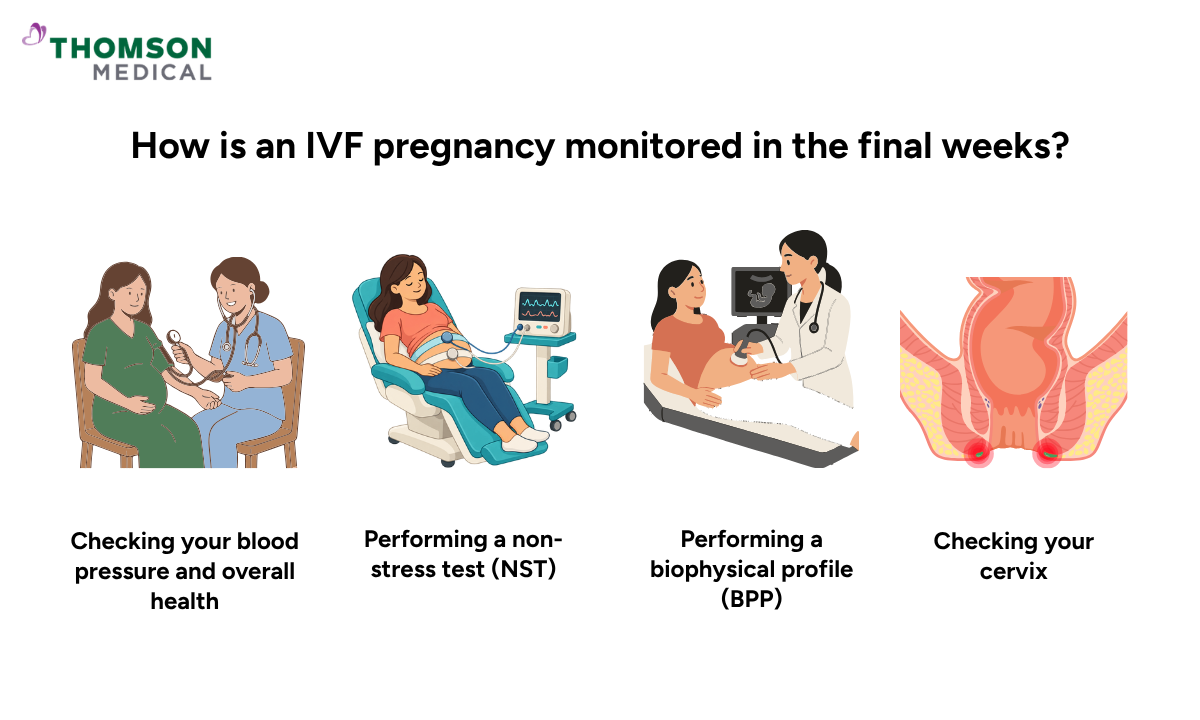
If your IVF pregnancy continues past the estimated due date, your doctor may recommend closer monitoring to ensure the health of you and your baby. At around 41 weeks, they will assess the pregnancy and decide whether to continue monitoring or to discuss inducing labour. This may include:
Checking your blood pressure and overall health to look for any concerns that could affect your pregnancy.
Performing a non-stress test (NST), which monitors your baby’s heart rate and how it responds to movement.
Performing a biophysical profile (BPP), which uses a pregnancy ultrasound to assess your baby’s movements and breathing, muscle tone, as well as the amount of amniotic fluid.
Checking your cervix to see whether it has started to soften or open in preparation for labour.
When is induction recommended for an overdue IVF pregnancy?
If your pregnancy goes past your due date, your doctor will monitor closely your health and your baby’s well-being and may recommend induction of labour when:
Monitoring results suggest a cause for concern:
Monitoring could assess your baby’s heart rate, movements, placenta function, and amniotic fluid levels. Induction may be recommended if changes in these suggest that continuing the pregnancy could carry additional risks.
Your waters break before labour begins:
If contractions do not start after your waters break, induction may be recommended to reduce the risk of infection.
You develop a medical condition during pregnancy:
Conditions such as high blood pressure, pre-eclampsia, or diabetes may affect the timing of your baby's delivery.
Your individual circumstances may also affect the timing of delivery. Factors such as your age, health conditions, and pregnancy history may influence when your doctor recommends an induction.
If you have reached your due date without signs of labour, speak with your O&G doctor about whether induction may be appropriate for your IVF pregnancy. Schedule an appointment with Thomson Medical.
How to manage a pregnancy that goes past the due date?
Reaching your due date without going into labour may feel frustrating, especially when you are eagerly waiting to meet your baby. However, there are a few things you could try to do to make this time easier, such as:
Stay occupied by planning simple activities to keep yourself busy, such as spending time with loved ones, reading, or going for a light walk.
Prepare for the days after birth by organising essential items before your baby arrives, which may make the first few days after delivery a little easier.
Get enough rest by taking breaks whenever possible, especially if you are finding it difficult to sleep at night, as you may need extra energy for labour and caring for your newborn.
Speak to your doctor if you have any concerns, questions, or changes in your pregnancy that you would like to discuss.
FAQ
Does the type of embryo transfer (fresh vs. frozen) affect when my baby is born?
Both fresh and frozen embryo transfer pregnancies can result in birth before, on, or after the estimated due date. This study indicates that pregnancies following frozen embryo transfer may be associated with a slightly longer pregnancy in some cases, but the difference is generally small and does not determine when the baby will be born.
Can I request an early induction for an IVF pregnancy?
You can discuss your preferred timing of delivery with your doctor, who will be able to advise you on the best time to expect your delivery.
For some IVF pregnancies, induction at around 39 weeks may be an option, depending on your individual circumstances and preferences. Before recommending induction, your doctor will also consider your health, your baby’s wellbeing, and whether your cervix is ready for labour.
Is my IVF history a factor in my delivery plan?
Your IVF history can be one of the factors your doctor considers when planning your delivery. They may also look at your age, the reason you needed fertility treatment, your previous pregnancy history and whether donor eggs or sperm were used. However, the timing and method of delivery will mainly depend on how your pregnancy is progressing, rather than IVF alone.
What should I do if I reach my due date without labour signs?
If you reach 40 weeks or more without contractions, your waters breaking, or showing any other signs of labour, these are the steps you can take:
- Attend every scheduled appointment and monitoring session to allow your doctor to check your health and your baby’s wellbeing.
- Keep track of your baby’s usual pattern of movements and look out for any noticeable changes.
- Seek medical attention immediately if your baby is moving less than usual or experiences other concerning symptoms, such as severe headache, changes in your vision, or fever.
The information provided is intended for general guidance only and should not be considered medical advice. For personalised advice based on your conditions, schedule an appointmentwith Thomson Medical.
Reference
National Institute of Child Health and Human Development. (2019). Know your terms newsletter drop-in language for consumers and providers. Eunice Kennedy Shriver National Institute of Child Health and Human Development.https://www.nichd.nih.gov/ncmhep/materials/knowyourterms-newsletter-language
ScienceInsights. (2026). How to calculate your IVF due date: Day 3 and Day 5.https://scienceinsights.org/how-to-calculate-your-ivf-due-date-day-3-and-day-5/
Westvik-Johari K, Romundstad LB, Lawlor DA, Bergh C, Gissler M, et al. (2021) Separating parental and treatment contributions to perinatal health after fresh and frozen embryo transfer in assisted reproduction: A cohort study with within-sibship analysis. PLOS Medicine 18(6): e1003683.https://doi.org/10.1371/journal.pmed.1003683
For more information, contact us:
Thomson Fertility Centre
- Paragon: 6252 7766
- Novena: 6399 3758, 8811 0358 (WA)