

Fibroids are often found by accident, picked up during a routine ultrasound or a scan for something else. Others come to light after years of heavy periods or pelvic discomfort, once the symptoms prompt investigation. Either way, diagnosis usually starts in the same place, a pelvic examination and an ultrasound, which is enough to identify most fibroids and give a sense of the size and position.
Further imaging, such as an MRI or a hysteroscopy, may follow when the picture isn’t clear or when more detail is needed to guide treatment. Here’s what each step involves and how doctors work out whether fibroids are behind your symptoms.
What are fibroids?
Uterine fibroids are non-cancerous growths that develop around or within your uterus (womb). They are made of muscle and fibrous tissue and may range from very small (about the size of a pea) to several centimetres across.
They are most commonly diagnosed during a woman's reproductive years, typically between the ages of 30 and 50. This is because, although the exact cause of fibroids is not fully understood, oestrogen and progesterone – the hormones that regulate your menstrual cycle – play a role in stimulating their growth.
What symptoms might lead to a fibroid diagnosis?
As uterine fibroids do not always cause symptoms, some women live with them for years without any noticeable signs. But, when symptoms do occur, you may notice:
Heavy menstrual bleeding or periods lasting longer than usual
Pelvic pain or a feeling of pelvic pressure, heaviness, or a dull ache in your lower abdomen
Needing to urinate more often than usual
Bloating or constipation
Discomfort or pain during sexual intercourse
Lower back pain that does not settle with rest
In some cases, fibroids are first identified during investigations into fertility issues or repeated miscarriages, even when no other symptoms are present. In other situations, they are found by chance during a routine pelvic examination or an unrelated scan.
If you experience these symptoms or if your doctor finds fibroids during a routine examination, they may recommend further diagnosis.
How to prepare for your appointment
To help your doctor form an accurate clinical picture, it is helpful to prepare a few things before your consultation. These include:
Tracking your symptoms, including how heavy your menstrual bleeding is, how long it lasts, and any pain or pressure you feel.
Noting any other changes, such as needing to urinate more often, changes to your bowel movements, or discomfort during sexual intercourse.
List all the medications and supplements you take regularly.
Bring your medical history, including any previous gynaecological conditions, surgeries or imaging results.
Note your family history and inform your doctor if close relatives have had uterine fibroids.
Taking these simple steps may help you get the most out of your visit. Request a consultation with Thomson Medical to discuss your symptoms and explore your diagnostic options.
Our O&G specialists
Loading...
How are fibroids diagnosed?
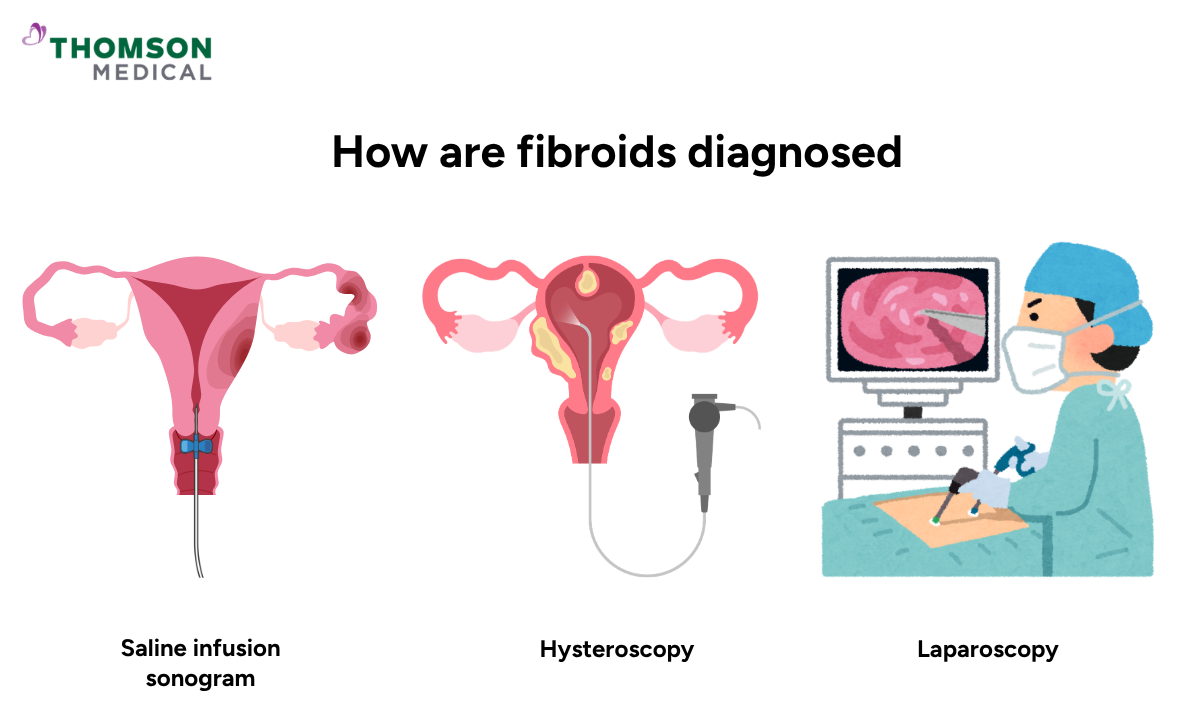
Your doctor will usually begin with a physical examination to check whether your uterus feels enlarged or irregular. If further investigation is needed, one or more tests will be recommended to better understand the size, number, and position of your uterine fibroids.
Ultrasound scan
An ultrasound scan is usually the first test used to look for fibroids and rule out other possible causes of your symptoms. It uses sound waves to create images of your uterus.
You may have:
An abdominal ultrasound, where a probe is moved gently over your abdomen
A transvaginal ultrasound, where a probe is gently inserted into the vagina for a closer view
The type of ultrasound used depends on what your doctor needs to assess. In some cases, both are performed during the same visit to get a clearer evaluation.
Saline infusion sonogram
This is a more detailed type of ultrasound. A small amount of sterile saline fluid is gently introduced into the uterus to help improve the clarity of the images. It is especially useful for detecting fibroids that grow just inside the uterine cavity, which may be harder to see on a standard scan.
Magnetic resonance imaging (MRI) scan
An MRI scan uses strong magnetic fields and radio waves to produce detailed images of your uterus and does not involve radiation.
It is usually recommended when a more detailed view is needed, such as when there are multiple fibroids or when surgery is being planned. It helps your doctor map the fibroid size, number, and position of uterine fibroids more precisely.
Hysteroscopy
A hysteroscopy involves passing a thin camera through the vagina and cervix into the uterus so your doctor may view the inside of the uterine cavity directly. It is particularly useful for fibroids that grow into the cavity. In some cases, small fibroids could be removed during the same procedure.
Laparoscopy
A laparoscopy is a minor surgical procedure carried out under general anaesthetic. A small camera is inserted through a tiny cut in the abdomen, allowing your doctor to view the outside of the uterus and surrounding organs.
It is usually recommended when other scans have not provided enough information or when outer wall fibroids are suspected.
Biopsy
A biopsy involves taking a small tissue sample for testing. It is usually only considered if a uterine fibroid has unusual features or if your doctor needs to rule out other conditions.
This is because a biopsy does not usually confirm fibroids themselves. However, it may be used to rule out other conditions when symptoms or imaging findings are unusual. For most women, it is not part of the diagnostic process.
What happens after a diagnosis?
Receiving a diagnosis of fibroids does not automatically mean that you need treatment. Many fibroids are small and cause no significant problems, requiring only occasional monitoring. However, as fibroids may behave differently depending on where they develop in the uterine wall, their location plays a central role in determining the most effective management plan.
Uterine fibroids are classified into four main types:
Submucosal fibroids: which grow inside the uterine cavity and may cause heavy menstrual bleeding or affect fertility.
Intramural fibroids: which grow within the muscular wall of the uterus, often causing pelvic heaviness or pressure as they expand.
Subserosal fibroids: which grow on the outer surface of the uterus and may press against the bladder or bowel.
Pedunculated fibroids: which are attached to the uterus by a stalk, either inside or outside. If this stalk twists, it could cause sudden, sharp pelvic pain requiring prompt medical attention.
Depending on your diagnosis, symptoms and reproductive goals, fibroid treatment options include:
Regular monitoring with occasional scans if your fibroids are small and not causing symptoms
Medication to help manage heavy menstrual bleeding or to temporarily reduce the size of fibroids before further treatment
Procedures or surgery such as myomectomy, uterine artery embolisation, or hysterectomy for more significant cases
For women who are planning a pregnancy, the timing of any treatment matters. Your doctor will take your fertility goals into account when discussing the options that may suit you best.
If you have been diagnosed with uterine fibroids or are experiencing persistent pelvic symptoms, request a consultation with Thomson Medical. An O&G specialist could help to evaluate your scan results and discuss personalised management options.
FAQ
How long does it usually take to get a fibroid diagnosis?
It varies. If an ultrasound scan gives a clear picture, a diagnosis may be confirmed within one or two appointments. If further tests such as an MRI scan or hysteroscopy are needed, the process may take a few weeks longer.
Is a fibroid ultrasound scan painful or uncomfortable?
A transabdominal ultrasound is generally painless. A transvaginal ultrasound may feel slightly uncomfortable but should not be painful. A saline infusion sonogram may cause mild cramping when the fluid is introduced, similar to period pain, though this usually passes quickly.
Can uterine fibroids be missed on a scan?
Yes, particularly small or awkwardly positioned ones. A saline infusion sonogram or MRI scan provides greater detail and is less likely to miss what a standard ultrasound may not clearly show.
Can ultrasound detect fibroids, or do I need an MRI?
For most women, an ultrasound scan is sufficient. An MRI scan is usually only needed when more detail is required, such as when fibroid size or location needs to be mapped precisely before surgery or when MRI-guided focused ultrasound surgery is being considered.
Can uterine fibroids be found during a routine gynaecological check-up?
Yes, fibroids are sometimes discovered by chance during a routine pelvic examination if the uterus feels enlarged or irregular. They may also be picked up incidentally during an ultrasound scan arranged for another reason.
What medications are available to manage fibroid symptoms without surgery?
Several medications can help manage symptoms without the need for surgery. Your doctor will recommend the most suitable option based on your symptoms and whether you are planning a pregnancy.
- Tranexamic acid: helps reduce heavy period bleeding by encouraging the blood to clot more effectively during your cycle.
- Non-steroidal anti-inflammatory drugs: such as ibuprofen are commonly used to relieve pelvic pain and cramping.
- Hormone therapy: may help reduce heavy menstrual bleeding or manage symptoms, depending on the patient’s suitability and fertility plans.
- GnRH agonists: temporarily lower oestrogen levels, which can cause fibroids to shrink ahead of surgery.
- Other hormonal medicines: may be considered in selected cases, depending on local availability, safety considerations and your doctor’s assessment.
The information provided is intended for general guidance only and should not be considered medical advice. For personalised recommendations and tailored advice based on your unique conditions, request a consultation with Thomson Medical.
For more information, contact us:
Thomson Specialists (Women's Health)
Thomson Women's Clinic (TWC)
- Novena:
6592 6686 (Call), 8611 8986 (WA) - Bukit Batok:
6569 0668 (Call), 8686 3525 (WA) - Choa Chu Kang:
6893 1227 (Call), 8282 1796 (WA) Jurong:
6262 8588 (Call), 6262 8588 (WA)- Katong (female doctor):
6970 2272 (Call), 8611 9020 (WA) - Punggol:
6243 6843 (Call), 8811 0328 (WA) - Sembawang: 6753 5228
- Sengkang: 6388 8125
- Serangoon (female doctor): 6382 3313
- Tampines: 6857 6266
- Tiong Bahru: 6276 1525