

If you’ve recently been diagnosed with ovarian cancer, it’s natural to have many questions about what treatment involves and which options are available in Singapore. You may have heard terms like “surgery”, “chemotherapy”, or “targeted therapy”, yet still feel unsure about what each one means for your body or how doctors decide on the right approach.
Treatment decisions can feel overwhelming, especially when you are still coming to terms with a cancer diagnosis. The good news is that ovarian cancer care in Singapore is guided by specialist teams who tailor treatment plans to each individual.
Understanding your options and what to expect at each stage can help you move forward with greater clarity, confidence, and support.
When does treatment usually begin?
A cancer diagnosis doesn't mean everything starts right away.
Before treatment begins, your doctor needs time to fully understand your cancer. This usually involves imaging scans, blood tests, and sometimes surgery to find out the ovarian cancer's type and whether it has spread.
This assessment period can feel stressful, but it helps your team create a treatment plan that's accurate, safe, and right for you. You won't be rushed into decisions. Your care team will walk you through each step and explain what every test means when the time comes.
Ovarian cancer treatment options in Singapore
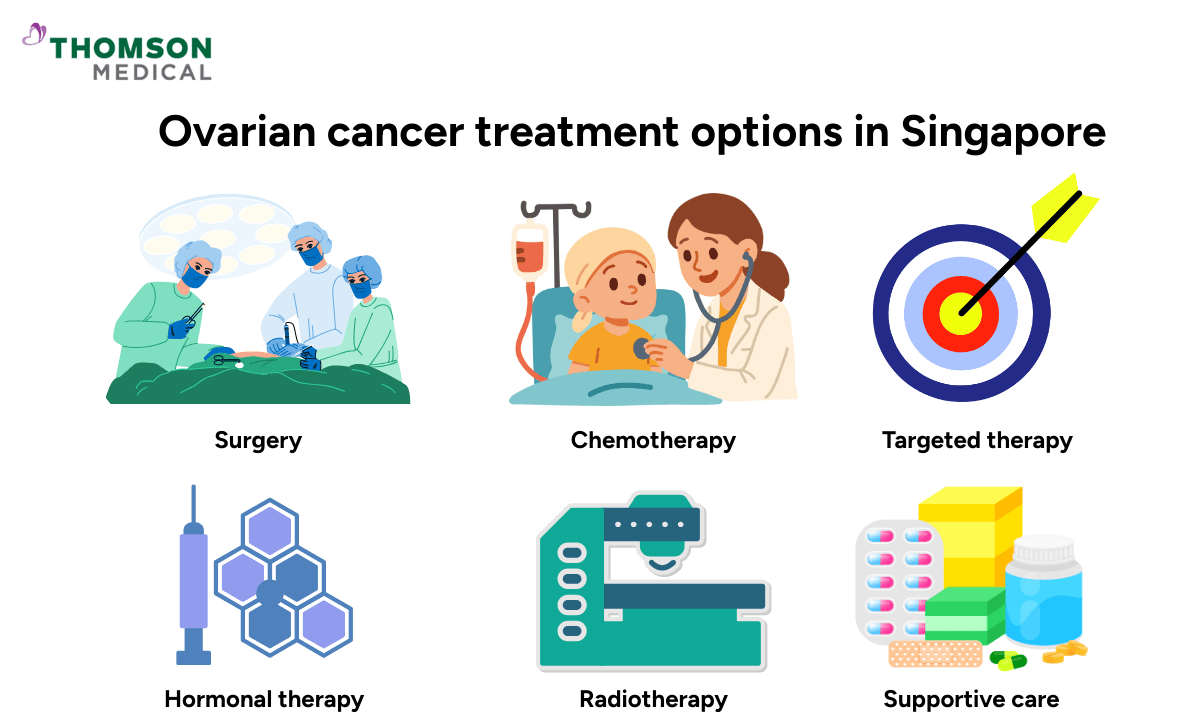
Ovarian cancer treatment is not one-size-fits-all. It is shaped around your body, your health, and what your cancer needs, and often includes more than one form of care.
Surgery
Surgery is often the first step in treating ovarian cancer. It removes the cancer and helps your doctors see how far the disease has spread, so they can plan what comes next.
In earlier stages, ovarian cancer surgery might mean removing one ovary and the affected tissue. In more advanced cases, it can include removing both ovaries, the fallopian tubes, the womb, and sometimes nearby tissue in the abdomen. Your surgical team will always try to remove as much of the cancer as they safely can while looking after your health overall.
After surgery, you'll likely need some time in hospital, then a period of rest and recovery at home. Feeling tired, sore, and drained at first is completely normal, and you'll usually get better bit by bit, over several weeks.
Chemotherapy
Chemotherapy uses medicines to destroy cancer cells that are too small to see or remove during surgery. It's usually given after surgery, though sometimes it starts before surgery to help shrink the tumour and make the operation safer or easier.
Ovarian cancer chemotherapy begins a few weeks after surgery, once your body has started to heal. This gives you time to recover before moving into the next phase of treatment.
In Singapore, chemotherapy is usually given at the hospital through an IV drip into your vein. Treatment happens in cycles, often every three weeks, and runs for several months.
It's normal to worry about side effects. You won't have to handle this alone. Your doctors and nurses will check on you regularly, adjust treatment if needed, and give you medications and support to help manage any side effects.
Targeted therapy
Targeted therapy is a more focused type of cancer treatment. It targets specific features of cancer cells, rather than affecting all fast-growing cells in your body the way traditional chemotherapy does. Because of this, it tends to cause fewer or different side effects than standard chemotherapy.
Not every woman with ovarian cancer will need targeted therapy. It's mainly used for:
Advanced ovarian cancer
Recurrent disease
Tumours have genetic features like BRCA mutations or HRD-positive cancers
Some targeted therapies are taken as daily tablets at home, while others are given as infusions at the hospital every few weeks. Your care team will explain what your schedule looks like and what to expect.
Other treatment options
In some cases, other forms of treatment may also be part of your care plan, such as:
Hormonal therapy:
This treatment is usually used in slower-growing types of ovarian cancer.
It works by blocking hormones that help some cancer cells grow.
Radiotherapy:
In some situations, radiotherapy helps relieve pain, control bleeding, or shrink tumours that are pressing on other organs.
Supportive care:
Supportive care aims to support both your physical and emotional wellbeing.
It can be part of care at any stage of the disease, alongside active cancer treatment.
Treatment is not a single step but a journey made up of different forms of care, brought together to support both your recovery and your wellbeing.
If you have questions about your diagnosis or treatment options,request an appointment with Thomson Medical. Our gynaecologic oncologists can help you better understand your situation and the care options available to you in Singapore.
Our women cancer specialists
Loading...
How your doctors decide the right treatment plan for you
Every woman’s situation is different, and treatment planning begins with understanding you as a whole person, not just your diagnosis.
Your doctor considers many factors, including:
The type and grade of your tumour
Your age and overall health
How your body is likely to tolerate treatment
Your personal priorities and life goals
Your voice matters in this process. Conversations about fertility, family planning, quality of life, and long-term wellbeing are all part of your personalised care.
What does “treatment success” mean?

Success in ovarian cancer treatment is not always defined in a single way.
For some women, it means complete remission. For others, it's keeping the cancer under control long-term and managing it as an ongoing condition. And for many, it means living well while receiving treatment.
Ovarian cancer care today looks beyond the illness itself, with a growing focus on helping women live as well as possible during and after treatment.
Where to receive ovarian cancer treatment in Singapore
Singapore offers both public and private healthcare options for ovarian cancer treatment.
Care is usually provided by multidisciplinary teams, which can include:
Gynaecologic oncologists
Medical oncologists
Radiologists
Pathologists
Oncology nurses
Allied health professionals
Many women choose where to receive care based on a balance of medical expertise, accessibility, comfort, and practical considerations, finding the place that feels right for them and their families.
Cost of ovarian cancer treatment in Singapore
The cost of treatment can vary widely depending on the hospital, type of treatment, and how long you need care.
This is the estimated cost in 2026 for ovarian cancer treatment in Singapore:
Treatment options | Approximate costs |
Surgery | SGD 5,000–20,000 |
Chemotherapy (per cycle) | SGD 500–4,000 |
Targeted therapy (per month) | SGD 5,000–15,000 |
Total treatment | SGD 64,500–258,000 |
While the cost of ovarian cancer treatment can feel overwhelming, financial support is available. Subsidies, MediShield Life, and MediSave can help ease the burden, and financial counsellors are there to guide you through your options.
Exact costs and coverage differ for everyone. It's important to speak with a hospital financial counsellor to understand your specific options, subsidies, and insurance coverage.
Receiving an ovarian cancer diagnosis can feel overwhelming, but treatment keeps improving. Many women now have more options, better chances, and stronger support than in the past. Wherever you are in your journey, you don’t have to face it alone.
If you're not sure what to do next, you don't need to sort through everything on your own. Request an appointment with Thomson Medical to explore a treatment plan tailored to your specific situation, with guidance and care from an experienced medical team.
FAQ
Who is most at risk of developing ovarian cancer?
People are at higher risk of developing ovarian cancer if they:
Have family history of ovarian or breast cancer
Carry inherited gene mutations such as BRCA1 or BRCA
Older age, especially after menopause
How does the doctor know I have ovarian cancer?
Your doctor usually reaches a diagnosis by carefully putting together information from your symptoms, physical examinations, imaging scans, blood tests, and tissue samples taken during surgery or biopsy. A definite diagnosis is made when cancer cells are identified under a microscope.
How is ovarian cancer staged?
Your doctor determines the stage of ovarian cancer based on how far it has spread in the body, ranging from:
Stage 1: Cancer limited to your ovaries
Stage 2: Spread to nearby pelvic organs
Stage 3: Spread to the abdomen or lymph nodes
Stage 4: Spread to distant organs
Imaging scans can help your doctor estimate the stage of cancer before surgery. But the most accurate staging is confirmed during surgery, when your surgeon can directly see and assess the extent of the cancer.
How do you prepare for ovarian cancer treatment?
Preparing for treatment often includes medical tests and scans, conversations with your care team, emotional and nutritional support, and planning for rest and recovery at home.
How effective are ovarian cancer treatments?
Treatment effectiveness depends on the stage at diagnosis, the type of cancer, and how well the cancer responds to therapy. Early-stage ovarian cancer generally has better outcomes than advanced stages.
Where is the best place to go for ovarian cancer treatment?
The best care is usually provided in specialist cancer centres or hospitals with experienced gynaecologic oncologists and multidisciplinary cancer teams. In Singapore, both public and private hospitals offer high-quality ovarian cancer treatment.
The information is intended for general guidance only and should not be considered medical advice. For personalised recommendations and advice based on your unique situation, please consult a specialist at Thomson Medical. Request an appointment with Thomson Medical today.
References:
MediGence. (n.d.). Ovarian cancer treatment cost in Singapore - low-cost surgery. https://medigence.com/hospitals/oncology/ovarian-cancer/singapore/singapore
Alhambra, H. (2025, April 25). Ovarian cancer treatment cost in Singapore. Health365. https://www.health365.sg/ovarian-cancer-treatment-cost-in-singapore/
For more information, contact us:
Thomson Specialists (Women's Health)
Thomson Women's Clinic (TWC)
- Novena:
6592 6686 (Call), 8611 8986 (WA) - Bukit Batok:
6569 0668 (Call), 8686 3525 (WA) - Choa Chu Kang:
6893 1227 (Call), 8282 1796 (WA) Jurong:
6262 8588 (Call), 6262 8588 (WA)- Katong (female doctor):
6970 2272 (Call), 8611 9020 (WA) - Punggol:
6243 6843 (Call), 8811 0328 (WA) - Sembawang: 6753 5228
- Sengkang: 6388 8125
- Serangoon (female doctor): 6382 3313
- Tampines: 6857 6266
- Tiong Bahru: 6276 1525