

In standard IVF, eggs and sperm are placed together in the laboratory and fertilisation happens on its own. When sperm count or quality makes success less likely, or when a previous cycle didn’t fertilise well, your fertility specialist may recommend intracytoplasmic sperm injection (ICSI) instead. With ICSI, the embryologist picks a single sperm and injects it directly into an egg.
That choice is made using a standard microscope, which shows the sperm’s overall shape and movement but not its finer details. Intracytoplasmic morphologically selected sperm injection (IMSI) is a further step: the embryologist views the sperm at far higher magnification, allowing for a closer look before choosing the sperm for injection.
What is IMSI?

IMSI stands for intracytoplasmic morphologically selected sperm injection. It is a laboratory technique used within in vitro fertilisation (IVF) where an embryologist selects sperm under an inverted microscope with ultra-high magnification (around 6000x) before injecting a single sperm into each mature egg.
IMSI uses the same injection technique as intracytoplasmic sperm injection (ICSI), but the difference is that the embryology team examines and selects the sperm under higher magnification before injecting it into the egg.
The main idea behind IMSI is that some sperm that appear normal under standard ICSI magnification (around 200-400x) may exhibit subtle head or nuclear abnormalities (structural issues inside the sperm head’s nucleus) when viewed at much higher magnification. These abnormalities may be an indication of poor sperm quality.
How does IMSI work?
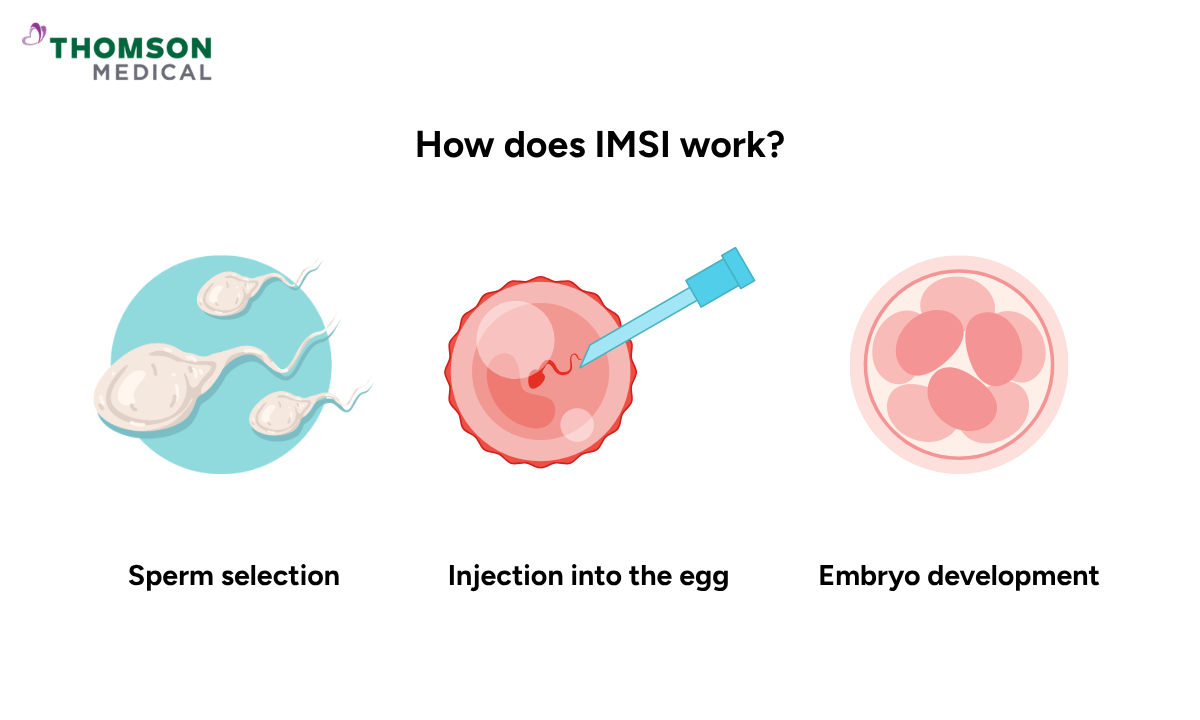
Your embryologist will perform IMSI in a laboratory as an additional, more detailed sperm-selection step within ICSI. It does not replace ICSI or conventional IVF insemination, but it modifies how the embryologist chooses sperm before carrying out the injection procedure.
Here is how IMSI is generally performed:
Sperm selection
During an IMSI cycle, your embryologist places the semen sample on a glass culture dish to ensure clarity. Then, using an inverted microscope at around 6,000× magnification, they then examine the shape of the sperm head and the appearance of its nucleus, looking for subtle abnormalities such as large or multiple vacuoles (small and bubble‑like areas within the sperm head that may indicate DNA issues).
Based on this examination, the embryologist may select sperm with fewer visible structural abnormalities for injection.
Injection into the egg
Once your embryologist selects a sperm, they immobilise it and load it into a fine injection pipette. Afterwards, they hold the mature egg gently with a holding pipette and inject the single sperm directly into the egg. This injection step is similar to conventional ICSI, which bypasses the natural step where sperm must penetrate the egg’s outer layers on their own.
Embryo development
After fertilisation, your embryologist will culture the embryos in a controlled laboratory environment. They monitor them daily to check that they are dividing normally and whether they develop into blastocyst formation by day 5 or 6.
The quality of embryo development depends on factors relating to both the sperm and the egg. If development is successful, your embryologist may transfer the embryo into your uterus (womb) or freeze it for future use.
Our fertility specialists in Singapore
Loading...
Who may be suitable for IMSI?

This fertility treatment aims to improve the sperm selection process by using ultra‑high magnification to identify subtle structural abnormalities that are not visible under a standard microscope.
Your fertility specialists may discuss IMSI when there are significant sperm abnormalities or when previous treatment outcomes are unfavourable for conception. These situations include:
Severe male infertility, such as very low sperm count (severe oligozoospermia), sperm motility issues, or severe teratozoospermia.
Unsuccessful IVF or ICSI, especially when prior cycles showed poor fertilisation, low‑quality embryos, or repeated unsuccessful implantation despite more favourable quality embryos.
Poor sperm morphology on semen analysis, where many sperm show head abnormalities that may reflect underlying nuclear or chromatin issues (abnormalities in the way DNA and its supporting proteins are tightly packed inside the sperm head, which may make the DNA more vulnerable to damage).
Concerns about sperm DNA quality, such as elevated sperm DNA fragmentation on specialised testing.
Recurrent miscarriage or poor embryo development, where male factors, such as elevated sperm DNA fragmentation and abnormal sperm chromatin packaging, are suspected to contribute.
In these cases, your fertility specialist may suggest IMSI as an additional attempt to improve sperm selection, alongside other strategies such as lifestyle changes.
If you are unsure whether IMSI may be suitable for your IVF treatment, visit a fertility specialist to assess your condition and advise you about the procedure. Schedule an appointment at Thomson Fertility Singapore.
What are the limitations of IMSI?
Though IMSI may offer several potential benefits, this procedure also has limitations:
It may be more time‑consuming than standard ICSI:
As each sperm must be examined individually under ultra‑high magnification, it may require the embryologist to spend additional time searching for and evaluating sperm candidates before injection.
It requires specialised equipment and advanced training:
IMSI requires microscopes capable of around 6,000× magnification, specialised optics, culture dishes designed for high‑magnification work, and embryologists trained in recognising subtle nuclear and head abnormalities.
Because of these requirements, not all fertility clinics may offer IMSI.
It does not address female factors:
IMSI focuses only on sperm selection, and it does not improve egg quality, ovarian response, uterine receptivity, or other female factors that influence IVF outcome.
The potential benefit may be limited:
The potential advantages of IMSI might be more relevant in cases of severe male factor infertility, poor sperm morphology, or high sperm DNA fragmentation, rather than for every IVF cycle.
Additionally, in Singapore, IMSI is typically offered as an optional laboratory add‑on which may not be covered by insurance or government subsidies. Therefore, you need to discuss with your fertility specialist whether IMSI is suitable for your specific situation.
Does IMSI improve IVF pregnancy rates?
IMSI may help improve pregnancy chances, particularly for those with severe male factor infertility or repeated unsuccessful IVF or ICSI cycles. By selecting sperm with a more normal head shape and nuclear structure, IMSI may reduce the chance of using sperm with subtle morphological abnormalities.
However, this fertility treatment may not detect all DNA-related issues. Even with ultra-high magnification, many DNA abnormalities, such as single‑ or double‑strand breaks, may not be visible. A sperm that looks structurally normal under IMSI may still carry DNA damage that could affect embryo development or increase miscarriage risk.
Additionally, IMSI could not guarantee pregnancy, because embryo development and pregnancy depend on many factors beyond sperm selection, including:
Egg quality and maternal age: they may influence chromosomal normality and embryo development.
Uterine environment: the lining of the womb, hormonal support, and uterine conditions (such as polyps or fibroids) may affect implantation.
Embryo genetics: even with well‑selected sperm, embryos may still have chromosomal abnormalities that reduce implantation or increase miscarriage risk.
How do doctors decide between IMSI and other sperm selection methods?
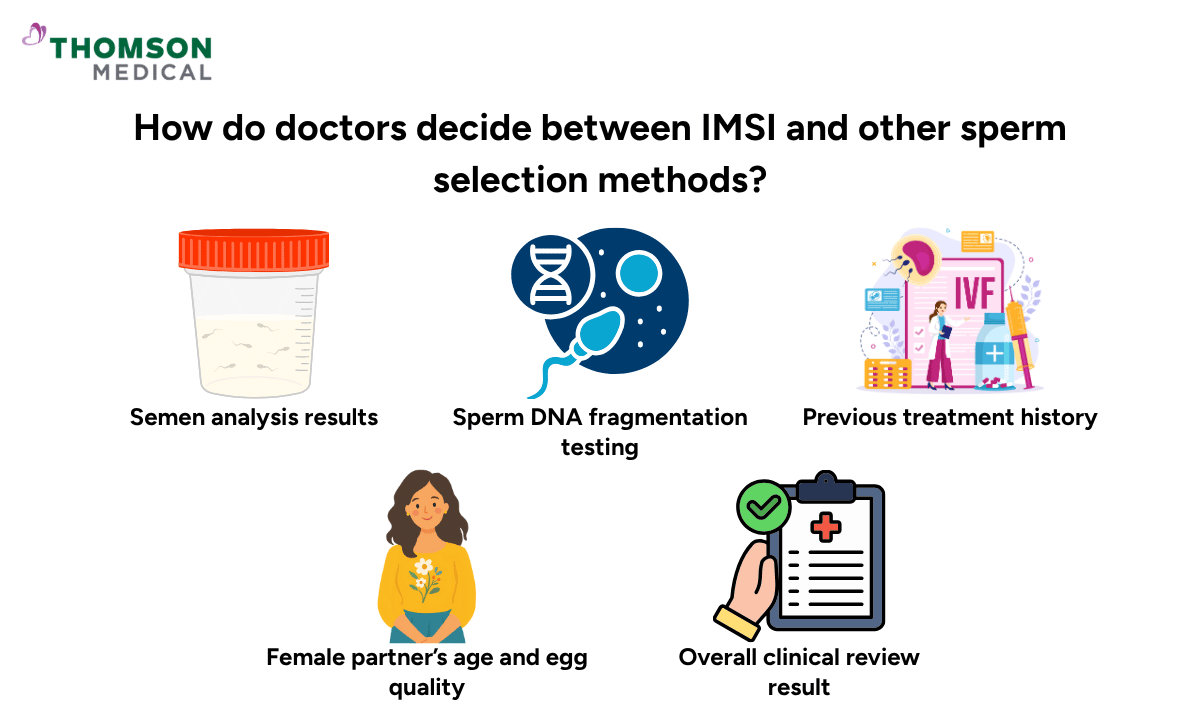
Deciding between IMSI, conventional ICSI, and other sperm selection techniques may require individual assessment. Your fertility specialist may consider:
Sperm analysis results: your fertility specialist will review your sperm count, motility, and morphology, which help them determine whether male factor infertility is present and how severe it is.
Sperm DNA fragmentation testing: this test provides additional information about DNA integrity inside sperm, which may not be captured by a standard semen analysis.
Previous treatment history: your fertility specialist may consider the number of IVF or ICSI cycles, fertilisation rates, embryo quality, implantation success, and any history of biochemical pregnancies or miscarriages.
Female partner’s age and egg quality: as female age may affect ovarian reserve and egg quality, your fertility specialist may consider it when planning your IVF treatment and discussing whether IMSI may be appropriate.
Overall clinical review result: your fertility specialist may review the causes of infertility, uterine factors, genetic findings, and whether there is unexplained infertility or recurrent pregnancy loss.
Based on these considerations, your fertility specialist might explain which method is appropriate for your condition.
If you are considering IMSI as an additional procedure for your IVF treatment, consult a fertility specialist to help decide whether this procedure may help your condition. Schedule an appointment at Thomson Fertility Singapore.
FAQ
Can IMSI reduce miscarriage risk?
IMSI may possibly reduce miscarriage risk in specific cases, likely because the better-selected sperm may have fewer DNA abnormalities. However, miscarriage is influenced by many factors, including embryo genetics and maternal age, so IMSI alone cannot eliminate this risk.
How long does an IMSI procedure take?
The sperm selection process in IMSI may take longer than conventional IVF with ICSI because each sperm is examined in detail under high magnification. However, your overall IVF timeline may remain similar to a standard ICSI cycle; you may ask your doctor how long the IMSI procedure may take.
Are there any side effects of IMSI?
There are no direct side effects of IMSI itself for the patient, because the technique is performed entirely in the laboratory on the sperm sample and does not involve additional procedures on the men or women.
The physical risks and side effects of IMSI may be the same as for standard IVF or ICSI cycles, since IMSI is an add‑on to the ICSI procedure rather than a separate treatment. These risks and side effects can be related to the IVF medications, egg retrieval, or pregnancy.
Is IMSI suitable for every IVF cycle?
IMSI is not routinely used for every IVF cycle or for all patients. This procedure is usually reserved for specific cases where there are concerns about the sperm quality or when the previous IVF cycles have failed without explanation.
The information provided is intended for general guidance only and should not be considered medical advice. For personalised advice based on your conditions,schedule an appointmentwith Thomson Medical.
For more information, contact us:
Thomson Fertility Centre
- Paragon: 6252 7766
- Novena: 6399 3758, 8811 0358 (WA)