

When you’re trying to conceive, you may start to notice details you had previously overlooked, such as the colour of your period blood. While these changes are often dismissed as insignificant, they can sometimes reflect how well your body is supporting your reproductive health.
In Traditional Chinese Medicine (TCM), for example, the menstrual cycle is considered an indicator of overall reproductive health. The timing, flow, and colour of menstrual blood can offer insights into how well your body is nourishing and supporting conception.
How TCM understands menstrual timing
In TCM, menstrual timing is closely linked to the balance of Qi (energy) and Blood, both of which are essential for reproductive health.
Changes in menstrual timing may be interpreted in the following ways:
Early periods:
Often linked to excess heat in the body
Blood may be moving too quickly before it is properly regulated
Late periods:
May suggest blood deficiency
Can also indicate blood stagnation and slower circulation
Alongside timing, the colour and quality of menstrual blood can provide further clues. From a TCM perspective, these variations are not random. They are meaningful signals that reflect the body’s internal balance and help TCM physicians to assess how well your body is supporting reproductive health.
What can your period colour mean for your fertility and health?
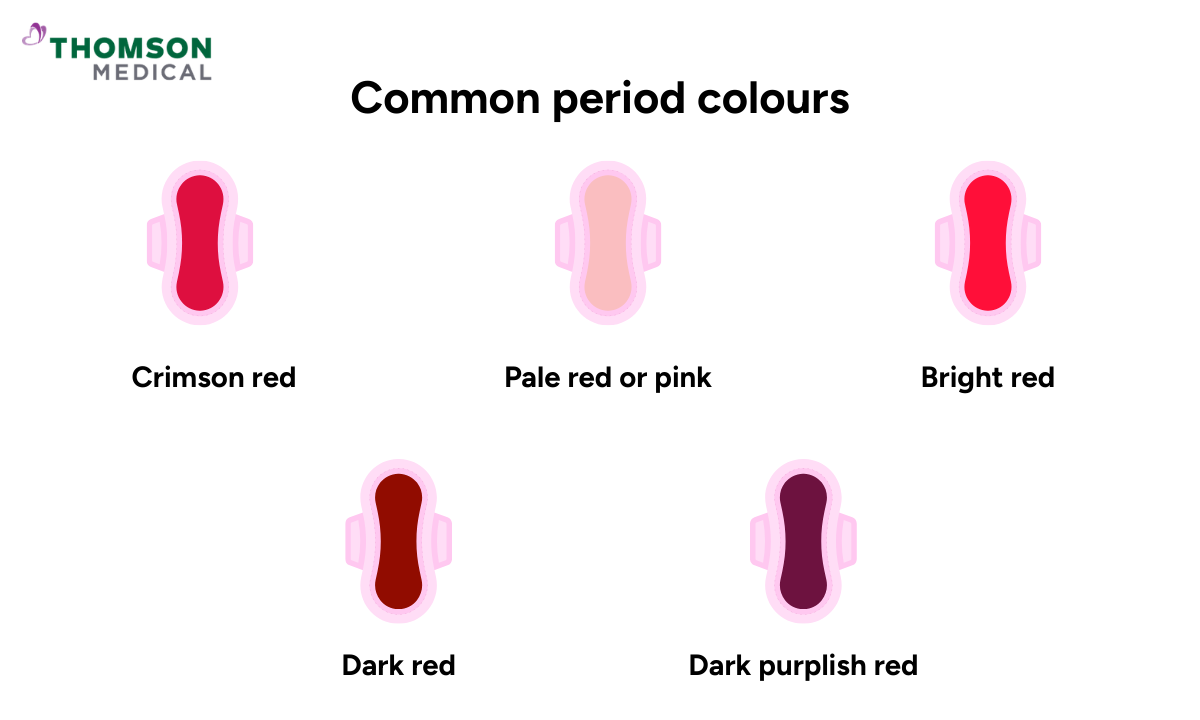
Crimson red
In TCM, blood is considered the foundation of a woman’s health. Ideally, menstrual blood should appear crimson red.
A healthy cycle typically:
Occurs every 28 to 35 days
Requires about one regular pad every 3 to 4 hours
Shows a smooth flow without excessive clots
Small, pea-sized clots can be normal, as menstruation involves shedding the uterine lining. Crimson red blood with a moderate flow is usually a sign of balanced Qi, healthy blood production and good reproductive potential.
Pale red or pink
If your menstrual blood appears watery, pale red or pink, it is natural to feel concerned, especially when trying to conceive. These changes can be your body’s way of signalling that it may need a little more support.
From a Western perspective, this can be linked to:
Anaemia
Low iron levels
Poor nutrient absorption
An imbalanced diet
In TCM, pale and watery menstrual blood is commonly associated with Spleen Qi deficiency. When the Spleen is weakened, your body may struggle to produce enough healthy blood to properly nourish the uterus, which can affect the quality of the endometrial lining needed for implantation.
It’s also reassuring to know that occasional light spotting around mid-cycle isn’t always a cause for concern and may simply be implantation bleeding.
Bright red
If your menstrual blood appears bright red, it may suggest excess heat in the body. This is sometimes associated with a higher basal body temperature, particularly in the early part of the cycle.
When body temperature is consistently elevated, blood may become more active and appear brighter than usual.
You may also notice:
Feeling unusually thirsty
Sore throat
Yellow vaginal discharge
Pelvic discomfort
Excess heat can disrupt ovulation timing and hormonal balance, which may affect fertility. In these cases, TCM focuses on clearing heat and supporting the body in restoring internal balance.
Dark red
Dark red menstrual blood may indicate cold or stagnation within the uterus. When basal body temperature is lower, blood circulation can slow and the uterine muscles may contract more strongly.
You may notice:
Menstrual cramps
Heavier clotting
A slower or sluggish flow
In TCM, this pattern is commonly associated with Liver Qi stagnation. When Qi doesn’t flow smoothly, blood circulation can become restricted.
Some women may also experience:
Premenstrual symptoms such as fatigue or lower abdominal discomfort
Breast tenderness
Irritability
Emotional tension
TCM treatment focuses on moving Qi, improving circulation, gently warming your uterus and supporting a smoother, more comfortable menstrual flow.
Dark purplish red
If you notice that your menstrual blood is dark purplish red, especially when it is accompanied by large clots or sharp, stabbing pain, this may suggest significant blood stasis.
This pattern is sometimes seen in women with conditions such as fibroids or endometriosis. You may experience a heavier flow, more intense cramps or persistent clotting, all of which can affect fertility and, in some cases, increase pregnancy-related risks.
If these describe your cycle and it occurs regularly, it's important to seek a professional assessment. Schedule a consultation with Thomson Chinese Medicine to receive an early evaluation and personalised support to help address any underlying imbalances and better protect your reproductive health.
Our TCM specialists
Loading...
TCM support for menstrual and fertility health at Thomson Medical

In fertility support, acupuncture focuses on:
Regulating hormones:
Acupuncture may influence the endocrine system, helping to regulate hormone levels crucial for ovulation and menstrual cycle regularity.
This can be particularly beneficial for women with hormonal imbalances affecting their fertility.
Improving blood flow:
Acupuncture can enhance blood circulation to the reproductive organs, including the ovaries and uterus.
Improved blood flow can support healthy egg production, implantation, and overall reproductive function.
Supporting uterine health:
Regular acupuncture sessions may help regulate menstrual cycles and alleviate symptoms of conditions like polycystic ovary syndrome (PCOS), endometriosis, and adenomyosis, which can impact fertility and overall wellbeing.
Reducing stress:
Stress can significantly impact fertility by disrupting hormone levels and affecting ovulation. Acupuncture sessions are often relaxing and can help reduce stress, promoting a more conducive environment for conception.
Addressing underlying imbalances:
The colour of your menstrual blood offers a visible window into your internal health. By understanding these patterns, a TCM physician can tailor treatment to your specific needs, rather than applying a one-size-fits-all approach.
Consistently healthy menstrual blood is often a sign that the body is well-prepared for conception. If your cycle shows persistent irregularities, unusual colours, or is accompanied by pain or discomfort, this may be your body's way of asking for support.
What to expect during your acupuncture consultation
At Thomson Chinese Medicine, our certified physician conducts a thorough assessment during your initial consultation, reviewing your medical history and menstrual symptoms to determine the most effective treatment plan.
The procedure involves the gentle insertion of fine, sterile needles at specific acupuncture points on the body. Most patients experience minimal discomfort, often describing the sensation as a light tingling or warmth.
Each session typically lasts between 20 to 40 minutes, depending on the condition being treated. Regular sessions are recommended to achieve optimal results, with the number of treatments varying based on your individual needs and health goals.
If you are considering TCM as part of your fertility or menstrual health journey, schedule a consultation with Thomson Chinese Medicine. Our qualified physician can help to assess your cycle, discuss personalised treatment options, and provide tailored guidance for your conditions.
FAQ
Is it normal for period colour to vary from cycle to cycle?
Yes, you may notice changes in period colour from time to time, especially during periods of stress, travel, illness or lifestyle changes. In TCM, what matters most is whether a particular colour or pattern appears consistently over several cycles rather than as a one-off change.
Are blood clots during menstruation always a concern?
Small clots can be a normal part of menstruation, particularly on heavier flow days. However, if you regularly experience large clots, especially together with significant pain or very dark blood, it may be helpful to seek professional assessment.
If my menstrual cycle is regular, can there still be fertility concerns?
A regular cycle is generally reassuring, but it does not always reflect the full picture of reproductive health. Factors such as blood quality, hormonal balance and uterine environment also play an important role in fertility, even when cycle timing appears normal.
How long does it typically take to see improvements with acupuncture or TCM?
This varies from person to person. Some women notice improvements within one to three cycles, while others may require a longer period of treatment depending on their individual health patterns and goals.
Can TCM be used alongside assisted fertility treatments?
Yes. Many women choose to use TCM alongside assisted fertility treatments. When coordinated appropriately, acupuncture and herbal medicine may help support overall wellbeing and cycle regulation. It is important to inform all healthcare providers involved so care remains aligned.
When should I consider seeking professional advice about my period?
If you notice ongoing irregular cycles, unusual blood colours, heavy clotting or persistent pain, particularly when you are planning to conceive, it is advisable to seek professional guidance rather than wait for symptoms to resolve on their own.
The information provided is intended for general guidance only and should not be considered medical advice. For personalised recommendations and tailored advice based on your conditions, schedule an appointment with Thomson Chinese Medicine today.
Physician Jun Negoro
Traditional Chinese Medicine
Thomson Chinese Medicine (TCM Paragon Medical Centre) and 1 other
English, Mandarin
Alliance MediNet
