

Your period arrives like clockwork one month, then disappears the next. You've tried tracking your cycle, adjusting your diet, and managing stress, but nothing seems to bring lasting balance. What if the answer lies in a system that's been regulating women's cycles for thousands of years?
Traditional Chinese Medicine (TCM) approaches menstruation differently from Western medicine. Instead of treating symptoms in isolation, TCM looks at your body as an interconnected system where energy flow, blood quality, and organ function all influence your cycle.
This holistic perspective offers natural pathways to cycle regulation that many women find transformative.
How is menstrual health understood in TCM?
When menstrual problems arise, it is natural to think of hormonal changes or an issue with the uterus. This way of thinking is completely understandable. In TCM, however, menstrual health is viewed through a broader lens – a reflection of the body’s overall balance. It considers how different systems work together to support a regular and healthy menstrual cycle.
At the core of menstrual health in TCM are Qi (vital energy), blood, and the harmony of key organ systems, including Kidney, Liver, and Spleen.
Menstrual health also reflects the close connection between the mind and the body. The Heart is linked to emotional balance and blood flow, and through the Bao Mai (uterus vessel), it is connected to the uterus and ovaries. This helps explain why emotional stress is believed to directly affect ovulation and the menstrual cycle.
This balance is expressed through the natural rhythm of the menstrual cycle. Throughout the cycle, your body moves between yin and yang energy. Yin is associated with the first half of the cycle (days 1-14), when the body focuses on nourishing and building. Yang is linked to the second half (days 14-28), when warmth and activity become more prominent.
The root causes of menstrual issues in TCM
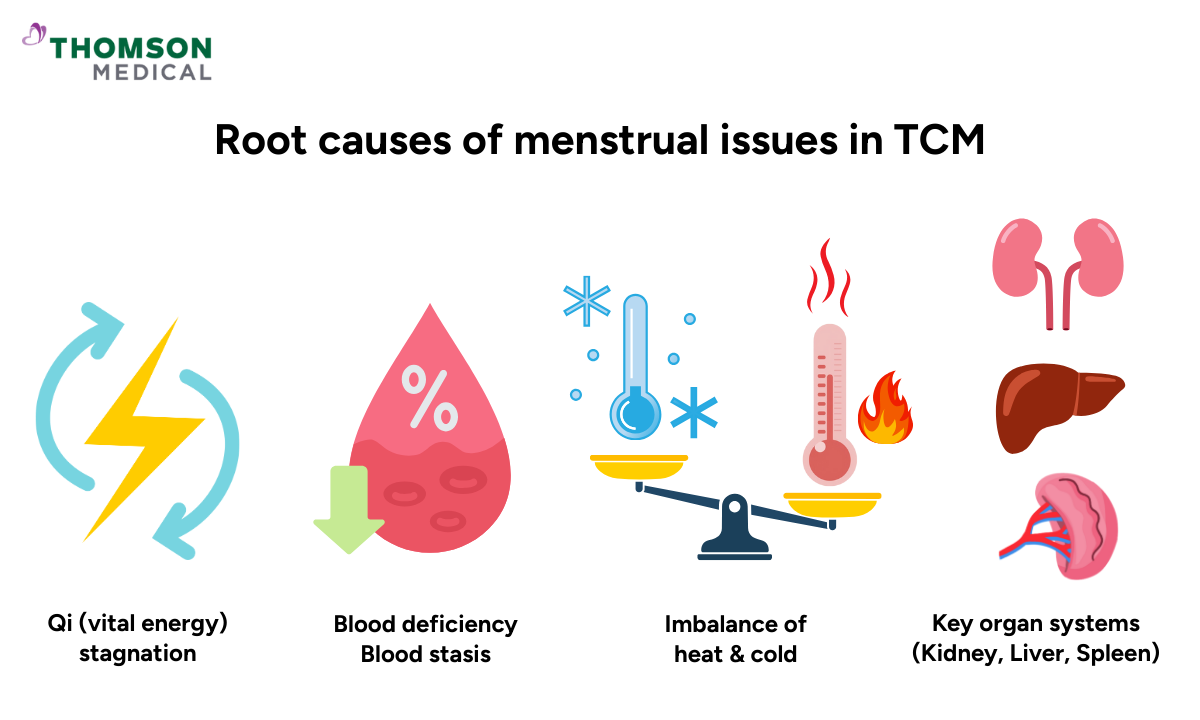
Having an unpredictable menstrual cycle can feel frustrating or even exhausting. In TCM, these changes are not seen as signs that something’s “wrong” with you, but instead as a signal that your body may be slightly out of balance.
Common root causes may include:
Qi stagnation:
When Qi flows smoothly, your menstrual cycle tends to be regular and comfortable.
When Qi becomes stagnant, which is often linked to stress or emotional strain, it may contribute to irregular cycles, breast tenderness, or menstrual pain.
Blood deficiency or blood stasis:
Adequate and well-circulating blood is associated with regular periods and healthy menstrual flow.
Blood deficiency may lead to light periods or fatigue, while blood stasis may cause pain or dark clots.
Imbalance of heat and cold:
Excess heat may be associated with heavy bleeding, short cycles, or irritability.
Cold, especially in the uterus, may lead to delayed periods, cramps, or scanty flow.
Key organ systems:
The Kidney is linked to reproductive potential and long-term fertility.
The Liver helps ensure the smooth flow of Qi and blood, especially throughout the menstrual cycle.
The Spleensupports blood production and overall energy.
These patterns often occur together rather than in isolation. Your TCM physician takes time to understand your individual pattern before recommending an appropriate treatment approach.
At Thomson Chinese Medicine, our TCM physicians assess both symptoms and underlying patterns to identify the root cause of menstrual imbalance and tailor a treatment plan that supports your body’s natural rhythm. Request an appointment today.
Our women's health physicians
Loading...
How TCM treats menstruation issues

You may be wondering how TCM can support your menstrual health and whether it is right for you. Rather than forcing change, TCM treatment works gently to regulate the flow of Qi and Blood, restore balance between Yin and Yang, and support your body systems involved in reproductive health.
Regulate menstrual cycle
A menstrual cycle has its own natural rhythm, which lasts around 28 to 35 days. Some factors, such as stress, medications, or conditions like endometriosis, may disrupt this rhythm.
Acupuncture is usually used to gently encourage the smooth movement of Qi and Blood, helping your body return to its natural rhythm. As circulation improves and energy vitality is supported, balance between yin and yang can gradually be restored.
Relieve menstrual cramps
Another treatment that your TCM physician may recommend is moxibustion. This technique involves burning mugwort, leaving a few inches between it and your acupoints to ease menstrual cramps.
In TCM, this warmth therapy is believed to dispel cold, improve circulation, and ease stagnation, allowing the body to release tension and soften menstrual cramping.
Help with premenstrual syndrome (PMS)
In the days leading up to a period, it is common to go through both physical and emotional changes, often recognised as premenstrual syndrome (PMS). PMS may show up as mood swings, breast tenderness, bloating, changes in appetite, acne, and migraine.
These symptoms are often linked to Liver Qi stagnation, where energy and emotions become constrained. Through acupuncture and carefully selected Chinese herbs, TCM aims to soothe the Liver’s Qi, nourish your body, and support healthy circulation, helping you feel more balanced and at ease through this phase of the cycle.
Manage menopausal symptoms
Menstrual concerns do not end with the reproductive years. During the transition to menopause, hormonal changes may bring irregular bleeding, hot flushes, night sweats, or mood shifts. While this stage may bring unfamiliar changes to both your body and emotions, TCM views it as a natural transition rather than a loss.
A combination of acupuncture and herbal medications can help to balance any disharmony between yin and yang, focusing on the Spleen, Kidney, and Liver. Many women find that TCM support helps ease menopausal symptoms and makes this transition feel more manageable.
TCM treatment offers a natural, holistic approach that works to restore balance across the entire body, supporting menstrual health at its root. If you are experiencing menstrual concerns, our qualified TCM physicians are here to support you. Request a consultation to explore a personalised, natural approach to menstrual health.
FAQ
What does TCM say about periods?
A regular and comfortable period reflects smooth flow of Qi and Blood and overall balance within the body. Menstrual symptoms are seen as signs of underlying imbalance rather than isolated problems.
What herbs can jumpstart your period?
TCM does not rely on a single herb to jumpstart a period. Chinese herbs are prescribed by a qualified TCM physician as personalised formulas to regulate Qi and blood based on an individual’s pattern.
What do heavy periods mean in Chinese medicine?
In TCM, heavy periods are often associated with imbalances such as heat in the blood or weakness in the Spleen’s ability to hold blood, depending on accompanying symptoms.
What to drink during your period?
Your TCM physician may recommend warm drinks during menstruation to support circulation and avoid cold. Specific herbal teas may be suggested based on your individual needs.
Can acupuncture help with heavy periods?
Acupuncture regulates Qi and blood and supports balance, which may help manage heavy periods when used as part of a personalised treatment plan.
Is acupuncture good for menstrual cramps?
Acupuncture is commonly used in TCM to relieve menstrual cramps by improving circulation, easing stagnation, and reducing discomfort.
The information provided is intended for general guidance only and should not be considered medical advice. For personalised recommendations and advice based on your unique situation, request an appointment with Thomson Chinese Medicine today.
Physician Seah Ai Wei
Traditional Chinese Medicine
Thomson Chinese Medicine (TCM United Square) and 1 other
English, Mandarin
Alliance MediNet
