

Blood tests are part of many routine health checks, so it is natural to wonder whether they can also be used to detect cervical cancer. Unfortunately, while blood tests are helpful for identifying many medical conditions, cervical cancer is usually found through specific screening tests that look directly at the cervix.
Understanding why these tests are used, and which ones are most effective, can help you feel more reassured and confident about taking the right steps to protect your cervical health.
What is a blood test?
A blood test is a common medical test that analyses a small sample of your blood to measure different substances in your body. Your doctor may use blood tests to check:
Blood cell counts (red and white blood cells, and platelets)
Hormone levels
Proteins and enzymes
Tumour markers (for some types of cancer)
Blood tests provide valuable insights into your body. They help your doctor understand your overall health, detect infections, and monitor how well your organs are working.
Can a blood test detect cervical cancer?
Blood tests offer many benefits, so it's completely natural if you wonder whether they can detect cervical cancer, especially when you're looking for easier screening options.
Although blood tests are helpful, they cannot detect cervical cancer on their own because there’s no specific blood marker that confirms this disease.
While other cancers release detectable substances into your bloodstream, cervical cancer works in a different way. It develops from abnormal cells on the surface of your cervix, not in your blood.
That said, blood tests still play an important supporting role in your care. Your doctor usually uses them to:
Check your general health before or during treatment
Monitor how your body responds to treatment
Check for signs of infection, anaemia, or organ function
Support other diagnostic findings
There's ongoing research about HPV DNA blood tests and circulating tumour DNA tests, which may offer simpler options in the future. But these are not yet standard for cervical screening.
Fortunately, there are trusted approaches available today that can help you detect cervical cancer early. Your doctor will work with you to find the screening plan that's right for you.
What are the screening tests for cervical cancer?

The two main screening tests for cervical cancer are the Pap smear and the HPV test. They are both simple and effective in helping your doctor catch problems early, especially when they’re easiest to treat.
Pap Smear (Pap Test)
A Pap smear is a screening test that detects abnormal or precancerous cells on your cervix.
During the process, your doctor will use a small brush or spatula to gently collect cells from your cervix. The cells are then sent to the lab for examination. You may feel a bit of discomfort, but the test is usually quick and not painful.
If you are 21–29 years old, a Pap test is usually recommendedevery 3 years. From 30 to 65, you should have it every 5 years when combined with HPV testing.
HPV Test
The HPV test detects the presence of high-risk human papillomavirus (HPV) types that cause cervical cancer.
This test uses the same cell sample collected during a Pap test, though your doctor may take a separate swab. After that, the sample is tested in a lab to see if high-risk HPV types are present.
If you are between 30 and 65, your doctor usually combines it with a Pap test (called co-testing). This combination will give your doctor a clearer picture of your cervical health.
An important thing to note is that a positive HPV test doesn’t necessarily mean you have cancer. Instead, it could simply be a sign your risk is higher. Your doctor will monitor you more closely and provide advice to make sure you are safe.
If you want to take a proactive step to protect your cervical health but are unsure which test is suitable for you, schedule an appointment with Thomson Medical. Our specialists will guide you through your options and create a personalised care plan for your specific condition.
Our cervical cancer specialist
Loading...
How do doctors diagnose cervical cancer?
If your Pap smear or HPV test comes back abnormal, don’t panic; it doesn’t necessarily mean you have cancer. Most of the time, it simply means there are changes that need more attention.
That’s why your doctor may suggest further tests to figure out what’s happening with your cervix, including:
Colposcopy:
Colposcopy is a detailed examination that allows your doctor to look closely at your cervix to find abnormal areas.
Biopsy:
If your doctor sees suspicious areas during colposcopy, they’ll take a biopsy. This is the only way to know for sure whether abnormal cells are precancerous or cancerous.
During these processes, you may experience mild cramping or pressure, but this feeling only lasts for a short time. Your doctor will help address any concerns you may have and gently guide you through each step to make sure you feel as comfortable as possible.
How to prevent cervical cancer
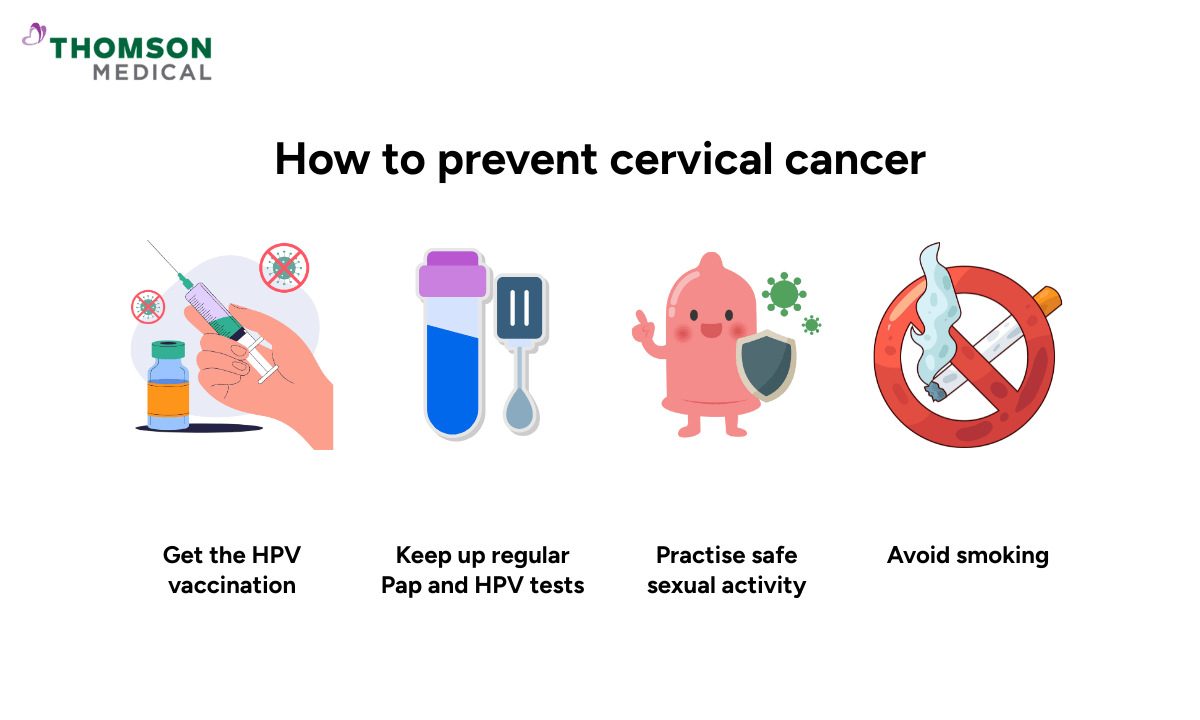
Cervical cancer is one of the most common cancers in women, but it’s also one of the most preventable. This means you have more power to protect yourself than you might think.
With simple and proactive steps, you can lower your risk and take charge of your cervical health. Here are some effective tips you can follow:
Get the HPV vaccination:
The HPV vaccine protects you against the high-risk HPV types that cause 90% of cervical cancer.
Keep up regular Pap and HPV tests:
Cervical cancer usually shows no symptoms in its early stages, so regular screening is very important. It helps catch abnormal cells early before they become serious.
Practise safe sexual activity:
Because HPV spreads through sexual contact, you can lower your risk by using condoms consistently and limiting your number of partners.
Avoid smoking:
Smoking weakens your immune system and makes it harder for your body to clear HPV infections naturally. That’s why quitting smoking can help reduce your risk of developing cervical cancer.
Taking care of your cervical health doesn't have to be complicated or stressful. You can take a small step first, then build up over time. What actually matters is your patience and consistency.
If you need more guidance or have any concerns, your doctor is there to support you every step of the way.
If you’re experiencing symptoms or noticing unusual changes to your body, schedule an appointment with Thomson Medical. Our specialists will evaluate your condition and recommend the right care plan for you.
FAQ
Can a blood test detect cervical cancer?
No, a blood test cannot detect cervical cancer. For cervical cancer screening, Pap smears and HPV tests are far more effective and reliable.
HPV test vs. Pap smear: Which is better?
Both tests are helpful, but they serve different purposes:
Pap smear: Detects abnormal cells on your cervix.
HPV test: Detects the virus that causes those changes.
That’s why they cannot replace each other. The most effective approach is “co-testing”, which combines the Pap smear and HPV test, as it improves detection and reduces the chance of missing anything important.
How to check for cervical cancer without a Pap smear?
If a Pap test isn’t the best choice for you, your doctor may suggest:
An HPV self-sampling test:
In some screening programmes, you may be offered a vaginal swab that you can do yourself at home.
A pelvic exam:
Your doctor may use this test to identify visible abnormalities.
Imaging tests:
Ultrasound or MRI scans may only be used once symptoms or abnormalities are found.
However, Pap tests and HPV tests remain the gold standard for screening. If you’re uncomfortable with a Pap smear, let your doctor know.
How do doctors tell if you have cervical cancer?
Your doctor follows a step-by-step process:
Abnormal screening results:
If these tests show abnormal results, your doctor will suggest further testing.
Colposcopy:
This allows your doctor to examine your cervix closely.
Biopsy:
It confirms whether abnormal cells are precancerous or cancerous.
If cancer is diagnosed, your doctor may order imaging tests (like MRI, CT, or PET scans) to check how far the cancer has spread.
What signs might indicate cervical cancer?
Cervical cancer usually shows no symptoms in its early stages. However, when it progresses, you may notice:
Abnormal vaginal bleeding (between periods, after sex, or after menopause)
Unusual vaginal discharge (possibly with blood or odour)
Pelvic or back pain
Pain during intercourse
Leg swelling (in later stages)
If you’re experiencing these symptoms, don’t hesitate to consult your doctor.
Can you get a blood test instead of a Pap smear?
No, a blood test cannot replace a Pap smear for cervical cancer screening.
Although it’s very helpful in checking your overall health, it’s not reliable enough to replace a Pap smear, which directly examines your cervical cells.
What are the treatment options for cervical cancer?
Your treatment plan depends on different factors, such as the stage of cancer, your age, and whether you want to preserve fertility.
Common treatment options include:
Surgery:
This approach helps remove cancerous tissue (e.g., cone biopsy for early cancer and hysterectomy for more advanced cases).
Radiation therapy:
This treatment uses high-energy beams to destroy cancer cells.
Chemotherapy:
Chemotherapy uses drugs to kill or slow cancer cell growth.
Targeted therapy:
Drugs like bevacizumab are used to block the blood supply to your tumours.
Immunotherapy:
Medications like pembrolizumab help your immune system recognise and attack cancer cells.
Your doctor will work closely with you to create a plan tailored to your specific situation.
The information provided is intended for general guidance only and should not be considered medical advice. For personalised recommendations and advice based on your unique situation, please consult a specialist at Thomson Medical. Request an appointment with Thomson Medical today.
For more information, contact us:
Thomson Specialists (Women's Health)
Thomson Women's Clinic (TWC)
- Novena:
6592 6686 (Call), 8611 8986 (WA) - Bukit Batok:
6569 0668 (Call), 8686 3525 (WA) - Choa Chu Kang:
6893 1227 (Call), 8282 1796 (WA) Jurong:
6262 8588 (Call), 6262 8588 (WA)- Katong (female doctor):
6970 2272 (Call), 8611 9020 (WA) - Punggol:
6243 6843 (Call), 8811 0328 (WA) - Sembawang: 6753 5228
- Sengkang: 6388 8125
- Serangoon (female doctor): 6382 3313
- Tampines: 6857 6266
- Tiong Bahru: 6276 1525