

Receiving a normal Pap smear result often brings a sense of relief. Still, it is common for questions to follow, especially when you start thinking about other gynaecological conditions.
Unfortunately, while Pap smears are highly effective at detecting changes in the cervix, they are not designed to identify ovarian cancer. Understanding the purpose of each test and how ovarian cancer is usually detected can help you feel more informed and confident when discussing your screening options with your doctor.
What is a Pap smear test?
A Pap smear (Pap test) is a screening test that your doctor uses to check the health of your cervix – the opening of your uterus.
During the process, your doctor gently collects a small sample of cells to look for:
Precancerous changes
Cervical cancer
Some infections
The main purpose of a Pap test is to catch cervical problems early, before they become serious. It’s a very effective screening tool, but it’s only designed for cervical cancer, not other types of cancer.
Does a Pap test detect ovarian cancer?

Unfortunately, a Pap test cannot detect ovarian cancer.
That’s because your ovaries and cervix are different organs in different locations. A Pap smear only collects cells from your cervix, while ovarian cancer starts in the ovaries, which sit deeper inside your pelvis. This means the test cannot reach the area where ovarian cancer develops.
For this reason, you can have a normal Pap test and still have ovarian cancer. This may worry you, and that’s natural. However, ovarian cancer is relatively uncommon, and knowing what symptoms to watch for and when to see your doctor can help you take charge of your ovarian health.
What are the warning signs and risk factors?
It's important to be aware of the warning signs and risk factors of ovarian cancer, as it can give you a clear picture of what you should pay attention to. You can recognise when something doesn’t feel quite right and reach out for support when needed.
Early warning signs
One of the challenges of ovarian cancer is that early symptoms can be vague and easy to overlook, so it’s easy to mistake them for digestive problems or menstrual discomfort.
However, there are some common early signs you can watch for, including:
Persistent bloating
Pelvic or lower belly pain
Feeling full quickly when eating
Needing to urinate more often
Ongoing fatigue
If you find yourself having one or more of these symptoms, don’t panic. Many non-cancerous conditions can cause the same symptoms, so this doesn’t automatically mean you have cancer.
However, you should pay closer attention if your symptoms are:
Happening frequently
Last for weeks
Getting worse over time
If this sounds like what you’re experiencing, it’s best to check with your doctor as soon as possible. With proper evaluation, they can help you find out what’s behind these symptoms and suggest the right care plan for you.
If you have concerns about ovarian health, schedule an appointment at Thomson Medical. Our obstetricians and gynaecologists can guide you through the right tests for early detection and provide personalised care every step of the way.
Women's cancer specialists
Loading...
Risk factors
Ovarian cancer is quite uncommon, particularly in younger women. However, there are some factors that can increase your risk, and knowing them can help your doctor decide if closer monitoring is necessary.
Here are the most common risk factors:
Family history of ovarian or breast cancer
Inherited gene changes (such as BRCA1 or BRCA2 mutations)
Older age – the risk increases as you get older, especially after menopause
There are also less common or weaker risk factors:
Never having been pregnant
Long-term hormone therapy after menopause
It’s important to remember that just having one or two risk factors doesn’t necessarily mean you are guaranteed to get ovarian cancer. In fact, many women with these risk factors never get the disease. While knowing these factors can help you and your doctor work more effectively, they aren’t a prediction of your future.
How is ovarian cancer diagnosed?
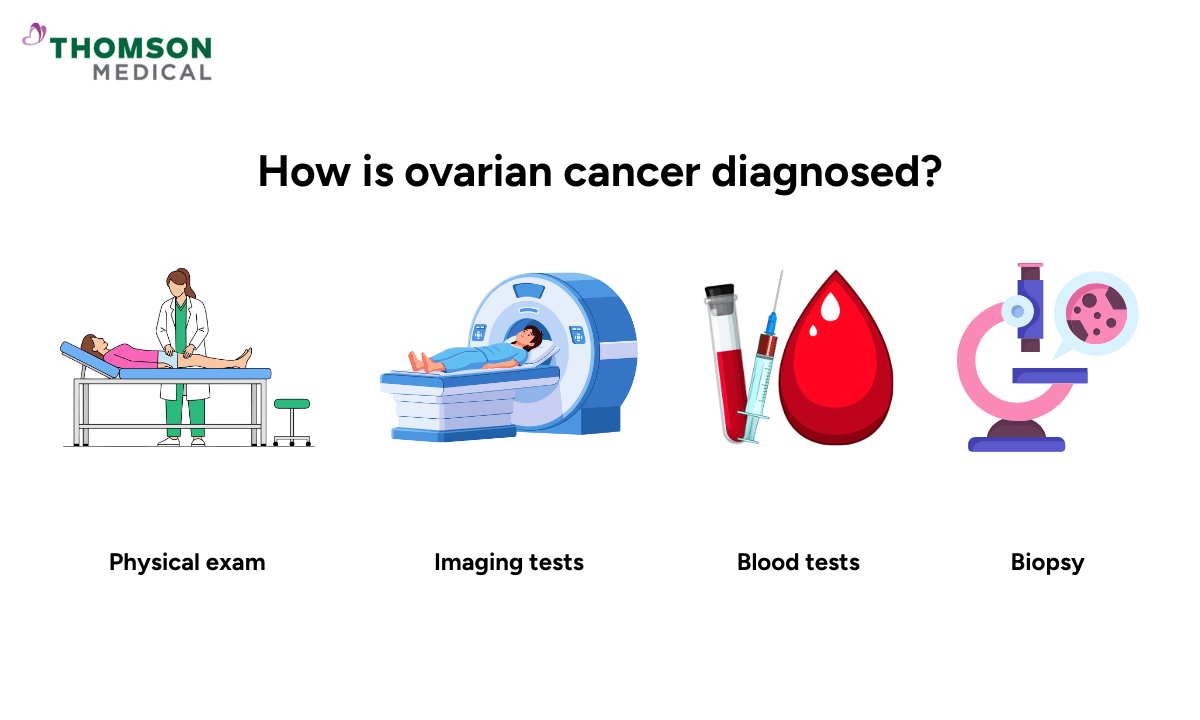
There is no single screening test for ovarian cancer, so if your doctor suspects that you may be at risk, they will usually combine different tests to get a clearer picture.
Physical exam
Your doctor often starts with a pelvic examination to feel for any swelling or masses in your ovaries or uterus.
This can suggest a problem that needs further evaluation, but a pelvic exam alone cannot confirm cancer. It’s just a first step to help your doctor understand what’s going on.
Imaging tests
If your doctor finds something unusual during the exam, they’ll likely order imaging tests. These help create a clearer picture of what’s happening inside your body:
Common imaging tests include:
Pelvic ultrasound:
This is usually the first imaging test your doctor orders. It uses sound waves to create images of your ovaries and can show cysts or masses.
CT scan or MRI scan:
These imaging tests can show if something looks unusual, but like the physical exam, they cannot confirm cancer on their own. If your doctor orders these tests, don’t worry too much, because many ovarian cysts and masses turn out to be benign (not cancerous).
Blood tests
Your doctors may check some markers in your blood:
CA-125:
A protein that can be elevated in ovarian cancer.
Other blood tests:
Help rule out different conditions that may cause your symptoms.
It’s important to note that while blood tests can provide valuable information, they’re not definitive. CA-125 can be elevated for many non-cancer reasons, and it can even be normal when cancer is present. Blood tests can give your doctor helpful clues, but they will need further tests to have an accurate result.
Biopsy
A biopsy involves examining actual tissue under a microscope.
However, unlike other cancers where your doctor might do a needle biopsy, ovarian tissue is usually examined during surgery rather than as a routine test. This is because the ovaries are located deep in your pelvis, which makes them difficult to access safely with a needle. Surgery, on the other hand, allows your doctor to examine the tissue thoroughly and, if needed, remove any concerning areas all in one procedure.
It’s natural to feel overwhelmed when learning about all these steps, and you may have questions about the best tests suited for your individual circumstances. Your doctor will take the time to explain each test and gently walk you through the diagnostic plan that’s right for you.
If you're unsure whether you need screening or if you simply want to be more proactive about your reproductive system health, schedule an appointment with Thomson Medical. Our gynaecologists will assess your risk factors, answer your questions, and guide you through the screening process with care and expertise.
FAQ
Can a full blood count detect ovarian cancer?
No. A full blood count (FBC) test cannot detect ovarian cancer. It might show anaemia or signs of inflammation, but these findings aren't specific to ovarian cancer and can happen for many other reasons.
How long can a woman have ovarian cancer without knowing?
Sometimes months or even years, which is why ovarian cancer is often called a "silent" disease. Its early symptoms are so subtle that they can feel like normal digestive or period issues.
At what age should I start worrying about ovarian cancer?
Ovarian cancer is rare in teenagers and young adults. Your risk increases with age, particularly after menopause. Most cases occur in women over 50, with the highest rates in women in their 60s and 70s.
Should I get a CA-125 blood test to screen for ovarian cancer?
CA-125 testing isn't recommended as a routine screening tool for women at average risk. This is because CA-125 can be elevated for many non-cancer reasons, such as endometriosis, fibroids, or even your menstrual cycle. It can also be normal even when ovarian cancer is present.
The test is more useful for monitoring women who've already been diagnosed with ovarian cancer or for women with very high-risk factors. Your doctor can help you decide if CA-125 testing makes sense for your situation.
What's the difference between ovarian cysts and ovarian cancer?
Ovarian cysts are fluid-filled sacs that develop on your ovaries. Most women will have at least one cyst at some point, and they're usually harmless and can resolve on their own.
Ovarian cancer involves abnormal tissue growth, not just fluid. The cells grow abnormally and uncontrollably. Cancer is much less common than cysts.
Can ultrasound miss ovarian cancer?
Yes, ultrasound can sometimes miss ovarian cancer, especially in very early stages. That's why your doctor usually combines different tests for the most accurate diagnosis.
The information provided is intended for general guidance only and should not be considered medical advice. For personalised recommendations based on your medical conditions, request an appointment with Thomson Medical.
For more information, contact us:
Thomson Specialists (Women's Health)
Thomson Women's Clinic (TWC)
- Novena:
6592 6686 (Call), 8611 8986 (WA) - Bukit Batok:
6569 0668 (Call), 8686 3525 (WA) - Choa Chu Kang:
6893 1227 (Call), 8282 1796 (WA) Jurong:
6262 8588 (Call), 6262 8588 (WA)- Katong (female doctor):
6970 2272 (Call), 8611 9020 (WA) - Punggol:
6243 6843 (Call), 8811 0328 (WA) - Sembawang: 6753 5228
- Sengkang: 6388 8125
- Serangoon (female doctor): 6382 3313
- Tampines: 6857 6266
- Tiong Bahru: 6276 1525