

Finding out you have a growth inside your body can naturally cause a moment of worry. The good news is that most gallbladder polyps (small growths on the inner lining of the gallbladder) are benign and do not require surgery.
Understanding how they are monitored and the available treatment options in Singapore can help you feel calm, informed and fully prepared for your next medical visit.
What are gallbladder polyps?
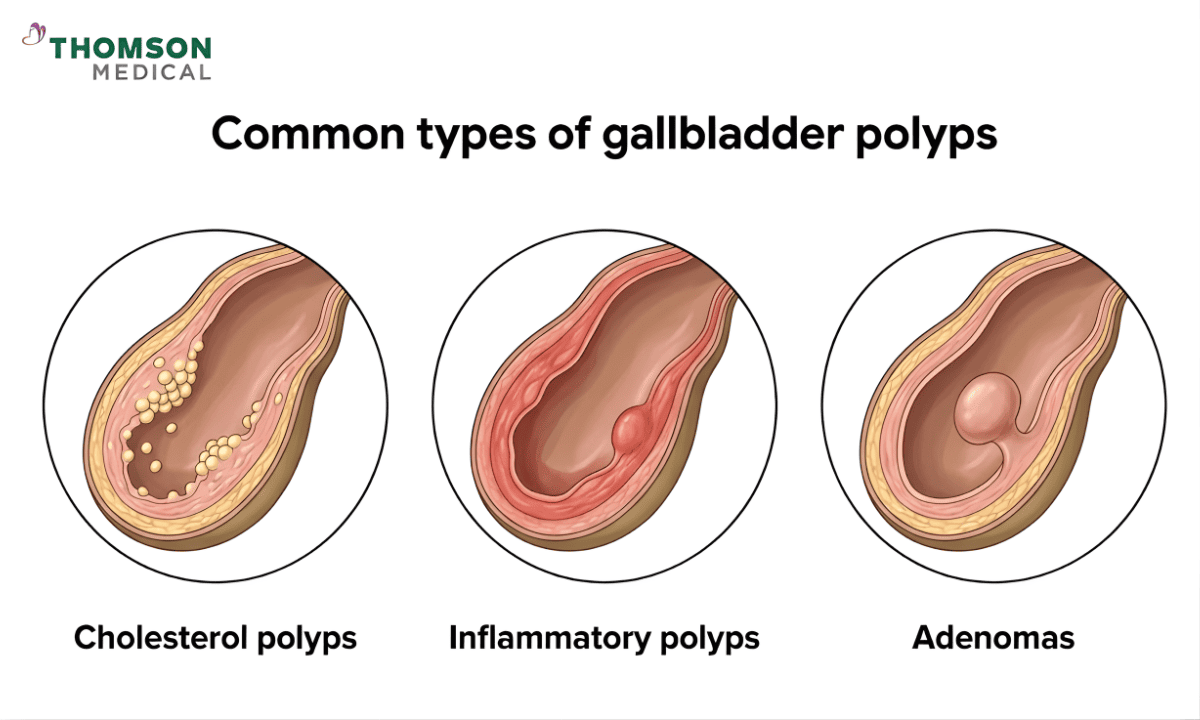
Gallbladder polyps are small growths that appear on the inner lining of your gallbladder. Most of the time, they are found incidentally during an ultrasound or scan and do not cause symptoms.
Your doctor will usually look at the type, size, and appearance of the polyp to understand what it might mean for your health.
The most common types include:
Cholesterol polyps:
This is the most common type.
They generally don’t signal anything serious to your health.
They form due to a simple imbalance of bile salts and bile pigments in your system.
Inflammatory polyps:
These are non-cancerous growths as a direct result of inflammation in your gallbladder.
They are usually linked to chronic irritation.
Adenomas:
These are uncommon growths of tissue.
They have a small potential to turn into malignant (cancerous) polyps over time.
Understanding these different types helps your doctor decide whether your gallbladder polyps simply need monitoring or require closer medical attention.
What makes treatment for gallbladder polyps different?
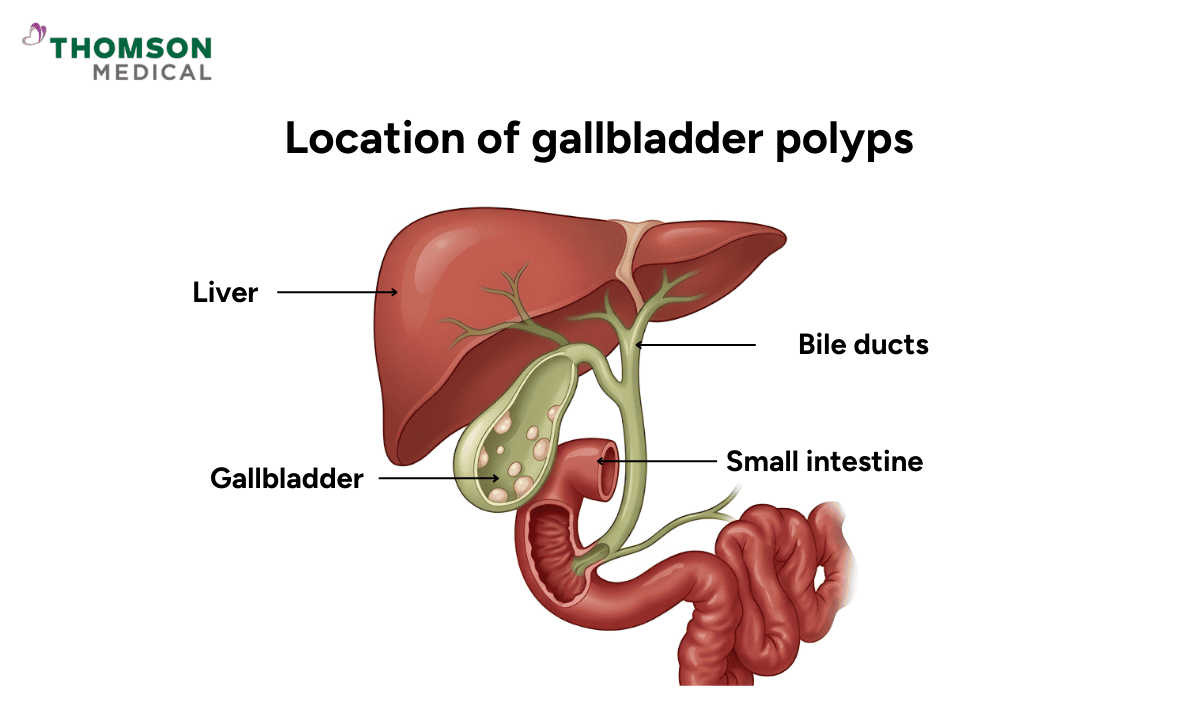
You might notice that gallbladder polyps are managed differently from polyps in other parts of your body. For example, during screening for conditions such as colorectal cancer, doctors can often remove polyps during a colonoscopy using small instruments like a wire loop or biopsy forceps.
The gallbladder, however, sits deep within the biliary system, which is the network of organs and tubes that produce, store, and transport bile to help digest fats. It connects closely to the bile ducts, which are small channels that carry bile from the liver and gallbladder into the small intestine.
Because of this location and structure, gallbladder polyps cannot usually be removed in the same simple way. Instead, your doctor will recommend monitoring or a treatment plan that best protects your long-term health.
How are gallbladder polyps diagnosed in Singapore?
To get a clear picture of what is happening inside and ensure an accurate early assessment, your doctor may use a few gentle imaging tests.
Common tests include:
Abdominal ultrasound:
This is usually the first test your doctor will recommend.
It is painless and does not use radiation.
The ultrasound findings help your doctor show the size, number, and shape of the polyps.
Advanced scans:
These provide a much more detailed view.
This may include magnetic resonance imaging (MRI) or a specialised scan called magnetic resonance cholangiopancreatography (MRCP)
These are used if the polyp is large or if cancer needs to be carefully ruled out.
Blood tests:
These are used to check your overall organ health.
These often include liver function tests, which help assess how well your liver and bile system are working
They are usually recommended only if there is a concern about malignancy or a blocked duct.
These straightforward diagnostic tools give your healthcare provider all the details they need. With this information, they can keep a close, protective eye on your digestive health and ensure you receive the right care at the right time.
If imaging tests suggest gallbladder polyps or you have ongoing digestive symptoms, it is advisable to seek medical evaluation for proper monitoring. You may arrange a consultation with Thomson Medical to discuss suitable diagnostic tests and next steps.
Treatment options for gallbladder polyps in Singapore
Your treatment plan will mainly depend on the size of the polyp, whether it is growing, the symptoms you may be experiencing, and any personal risk factors your doctor identifies.
Watchful waiting and monitoring
This is a gentle and conservative approach.
It is usually recommended if:
The polyp is smaller than 10 millimetres.
You are not experiencing any symptoms.
Your doctor may suggest having an ultrasound every 6 to 12 months to keep an eye on the polyp. If it remains stable for two to three years, monitoring may safely stop.
Cholecystectomy (gallbladder removal surgery)
It is important to note that polyps are not removed on their own. Your entire gallbladder is gently removed in a process called cholecystectomy to completely eliminate any future cancer risk and keep you safe.
Surgery may be recommended if:
The polyp measures 10 millimetres or larger.
There is a growth of more than 2 millimetres discovered during your follow-up scans.
You have coexisting gallstones.
It causes symptoms such as biliary colic.
You are over 50 years of age with newly discovered polyps.
The polyp appears sessile (flat) on ultrasound, which may sometimes carry a higher risk.
Removing the gallbladder can also help prevent rare but serious complications, such as a gallbladder perforation or a gallbladder abscess.
Our gallbladder specialist
Loading...
Laparoscopic versus open surgery
When it comes to surgical methods, a specialist gallbladder surgeon typically chooses between two main approaches: laparoscopic cholecystectomy and open cholecystectomy.
Here’s a table on the key differences between the two:
Feature | Laparoscopic cholecystectomy | Open cholecystectomy |
Approach | The most common and preferred approach – highly effective minimally invasive surgery | A more traditional method |
Incision type | Uses three to four small keyhole cuts | Involves a larger incision on your abdomen |
Pain & recovery | Results in much less pain and a faster recovery | Naturally requires a slower healing time |
Hospital stay | Shorter hospital stay of one to two days | Requires a longer hospital stay |
When it is used | Standard recommendation for most patients | Only used if unexpected complications arise or if cancer is strongly suspected |
Your surgeon will walk you through the most appropriate treatment option and explain how to prepare for the procedure, including whether you need to temporarily pause medications such as blood thinners.
What to expect during surgery
It is normal to have questions before surgery. Knowing what to expect on the day can help you feel more prepared.
Anaesthesia:
You will receive general anaesthesia, which means you will be asleep and will not feel pain during the procedure.
Duration:
The surgery time is usually very quick, taking about one hour.
Hospital stay:
You will either have a same-day discharge or a short one- to two-night stay.
Diet:
You will resume your normal diet gradually as your body adjusts after surgery.
Recovery timeline:
Most patients return to desk work in 7 to 10 days.
They also may resume full physical activity within 2 to 4 weeks depending on their recovery.
The recovery is generally very straightforward. Your medical team will provide clear, simple instructions to keep you comfortable while you heal at home.
If you have been advised to undergo gallbladder surgery and would like to understand the procedure and recovery process, you may schedule an appointment with Thomson Medical to address your concerns and discuss what to expect.
Cost of gallbladder polyp treatment in Singapore
Planning for medical expenses is an important part of your healthcare journey. The costs can vary depending on where you choose to receive your care.
Facility/Coverage type | Estimated cost | Details & benefits |
Public hospital (subsidised) | Roughly SGD 2,000 to 4,000 | Often the most affordable option. Costs are significantly reduced after using Medisave. |
Public hospital (private patient) | SGD 6,000 to 10,000 | Applies to private patients receiving care within the public hospital system |
Private hospital & specialist | Consultation: SGD 150 to 300 Surgery: SGD 12,000 to 20,000 or more | Offers faster access to care. The total depends on the surgeon, hospital, and overall complexity. |
Medisave | Withdrawal limit of up to SGD 6,300 to 7,150 | Financial support is widely available. Medisave is fully claimable for this surgery. |
Insurance (Integrated Shield Plans) | Varies based on individual policy | Usually covers hospitalisation, anaesthesia, and specialist fees. |
Medisave and insurance coverage
Medisave can be used to help pay for gallbladder surgery. The typical withdrawal amount is up to SGD 6,300 to 7,150, depending on the complexity of the procedure and the hospital setting.
If you have an Integrated Shield Plan, it may also cover several components of your treatment, such as:
Hospitalisation
Surgical fees
Anaesthesia
Specialist consultation and procedure fees (depending on your policy)
It is always best to check with your healthcare provider or insurer beforehand to understand your specific coverage and any out-of-pocket costs.
FAQ
Can I use Medisave for gallbladder surgery in Singapore?
Yes, cholecystectomy (gallbladder removal surgery) is a Medisave-claimable procedure in both public and private hospitals in Singapore.
Can gallbladder polyps be removed without removing the gallbladder?
No. At the moment, there is no reliable way to remove only the polyp. Doctors usually remove the entire gallbladder to reduce the risk of recurrence and to rule out potential cancer.
How long is the recovery after gallbladder removal?
Most people start feeling better within about one week.
Return to light or desk work takes 7 to 10 days
Full recovery takes about 2 to 4 weeks
Your exact recovery time may vary depending on your overall health and the type of surgery performed.
Do gallbladder polyps always turn into cancer?
No. The majority of gallbladder polyps are benign and never become cancerous.
General risk guidance:
Less than 5 mm means extremely low risk
6 to 9 mm means low risk but usually monitored
10 mm or larger means higher risk, and surgery may be recommended
Even so, gallbladder cancer itself is rare.
How often should I monitor gallbladder polyps?
Monitoring frequency depends on the size of the polyp, but a common approach is:
Less than 6 mm may need ultrasound once a year.
6 to 9 mm may need ultrasound every 6 months.
If the polyp remains stable for two to three years, your doctor may decide that further monitoring is no longer necessary.
Can I live a normal life after gallbladder removal?
Yes. Most people return to a completely normal lifestyle after recovery. The liver continues to produce bile, and the digestive system gradually adapts.
The information provided is intended for general guidance only and should not be considered medical advice. For personalised recommendations and tailored advice based on your unique situations, please consult a specialist at Thomson Medical. Request an appointment with Thomson Medical today.
For more information, contact us:
Thomson Medical Concierge
- 8.30am - 5.30pm
- WhatsApp: 9147 2051
Need help finding the right specialist or booking for a group?
Our Medical Concierge is here to help you. Simply fill in our form, and we'll check and connect you with the right specialist promptly.
Notice:
The range of services may vary between Thomson clinic locations. Please contact your preferred branch directly to enquire about the current availability.
Get In Touch