

If you have recently received a positive HPV result, it is completely natural to feel worried. You may be wondering what this means for your health, your relationships, and what to do next.
The good news is that HPV is very common. In many cases, your body can suppress it naturally over time. With the right follow-up and care, most people manage HPV well and continue to live healthy lives.
What is HPV?
Human papillomavirus (HPV) is one of the most common viral infections worldwide. Most sexually active adults will encounter it at some point, often without knowing.
Not all strains behave the same way. They fall into two groups:
Low-risk strains (such as HPV 6 and 11) are linked to genital warts, not cancer.
High-risk strains (such as HPV 16 and 18) are associated with abnormal cell changes that may progress if left undetected.
It is worth knowing that there is currently no treatment that clears the HPV virus itself. In many cases, your immune system will suppress it naturally over time.
If you have recently received a positive result, it is completely understandable to feel worried. But a positive result is not a cancer diagnosis. With the right follow-up, many people manage HPV well.
How do you know if you have HPV?
HPV often does not cause noticeable symptoms. This is why regular screening is so important.
Symptoms to look out for
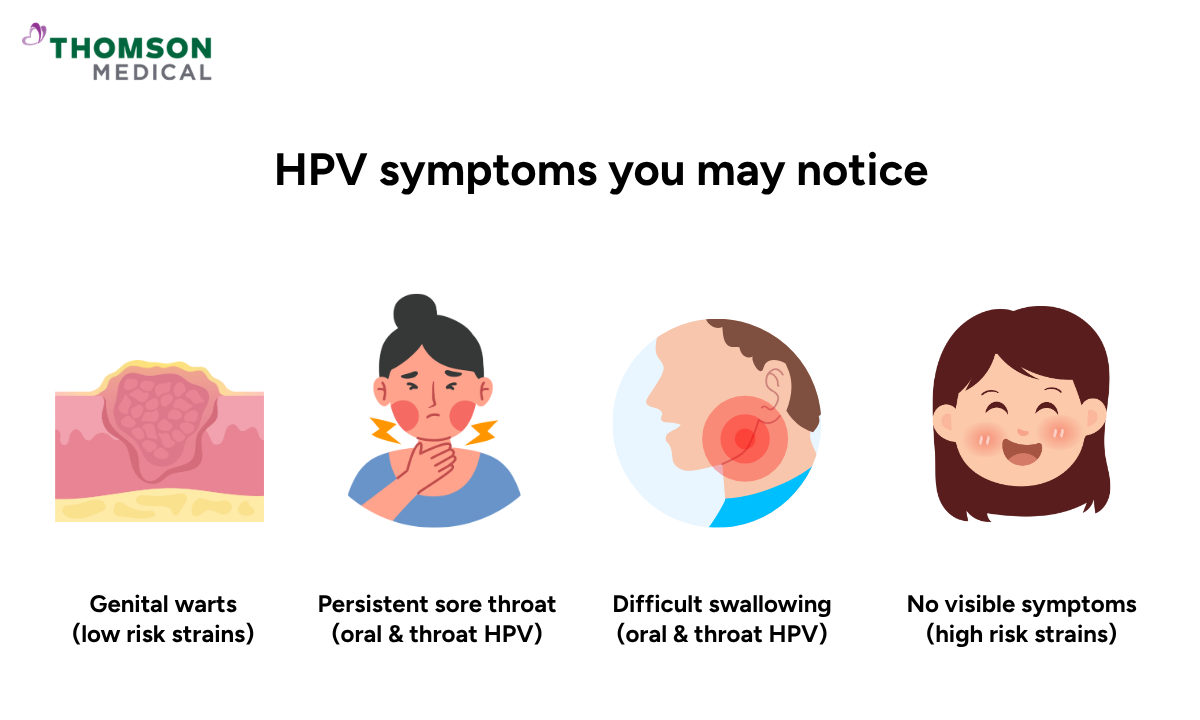
The symptoms you may notice depend on which strain you have:
Low-risk strains may cause genital warts:
Small, flesh-coloured growths around the genitals or anal area
Flat or raised, singular or clustered
Sometimes itchy or uncomfortable, though not always
High-risk strains:
Often cause no visible symptoms
Abnormal cell changes in the cervix are usually only picked up through screening
Oral and throat HPV (less common):
Persistent sore throat
Difficulty swallowing
A hoarse voice that does not go away
If you notice any of the above, it is worth mentioning to your doctor. Symptoms alone are not enough to identify the strain, so proper assessment is important.
HPV tests and screening in Singapore
Regular cervical screening plays an important role in detecting high-risk HPV early, often before any symptoms appear.
In Singapore, the recommended screening depends on your age:
Women aged 25 to 29 who have ever been sexually active are recommended a Pap smear every three years.
Women aged 30 to 69 who have ever been sexually active are recommended an HPV test every five years.
If you are unsure which test is suitable for you, a doctor can guide you based on your age and medical history.
It is also worth knowing that there is currently no equivalent approved screening test for oral or anal HPV. If you have any concerns in those areas, speaking with a doctor is the right place to start.
Sexual health specialists at Thomson Medical
Loading...
What can be treated if you have HPV?
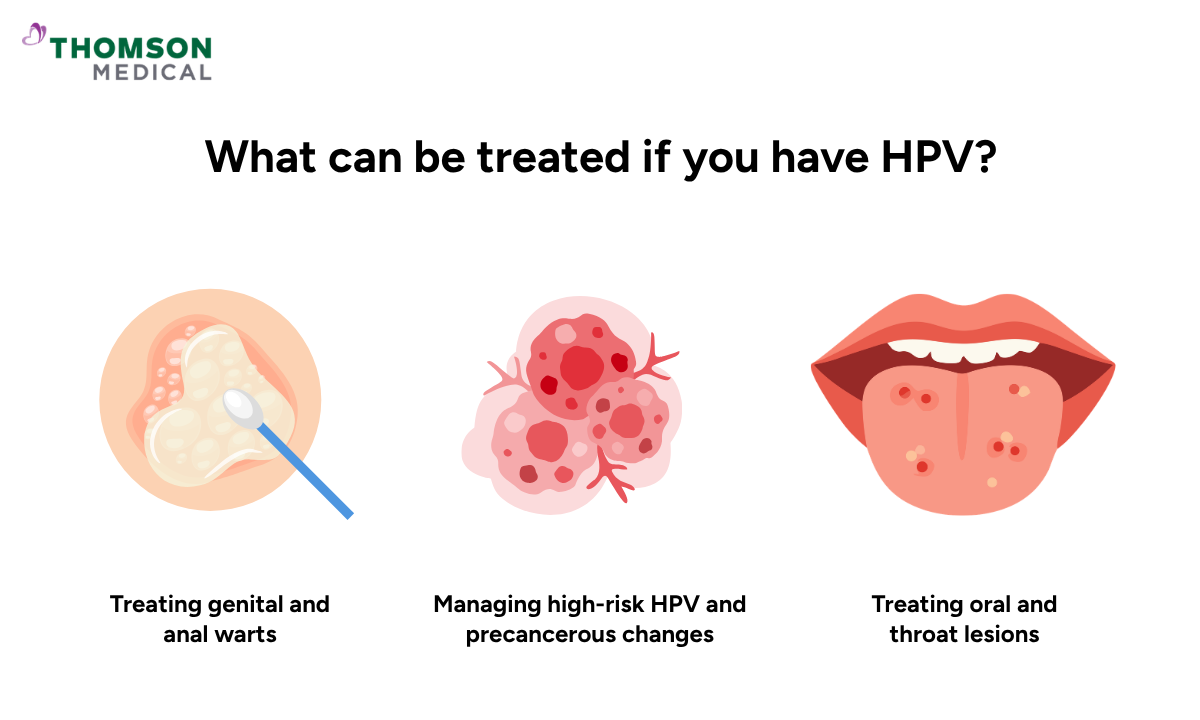
While the virus itself cannot be removed, the changes it causes can be treated effectively. This may include genital warts, abnormal cervical cells, or, in rarer cases, lesions in other areas.
With the right care, all of these can be addressed effectively.
Treating genital and anal warts
Genital and anal warts are caused by low-risk HPV strains, most commonly HPV 6 and 11. They are not cancerous, but they can be uncomfortable and unsettling to discover.
Treatment options include:
Topical creams applied to the warts at home or by a clinician
Cryotherapy, where warts are gently frozen using liquid nitrogen
Laser or electrosurgery, which is used for larger or more persistent warts
Surgical removal for warts that do not respond to other treatments
Treatment removes visible warts, but the virus may still remain in the body. This means recurrence can happen, and more than one treatment session may be needed. Your doctor will talk you through the suitable approach based on your situation.
Managing high-risk HPV and precancerous changes
High-risk HPV strains, particularly HPV 16 and 18, can trigger abnormal cell changes in the cervix over time. These are graded as cervical intraepithelial neoplasia (CIN) 1, 2, or 3, with higher grades indicating more significant changes.
Management depends on the grade:
CIN 1 is often monitored with repeat screenings, as many cases resolve on their own
CIN 2 may be monitored or treated, depending on your age, results, and individual circumstances
CIN 3 is usually treated through a procedure called loop electrosurgical excision procedure (LEEP), which carefully removes the affected tissue
If your screening result is abnormal, a colposcopy (a closer examination of the cervix) will usually be recommended first to assess the extent of any changes before deciding on next steps.
Treating oral and throat HPV lesions
HPV can occasionally affect the mouth and throat, though this is much less common than cervical or genital effects. Most oral HPV infections clear on their own without any treatment needed.
Where benign lesions such as throat warts are found, they are usually removed through a minor surgical procedure, usually as a day surgery case.
Where HPV is linked to more significant changes, particularly in the tonsils or back of the throat, care is guided by an ENT specialist or oncologist, and the treatment approach will depend on the individual case.
If symptoms such as a persistent sore throat or difficulty swallowing do not improve, it is worth having them assessed early.
If you have received an abnormal screening result and are unsure what to do next, schedule an appointment with Thomson Medical. Our doctors can walk you through what your results mean, what treatment, if any, is needed, and what to expect at each step.
How much does HPV treatment cost in Singapore?
The cost of HPV-related care in Singapore varies widely depending on what needs to be treated, how many sessions are required, and whether you seek care at a public or private provider.
Here’s what you can expect:
Genital wart removal ranges from a few hundred to over a thousand dollars, depending on the treatment method and number of sessions needed.
Cervical screening is significantly more affordable, especially at polyclinics or under government subsidy schemes
Follow-up procedures (colposcopy, LEEP) costs vary between public and private settings. Medisave and Integrated Shield Plans can help offset these
If you are a Singapore citizen or permanent resident, there are several ways to make care more affordable:
Screen for Life offers subsidised cervical screening at CHAS GP clinics, from SGD 2 to SGD 5, or free for the Pioneer Generation
Polyclinic screening – Pap smears and HPV tests are available at subsidised rates
Medisave and MediShield Life can be used for eligible procedures such as colposcopy and LEEP
Integrated Shield Plans may cover a larger portion of private hospital costs depending on your policy
For the most accurate estimate, ask your doctor for a cost breakdown based on your specific situation before proceeding with any treatment.
Can HPV be prevented?
HPV cannot be completely prevented, but there are some effective ways to reduce your risk. The two most effective tools are vaccination and regular screening.
HPV vaccines available in Singapore
Three HPV vaccines are currently approved in Singapore:
Vaccine | Strains covered |
Cervarix (HPV2) | HPV 16, 18 |
Gardasil (HPV4) | HPV 6, 11, 16, 18 |
Gardasil 9 (HPV9) | HPV 6, 11, 16, 18, 31, 33, 45, 52, 58 |
Gardasil 9 offers the broadest protection and covers strains responsible for the majority of cervical cancer cases worldwide.
Vaccination works best before first sexual exposure, but it may still be beneficial even if you are already sexually active. Your doctor can help you decide if it is right for you.
That said, the vaccine is not a treatment for existing HPV. It works by protecting against future infection. Regular cervical screening remains an important part of your care, even after vaccination.
Even if you are already sexually active, vaccination may still provide benefit. A doctor can help you decide if it is suitable for you.
Other ways to reduce your risk
Vaccination works best when combined with other protective habits:
Condoms reduce the risk of HPV transmission, though they do not eliminate it entirely, as HPV spreads through skin-to-skin contact.
Regular cervical screening remains the most reliable way to catch cell changes early, regardless of vaccination status.
Limiting sexual partners means reducing your exposure risk over time.
No single measure offers complete protection. A combination of vaccination, screening, and regular check-ups gives you the strongest foundation for your cervical health.
If you are unsure whether the HPV vaccine is suitable for you or want to understand how it fits alongside your current screening plan, schedule an appointment with Thomson Medical. Our doctors can review your history and help you decide on an approach that makes sense for where you are now.
FAQ
How quickly do HPV warts respond to treatment?
It depends on the method. Cryotherapy typically heals the treated area within one to two weeks. Topical creams can take up to 16 weeks. Some people need more than one session – your doctor can give you a clearer timeline based on your situation.
Can HPV return after being treated?
Treatment removes the visible effects of HPV, such as warts or abnormal cells, but does not clear the virus from your body. This means symptoms can recur, which is why regular follow-up and screening remain important even after treatment.
How do I know if my HPV infection is gone?
There is no single test that confirms the virus has fully cleared. Your doctor will monitor your health through repeat screenings over time. A series of normal results is generally a reassuring sign.
Are oral HPV infections contagious?
Yes, oral HPV can be passed through oral sexual contact. Most infections clear on their own without causing symptoms. If you notice anything unusual, it is worth mentioning to your doctor.
At what age should I consider HPV vaccination?
In Singapore, vaccination is recommended for females aged 9 to 26. Adults outside this range can still speak to their doctor about whether vaccination may offer them some benefit.
Can I get the HPV vaccine if I am already sexually active?
Yes. While the vaccine is most effective before first sexual exposure, it may still offer protection against strains you have not yet encountered. Your doctor can advise whether it is suitable for you.
The information provided is intended for general guidance only and should not be considered medical advice. For personalised recommendations based on your medical conditions, request an appointment with Thomson Medical.
For more information, contact us:
Thomson Specialists (Women's Health)
Thomson Women's Clinic (TWC)
- Novena:
6592 6686 (Call), 8611 8986 (WA) - Bukit Batok:
6569 0668 (Call), 8686 3525 (WA) - Choa Chu Kang:
6893 1227 (Call), 8282 1796 (WA) - Jurong:
6262 8588 (Call), 6262 8588 (WA) - Katong (female doctor):
6970 2272 (Call), 8611 9020 (WA) - Punggol:
6243 6843 (Call), 8811 0328 (WA) - Sembawang: 6753 5228
- Sengkang: 6388 8125
- Serangoon (female doctor): 6382 3313
- Tampines: 6857 6266
- Tiong Bahru: 6276 1525
Notice
The range of services may vary between TWC/TS locations. Please contact your preferred branch directly to enquire about the current availability.
Request an Appointment