

Learning that you or someone you love may carry a BRCA1 mutation can bring up a lot of questions. You may wonder whether you should get tested, what a positive result would actually mean, or what comes next.
BRCA1 is a gene that helps protect your body from cancer. However, when it mutates, that protection weakens, and the risk of breast and ovarian cancer may increase.
Knowing what BRCA1 is, what testing involves, and what your options look like can help you move forward with clarity and confidence.
What is the BRCA1 gene and mutation?
BRCA1 is a gene that helps your cells grow in a controlled and healthy way by repairing damaged DNA before it becomes harmful.
When the BRCA1 gene works as it should, it protects you against cancer. But when there is a mutation, which is a change in the gene’s normal structure, that function is weakened.
Damaged cells can then grow and divide without being repaired. Over time, this may raise your risk of certain cancers developing.
However, having a BRCA1 mutation doesn’t guarantee cancer. It simply means your risk is higher than average. It’s also worth knowing that a BRCA1 mutation is not something you develop during your lifetime. It’s inherited, meaning it is passed down through families, from parent to child.
Getting your BRCA1 status confirmed can feel overwhelming at first. But it allows you and your doctor to monitor your health more closely and explore preventive options that are right for your situation.
What cancers are linked to the BRCA1 mutation?
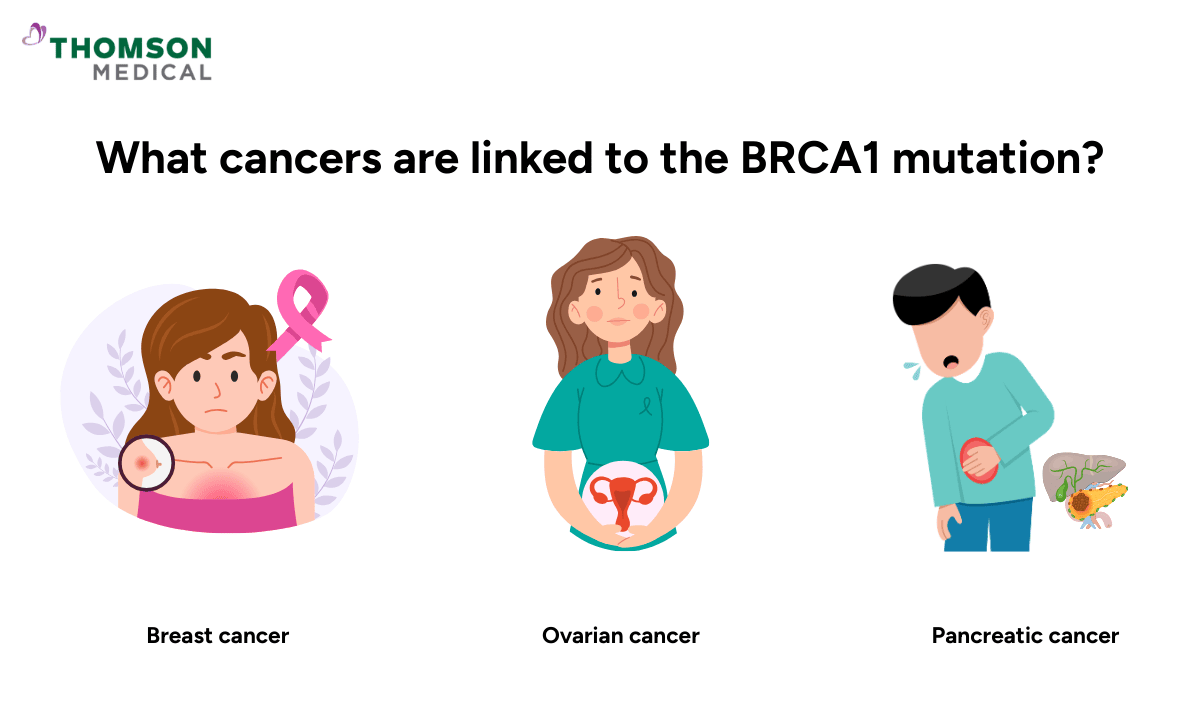
If you are wondering what a BRCA1 mutation actually means for your cancer risk, you are not alone – this is one of the most common questions BRCA1 carriers have. Understanding which cancers are linked to your condition and what the risk truly looks like can help replace some of your worry with clarity.
Cancers related to the BRCA1 mutation include:
Breast cancer:
Women with a BRCA1 mutation have a much higher chance of developing breast cancer in their lifetime.
It also tends to appear at a younger age than usual.
Ovarian cancer:
This is the cancer most strongly linked to BRCA1.
The risk is higher than in the general population. That’s why regular monitoring is so important for carriers.
Other cancer:
BRCA1 mutations are also linked to the risk of pancreatic cancer. The risk is low but still worth being aware of.
It’s natural to feel anxious when learning about cancer risk. That said, a higher risk is not the same as certainty. Many women with this mutation never develop cancer at all.
Should you consider BRCA1 genetic testing?
While BRCA gene testing is not the right path for everyone, there are situations where it may be especially relevant.
The BRCA1 genetic test makes sense if:
You've been diagnosed with breast cancer yourself, particularly before 45
Someone in your family has already tested positive for a BRCA1 mutation
You have a family history of cancer on either your mother's or father's side
A close relative has been diagnosed with breast or ovarian cancer, especially at a young age (under 50)
There is no pressure to decide anything right away. If you are unsure, a conversation with your doctor is always a good place to start. They can review your circumstances and help you decide whether it is the right step for you.
If you have a family history of breast or ovarian cancer and are concerned about BRCA1, schedule an appointment with Thomson Medical. Our specialist will guide you through your options with care and clarity.
Our specialists in Singapore
Loading...
BRCA1 genetic testing: What to expect
Once you have made the decision to test, knowing what comes next can help you feel calmer and more prepared.
The procedure and result
The testing is simple and straightforward. Your doctor will take a blood or saliva sample, then send it to the laboratory for analysis.
Before your test, genetic counselling is usually recommended. Your counsellor will walk you through what you’re testing for, what different results mean, and how to think about next steps, so you feel informed rather than overwhelmed.
Results usually come back in a few weeks and fall into three categories:
Positive: a BRCA1 mutation was found
Negative: no mutation found (though this doesn't eliminate all cancer risk)
Variant of uncertain significance (VUS): a change was found, but its implications aren't yet fully understood
Your doctor will take time to explain in detail what the results mean for your situation. If something is unclear or you have concerns, don’t hesitate to share them.
Your options if you test positive
Learning that you carry a BRCA1 mutation can feel like a lot to process. But a positive result does not mean that cancer is guaranteed to appear. Confirming your condition is the first step to help you and your doctor start planning the right path forward.
Your doctor may discuss these options with you:
More frequent health checks:
Your doctor may recommend annual breast MRI scans alongside mammograms, regular pelvic ultrasounds, and CA-125 blood tests for ovarian monitoring
The goal is to catch any issues early and get the right care promptly
Medications:
Certain medications can reduce breast cancer risk in BRCA1 carriers
This isn't right for everyone, but it's worth discussing with your doctor
Risk-reducing surgery:
Some women choose preventive mastectomy (removal of breast tissue) or salpingo-oophorectomy (removal of the ovaries and fallopian tubes) to reduce cancer risk
There's no single right answer. Your choices depend on your age, your family plans, and your values. Whatever you are weighing up, your doctor will take the time to understand all of them before helping you decide.
What does a BRCA1 mutation mean for your family?

After confirming your BRCA1 mutation, it is natural for your thoughts to turn to the people you love.
You may find yourself wondering: could this affect them too?
The truth is, first-degree relatives (such as your parents, siblings, and children) each have a 50% chance of carrying the same mutation. This means that genetic testing may be worth considering for them too.
Sharing this news with your family is never easy. Your genetic counsellor can offer guidance on how to approach these conversations in a way that feels manageable for you.
For your children, genetic testing is usually not recommended until adulthood, when they can make a decision about their own health.
If you are thinking about having children, there is an option worth knowing about. During IVF (in vitro fertilisation), a process called preimplantation genetic testing (PGT) can identify embryos that do not carry the mutation. It is not the right path for everyone, but for some families, it is a meaningful choice.
These are big decisions, and there is no rush to make them. Your doctor and care team will help you think through each option carefully so you can make choices that feel right for you and your family.
If you've just received your BRCA1 results and aren't sure what to do next, schedule an appointment with Thomson Medical. Our specialist will walk you through what your results mean and help you build a plan that's right for you.
FAQ
Is BRCA1 testing only for women?
No. Men can carry and pass on a BRCA1 mutation. Male BRCA1 carriers have an elevated risk of breast cancer (though still much lower than in women), as well as a possibly increased risk of prostate and pancreatic cancers. If there's a BRCA1 mutation in your family, the men in your family may want to consider testing too.
At what age should I consider BRCA1 testing?
Generally, testing is recommended for adults, typically from around age 25, or earlier if there's a strong family history with very young diagnoses.
What's the difference between BRCA1 and BRCA2?
Both increase breast and ovarian cancer risk, but BRCA1 tends to carry a higher ovarian cancer risk and is more associated with triple-negative breast cancer.
BRCA2 is also linked to pancreatic cancer and male breast cancer at somewhat higher rates.
The two mutations are distinct, so testing positive for one doesn't tell you anything about the other.
If my sister tested negative, does that mean I'm also negative?
No. Each child has an independent 50% chance of inheriting a parent's mutation. Your sister's negative result doesn't change your own probability. You'd need your own test to know for certain.
How accurate is BRCA1 testing?
Very accurate for detecting known mutations. The main limitation is that testing usually looks for mutations in the BRCA1 gene specifically. A negative result does not mean you have no hereditary cancer risk at all; it just means no BRCA1 mutation was found. There are other genes that can also raise cancer risk, and a negative BRCA1 test does not check for those.
What is the life expectancy of someone with BRCA1?
Carrying a BRCA1 mutation does not shorten life expectancy in itself. Women who know they carry the mutation and act on it, through regular screening, risk-reduction strategies, or preventive surgery, have outcomes comparable to the general population.
The information provided is intended for general guidance only and should not be considered medical advice. For personalised recommendations and tailored advice based on your unique situations, request an appointment with Thomson Medical today.