

If your doctor has recommended a laparoscopy or endoscopy, you might be trying to work out exactly what that means and why one is being suggested for you. The medical names sound similar, and both use cameras looking inside your body, which can make it hard to understand the real differences.
You might be wondering: Which parts of the body does each one examine? Will I need to stay in hospital? How long does recovery take? And most importantly: Why is my doctor recommending this particular one?
Understanding how they differ can help you feel more prepared, ask the right questions, and approach the process with a little more confidence.
What is laparoscopy?
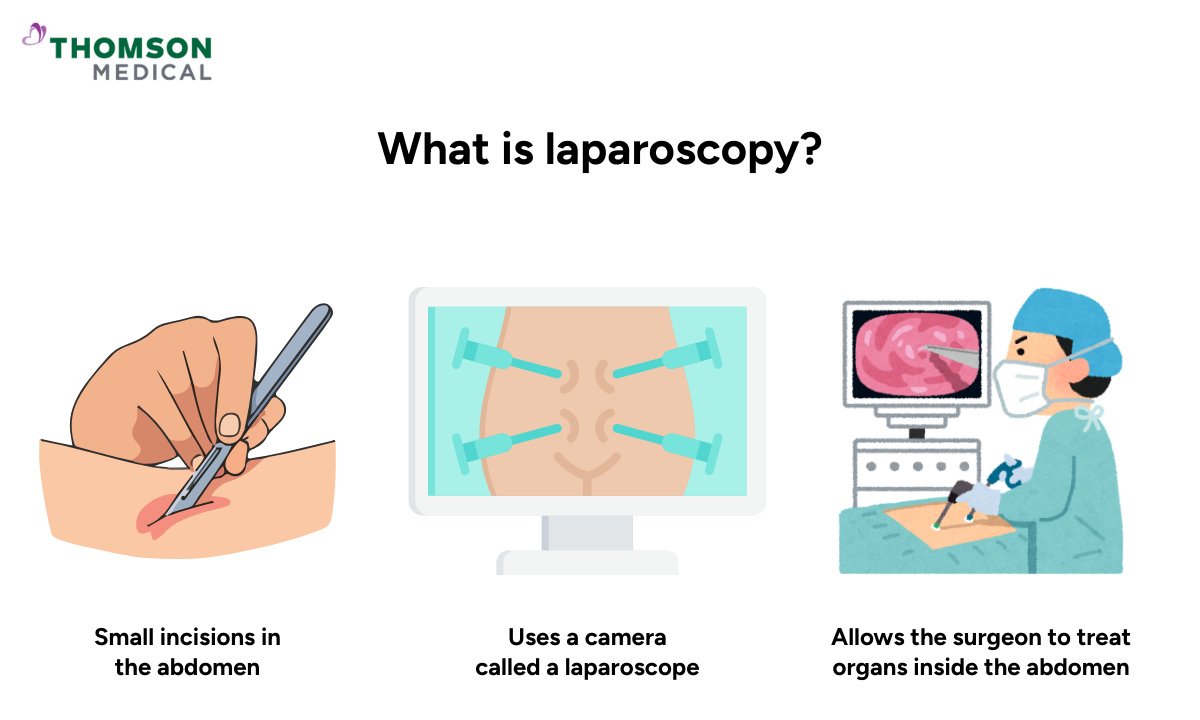
Laparoscopy is a type of surgery that allows your doctor to examine and treat organs inside your abdomen or pelvis. Your surgeon makes a few small openings in your abdomen, each usually around half a centimetre to one and a half centimetres wide.
A small camera called a 'laparoscope' and surgical tools are passed through these openings. Your surgeon watches a live video feed on a screen to guide the procedure.
What is endoscopy?
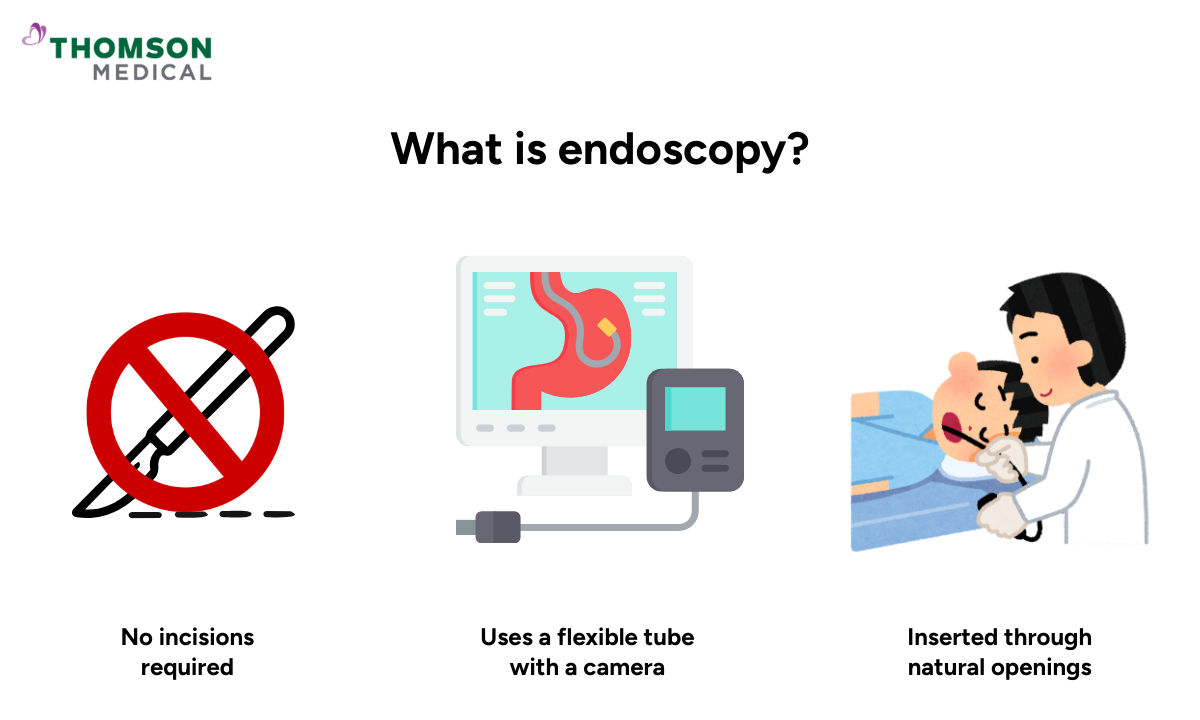
Endoscopy is a procedure that allows your doctor to look inside your body without making any cuts.
It uses a thin, flexible tube called an endoscope, which has a small camera and light at the tip. This tube is gently guided through a natural opening in your body, such as your mouth, throat, or back passage.
If something needs attention during the procedure, small tools can be passed through the endoscope to take tissue samples or address the issue during the same visit.
Key differences between laparoscopy and endoscopy surgery
While both procedures use cameras to look inside your body, they differ significantly in how they are performed, what they are used for, and how your body recovers afterwards.
Laparoscopy | Endoscopy | |
How it is performed | Small incisions are made in the abdomen. Camera and instruments inserted through cuts | A flexible tube passed through natural body openings and no cuts needed |
Instruments used | Rigid laparoscope and specialised surgical tools | Flexible or rigid endoscope, depending on the area examined |
Areas examined | Abdominal and pelvic organs (e.g. gallbladder, appendix, ovaries, uterus) | Digestive tract, respiratory tract, urinary system, or joints |
Anaesthesia | General anaesthesia in most cases | Light sedation or local anaesthesia |
Recovery time | Days to weeks depending on procedure | Same day in most cases |
Main use | Diagnosis and surgical treatment | Diagnosis, screening, and minor treatment |
Risks | Bleeding, infection, organ injury, anaesthesia reactions | Mild discomfort, minor bleeding, rarely perforation |
Laparoscopy and endoscopy may sound similar, but the two procedures are not interchangeable. They serve different purposes and are used in different situations.
If your doctor has suggested either laparoscopy or endoscopy, it can help to understand why one approach may be recommended over the other. Request an appointment with Thomson Medical to discuss which procedure is more appropriate for your condition and what you can expect in terms of preparation, recovery time, and potential risks.
When is each procedure recommended?
When deciding which procedure is suitable for you, your doctor will consider your symptoms, your medical history, and any tests you've already had, as each procedure is suited to different situations.
Laparoscopy
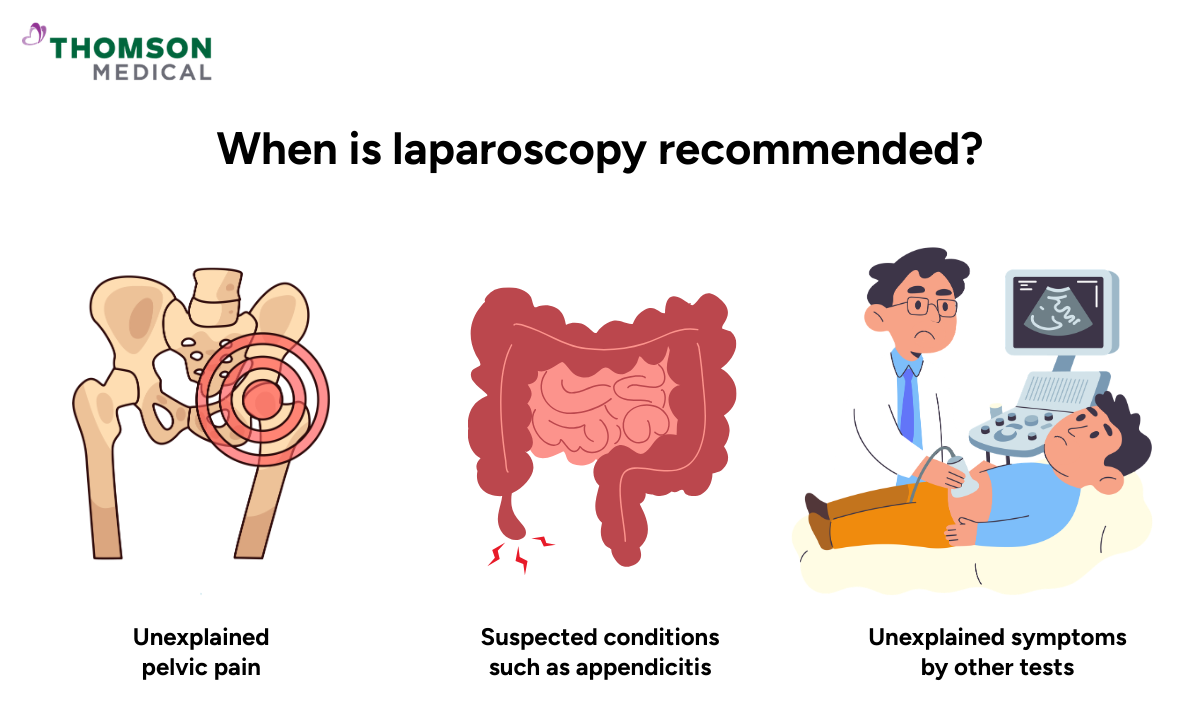
Laparoscopy is often recommended when imaging tests such as ultrasounds have not provided a clear enough picture or when treatment is already needed.
Your doctor may suggest laparoscopy if you have:
Unexplained abdominal or pelvic pain
Diagnosed or suspected conditions such as appendicitis, gallstones, endometriosis, or a hernia
An organ or mass that needs to be removed
Symptoms that have not been explained by other tests
In some cases, such as when a cyst or inflamed appendix is found, your doctor may be able to remove it during the same laparoscopic procedure rather than scheduling a separate surgery.
Endoscopy
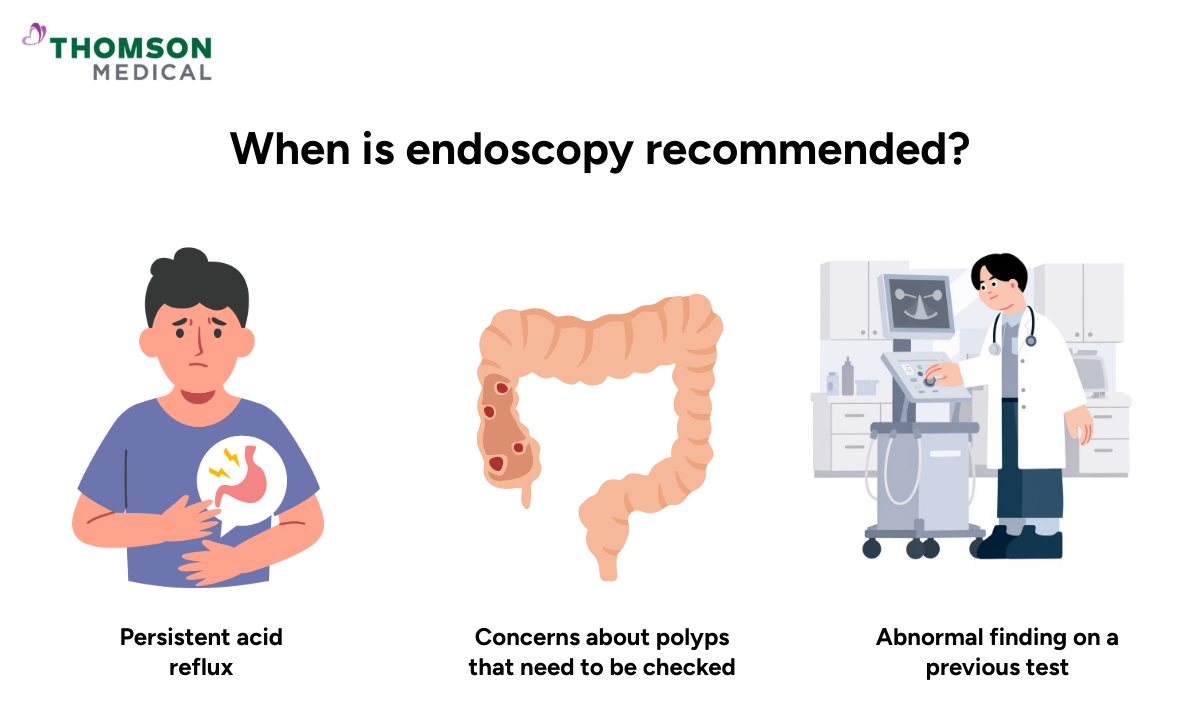
If endoscopy is being recommended, it is often the first step when your doctor needs a closer look at your digestive tract.
Your doctor may suggest endoscopy if you have:
Persistent digestive pain, acid reflux, or bleeding
Concerns about polyps or cancer that need to be checked
Symptoms affecting your stomach, intestines, or colon
A finding on a previous scan or test that needs closer examination
Endoscopy is also used as a routine screening tool for prevention. A colonoscopy, for example, checks for bowel cancer even in people with no obvious symptoms, based on age or family history.
If your doctor has mentioned the possibility of both procedures, that's not necessarily a cause for concern. Each one reveals something the other cannot, giving your doctor a more complete picture of your digestive health before deciding on treatment.
Our obstetrics & gynaecology specialist
Loading...
Cost comparison in Singapore
Costs can feel like an added worry when you're already dealing with a health concern. In Singapore, fees vary depending on the type of procedure, where it is performed, and what is involved.
Laparoscopy costs
Because laparoscopy involves surgery, operating theatre time, and general anaesthesia, it is generally more costly than endoscopy. Fees at private hospitals in Singapore can range from SGD 7,200 to SGD 11,750, depending on the complexity of the surgery and the specialist you see.
Endoscopy costs
Endoscopy is generally more affordable than laparoscopy. It does not require an operating theatre or general anaesthesia in most cases. A diagnostic endoscopy in Singapore may range from SGD 1,100 to SGD 6,000. Costs may increase if additional steps are taken, such as removing polyps or collecting tissue samples for biopsy.
What affects the cost of either procedure?
No two procedures cost exactly the same, and several variables can influence your final bill.
Factors that may affect cost include:
Public vs private hospital setting
Whether the procedure is for diagnosis or treatment
Type of anaesthesia used
Specialist fees
Additional tests, such as a biopsy or pathology report
Getting an itemised quote beforehand can help you avoid unexpected costs and plan more clearly.
Your doctor is there to walk you through what to expect at each step, including costs. You can ask your doctor why a particular procedure is being recommended or whether alternatives are available before deciding how to proceed.
Please note that these costs are based on 2026 rates and may vary over time.
If you are considering either procedure and would like a clearer estimate, it may help to discuss the expected costs before scheduling your treatment. You can request an appointment with Thomson Medical to obtain a more personalised cost estimate based on the procedure and care required.
FAQ
Which procedure is less invasive?
Endoscopy is generally the less invasive option. A flexible tube is passed through a natural body opening, so no cuts are needed. This means less risk, less discomfort, and a quicker recovery.
Can endoscopy replace laparoscopy?
No. The two procedures do different things and look at different parts of the body. Endoscopy examines hollow organs such as the stomach and intestines. Laparoscopy is a surgical procedure used to examine or treat conditions inside the abdomen or pelvis. One cannot replace the other.
Do both procedures require anaesthesia?
Yes, though the type varies. Endoscopy uses sedation or local anaesthesia, so you remain semi-conscious and recover quickly. Laparoscopy requires general anaesthesia, meaning you are fully asleep throughout.
How long does recovery take?
Recovery times differ between the two. After an endoscopy, most patients go home the same day or the day after. After a laparoscopy, recovery can take several days to a few weeks, depending on what was done and the patient's condition.
Can biopsies be taken during both procedures?
Yes. Tissue samples can be collected during both endoscopy and laparoscopy. The samples are then sent to a laboratory for further testing, with no need for a separate procedure.
Can either procedure detect cancer?
Yes. Both procedures can help identify cancer, depending on where it is located. Endoscopy is well suited for cancers along the digestive tract. Laparoscopy can identify cancers within the abdomen or pelvis.
When should I see a specialist?
See a specialist if you have symptoms that do not go away, unexplained pain, bleeding, or test results that need further review. Getting checked early may improve the chances of finding and managing any underlying condition.
The information is intended for general guidance only and should not be considered medical advice. For personalised recommendations and advice based on your unique situation, please consult a specialist at Thomson Medical. Request an appointment with Thomson Medical today.
Reference:
Ministry of Health. (2024). SF700C – Capsule endoscopy: Bill information. https://www.moh.gov.sg/managing-expenses/bills-and-fee-benchmarks/cost-financing/tosp-sf700c-bill-information/
For more information, contact us:
Thomson Specialists (Women's Health)
Thomson Women's Clinic (TWC)
- Novena:
6592 6686 (Call), 8611 8986 (WA) - Bukit Batok:
6569 0668 (Call), 8686 3525 (WA) - Choa Chu Kang:
6893 1227 (Call), 8282 1796 (WA) - Jurong:
6262 8588 (Call), 6262 8588 (WA) - Katong (female doctor):
6970 2272 (Call), 8611 9020 (WA) - Punggol:
6243 6843 (Call), 8811 0328 (WA) - Sembawang: 6753 5228
- Sengkang: 6388 8125
- Serangoon (female doctor): 6382 3313
- Tampines: 6857 6266
- Tiong Bahru: 6276 1525
Notice
The range of services may vary between TWC/TS locations. Please contact your preferred branch directly to enquire about the current availability.
Request an Appointment