

Ovarian and endometrial cancer both affect the female reproductive system, and they may cause overlapping symptoms such as pelvic pain and abnormal bleeding, which is why the two are sometimes confused. Though they start in different places. Ovarian cancer begins in the ovaries, while endometrial cancer begins in the lining of the womb.
That difference matters, because it changes how each one tends to show up. Endometrial cancer usually announces itself early through abnormal bleeding, while ovarian cancer often causes vaguer symptoms, such as bloating or feeling full quickly, that are easy to put down as something else. Here’s how the two differ in their risk factors, symptoms, diagnosis and treatment.
What is ovarian cancer?
Ovarian cancer is a type of cancer that may develop in the ovaries, fallopian tubes, or the peritoneum (the lining of the abdomen). There are several types of ovarian cancer, which are classified based on the cells they develop from and their genetic characteristics.
The most common type is epithelial ovarian cancer, which accounts for around 90% of ovarian cancers. Less common types include germ cell tumours and sex cord-stromal tumours, which are more likely to occur in younger women.
What is endometrial cancer?

Endometrial cancer is a type of gynaecological cancer that develops in the endometrium, the inner lining of the womb. It is one of the most common gynaecological cancers and typically occurs after menopause, though it may also affect younger women.
Although this cancer is often referred to as uterus or uterine cancer, the two terms are not exactly the same. Uterus cancer is a broader term that describes cancers originating in the uterus, including endometrial cancer and the much rarer uterine sarcoma, which develops in the muscle or supporting tissues of the uterus.
Differences between ovarian and endometrial cancer
To help you understand how these conditions differ, the following table compares the differences between ovarian and endometrial cancer, including their risk factors and common symptoms.
| Ovarian cancer | Endometrial cancer | |
|---|---|---|
Risk factors | Ovarian cancer is more common in older women, although it could occur at any age. Factors that may increase the risk include:
| Endometrial cancer is more common after menopause, with the average age of diagnosis around 60. Factors that may increase the risk include:
|
Symptoms | Symptoms more commonly associated with ovarian cancer include:
| Endometrial cancer symptoms include:
|
As these two cancerous conditions affect the female reproductive system, some of their symptoms may overlap, making them difficult to distinguish based on symptoms alone. For example, both conditions may cause:
Abdominal or pelvic pain
Abnormal vaginal bleeding
Pain during intercourse
Unexplained weight loss
Fatigue
They also share some risk factors, such as older women after menopause, obesity, and a family history of certain cancers, although the strength of these associations may differ between the two conditions.
If you have any of the risk factors mentioned above or are experiencing the associated symptoms, you may consider consulting a doctor for an assessment. Schedule an appointment with Thomson Women's Clinic for a consultation with a gynaecological oncologist.
How are ovarian and endometrial cancers diagnosed?
The diagnosis of ovarian and endometrial cancer involves some similar tests, particularly a pelvic examination and imaging tests such as ultrasound, CT scan, MRI, and PET scan. However, the tests used to confirm each cancer are different because they develop in different parts of the reproductive system.
Ovarian cancer
If ovarian cancer is suspected, your doctor may recommend the following tests to help confirm the diagnosis and determine the most appropriate treatment:
CA-125 blood test:
This blood test measures the level of CA-125, a protein that may be elevated in some people with ovarian cancer. However, other conditions can also increase CA-125 levels, so this test cannot confirm ovarian cancer on its own.
Surgical biopsy:
Surgery is generally needed to confirm ovarian cancer. During the procedure, your doctor examines the ovaries and surrounding tissues and collects tissue samples for laboratory analysis.
The results may help confirm the presence of cancer as well as determining its type and stage.
Genetic testing:
Your doctor may recommend genetic testing to look for inherited gene changes, such as BRCA1 or BRCA2 mutations. The results may help guide treatment and provide information about cancer risk for you and your family.
Endometrial cancer
If endometrial cancer is suspected, doctors use tests that examine the lining of the uterus to confirm or rule out cancer:
Endometrial biopsy:
Endometrial biopsy is the main test used to confirm endometrial cancer. Your doctor takes a small sample of tissue from the lining of the uterus through the cervix and examines it under a microscope for cancer cells.
Hysteroscopy:
During a hysteroscopy, your doctor passes a thin, lighted instrument called a hysteroscope through the vagina and cervix to look directly inside the uterus.
If they find an abnormal area, they may take a small tissue sample for testing. In some cases, hysteroscopy is performed together with a dilation and curettage (D&C) procedure.
Dilation and curettage (D&C):
If an endometrial biopsy does not provide enough tissue or the diagnosis remains unclear, your doctor may recommend a D&C.
This procedure involves gently widening the cervix to collect tissue from the lining of the uterus for further examination.
Our women's cancer specialists
Loading...
How are ovarian and endometrial cancers treated?
Treatment for ovarian and endometrial cancer may include similar options, but the most suitable approach depends on your condition. Your doctor will consider factors such as the cancer type, stage, tumour characteristics, and overall health when planning treatment.
Surgery:
For endometrial cancer, surgery commonly involves a hysterectomy to remove the uterus, often together with the fallopian tubes and ovaries. Your surgeon may also remove nearby lymph nodes to check whether the cancer has spread.
Forovarian cancer, surgery may involve removing one or both ovaries and fallopian tubes, and sometimes the uterus. If the cancer has spread within the abdomen or pelvis, more extensive surgery may be needed to remove as much of the cancer as possible.
Radiotherapy:
Radiotherapy uses high-energy radiation to destroy cancer cells. It is more commonly used to treat endometrial cancer, particularly to reduce the risk of recurrence or control cancer in specific areas such as the pelvis or vaginal vault. It may also be used in selected cases of ovarian cancer.
Chemotherapy:
Chemotherapy uses anti-cancer medicines that travel through the bloodstream to destroy cancer cells. It may be given before or after surgery or used to treat cancer that has spread or returned.
Chemotherapy is commonly used in the treatment of ovarian cancer and may also be recommended for higher-risk or advanced endometrial cancer.
Hormone therapy:
Hormone therapy may be suitable for certain endometrial cancers that depend on hormones to grow. It can help slow cancer growth and may be considered for selected patients with advanced or recurrent disease.
In some younger patients with very early-stage, hormone-sensitive endometrial cancer, hormone therapy may also be considered as a fertility preservation treatment.
Targeted therapy:
Targeted therapy uses medicines that act on specific changes or proteins that help cancer cells grow and survive.
It may be recommended for selected patients with advanced or recurrent ovarian or endometrial cancer, depending on the characteristics of the tumour.
Immunotherapy:
Immunotherapy helps the immune system recognise and attack cancer cells. It may be used for some patients with advanced, recurrent, or metastatic endometrial cancer.
Immunotherapy may also be considered for selected cases of ovarian cancer depending on the cancer’s characteristics and previous treatments.
What is the outlook of each condition?
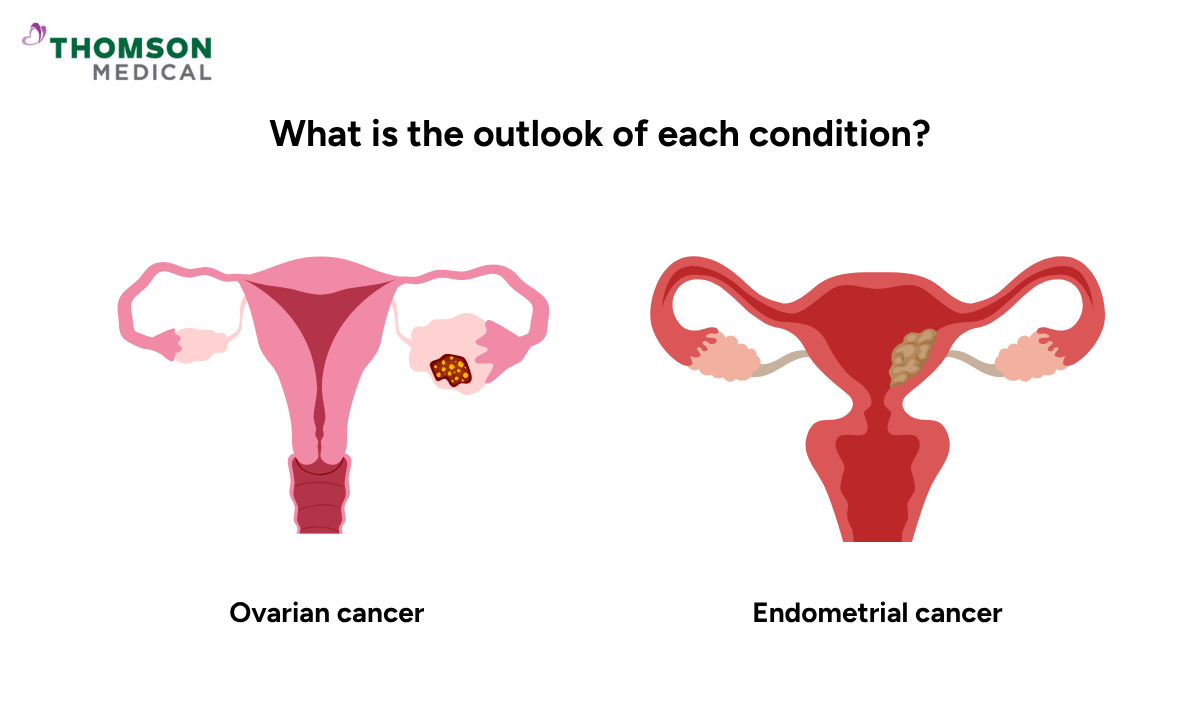
The outlook for ovarian and endometrial cancers can vary depending on stage, type and tumour characteristics, as well as the patient's response to treatment. Doctors usually use the five-year relative survival rate as a standard benchmark for measuring the outlook for both cancers.
While the word “survival” can feel worrying, these figures are not meant to predict how long an individual person will live or what their outcome will be after diagnosis. Rather, they provide the percentage of people with a particular cancer who are alive five years after diagnosis, compared to people of the same age in the general population without that cancer.
They can help doctors to understand the overall effectiveness of available treatments. The five-year period is also considered meaningful for assessing cancer outcomes, as recurrences are likely to occur within this timeframe.
Ovarian cancer
Ovarian cancer can be difficult to detect in its early stages because its symptoms may be mild or similar to other conditions. As a result, doctors often diagnose cases after the cancer has spread beyond the ovaries. According to the data from NCI SEER, the 5-year outlook for ovarian cancer is:
Localised:
Approximately 91.9% when the cancer is confined to the ovaries or primary site.
Regional:
Approximately 70.1% when the cancer has spread to nearby areas or lymph nodes.
Distant:
Approximately 31.5% when the cancer has spread to distant parts of the body.
However, these statistics are based on large groups of people and cannot predict the outcome for any individual. An oncologist specialist may be able to treat both ovarian and endometrial cancer, particularly if the condition is diagnosed early.
Endometrial cancer
Based on the research performed in the US, which analysed over 129,000 patients using the FIGO 2023 staging of endometrial cancer, the estimated 5-year outlook varies according to the stage of cancer.
Stage 1:
As the cancer remains within the uterus at this stage, it is generally associated with a more favourable outlook compared with later stages. The estimated 5-year outlook for stage 1 endometrial cancer is around 86% to 88%.
Stage 2:
At this stage, the cancer has extended beyond the uterine lining but remains within the reproductive organs.
Treatment may involve a combination of approaches depending on the cancer characteristics and individual health factors. The estimated 5-year outlook for stage 2 endometrial cancer is around 75% to 85%.
Stage 3:
The cancer has spread beyond the uterus, which may require more comprehensive treatment approaches. The estimated 5-year outlook for stage 3 endometrial cancer is approximately around 41% to 62%.
Stage 4:
As the cancer has spread more extensively, treatment focuses on managing the disease, controlling symptoms, and improving quality of life. The estimated 5-year outlook for stage 4 endometrial cancer is approximately 18% to 33%.
It is important to note that outlooks are based on data from groups of people with similar diagnoses and cannot predict an individual’s outcome. Your doctor will consider several factors when discussing your expected outlook. Schedule an appointment with Thomson Women's Clinic & Cancer Surgery for a consultation with a gynaecological oncologist.
How to prevent ovarian and endometrial cancer?
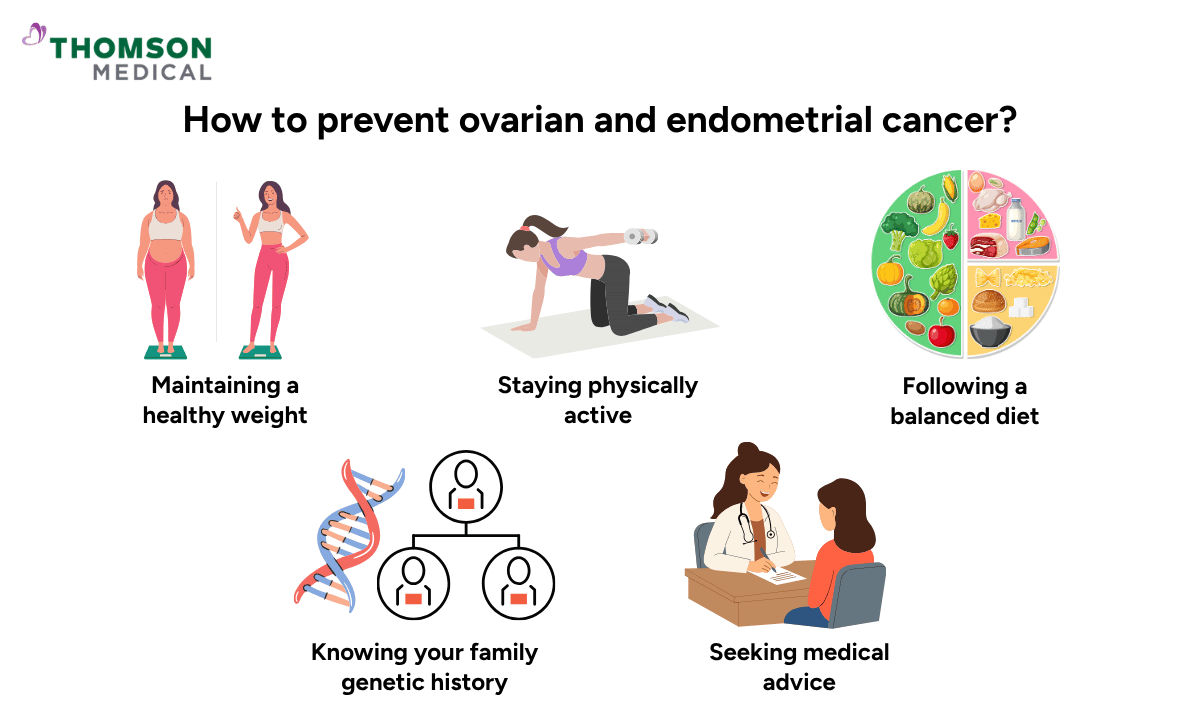
There is currently no guaranteed way to prevent ovarian or endometrial cancer completely. However, maintaining a healthy lifestyle and being aware of changes in your body may help reduce certain risk factors and support early detection.
Some steps that may help include:
Maintaining a healthy weight: as excess body weight could affect hormone levels, particularly oestrogen, which may influence endometrial cancer risk and overall hormonal balance.
Staying physically active: as regular exercise may support overall health, help maintain a healthy weight, and may help reduce inflammation in the body.
Following a balanced diet: including a variety of fruits, vegetables, whole grains, and nutrient-rich foods.
Knowing your family genetic history: as people with a strong family history of cancer or inherited gene changes such as BRCA1, BRCA2, or Lynch syndrome may be advised to have genetic counselling or testing.
Seeking medical advice for unusual symptoms: as early assessment could help identify conditions that may require further evaluation.
FAQ
Can ovarian cancer be mistaken for endometrial cancer?
Yes, it is possible for ovarian and endometrial cancer to initially be difficult to distinguish because they can cause similar symptoms, such as pelvic pain or abnormal bleeding. Further examinations, imaging, and tissue testing are needed to determine where the cancer started and confirm the diagnosis.
Can you have ovarian and endometrial cancer at the same time?
Yes, although this is uncommon. When cancer is found in both the ovary and the endometrium at the same time, doctors need to determine whether these are two separate primary cancers or whether cancer that started in one organ has spread to the other. Your doctor will consider the appearance of the tumours, imaging results, surgical findings and laboratory tests.
Can endometrial cancer turn into ovarian cancer?
No, endometrial cancer does not transform into ovarian cancer. They are separate cancers that begin in different tissues. Endometrial cancer starts in the lining of the uterus, while ovarian cancer begins in the ovaries, fallopian tubes or peritoneum.
However, endometrial cancer can spread to the ovaries in some cases. When this happens, it is called metastatic endometrial cancer, not a new ovarian cancer.
Is ovarian cancer more serious than endometrial cancer?
Neither ovarian nor endometrial cancer is more serious than the other. Your outlook depends on factors such as the cancer type, grade, stage, and response to treatment. However, in general, endometrial cancer tends to have a more favourable outlook than ovarian cancer.
This is partly because abnormal vaginal bleeding is a common early symptom of endometrial cancer, which may encourage people to seek medical attention sooner and allow the cancer to be diagnosed while it is still confined to the uterus. By comparison, ovarian cancer can cause vague or non-specific symptoms in its early stages, which may make it harder to detect until the cancer has spread.
The information provided is intended for general guidance only and should not be considered medical advice. For personalised recommendations and advice based on your individual circumstances, schedule an appointment with Thomson Medical.
References
Ali, A. T., Al-Ani, O., Al-Ani, F. (2023). Epidemiology and risk factors for ovarian cancer. Przeglad menopauzalny = Menopause review, 22(2), 93–104. https://doi.org/10.5114/pm.2023.128661
Han, K. H., Park, N., Lee, M., Lee, C., Kim, H. (2024). The new 2023 FIGO staging system for endometrial cancer: what is different from the previous 2009 FIGO staging system?. Journal of gynecologic oncology, 35(5), e59. https://doi.org/10.3802/jgo.2024.35.e59
For more information, contact us:
Thomson Specialists (Women's Health)
Thomson Women's Clinic (TWC)
- Novena:
6592 6686 (Call), 8611 8986 (WA) - Bukit Batok:
6569 0668 (Call), 8686 3525 (WA) - Choa Chu Kang:
6893 1227 (Call), 8282 1796 (WA) Jurong:
6262 8588 (Call), 6262 8588 (WA)- Katong (female doctor):
6970 2272 (Call), 8611 9020 (WA) - Punggol:
6243 6843 (Call), 8811 0328 (WA) - Sembawang: 6753 5228
- Sengkang: 6388 8125
- Serangoon (female doctor): 6382 3313
- Tampines: 6857 6266
- Tiong Bahru: 6276 1525