

Ovarian cancer is most commonly diagnosed women's cancer after menopause, with most cases occurring in women over the age of 50. That said, age is only one part of the picture. Understanding how risk changes over time, which types of ovarian cancer are seen at different ages, and when you should speak with a doctor that can help you stay informed without unnecessary worry.
What are the early symptoms of ovarian cancer?

It's natural to worry about ovarian cancer, as it can be hard to predict and catch early.
In its early stages, ovarian cancer often causes vague symptoms deep in your pelvis. They're easy to miss or blame on digestion or hormonal shifts.
Some early warning signs may include:
A persistently swollen abdomen
Ongoing abdominal or pelvic pain
Feeling bloated more often than usual
Changes in your bowel movements, such as constipation or diarrhoea
Nausea or feeling unwell
Loss of appetite or feeling full quickly
Needing to urinate more often
These symptoms do not always mean cancer, but if they're new and symptoms persists, it’s important to get them checked.
Who is at a higher risk of developing ovarian cancer?
There are several types of ovarian cancer, such as epithelial ovarian cancer (the most common), fallopian tube cancer, germ cell ovarian cancer, and sex cord stromal tumours.
The risk factors below apply mainly to epithelial ovarian cancer. They don't necessarily apply to rarer types like germ cell or stromal tumours.
Factors that may increase your risk include:
Getting older
Inherited BRCA mutations (BRCA1, BRCA2 genes) or Lynch syndrome
Starting your period before age 12
Going through menopause after age 52
Not having children
Past radiation treatment to your pelvis
Endometriosis (when tissue like your uterine lining grows outside your uterus)
Having one or more of these risk factors doesn't mean you'll get ovarian cancer, but regularly engaging in preventative health screening and regular check-ups may help detect any abnormalities earlier.
If you recognise any of these risk factors and feel unsure about what they mean for you, you don’t have to figure it out on your own. Request a consultation at Thomson Medical, where our O&G specialists can help assess your individual risk and discuss whether closer monitoring or genetic counselling is appropriate.
Our ovarian cancer specialist
Loading...
How to diagnose ovarian cancer early
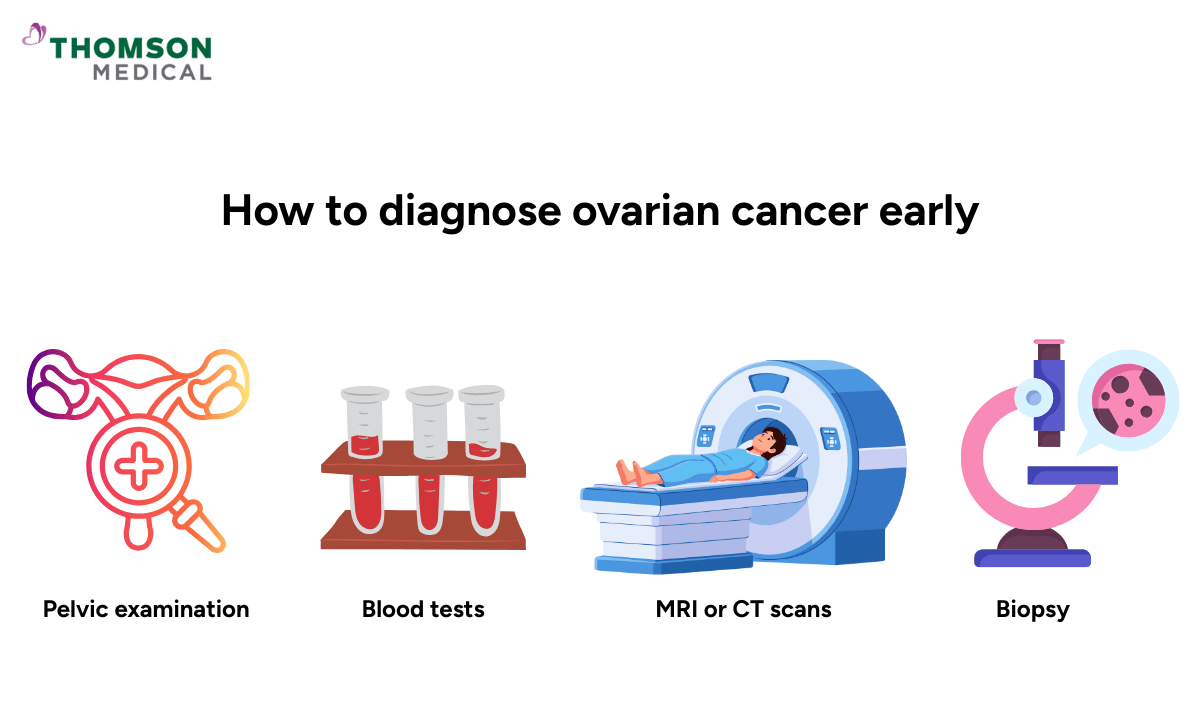
Because there's no single screening test for ovarian cancer, diagnosis often involves a step-by-step process. Your doctor might use a physical exam, blood tests, and imaging to get a full picture.
Pelvic examination
A pelvic exam is usually the first step. On its own, this exam might not catch very small tumours, but it helps your doctor decide if you need more tests.
Your doctor gently presses on your abdomen and does an internal vaginal exam to check the size, shape, and position of your womb and ovaries. This pelvic exam might feel a bit uncomfortable, but it shouldn't hurt and is usually quick.
If you're having a pelvic exam for the first time, it's normal to feel nervous. The procedure is done in a private room, and your doctor will explain the entire process before they start. You can always request to stop the test at anytime \if you're anxious, need a break, or have questions.
Blood tests
As part of your clinical assessment, your specialist may recommend a CA125 blood test. This procedure measures the level of a specific protein in the blood that can be elevated in individuals with ovarian cancer. While the blood test is a simple and routine procedure, it is important to understand that an elevated CA125 level is not a definitive diagnosis on its own.
Levels can also rise due to non-cancerous conditions such as endometriosis, your menstrual cycle, or the presence of an ovarian cyst. Furthermore, in some cases of early stage ovarian cancer, protein levels may still fall within the normal range. For an accurate evaluation, your doctor will interpret these results alongside imaging and other diagnostic findings.
MRI scan
A Magnetic Resonance Imaging (MRI) scan is a non-invasive imaging test that provides your specialist with detailed views of the ovaries and surrounding pelvic structures. Typically, an MRI is recommended for further evaluation if an ultrasound reveals an abnormality. This scan is particularly helpful in assisting clinicians to differentiate between harmless cysts and other types of growths.
The procedure is painless and, unlike X-rays or CT scans, it doesn't use radiation. During the scan, you will lie on a motorised table that slides into the MRI machine. It is normal to hear rhythmic knocking or humming sounds while the images are being captured. If you have concerns about enclosed spaces, please inform our clinical staff; our team monitors you throughout the session, and you can communicate with them at any time via the intercom.
CT scan
A CT scan provides detailed, cross-sectional images to help your medical team understand your internal health. In gynaecological oncology, it is frequently used to assess the dimensions of an ovarian mass and to evaluate whether there is any involvement of nearby organs or lymph nodes.
The procedure is efficient and non-invasive, requiring you to lie on a motorised table that moves through the scanner for several minutes. To improve the clarity of the images, a contrast dye may be administered intravenously. While this may cause a temporary sensation of warmth or a metallic taste, these effects are brief and typically resolve shortly after the scan is complete.
Biopsy
A biopsy is a clinical procedure used to collect a tissue or cell sample for specialised laboratory testing. This is a critical step, as it is the definitive method to confirm a diagnosis of ovarian cancer. The specific approach for a biopsy is tailored to your individual condition.
In many cases, the sample is obtained during laparoscopic surgery or open surgery. These procedures are performed under general anaesthesia to ensure you remain comfortable and pain-free throughout the process, usually requiring a short hospital stay for recovery and observation. In other instances, a biopsy may be performed using ultrasound imaging or CT guidance. This less invasive method may only require local anaesthesia and light sedation, often allowing for same-day discharge. Before the procedure, your specialist will discuss the most suitable method for you, including the type of anaesthesia and the expected recovery timeline, ensuring you are fully informed and supported.
When should you see a doctor?
There's no routine screening test for ovarian cancer but catching symptoms early matters. Here's what to look for and when to get help.
See a doctor if you have symptoms that last more than two weeks, including:
Abdominal or pelvic pain
Bloating
Less appetite
Changes in your bowel movements or urination
If ovarian or breast cancer runs in your family, it’s best to talk to your doctor sooner.
Ovarian cancer symptoms are vague and easy to confuse with other things. If something feels off in your body, get it checked. That's not overreacting; it's looking after yourself.
Trust your body. When symptoms don’t feel right or don’t go away, seeking medical advice can offer clarity and peace of mind. Request a consultation with our O&G doctors at Thomson Medical, where your concerns are listened to and your care is tailored to you.
FAQ
Can ovarian cancer be detected early with regular check-ups?
Ovarian cancer is difficult to detect early with routine check-ups, as the ovaries are located deep in your pelvis and often cause no symptoms in early stages. Early detection relies mainly on recognising symptoms and seeking regular gynaecological care.
What is the most reliable test for early ovarian cancer detection?
There is no single reliable test for early detection of ovarian cancer. Tests such as CA-125 blood tests and transvaginal ultrasound may be used for women at high risk, but they are not recommended as routine screening tools for everyone.
Does a normal CA-125 test mean I’m cancer-free?
A normal CA-125 level does not rule out ovarian cancer, especially in early stages. Some ovarian cancers do not raise CA-125 levels, while several non-cancerous conditions can cause CA-125 to be elevated.
How often should I get screened if I have a family history?
If you have a family history of ovarian or breast cancer, it’s best to consult your doctor. They may recommend screening with CA-125 blood tests and transvaginal ultrasound every 6–12 months, starting around age 30–35 or earlier, depending on your family history.
Can lifestyle changes lower the risk of ovarian cancer?
A healthy lifestyle may help lower your risk of ovarian cancer. These include:
Maintaining a healthy weight
Eating a balanced diet rich in fruits and vegetables
Avoiding smoking
Limiting alcohol intake
What is the difference between an ovarian cyst and ovarian cancer?
Ovarian cysts are common, usually harmless, fluid-filled sacs that often resolve on their own. Ovarian cancer involves abnormal growth of malignant cells, often forming solid or complex masses. While symptoms can overlap, cancer is much rarer and requires imaging tests and sometimes a biopsy for diagnosis.
The information provided is intended for general guidance only and should not be considered medical advice. For personalised recommendations and advice based on your unique situation, please consult a specialist at Thomson Medical. Request an appointment with Thomson Medical today.
For more information, contact us:
Thomson Fertility
- Paragon: 6252 7766
- Novena: 6399 3758, 8811 0358 (WA)
Thomson Specialists (Women's Health)
Thomson Women's Clinic
- Novena:
6592 6686 (Call), 8611 8986 (WA) - Bukit Batok:
6569 0668 (Call), 8686 3525 (WA) - Choa Chu Kang:
6893 1227 (Call), 8282 1796 (WA) Jurong:
6262 8588 (Call), 6262 8588 (WA)- Katong (female doctor):
6970 2272 (Call), 8611 9020 (WA) - Punggol:
6243 6843 (Call), 8811 0328 (WA) - Sembawang: 6753 5228
- Sengkang: 6388 8125
- Serangoon (female doctor): 6382 3313
- Tampines: 6857 6266
- Tiong Bahru: 6276 1525